Enki, God of the Mesopotamian Tradition
By Ralf Ittermann · last reviewed on
God of fresh waters, creator of wisdom, lord of magic. Enki (Akkadian Ea) is one of the most powerful Mesopotamian gods, ruler of the life-giving waters, and at the same time a bearer of knowledge and cosmic craftsman.
In Eridu, the oldest Sumerian city, he is venerated as father of the later king Marduk and as originator of all arts, skills, and secret knowledge. His wildness and cunning make him unpredictable, yet he always acts for the good of humankind.
Enki (Akkadian Ea) is the chief god of Eridu and one of the central gods of the Sumerian pantheon. His sphere of activity encompasses the fresh-water Apsu, wisdom, magic, and the arts of civilization (writing, architecture, sorcery).
In Mesopotamian theology, Enki is the creator of humans and teacher of the ME (divine ordering principles). His temple function in Eridu remained central into late Babylonian times; in the Atrahasis myth he warns humans of the flood ordered by Enlil.
Enki
Type: Mesopotamian chief deity, god of fresh water, wisdom, and magic
Pantheon: Sumer (Enki), Akkad/Babylon/Assur (as Ea)
Function: Lord of the Apsu (fresh-water deep), creator of humans, patron of magic and the healing arts
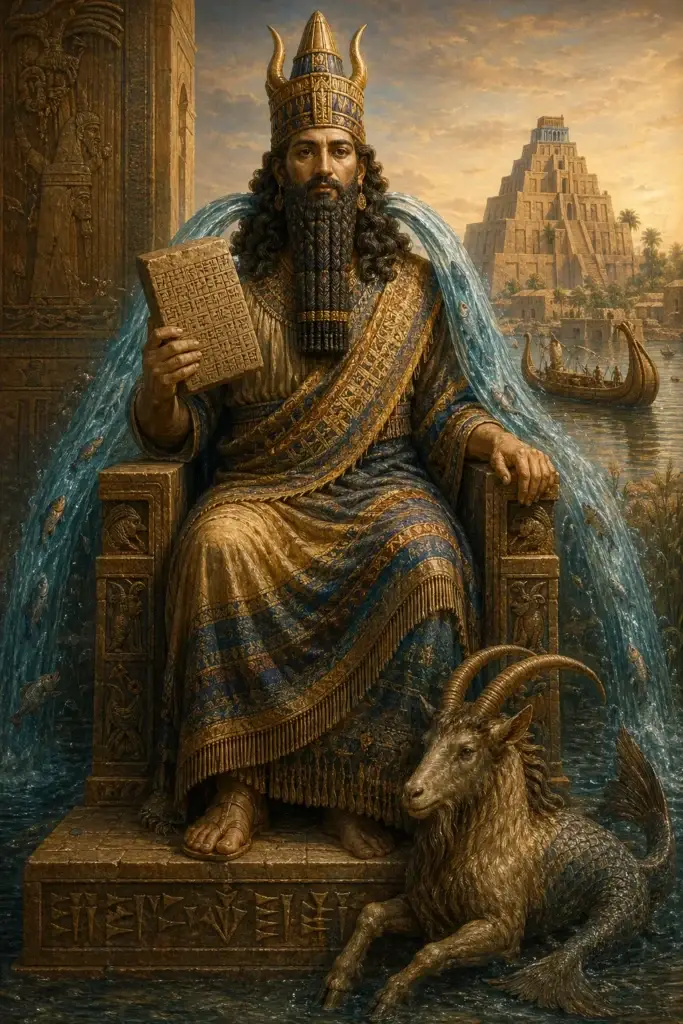
Main attributes: Streams of water from the shoulders, fish-goat hybrid creature, tall horned diadem
Main cult sites: Eridu (Sumerian original seat), Babylon, Susa
Akkadian counterpart: Ea
Context
Enki is attested from the early Sumerian period (3rd millennium BCE); in Eridu, the oldest documented city of Sumer, he was the chief deity. In the Akkadian-Babylonian pantheon he appears as Ea, with nearly identical functions.
The main flowering of the Enki/Ea tradition: 3rd and 2nd millennia BCE. In the 1st millennium BCE he is increasingly overlaid by Marduk (Babylon) as imperial god; yet Ea remains „father of Marduk“ and retains his key cosmological role.
The main cult site was Eridu (Sumerian Eridug, today Tell Abu Shahrein in southern Iraq), one of the oldest temple complexes of Mesopotamia, settled from about 5400 BCE. Alongside this, Babylon (Ea temple in the Esagila complex), Ur, Susa (Elamite). Inshushinak, the independent city god of Susa, has partly overlapping functions with Enki/Ea.
Central sources: the Enuma Elish (Babylonian creation epic), the Sumerian Inanna and Enki narrative, the Atrahasis myth (flood), Enki and the World Order, the Adapa myth. Secondary literature: Lambert/Millard, Atra-Hasis; Black/Cunningham, Literature of Ancient Sumer; Bottéro, La plus vieille religion. En Mésopotamie.
Name
Enki is mostly depicted as a wise, bearded man, often with a horned crown or diadem. His name is borne by water: he is accompanied by two water serpents or fish that spring from his shoulders (the Abzu symbol).
On seals he sits on a throne above springs, rivers, and sea waves. His emblem is the goat-fish demon (Suhurmašu), a hybrid being of mountain and water forces. As a magician he bears the insignia of cleverness: writing stylus, measuring rod, scroll of knowledge.
Characteristics
Enki (Sumerian en-ki, „lord of the earth“; Akkadian Ea) is the Sumerian-Akkadian water god of Eridu, the city regarded in the Sumerian King List as the first city of creation.
He is the god of the fresh-water deeps (abzu), of wisdom, and of the craft and magical arts. In the Mesopotamian hierarchy of gods he stands third, after An (heaven) and Enlil (wind).
His temple E-abzu in Eridu was regarded as the oldest sanctuary of Mesopotamia. In the Atrahasis myth and in the Sumerian flood myth, Enki warns the human hero of the flood, a model for the biblical Noah myth (cf. Bottéro, Mesopotamia; Black/Green, Gods, Demons and Symbols; Jacobsen, The Treasures of Darkness).
Profile: Enki
The most important aspects of Enki/Ea at a glance. The following fields summarize origin, function, appearance, veneration, symbols, and parallels.
Enki is the son of the primeval goddess Nammu (in one tradition) or of An (heaven) and Ki (earth). Brother of Enlil.
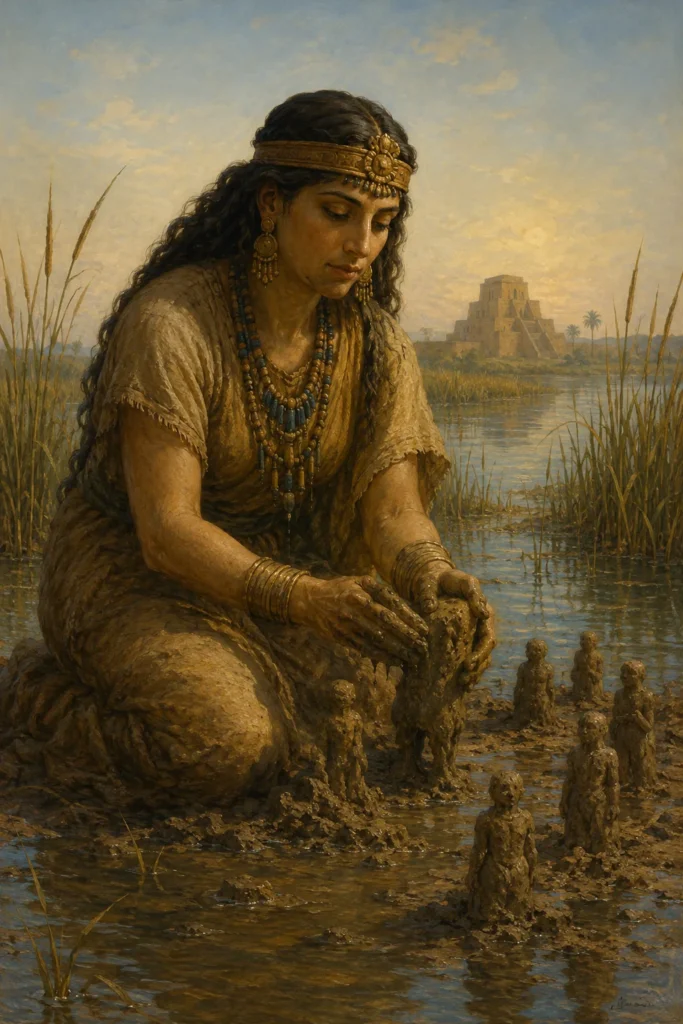
In the Sumerian creation myth he forms humans from the clay of the Apsu in order to relieve the gods of their labor (central in Atrahasis). Father of Marduk (in the Babylonian tradition). Consort of Damkina (Damgalnuna), and in some myths associated with Ninhursanga (Ninmah).
Lord of the Apsu, the cosmic fresh-water deep from which all fertile life springs. Patron of wisdom, magic, and the incantation priests (asipu).
Inventor of the healing arts, of canal irrigation, of the arts of civilization (in the Sumerian me system). In the flood myth the one who warns Atrahasis, Enki is the human-friendly god who acts against Enlil’s decree of annihilation.
Anthropomorphic as a bearded male figure with a tall horned diadem and long robe. Characteristic: two streams of water (with small fish) flow from his shoulders, the water of the Tigris and Euphrates.
Frequently accompanied by the hybrid creature Suhurmashu (goat-fish, later in the zodiac as Capricorn). In glyptic art he is frequently depicted on cylinder seals.
Sphere of effect: Enki/Ea was the god of the magic priests par excellence; the asipu (incantation priests) were regarded as his servants. He was invoked before every healing or protective ritual.
In Eridu stood thousands of votive images. Babylonian kings often built their palaces over underground fresh-water tank systems that symbolically represented the Apsu. Among the people he was also patron of farmers (irrigation) and craftsmen.
Streams of water from the shoulders (with small fish), tall horned diadem, long robe, goat-fish (Suhurmashu), serpent (cosmic wisdom), brick form (as giver of measure). Sacred plant: tamarisk (central in incantation rites). Sacred number: 40.
Inshushinak (Elam, related function), Poseidon (Greece, mastery of water, though also salt water), Hermes (patron of magic and wisdom), Thoth (Egypt, patron of scribes and magic), Varuna (Hinduism, cosmic waters), Mimir (Germanic, well of wisdom), Yu (China, tamer of the flood, patron of irrigation).
Protective Practice
Veneration Rituals
Enki/Ea was venerated in the E-abzu temple at Eridu, whose purification rites served as a central model for Mesopotamian liturgy. Daily purification offerings with water from the sacred well (apsu), bread, and beer.
At the New Year festival akītu, Enki played a central role as wisdom advisor of cosmic kingship. The Asaluhi incantations (Asaluhi = son of Enki/Marduk) of the Maqlû series operate with Enki’s water-purifying power (cf. Foster, Before the Muses).
Incantations and Hymns
The „Hymn to Enki and his temple E-abzu“ (BWL 100-105, Lambert) as well as the longer „Enki’s Journey to Nippur“ narrative are central hymnic texts.
In the incantation repertoire he is invoked as „Bēl nēmeqi“ (Lord of Wisdom). The asipu priests (healing incanters) were regarded as the earthly representatives of Enki/Marduk; their healing rituals rested on Enki’s secret knowledge.
Amulets and Protective Symbols
Symbol of Enki: goat-fish (suhurmašu) and the sacred water jar (apsu vase), on boundary stones (kudurrus) and cylinder seals.
Apsu basins in temple courtyards (Eridu, later Babylon, Nippur) as an earthly manifestation of his water domain. Apotropaic clay pegs with rolled-up Enki incantations beneath house entrances, above all to ward off fever illnesses.
Enki, Parallels in Other Cultures
Enki and Ea: Name, Nature, and Sphere of Responsibility
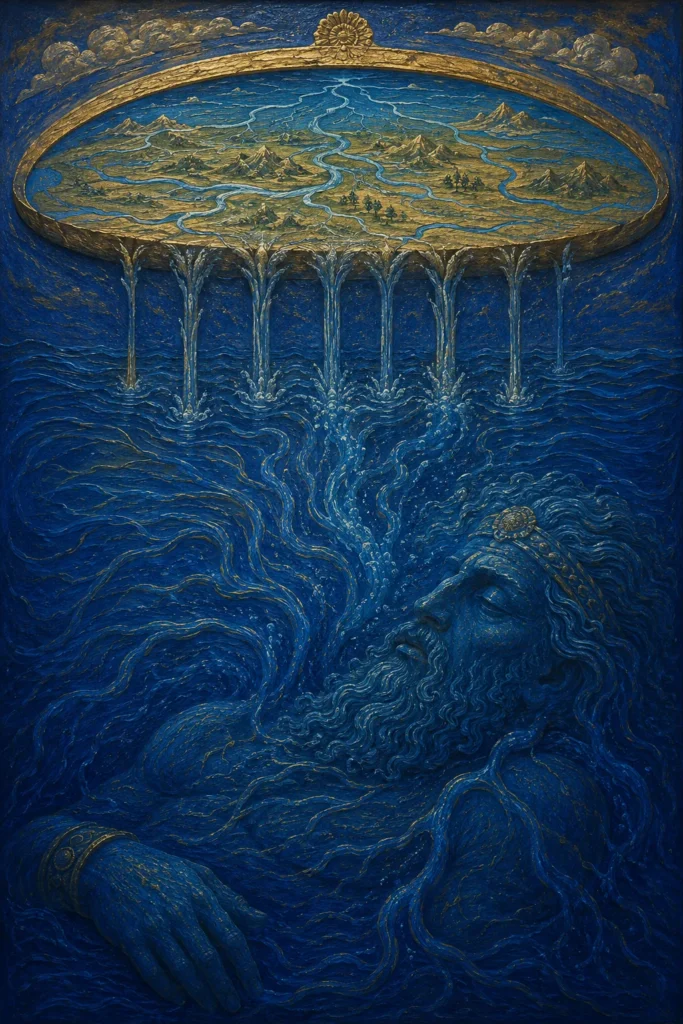
Enki is the Sumerian name of one of the most important gods of Mesopotamia; in the Akkadian, Babylonian, and Assyrian sources the same deity is called Ea. The Sumerian name is traditionally interpreted as lord of the earth, yet this translation is not undisputed, for Enki’s actual domain is not the solid earth but the fresh water that, according to Mesopotamian conception, lies beneath the earth, the Abzu or Apsu.
From this sphere of activity Enki’s responsibilities follow. He is the god of fresh water, of springs, and of irrigation, without which no agriculture was possible in Mesopotamia.
He is at the same time the god of wisdom, cleverness, and cunning, the god of the craft and magical arts and of incantations. His sanctuary E-abzu stood in the ancient city of Eridu, which in Mesopotamian tradition was regarded as one of the oldest cities of all.
In the hierarchy of gods, Enki stands in the front rank, together with the sky god An and the air god Enlil. While Enlil often appears as the distant, sometimes stern director, Enki is the approachable, resourceful god who takes the side of humans and solves problems through cleverness.
This division of roles shapes numerous myths and makes Enki one of the most appealing figures of the Mesopotamian pantheon. Religious studies see in him a typical representative of the divine culture-founder who possesses the knowledge that first makes civilization possible.
Enki as Creator and Bringer of Culture
In several Mesopotamian myths, Enki is involved in the creation and ordering of the world.
The myth Enki and the World Order describes how Enki assigns their destinies to the various lands, rivers, animals, and human activities, and transfers their areas of responsibility to individual deities. Here he appears as the establisher of order who gives the created cosmos its functions.
Enki is especially closely connected with the creation of humans. In the myth Enki and Ninmah the gods form humans from clay so that they may relieve them of their labor; it is Enki who gives the decisive counsel.
In other texts, such as the Atrahasis Epic, it is likewise Enki who plays the authoritative role in the creation of humans. The notion that humans were created to serve the gods and provide for them belongs to the core of Mesopotamian theology, and Enki is the god who carries out this plan.
Connected with Enki is also the concept of the me, a collection of divinely conferred foundations of civilization that encompass everything, from kingship and priestly offices through crafts to forms of conduct.
In the myth Inanna and Enki, the goddess Inanna coaxes these me from Enki and brings them to her city of Uruk.
Enki appears here as the original keeper of cultural knowledge. Scholarship interprets such myths as attempts by the Mesopotamians to explain the origin of their own highly developed urban culture and to anchor it religiously.
Enki and the Great Flood
In the Mesopotamian flood narratives, Enki plays the rescuing role. The basic structure is preserved in several texts, most extensively in the Atrahasis Epic and in the flood episode of the eleventh tablet of the Epic of Gilgamesh; a fragmentary Sumerian version is also known.
In all versions the gods decide to annihilate humankind, in some versions because humans have become too numerous and too loud and disturb the gods in their sleep.
Enki does not abide by the decision of the divine assembly. He warns a single pious human, who depending on the text is called Atrahasis, Ziusudra, or Utnapishtim, and instructs him to build a great ship in order to save himself, his family, and animals.
In a subtle episode, Enki circumvents an oath by not addressing the warning directly to the human, but seemingly speaking it to the reed wall of the house behind which the human is listening.
After the flood it is again Enki who argues before the divine assembly for the survival of humankind and proposes milder means of population regulation.
These narratives are of great significance in the history of religion, because they belong to the oldest known flood narratives of world literature and because they evidently stand in a tradition-historical connection with the biblical flood narrative.
Scholarship has discussed this relationship since the decipherment of the Epic of Gilgamesh in the 19th century. It should be noted that in the Mesopotamian version Enki plays the role of the wise god turned toward humankind, who averts annihilation through an act of cunning and intercession.
Iconography and Afterlife
In Mesopotamian pictorial art, Enki can be recognized by a characteristic feature: from his shoulders or from a vessel held in his hand flow two streams of water, in which fish are often visible.
These streams stand for the Tigris and Euphrates, or generally for the life-giving fresh water over which he rules. He frequently appears on cylinder seals, the small engraved stone cylinders used for sealing documents and containers, which are an important pictorial source for the Mesopotamian world of gods.
Connected with Enki is also a peculiar figure, the apkallu, a wise hybrid creature helper, sometimes depicted in a fish garment, who conveys the knowledge emanating from Enki to humans.
Later tradition knows a figure named Oannes, a fish-shaped being said to have brought the arts of civilization to humans; this figure, described in Greek by the Babylonian priest Berossos, stands in the tradition of this circle of ideas around Enki and the apkallu.
After the end of Mesopotamian culture, Enki, unlike Ishtar for example, fell largely into oblivion; a continuous line of reception such as exists for the Greek gods is lacking. His rediscovery is owed to Assyriology, which has opened up the cuneiform texts since the 19th century.
For today’s religious studies, Enki is of interest above all as a type: as an example of the god of wisdom and culture who mediates between humans and the higher world of the gods, and as a central figure of the oldest creation and flood narratives of humankind that can be grasped in writing.
Further Links
Literature (Selection)
Further standard works in the literature index.
Frequently Asked Questions about Enki
Who was Enki in Sumerian mythology?
Enki (Akkadian Ea) was the Sumerian god of wisdom, fresh water, magic, and the craft arts. He is one of the oldest and most significant deities of Mesopotamia, with his main cult site in Eridu (one of the first cities in human history).
Unlike the often stern Enlil, Enki is a cunning and human-friendly god: it was he who formed humans from clay, who gave Inanna the divine powers (Me), and who warned of the flood by secretly instructing Utnapishtim to build an ark.
What role does Enki play in the flood myth?
In the Atrahasis Epic (around the 18th century BCE) and in the Epic of Gilgamesh (tablet 11), Enki is the god who prevents the flood annihilation of humankind. Enlil has condemned humans to destruction because of their noisiness.
Enki may not warn directly, but he speaks through a reed wall behind which Utnapishtim (Atrahasis in the older myth) happens to stand. Thus the hero builds an ark, saves himself, his family, and some animals. This Mesopotamian flood myth is the literary precursor of the biblical Noah story (Genesis 6-9).