Repun Kamuy, the orca kamuy of the open sea
By Ralf Ittermann · last reviewed on
Repun Kamuy is a god of Ainu tradition.
Generous provider of the coasts, embodied in the orca. At the centre stands the orca kamuy, the generous provider of the coasts in Ainu tradition.
Repun Kamuy is the Ainu god of the open sea and its animals, above all the orca. As a generous provider he brings whales and shoals of fish to coastal communities; his goodwill depends on people treating his gifts with respect.
The name means god of the open sea in Ainu, from rep-un, belonging to the open sea, and kamuy, god. He is embedded in the yukar epics and stories of the Ainu and has been documented ethnographically since the late 19th century.
Type: God of the open sea and lord of the orcas
Origin: oral Ainu tradition of the coastal regions of Hokkaidō, Sakhalin and the Kuril Islands
Texts: yukar epics and stories, documented ethnographically since the late 19th century
Period: passed down orally, recorded in writing since the late 19th century
Appearance: usually envisioned as an orca, sometimes as a mischievous young man with a harpoon

Historical Background
Period of the Texts
Carried orally in the yukar epics of the Ainu, documented ethnographically since the late 19th century and still part of a living storytelling tradition today.
Area of Diffusion
The coastal regions of the Ainu on Hokkaidō, Sakhalin and the Kuril Islands, wherever fishing and whaling shaped the life of coastal communities.
Sources
Solid by Ainu standards: the yukar epics and stories offer several episodes, documented in the classic collections of Batchelor, Munro and Philippi.
Name and variants
Ainu: The name is made up of rep-un, belonging to the open sea, and kamuy, god: god of the open sea. In many traditions the term also denotes the orca itself.
Appearance and behaviour
Appearance
Repun Kamuy is usually envisioned as an orca, a killer whale, though not as an ordinary animal but as a divine manifestation; in some stories he appears as a light-hearted, slightly mischievous young man with a harpoon.
Effect
Repun Kamuy is a benevolent provider who brings whales and shoals of fish, thereby ensuring the survival of coastal communities. His goodwill depends on people treating his gifts with respect, on the reciprocity of giving and receiving.
Profile: Repun Kamuy
The key aspects of the orca god at a glance.
Benevolent kamuy of the Ainu coastal communities of Hokkaidō, Sakhalin and the Kuril Islands.
Whales, shoals of fish and the catch of coastal fishermen, who depend on his generosity.
Usually envisioned as an orca, in some stories as a mischievous young man with a harpoon.
Provider of coastal communities: he guides fish to the fishermen and drives whales onto the beach.
Ritual whale burials, comparable to the bear ritual iomante, gift exchange with inau sticks and the respectful cutting up of the catch.
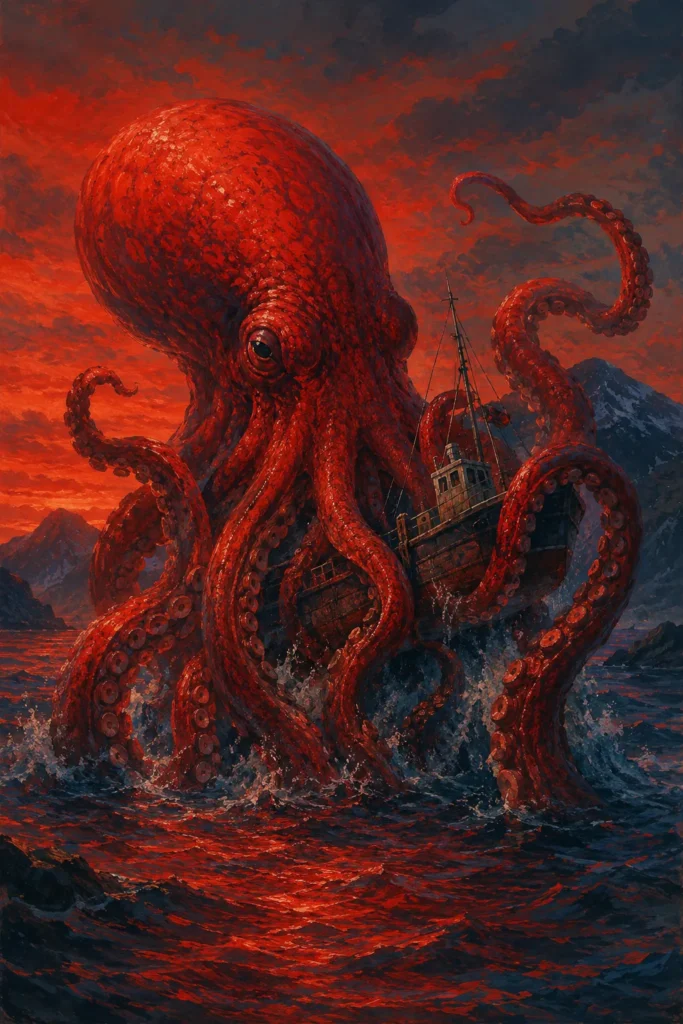
Within Ainu mythology closely linked to Akkorokamui, though clearly distinguished from its menace as a benevolent provider.
The disrespectfully cut-up whale and the god's gift
The name means god of the open sea in Ainu, from rep-un, belonging to the open sea, and kamuy, god; in many traditions the term also denotes the orca itself. Repun Kamuy is embedded in the yukar epics and stories of the Ainu and has been documented ethnographically since the late 19th century.
In a well-known story he harpoons a female whale with her calf and washes the catch ashore near a human village. A wren tells him that the humans are cutting up the whale disrespectfully with sickles and axes; instead of growing angry, the god laughs and declares that the meat now belongs to the humans. In an origin legend of Akkorokamui, Repun Kamuy also draws the spider-like being into Uchiura Bay.
From Ainu epic to manga title
Repun Kamuy appears in the manga and anime Golden Kamuy, whose title carries the Ainu word kamuy (god), and features in collections on Ainu mythology as well as in video games with kamuy references. As such, he is a reference point for the growing interest in Ainu culture.
Repun Kamuy is a classic providing kamuy within the animistic Ainu system, in which nature, here the sea, the orca and the whale, is thought of as an ensouled counterpart that stands in relationship to humans through the exchange of gifts. He is an expression of a hunter’s and fisher’s ethic of reciprocity and respect, in which the gift obligates and secures wellbeing. Unlike the menacing Akkorokamui, he poses no danger to humans; if any arises, it does so only indirectly, when the rules of gift exchange are disregarded.
Whale burial and gift exchange instead of warding off
Since Repun Kamuy is predominantly benevolent, the point is less about warding him off than about honouring him. For stranded or deceased orcas, the Ainu held ritual burials, comparable to the bear burials, the iomante. Gift exchange with carved inau sticks and the respectful cutting up of the catch secure his goodwill. The right approach thus lies in respect for the gift, not in warding off the god. Signs of this invocation for a good catch and safe return include a worn amulet, incense offerings and salt, the age-old purifying agent used in dealing with the powers of the sea.
Lords of the sea in cultural comparison
Repun Kamuy stands alongside the Japanese fishing god Ebisu and the dragon god Ryūjin; the Korean dragon king Yong-wang shares with him dominion over the sea and its gifts. Honouring the orca is also known in the Pacific Northwest coastal culture of North America, and within Ainu mythology he is closely linked to Akkorokamui, whom, according to the origin legend, he drew into Uchiura Bay.
Frequently asked questions about Repun Kamuy
Is Repun Kamuy an orca or a human?
Both are possible. He appears as a divine orca or as a young man with a harpoon, depending on the story. The orca is not an ordinary creature here but his divine form.
Why did he not punish the disrespectful humans?
The story emphasises his generosity: once gifts are given, they belong to the humans. The god laughs at the disrespectful cutting up rather than growing angry.
Is he the same as the sea god from the Akkorokamui legend?
Yes. In one origin version, Repun Kamuy draws the spider-like being into Uchiura Bay, where it becomes Akkorokamui.
Further links
Further reading:
- Akkorokamui – the red octopus kamuy that, according to legend, he drew into Uchiura Bay
- Amulet, smoke cleansing, salt – traditional protective means
- Protection Compass – protective means at a glance
Literature (selection)
Further standard works in the bibliography.
Whether sought as Repun Kamuy, the Ainu legend of coastal fishermen, or as the orca deity of the open sea: it refers to the same generous provider, whose whales and shoals of fish depend on people treating his gifts with respect.