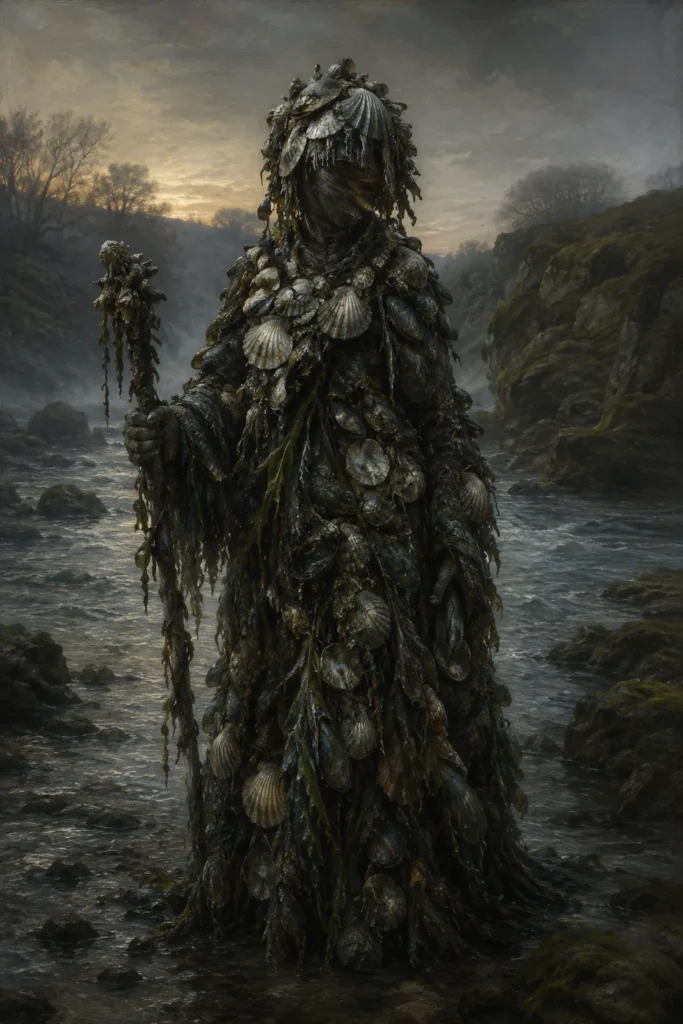
Aderyn y Corff, the bird at the window of the dying
By Ralf Ittermann · last reviewed on
Aderyn y Corff is a spirit of Welsh tradition.
Its knocking at the door announces a death soon to come in the house.
Aderyn y Corff, the corpse bird, is a Welsh death omen. Its knocking or calling at the door or window of a house is taken as a sign that someone there will die shortly. Popular interpretation equates it with an owl, while older tradition regards it as an independent, supernatural being.
The name is made up of aderyn, bird, and corff or corph, body or corpse, and literally means corpse bird. Its call is rendered onomatopoeically as dewch, dewch, Welsh for come, come, and interpreted as a summons for the dying person to follow into the afterlife. The being is attested mainly in Wirt Sikes and Marie Trevelyan; the source material remains noticeably thinner than for Canwyll Corff, the corpse candle, or the Cyhyraeth.
Type: Death omen in bird form, usually interpreted as an owl
Origin: Welsh folk belief around death and omens, rural Wales
Texts: Rather thinly attested, chiefly in Sikes and Trevelyan
Period: mainly 18th and 19th centuries, recorded by folklore collectors
Appearance: bird, mostly equated with an owl, in older tradition also featherless and wingless

Source context
Period of the Texts
Mainly 18th and 19th centuries: it was during this period that Welsh folklore collectors recorded the omen in their works.
Area of Diffusion
Rural Wales, particularly the Welsh-speaking regions where belief in the omen was alive.
Sources
Rather thin: the main sources come from Wirt Sikes and Marie Trevelyan, notably slighter than for the corpse candle or the Cyhyraeth.
Name and variants
Welsh: aderyn means bird, corff or corph body or corpse: Aderyn y Corff literally means corpse bird. The older spelling is Aderyn y Corph, alongside which the simplified form aderyn corph, without the connecting word y, is also common.
Description
Appearance
Aderyn y Corff appears as a bird, in popular interpretation usually an owl. Older tradition also knows it as a featherless and wingless being that dwells on another plane of existence between its appearances. As a nocturnal and threshold bird, the owl symbolically stands for the transition between life and death.
Effect
The bird knocks or calls at night at the door or window of the house where someone will soon die, marking the threshold of the house as the boundary between this world and the otherworld. Its effect is purely announcing: it does not cause the death but reports it, and whoever hears the call interprets it as a sign of an impending death in the house.
Profile: Aderyn y Corff
The key aspects of the corpse bird at a glance.
Part of the Welsh tradition of death omens, which knows portents of dying in animal, light and sound form.
The soon-to-die person and their household, at whose door or window the bird appears.
Usually interpreted as an owl, in older tradition also as a featherless and wingless being without a fixed bird body.
A pure omen: its knocking announces a death soon to come in the house but does not cause it.
No banishing ritual has been handed down; the call is interpreted and one prepares for the impending death.
Cyhyraeth, Gwrach y Rhibyn and Cwn Annwn as further Welsh messengers of death.
The call come, come and the interpretation as an owl
The bird’s call is rendered onomatopoeically as dewch, dewch, Welsh for come, come, and understood as a summons for the dying person to follow into the afterlife. Some collectors point out that the phrase also occurs in the Welsh Bible translation, which is discussed as a possible origin of the idea.
The rationalising interpretation sees in the appearance a screech owl drawn by the light in the sickroom. Aderyn y Corff is attested mainly in Wirt Sikes and Marie Trevelyan; the source material remains noticeably thinner than for Canwyll Corff, the corpse candle, or the Cyhyraeth.
A little-known Welsh omen
Aderyn y Corff has been taken up in popular culture markedly less than the Cwn Annwn or the corpse candle. It appears mainly in collections of Welsh death omens and in folkloric overview accounts, remaining a rather regional, little-known motif.
From a religious-studies perspective, Aderyn y Corff is a classic death omen and an example of the connection, typical of Welsh folklore, between pre-Christian otherworld beliefs and Christian-biblical motifs. The bird as a border-crosser between worlds announces death without causing it.
Facing the call: watching rather than banishing
The source material on protective measures is honestly thin: no established protective rituals against Aderyn y Corff have been handed down, for it is a pure omen that only reports what will happen regardless. Folk tradition knows no effective means of banishing it here; only the interpreting of the sign and the preparing for the approaching death are recorded.
In the wider surroundings of the house of the dying, holy water was regarded as a Christian sign in dealing with the death omen, the light of the protective candle as part of the death watch for which the omen prepares, and the sound of consecrated bells as a protective sign against misfortune upon the houses.
Messengers of death in Wales and elsewhere
Aderyn y Corff stands in Wales alongside other death omens: the corpse candle Canwyll Corff, the disembodied wailing called Cyhyraeth, and the hideous wailing woman Gwrach y Rhibyn. Beyond Wales, it takes its place among the widespread European bird death omens, in which the owl, raven and magpie are regarded as messengers of misfortune and death.
As further Celtic messengers of death, the Scottish Bean Nighe, with her wailing at the ford, and the Breton Ankou, with the creaking of his death cart, announce death in their own way, distinct from Aderyn y Corff; the Welsh spectral hunt Cwn Annwn moves as a pack across the night sky.
Frequently asked questions about Aderyn y Corff
Is Aderyn y Corff a real owl?
In the rationalising folk interpretation, yes: a screech owl drawn to the light of the sickroom. In the older tradition, however, it is regarded as a supernatural being, at times without feathers or wings.
What does its cry mean?
The cry sounds like dewch, dewch, Welsh for come, come, and is interpreted as a summons for the dying person to follow into the beyond.
Does the bird bring death?
No. It is a pure omen that announces an impending death in the house, but does not cause it.
Further links
Further reading:
- Celtic – beings of Celtic tradition
- Canwyll Corff – the Welsh corpse candle
- Cyhyraeth, Gwrach y Rhibyn – further Welsh death omens
- Holy water, protective candle, bells – traditional protective means
- Protection Compass – protective means at a glance
Literature (selection)
Further standard works in the bibliography.
As a Welsh corpse bird, Aderyn y Corff, also searched for as aderyn corph, remains a comparatively little-known yet telling example of Welsh death omens: a bird’s cry that makes the threshold between this world and the otherworld audible.