Cŵn Annwn and the Wild Hunt over Cadair Idris
By Ralf Ittermann · last reviewed on
Cŵn Annwn are spirits of Welsh tradition.
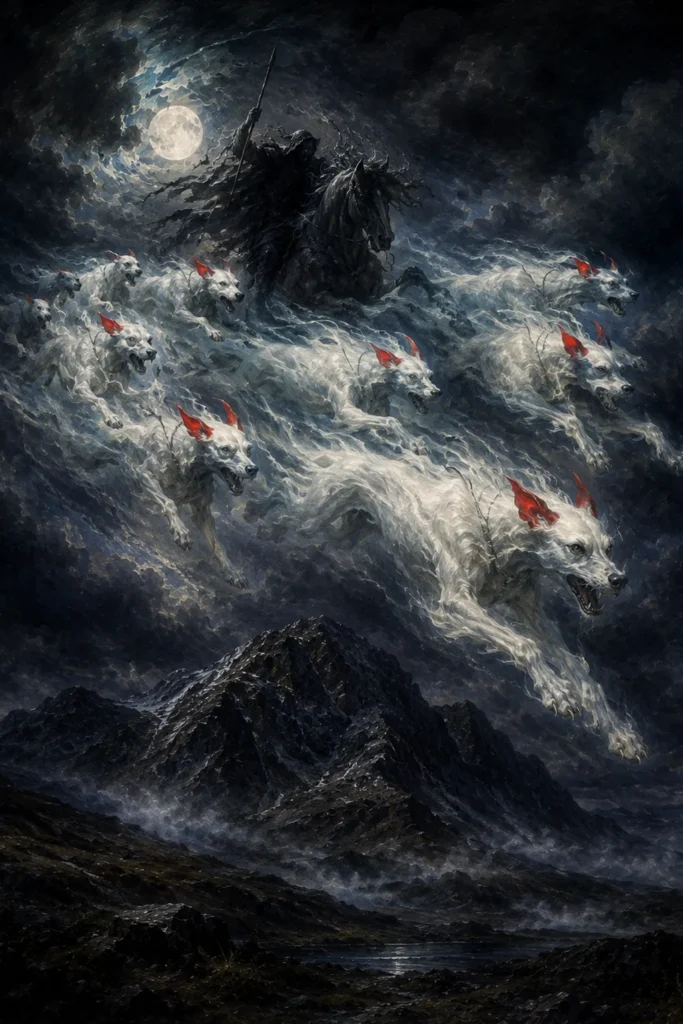
White hounds with red ears that guide the souls of the dead.
The Cŵn Annwn, the hounds of Annwn, are the spectral hunting dogs of the Welsh Otherworld. With white fur and red ears, they hunt through the night sky in the Wild Hunt and guide the souls of the dead. Hearing their howl is taken as a warning of death.
Their oldest attestation is found in the Mabinogion: in the First Branch, Pwyll, they are the hunting dogs of Arawn, King of Annwn. In later folk tradition, recorded by John Rhys, Gwyn ap Nudd leads the hunt as lord of the Otherworld, accompanied by the witch Mallt-y-Nos.
Type: Spectral hunting hounds of the Welsh Otherworld
Origin: Medieval Mabinogi, later folk tradition
Texts: Mabinogion (Pwyll), John Rhys
Period: medieval through to modern legend
Appearance: hounds with white fur and red ears
Area of origin and sources
Period of the Texts
Rooted in the medieval Mabinogi, expanded in later Welsh folk tradition as recorded by John Rhys.
Area of Diffusion
All of Wales, with a particular haunt on Cadair Idris mountain, over which their howl is regarded as an announcement of death.
Sources
Well documented: the Cŵn Annwn are among the oldest of the Welsh death figures and are attested from the Mabinogion through to modern legend.
Name and variants
Language: The name is Welsh, from cŵn, hounds, and Annwn, the Otherworld of Welsh mythology, thus hounds of Annwn. A regional variant is Cwn Wybir, sky hounds.
Appearance and behaviour
Appearance
The Cŵn Annwn have bright white fur and red ears, the Celtic colour scheme of Otherworld animals. Their acoustic signature is peculiar: their howl is loudest at a distance and grows quieter as they draw near.
Effect
They hunt in the spectral Wild Hunt, mostly in autumn and winter and on threshold nights such as the eves of All Saints, Christmas and New Year. As soul hunters they lead the dead into the Otherworld, forming an active part of the escort of the dead.
Profile: Cŵn Annwn
The key aspects of the Welsh Otherworld hounds at a glance.
Welsh mythology and folk tradition, from the Mabinogion to the legends of Gwyn ap Nudd.
Those who hear their howl, as well as the souls of the dead whom they guide into the Otherworld of Annwn.
A pack of bright white hunting hounds with red ears, led by Arawn or Gwyn ap Nudd across the night sky.
Death omen and soul escort at once: their call warns of death, their hunt leads souls into the beyond.
Not interfering with the hunt, as Pwyll’s penance shows; on the calendar hunting nights it was better to stay at home.
The English spectral hounds Black Shuck and Barghest as death messengers of the British Isles, along with the Breton leader of the dead Ankou.
The hounds of Arawn and the hunt of Gwyn ap Nudd
In the First Branch of the Mabinogion, Pwyll drives off Arawn’s hounds from a slain stag and, as penance, must fight in Arawn’s place against his adversary Hafgan. Even here, the hounds belong to the king of the Otherworld and represent the order between this world and Annwn.
In later folk tradition, Gwyn ap Nudd leads the hunt as lord of the Otherworld, accompanied by the witch Mallt-y-Nos. In the Christian reinterpretation the hounds became hounds of hell, but originally they belong to the Otherworld Annwn, a place of abundance, not of punishment.
Reception and classification
The Cŵn Annwn and the Wild Hunt are a recurring motif in modern fantasy, role-playing games and music; Glenn Danzig’s 1992 album Black Aria closes with a track called Cwn Annwn. In formats dealing with the Celtic Otherworld they are widely represented.
From a religious-studies perspective, the Cŵn Annwn combine the motif of the soul’s escort, the psychopomp, with the death omen and the Wild Hunt. It is important that Annwn, in medieval Welsh tradition, is a place of abundance and eternal youth, not a Christian hell of punishment; the interpretation as hounds of hell is a later reinterpretation.
Not disturbing the hunt
Concerning actual protection, the source material is thin. What is recorded is above all not to interfere with the hunt, as the example of Pwyll shows, who must do penance for his intervention. Against the hunters reinterpreted as hounds of hell, Christian signs served as protection: holy water, the sound of consecrated bells on the threshold nights, and the light of the protective candle kept as a watch on the feared nights of the hunt.
The Wild Hunt from Wales to Brittany
The Cŵn Annwn are the Welsh Wild Hunt, the Welsh manifestation of the pan-European motif. In northern England they correspond to the spectral aerial packs, to which the Black Shuck and the Barghest are also closely related as black spectral hounds; in Brittany the Ankou leads the procession of the dead. A related Welsh spectral hound is the Gwyllgi.
Frequently asked questions about Cŵn Annwn
Who leads the Cŵn Annwn?
In the oldest tradition, Arawn, king of Annwn; in later folk tradition, Gwyn ap Nudd, accompanied by the witch Mallt-y-Nos.
Why does their howling grow quieter the closer they come?
This is their characteristic, uncanny trait: loudest from afar, quieter as they approach.
Are the Cŵn Annwn hounds of hell?
Only in the Christian reinterpretation. Originally they are hounds of the Otherworld Annwn, a place of abundance, not of punishment.
Further links
Further reading:
- Celtic – beings of Celtic tradition
- Black Shuck, Barghest, Ankou – related death messengers of the British Isles
- Holy water, bells, protective candle – traditional protective means
- Protection Compass – protective means at a glance
Literature (selection)
Further standard works in the bibliography.
As hounds of Annwn and pack of the Welsh Wild Hunt, the Cŵn Annwn are both at once: a death omen, whose distant howling announces death, and a soul’s escort that leads the dead into the Otherworld.