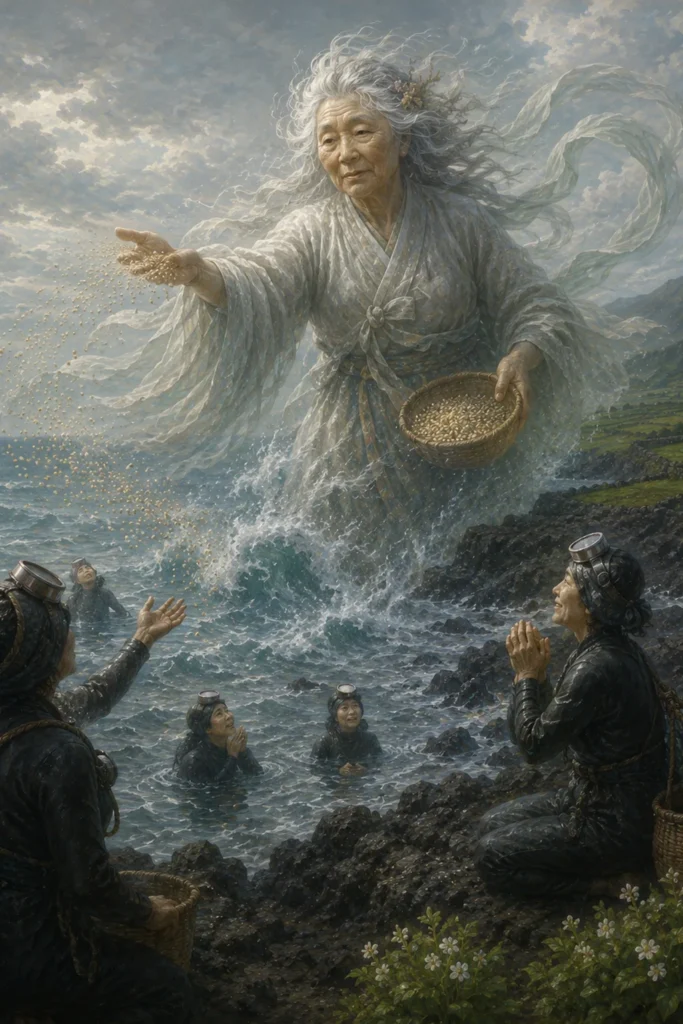
Eopsin, the god of stores in serpent form
By Ralf Ittermann · last reviewed on
Eopsin is a god of Korean tradition.
The god of prosperity, who as a house snake guards the stores.
Eopsin is the Korean god of stores and prosperity, one of the house gods, the Gasin. Unlike the other Gasin, he embodies himself in an animal, most often a snake, and guards the household’s stores and wealth.
Folk belief tied a house’s wealth directly to him: only those who venerated Eopsin could become rich, and if the animal left the house, impoverishment followed. For this reason these animals were never killed or driven away. The cult was practised in rural, pre-industrial agrarian Korea into the 20th century.
Type: god of stores and prosperity in animal form, one of the Gasin
Origin: Korean shamanism and folk belief, Muism
Texts: Korean folklore, Encyclopedia of Korean Folk Beliefs
Period: pre-industrial, practised in rural areas into the 20th century
Appearance: usually a snake, also a weasel or toad

Context of Tradition
Period of the Texts
Pre-industrial Korean folk belief; the agrarian Gasin system was practised in rural Korea into the 20th century.
Area of Diffusion
Korea, especially rural areas; on Jeju, Eopsin corresponds to the wealth goddess Chilseong.
Sources
Well documented through Korean folklore studies, above all the Encyclopedia of Korean Folk Beliefs.
Name and variants
Korean: The name combines eop, acquisition or wealth, with sin, god, together: god of wealth. In folk religion, the meaning acquisition predominates, although the character can also mean karma.
Appearance and behaviour
Appearance
Unlike the other Gasin, Eopsin takes on an animal form: most often a snake, the eop-gureongi, ideally a black snake with ears, otherwise a weasel or toad, rarely an ox, pig, rooster or dog, and also occasionally a human. Usually he remains invisible.
Effect
Eopsin is the god of stores, wealth and fortune; he guards grain and wealth against rodents, decay and theft. Only those who venerated him could become rich. If the animal leaves the house, impoverishment follows; for this reason these animals were never killed or driven away.
Profile: Eopsin
The most important aspects of the god of stores at a glance.
Part of the Gasin in Muism, Korean shamanism and folk belief, alongside Seongju, Jowang and other house gods.
Stores and wealth: Eopsin guards the grain against rodents, decay and theft, and ties the household’s wealth to the house.
Usually a snake, the eop-gureongi, ideally black and with ears; otherwise a weasel or toad, rarely other animals. Usually he remains invisible.
God of stores, wealth and fortune; his staying means prosperity, his leaving impoverishment of the household.
Venerated in the storage area, often at the Jangdok-dae, the jar terrace in the back yard; offerings were made at festivals and after the harvest.
Acquisition, wealth and the black snake
The name combines eop, acquisition or wealth, with sin, god: the god of wealth. In its folk-religious function, acquisition is the primary meaning, even though the character can also mean karma. Eopsin belongs to Korean shamanism and folk belief, Muism, and is part of the Gasin, alongside Seongju, Jowang and others.
The system is pre-industrial and agrarian, and was practised in rural Korea into the 20th century. In this rural world, stores were wealth, and their guardian was the house snake: the eop-gureongi, ideally a black snake with ears, whose staying meant riches and whose leaving meant impoverishment.
Afterlife and Classification
Eopsin is barely a living practice anymore; he is present chiefly in folklore studies, museum education and popular reception of mythology, where he is usually shortened to a wealth goddess in serpent form.
From a religious-studies perspective, Eopsin is a benevolent god of stores and prosperity. Important clarifications: the female gender fixed in English is a convention, since the Gasin are often gender-indeterminate. He is primarily a figure of ritual household belief, not of an elaborate myth. And the cult varied strongly by region.
Jar terrace and harvest offerings
Eopsin was venerated in the storage area, often at the Jangdok-dae, the jar terrace in the back yard, in some places in a dedicated Eop jar filled with rice under a straw cover. Offerings were made at festivals and after the harvest. The strictest commandment of the cult was an abstention: the animals in which Eopsin embodies himself were never killed or driven away, for their departure was considered impoverishment of the house. On Jeju, the wealth goddess Chilseong corresponds to him.
House snakes as bringers of fortune in comparison
Frequently asked questions about Eopsin
What is Eopsin?
The Korean god of provisions and prosperity, one of the household gods, the Gasin. He usually takes the form of a snake and guards the household’s grain and wealth.
Why was the house snake never killed?
Because its departure was seen as the household’s impoverishment. The animals in which Eopsin embodies himself were therefore never killed or driven away.
Where was Eopsin worshipped?
In the storage area, often at the Jangdok-dae, the jar terrace in the backyard, in some places in a dedicated Eop jar with rice under a straw cover.
Further links
Further reading:
- Korea – all beings of Korean belief
- Seongju, Jowang – the other great Gasin
- Domovoi, Žaltys – house-snake parallels
- Salt, Amulet, Smoke cleansing – traditional protective means
- Protection Compass – an overview of protective means
Literature (selection)
Further standard works in the bibliography.
As a Korean household god and god of prosperity, Eopsin shows how closely faith and household provisioning were interwoven: the wealth of a house had a form, and whoever tolerated and honoured it kept fortune within the household.