The Pentagram: The Five-Pointed Star as a Protective Sign
By Ralf Ittermann · last reviewed on
The pentagram, the five-pointed star drawn in a single stroke, is one of humanity’s oldest protective signs. From antiquity through the druid’s foot of folk belief to modern esotericism, it has been accompanied by the idea that a closed line can keep misfortune at bay.
Classification
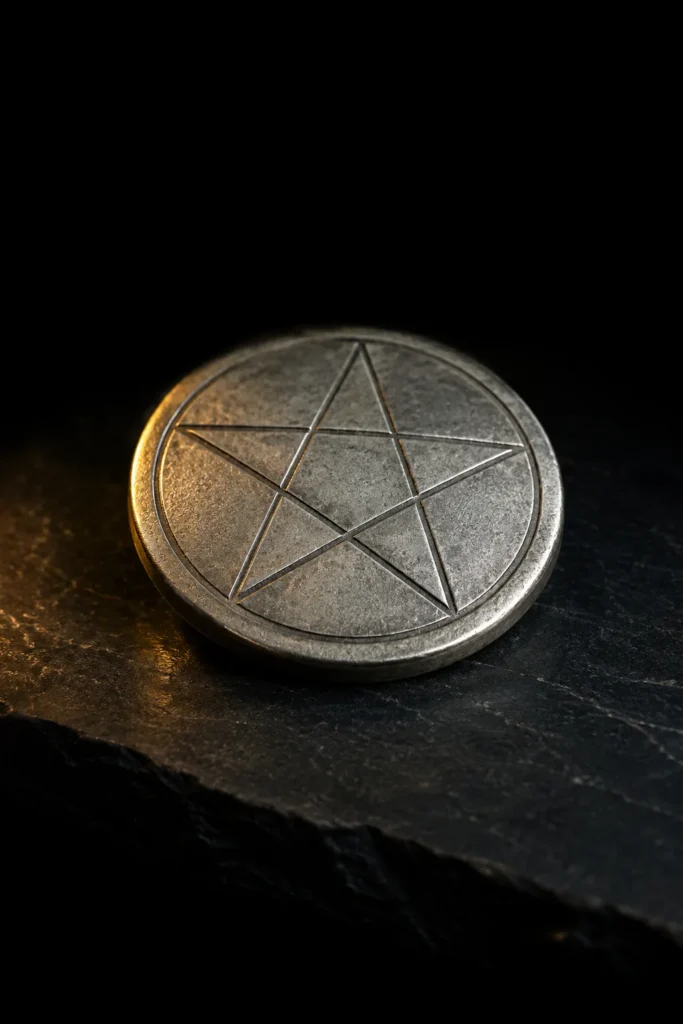
The pentagram is a five-pointed star formed from a single, self-crossing line. This line can be drawn without lifting the pen and returns at its end to its starting point. It is precisely this property, that of being a self-contained and unbroken line, that lies at the heart of its meaning as a protective sign.
The pentagram belongs to no single culture. It appears in the ancient Near East, in Greek antiquity, in the European Middle Ages, in folk belief and in modern esotericism. In each of these eras it received its own interpretations, yet the basic form and its connection with protection and wholeness remained remarkably constant.
Because of this long and multifaceted history, the pentagram is an instructive example among protective signs. It shows how a simple geometric sign can be carried, interpreted and understood anew across millennia without losing its basic meaning.
The five-pointed star is also a remarkable figure mathematically. It is closely connected with the regular pentagon, and in its segments the so-called golden ratio emerges, a proportion that has been considered especially harmonious since antiquity.
This geometric elegance has contributed over the centuries to the fascination with the pentagram and has supported its interpretation as a sign of perfection.
The Pentagram in Antiquity
The traces of the pentagram reach far back. As early as the ancient Near East, the five-pointed star is attested as a sign, where it appears, among other things, in administrative and pictorial language. Already in this early period the form was known and in use.
The pentagram acquired a special significance among the Pythagoreans in ancient Greece. For this philosophical school, the five-pointed star was a sign of recognition and an emblem of perfection. Tradition connects it with health and with the harmonious order that stood at the center of Pythagorean thought.
In antiquity, two lines of thought thus worked together. On the one hand there was the mathematical fascination with a figure that arises from a single line and from clear proportions.
On the other hand there was the interpretation of this perfection as a sign of the good and the wholesome. Both strands shaped the later understanding.
Already in Babylonian writing the five-pointed star appears as a sign that was connected with cardinal directions and domains.
In Greek mathematics a fundamental discovery was made on the pentagram, for its segments revealed that not all lengths can be expressed by a common measure. Thus the sign became associated early on with deep insights into number and magnitude.
The Druid's Foot: Protection at Door and Cradle
In German-speaking folk belief the pentagram bears its own name, the druid’s foot (Drudenfuss). According to old belief, a Drude was a nocturnal, oppressive being that haunted sleepers and was associated with the nightmare. The druid’s foot was the sign meant to keep these and similar powers at bay.
The druid’s foot was drawn or carved on doors, thresholds, window frames and on the cradle. In this way it secured precisely those places through which, in popular belief, harmful powers could enter the protected space. Its protection applied especially to the sleeper and to the child, who were regarded as vulnerable.
In this popular use the pentagram appears in its most immediate protective function. It was not a learned sign but a practical means of household defense, which remained alive in many regions over a long time and was deeply embedded in people’s everyday life.
The name druid’s foot points directly to the nocturnal being against which the sign was directed. A famous literary trace is found in Goethe’s Faust.
There the devil Mephistopheles cannot leave the study because a druid’s foot is drawn on the threshold, the outer angle of which was not cleanly closed. The scene shows how self-evidently the knowledge of the protective sign could still be assumed around 1800.
The Unbroken Sign: The Working Principle
The protective effect of the pentagram is often explained in folk belief by its particular way of drawing the line. The five-pointed star is drawn in a single stroke, and the line closes seamlessly at its end. A sign without a gap was considered a sign through which nothing can slip.
A widespread story is also explained by this idea. A druid’s foot that is not cleanly closed, whose lines therefore do not quite meet, is considered ineffective or even dangerous, because evil could enter or leave through the open spot. Care in the drawing was therefore decisive.
This working principle of the closed line connects the pentagram with other forms of protection, such as the drawn protective circle and the endless knot patterns of many cultures. All of them rest on the idea that an unbroken line forms a secure boundary.
The idea of the seamless line recurs in many notions of protection. A widespread assumption held that a harmful being had to trace every line of a sign and would become caught on an unbroken figure.
The pentagram, the drawn circle and the endless knot patterns of many cultures all follow this pattern. They form a boundary that offers no beginning and no end and was therefore considered impenetrable.
The Pentagram in the Middle Ages
In the European Middle Ages the pentagram was known both as a learned and as a popular sign. In the Christian interpretation the five-pointed star could be related to the five wounds of Christ and thereby acquired a pious meaning.
A famous literary testimony is the Middle English poem of Gawain and the Green Knight. There the knight Gawain bears a pentagram on his shield. The text interprets it at length as a sign of perfection and virtue and calls it an endless knot whose interlocking lines stand for related excellences.
At the same time the pentagram was, in the medieval imagination, connected with King Solomon, to whom a special power over spirits was attributed. The sign appears in this context as a means of binding spiritual powers and keeping them within bounds.
In medieval manuscripts on magic the pentagram appears among the signs by which spirits were to be bound. It was often linked there with the name of Solomon, although the sources do not always clearly distinguish the five-pointed from the six-pointed star.
The poem of Gawain expressly calls the pentagram an endless knot and thereby provides one of the most detailed medieval interpretations of the sign at all.
The Renaissance and the Human Figure in the Star
In the Renaissance the pentagram acquired a new and influential interpretation. Scholars who occupied themselves with so-called natural magic connected the five-pointed star with the form of the human being. The five points were assigned to the head and the four outstretched limbs.
In this interpretation the pentagram became an image of the human being as a small world, as a microcosm that mirrors the order of the great whole. The human figure in the star stood for the idea that the cosmic order is, as it were, summarized within the human being.
This Renaissance interpretation was consequential for the further history of the sign. It permanently connected the pentagram with the idea of order, completeness and the place of the human being in the cosmos. Later esoteric currents took up precisely this interpretation and developed it further.
The scholar Heinrich Cornelius Agrippa von Nettesheim, in his influential work on magic, drew the figure of a human being whose outstretched limbs touch exactly the five points of the star.
This depiction permanently connected the pentagram with the doctrine of the human being as microcosm. Related to it is Leonardo da Vinci’s famous Vitruvian Man, which expresses the same idea, that within the measure of the human being a greater order becomes visible.
Upright and Inverted
In modern perception a distinction is made between the upright and the inverted pentagram. The upright sign with one point upward is regarded as a sign of the good and of protection. The inverted sign with two points upward is frequently interpreted negatively.
This moral distinction is, however, comparatively recent. It became established only in the 19th and 20th centuries within certain esoteric currents. In older contexts the pentagram appeared in both orientations without this necessarily being connected with a value judgment.
For a factual account this point is important. The contrast between a good and an evil pentagram that is widespread today is a modern interpretation and not the original meaning of the sign. Throughout its long history the pentagram was above all a sign of wholeness and protection.
The sharp contrast between the upright and the inverted pentagram goes back essentially to the French author Éliphas Lévi in the 19th century. He interpreted the two orientations morally and thereby shaped an image that still has effect today.
In the older medieval and Renaissance sources this strict valuation is absent. Knowledge of this late origin helps not to fix the sign too hastily on a modern interpretation.
Pentagram and Pentacle in Esotericism
In modern Western esotericism the pentagram plays a central role. Here it is often called a pentacle when it is designed as a tangible object on a disc or a pendant. In ritual contexts it serves as a sign of protection and order.
A closely related practice is the work with signs and seals, as is also known to sigil magic. The pentagram stands here in a series of signs to which an ordering and delimiting effect is attributed. In some modern currents, such as neo-pagan movements, it has become a fixed sign of faith and recognition.
This development shows that the pentagram has preserved its meaning as a protective sign into the present. It traveled from the popular druid’s foot and from the learned sign of the Renaissance into modern esotericism without losing its basic reference to protection and wholeness.
In the ritual practice of Western esotericism the pentagram serves, among other things, to delimit and protect a space. In neo-pagan movements, especially in modern witchcraft, it has become a central sign of faith and recognition.
In some countries the pentagram of these communities is now recognized as a religious symbol, similar to the cross or other signs of faith, and may be used, for example, on gravestones.
Reception Today
The pentagram is today one of the best-known geometric signs of all. As a pure five-pointed star it is widespread far beyond any religious or esoteric context, for example on flags, decorations and markings of all kinds. In this form it no longer carries any particular protective meaning.
In popular culture, by contrast, the pentagram is frequently presented one-sidedly. The inverted sign in particular appears in films and stories often as a threatening symbol. This depiction considerably abbreviates the history of the sign and passes over its millennia-long role as a sign of protection and order.
A factual consideration places the pentagram in its historical context. For a long time it was a sign of wholeness, a protection at door and cradle and an emblem of perfection. This history is richer and more multifaceted than the widespread modern image of dread.
As a pure five-pointed star, the pentagram is today found on countless flags, badges and decorations without any religious or esoteric meaning being connected with it. This ubiquity shows how important it is to pay attention to the respective context.
A star on a flag, a druid’s foot on an old door and an esoteric pentacle are identical in form, but very different in their meaning.
Literature (Selection)
Related key terms: pentagram, druid’s foot, five-pointed star, pentalpha, pentacle, Pythagoreans, protective sign, microcosm, esotericism.
iWell Guard and Protective Traditions
iWell Guard stands in the cultural-historical line of portable protective objects to which the pentagram also belongs. A modern companion for people who live with protective symbols: made in Germany, 41 layers of genuine gold, platinum and silver, with a 30-day right of return.
Personal experiences may vary. Not a medical device. No healing promise.