King Gesar, Tibetan heroic epic
By Ralf Ittermann · last reviewed on
King Gesar stands at the centre of the most extensive Tibetan heroic epic, which is still performed orally by singers today. King Gesar of Ling (Tibetan Gling Ge-sar rgyal-po) is the mythical ruler of the Tibetan national epic and is regarded as the central heroic figure of the Inner Asian narrative tradition.
With over a million lines of verse in its complete versions, the Epic of Gesar is probably the longest living epic in the world, and in 2009 it was added to the UNESCO list of intangible cultural heritage.
To this day it is performed in many variants by professional singers in Tibet, in Mongolia, in Buryatia, in Ladakh and in Bhutan.

Source Situation and Textual History
The oldest written records of the Gesar epic date from the 14th to the 16th century, but the oral tradition probably reaches back considerably further.
In «Recherches sur l’épopée et le barde au Tibet» (1959), R. A. Stein worked out the complexity of the textual history and showed that the epic exists in numerous regional versions that sometimes differ strongly from one another. The canonised form preserved today in Tibetan monastery libraries usually comprises between 30 and 120 volumes.
In their studies of Tibetan history and geography, Per Sørensen and Andreas Gruschke examined the connection of the epic to concrete geographical areas in East Tibet (Kham, Amdo) and in the border regions adjoining Sichuan, Qinghai and Gansu.
The kingdom of Ling, over which Gesar rules, is associated with the historical region around the upper Yellow River, although no clear historical identification has been achieved.
In his studies of the Mongolian Gesar tradition, Klaus Sagaster examined the route by which the epic was transmitted into the Mongolian steppes and how it was adapted there.
Structure of the Content
The epic begins with the heavenly decision to send a Bodhisattva hero to earth in order to save the land of Ling, which is threatened by demons. Gesar is born as the son of the god Brahma and the human woman Gogmo.
His earthly name is Joru, and his childhood is marked by humiliation and misjudgement. Only in a horse race, which he wins against all expectations, is he recognised as King of Ling and takes the royal name Gesar.
The main parts of the epic consist of 18 so-called «conquests» («dgra ‘dul»), in which Gesar campaigns against demons, tyrants and hostile kings and subjects their territories to Buddhism.
Among the best-known episodes are the conquest of Hor (in the north), the conquest of Mon (in the south), the conquest of Jang (in the east) and the concluding conquest of the iron fortress in the Chinese border region.
In the end Gesar returns to heaven, with the promise of returning as a redeemer in an apocalyptic age.
Historical and Mythical Layers
In «Civilized Shamans» (1993), Geoffrey Samuel analysed the religious-historical stratification of the Gesar epic and distinguished three main layers: a pre-Buddhist Bön layer, in which Gesar appears as a divine king with shamanic features; a Buddhist layer, in which he is stylised as a Bodhisattva and defender of the Dharma; and a late layer, partly specific to the Gelug-pa and Nyingma-pa, in which he is connected with Padmasambhava and with Tantric practices.
This stratification explains the tensions within the transmitted versions.
The historical identification of Gesar with the Roman Caesar (via Persian and Uighur mediation as «Kesar») is an older hypothesis put forward by Stein and others, supported by phonetic correspondences but not by clear historical evidence.
Other researchers, including Lauran Hartley and Pema Bhum, locate the historical core of Gesar rather in a real Tibetan local king of the 11th or 12th century who was elevated into a legendary figure. A definitive clarification is still pending.
Forms of Performance
The epic is performed by professional singers, who in the Tibetan tradition are called «sgrung-mkhan» or «gling-pa». They frequently claim not to have learned the epic but to have received it in dreams or visions.
Some singers belong to a lineage of «skull bearers», who are given the epic by spirits at a particular place of initiation. Research by Hu Jinpu, Yang Enhong and Lauran Hartley has documented this cultural practice in detail.
The performance time of a complete version can extend over several weeks. Individual episodes are sung in 2 to 12 hours.
The singers use traditional hats, drums and bone flutes and stand in a line with old Central Asian bardic traditions, which scholarship compares with the «manaschis» of Kyrgyzstan (Manas epic) and with the «yöröölchis» of Mongolia. Klaus Sagaster and Walther Heissig have systematically researched the connections between these bardic traditions.
Religious Significance
In Tibetan religiosity Gesar is not only a literary hero but a sacred figure who is actively venerated in certain lineages. Above all in the Nyingma-pa school and in some Kagyü lineages, Gesar is regarded as a martial manifestation of Padmasambhava and as a protector of the teaching.
In his honour, protective practices (gsol-kha) and rituals (sang fumigations) are carried out. In «Prisoners of Shangri-La» (1998), Donald Lopez outlined Gesar’s role in modern Tibetan religiosity and showed how he is used by political movements as a national symbol.
In his works on Tibetan mythology, Robert Thurman pointed to the ambiguity of the Gesar figure: it combines the role of martial hero, sacred protection, social memory and political identity.
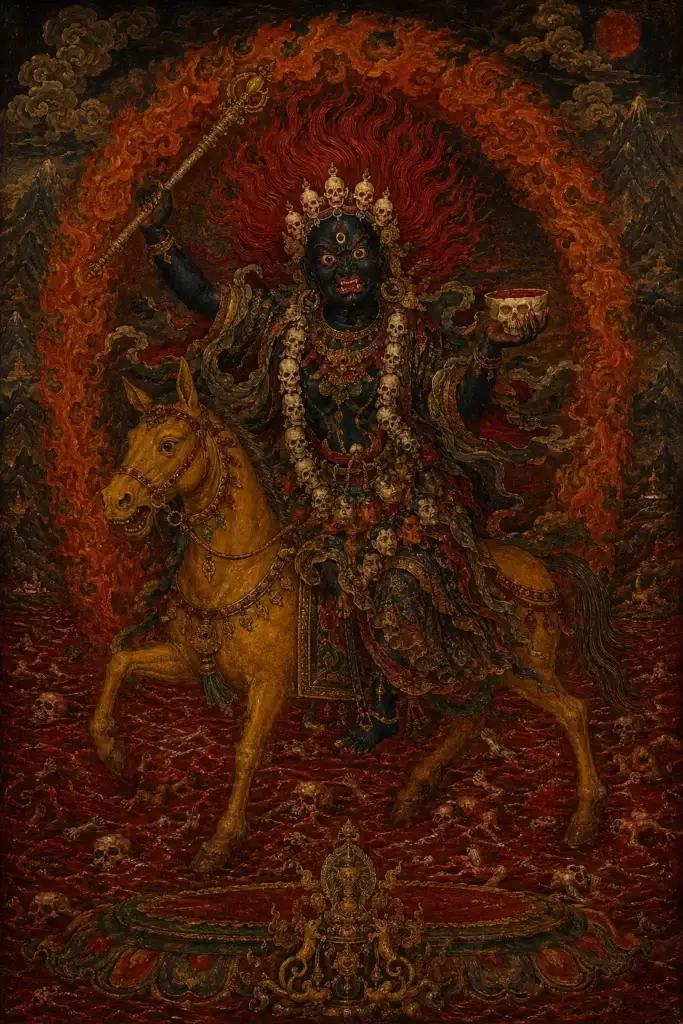
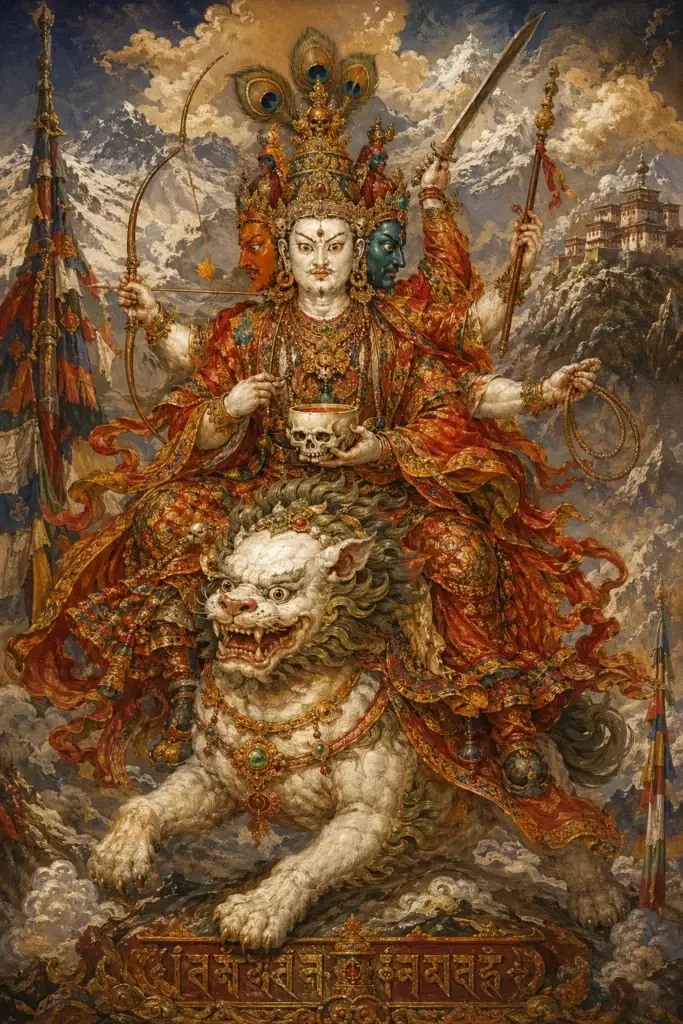
In monastery rituals Gesar is often depicted as a red-faced rider with lance and sword, accompanied by his white horse Kyang Bu and his 30 heroes.
Spread Beyond Tibet
The Gesar epic is not confined to Tibet but has found its way into the Mongolian steppe region, into the Buryat region around Lake Baikal, into the Tuvan language zone and into the Monguor, Salar and Yugur language communities on the fringe of the Chinese empire.
In Mongolia the epic is called «Geser khaan» and was translated into a complete Mongolian version in the 17th and 18th centuries. The Buryat variant has shamanic features and differs markedly from the Buddhist-influenced main Tibetan version.
In several volumes, Walther Heissig worked through the Mongolian and Buryat Gesar tradition and showed how the material took on its own local colourings in each region. In Ladakh the epic is performed in Tibetan and in local dialects and is connected with pilgrimage sites there. The UNESCO inscription of 2009 honours this transnational character.
Modern Reception and Research
In the People’s Republic of China the Gesar epic has been systematically documented since the 1950s and edited in dozens of volumes.
At the same time, the work of the collectors and editors produced tendencies towards modernisation, for example the fixing of a «standard version» that does not correspond to the diversity of the oral tradition. Lauran Hartley and Pema Bhum have documented and critically reflected on this tendency.
In European and American research, Gesar has been a key field of Tibetology and Mongolian studies since Stein and Heissig. Current work on singers, on literary structures, on comparative epic research and on present-day function is available from, among others, Solomon Mowtschanetz, Yang Enhong and Robin Kornman.
The English translation of large parts of the epic, published by Robin Kornman and his team under the title «The Epic of Gesar of Ling» (2012), has considerably broadened its international reception.
Political Instrumentalisation
Over the past centuries the Gesar epic has fulfilled various political functions. In the late Qing period it was regarded as a symbol of Tibetan autonomy, in the Republican period as an expression of Mongolian-Tibetan brotherhood.
In the People’s Republic of China, Gesar is officially presented as a «hero of the Chinese multi-ethnic family», which Tibetan intellectuals such as Tsering Shakya have criticised as an attempt at appropriation. In India and in the Tibetan exile, Gesar serves as a national symbol of resistance against cultural erasure.
Within the Tibetan religions, too, the epic is politically relevant. The Nyingma-pa and some Kagyü lineages emphasise Gesar as a guardian of the Tibetan people, while the Gelug-pa tradition, to which the Dalai Lama also belongs, treats the epic with greater reserve because it preserves many pre-Buddhist elements.
Geoffrey Samuel analysed these lines of tension as a typical expression of the inner plurality of Tibetan religion.
Singer Tradition and Oral Composition
In Tibetan usage, the performers of the Gesar epic are divided into several categories: «babs sgrung» (singers who have descended from visions or trance), «thos sgrung» (listening singers, who have learned by hearing), «dgongs sgrung» (those learning through spirit transmission) and «brda sgrung» (sign singers, who work with written aids).
This classification is already found in the early reports by Rolf Alfred Stein in «L’épopée tibétaine de Gesar dans sa version lamaïque de Ling» (Paris 1956) as well as in «Recherches sur l’épopée et le barde au Tibet» (Paris 1959).
There Stein documents the biographies of individual singers, who had mostly lived through a severe illness or a trance episode at a young age, after which the episodes of the epic are said to have «emerged» in them.
This observation was confirmed by Yang Enhong («A Comparative Study of the Singing Styles of Mongolian and Tibetan Geser/Gesar Artists», 2002) and Lauran Hartley for present-day singers of the provinces of Qinghai and Sichuan.
In «Civilized Shamans. Buddhism in Tibetan Societies» (Washington 1993) and in his later collected volume «Tantric Revisionings» (Aldershot 2005), Geoffrey Samuel showed that the singer types typologically connect with shamanistic patterns of initiation, without standing in a direct lineage relationship to the Bön specialist class.
According to Stein’s records, the average performance time of a complete episode of the epic lies between six and twelve hours; the complete epic, in its 120 episodes transmitted today, comprises, according to estimates by Donald Lopez and Yang Enhong, about a million verses, which makes it one of the most extensive oral epics in the world.
Mongolian, Buryat and Ladakhi Reception
The Mongolian version of the epic, «Geser Khan», was handed down through Mongolia and Buryatia in parallel with the Tibetan tradition and exists in several manuscript versions.
The most important is the «Beijing woodblock edition» of 1716, published under the Kangxi Emperor, which places Mongolian court culture in a protective relationship to the Geser complex. In «Geser-Studien.
Untersuchungen zu den Erzählstoffen in den neuen Kapiteln des mongolischen Geser-Zyklus» (Opladen 1983), as well as in several volumes of the series «Asiatische Forschungen», Walther Heissig demonstrated that the Mongolian versions omit some Tibetan episodes and instead integrate local Mongolian heroic material (Geser’s sword, the battle against the twelve-headed Mangus).
Buryat singers («ülgershin») developed from this their own epic tradition, in which Geser becomes a son of heaven from the northern steppe pantheon.
In Ladakh a distinct narrative form is attested, which was edited under the title «Kesar Saga» by August Hermann Francke in several volumes of the «Asiatic Society of Bengal» (1905 to 1909).
Francke had previously collected oral versions in Khalatse and Leh over more than ten years and published them in Tibetan transcription with English translation.
This edition is valuable for source criticism because it documents a western fringe region of the tradition, in which Geser is not yet fully integrated into the Buddhist doctrinal framework but preserves features of a pre-Buddhist solar and royal hero.
Symbolism and Iconographic Depiction
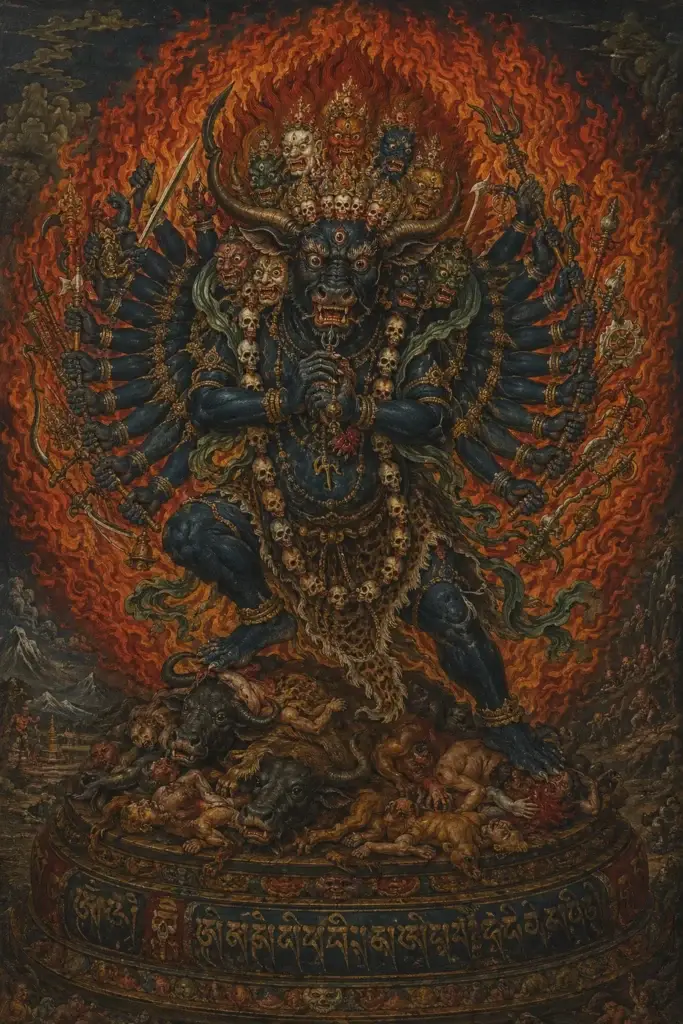
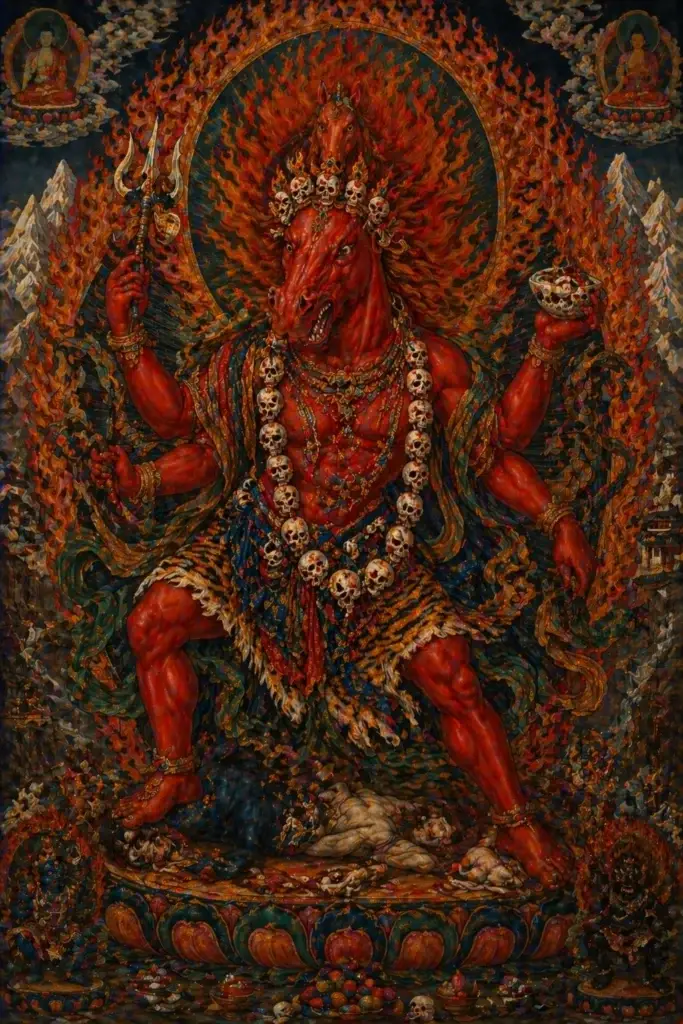
In the pictorial tradition Gesar is depicted as a martial rider, often with iron armour, lance, bow, feathered helmet and on a wind-swift horse. His white horse Kyang Bu, which is of heavenly origin, belongs firmly to the iconography.
In thangkas Gesar occasionally appears in the centre of a mandala, surrounded by his 30 heroes and the four kings of the cardinal directions. These depictions are attested in greater numbers from the 17th century onward.
The connection with the four heavenly kings gives the Gesar iconography a cosmological dimension that raises it beyond the purely heroic function.
In his works on the art of Amdo, Andreas Gruschke showed that the thangkas and wall paintings devoted to Gesar are designed very differently from region to region, and that the East Tibetan monasteries developed a particularly rich pictorial tradition.