Vanth: Etruscan Winged Demoness and Companion of the Dead
By Ralf Ittermann · last reviewed on
In Etruscan religion, Vanth is a winged demoness of the underworld who appears as a companion of the dead and a messenger of fate.
Unlike the male demon Charun, she is often depicted as less threatening, more as a messenger of fate and a companion. This depiction describes her position within religious studies in the Etruscan eschatological system.
Profile: Vanth
Vanth: the most important aspects at a glance. The following fields summarise origin, effect, appearance, function, protection and parallels.
Vanth is a winged demoness of the Etruscan underworld and, like Charun, is one of its prominent demons. No secure etymology of her name has been reconstructed. She sometimes appears in the plural, which points to several demonesses of this name; she has no exact Greek counterpart.
Vanth accompanies the dead to the underworld, sometimes alone, often together with Charun. On sarcophagi and tomb paintings she leads the dead away after the farewell from the living. As a messenger of fate, she comes when the time has come.
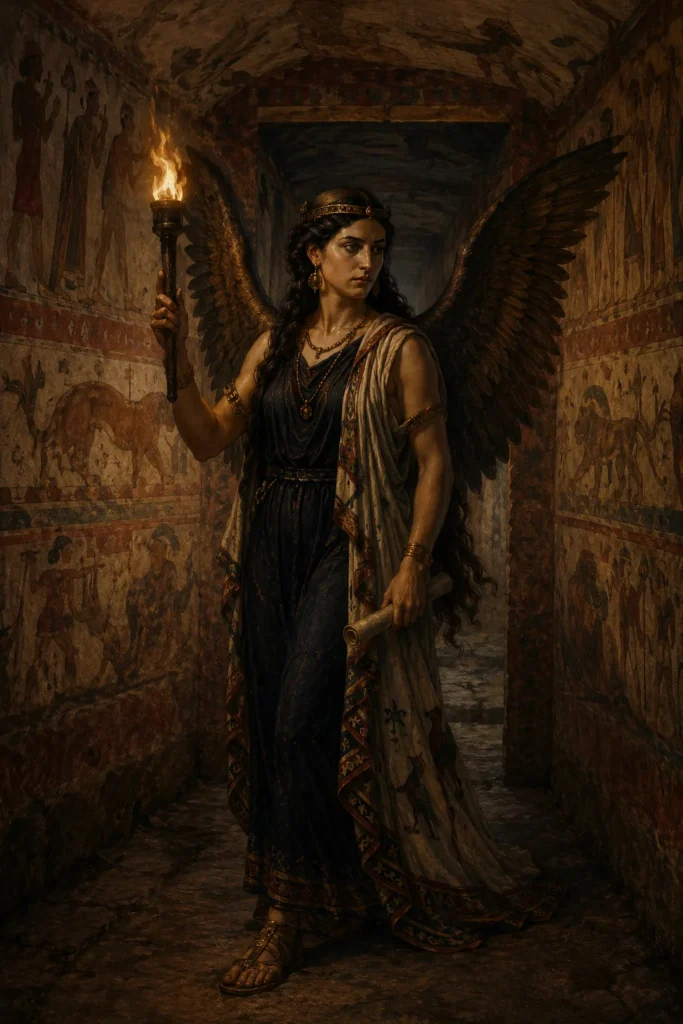
Vanth is depicted as a winged woman with a torch or a key, often in a short, belted garment. The wings distinguish her from the Greek Charon and place her close to the Greek Erinyes (Furies). The key points to the keeper of the gates of the underworld.
Vanth is the female companion of the dead and messenger of fate, whereas Charun is the male executor. She acts less threateningly, more like a natural power of fate, and regularly appears together with Charun.
Vanth was invoked above all in burial and mourning rituals, as a necessary companion in the passage from life to death. Apotropaic practices against her premature appearance are less well attested than for Charun. Images of Vanth in tombs were meant to ease the dead person’s way into the underworld.
Vanth can be compared with the Greek Erinyes (Furies), the Norse Valkyries and the Iranian Daenas, all of which are female companions of the dead or messengers of fate. The combination of wings, torch or key and the role of companion in a single figure is regarded as the Etruscan characteristic.
Classification within the Etruscan pantheon
Like Charun, Vanth belongs to the prominent demons of the Etruscan underworld. She is frequently depicted as a companion of the dead or as a messenger of fate. In Etruscan eschatology she holds a firm place and often appears together with Charun in scenes of separation and escort.
Larissa Bonfante and Erika Simon have treated Vanth in their works on Etruscan religion. She is a frequent figure in Etruscan pictorial art, often on sarcophagi and in tomb paintings.
Etruscan religion, in which the winged guide of the dead Vanth has her place, is especially rewarding for religious studies precisely because it stands between Greek-Mediterranean and Italic-Roman tradition.
Massimo Pallottino, Jacques Heurgon, Sybille Haynes, Mauro Cristofani and Giovanni Colonna have shown in their studies that this is an independent tradition and not a mere offshoot.
That Vanth fulfils a precisely defined role as guide of the dead fits an Etruscan theology that strongly structured its pantheon and distributed functions. The older talk of the ‘mysterious’ or ‘alien’ belief in gods of the Etruscans does not hold true: it is an independent variant of Mediterranean religion.
Vanth shows in exemplary fashion how the Etruscans mediated, in Italic religious history, between Greek influences and the emerging Roman religion. This bridging function makes her tradition particularly instructive for religious studies.
Vanth’s feathered form was formerly equated quickly with Greek models. Religious-ethnological research of recent decades has, however, recognized Etruscan religion as a closed, independent system and has replaced the earlier tendency to derive it as ‘derivative’ from Greek religion with a more precise examination.
Name and etymology
The name Vanth is attested on Etruscan pictorial works and inscriptions. A secure etymological meaning has not been reconstructed. Helmut Rix’s Editio Minor documents the attestations.
Vanth sometimes appears in the plural, which suggests that there were several Vanth demonesses, similar to the way there were several Charun demons. This plurality is interesting in terms of the phenomenology of religion.
Vanth’s name occurs on Etruscan pictorial works, but is written in a language that is regarded as isolated within language families, or that might belong to a posited ‘Tyrsenian’ family together with Lemnian and Raetic. Since the 19th century, research has worked on deciphering these texts without being able to complete the task.
Helmut Rix’s Editio Minor forms the fundamental epigraphic collection of the Etruscan language corpus and also documents the inscriptional attestations for Vanth. Today the Thesaurus Linguae Etruscae and the online database ETP (Etruscan Texts Project) supplement it.
The question of the origin of the Etruscans remains unresolved: Herodotus thought of an immigration from Lydia, Dionysius of Halicarnassus of a native Italic origin. For understanding figures like Vanth, this is relevant to religious history, because it raises the question of possible connections to cults of Asia Minor.
The close interlinking of linguistic and inscriptional research also benefits the Vanth tradition: the digital edition of Etruscan texts in the ETP (Etruscan Texts Project) makes comparative studies considerably easier. Marie-Laurence Haack and Vincent Jolivet have made trailblazing contributions here.
Description and iconography
In Etruscan art Vanth is depicted as a winged woman, often with a torch or key. Her feathered wings distinguish her clearly from the Greek Charon type and place her close to Greek Erinyes-Furies or Eros figures. The association with the key points to her function as guardian of the gates of the underworld.
On Etruscan sarcophagi and tomb paintings (Tomba dei Vipinana in Tarquinia) Vanth appears in numerous scenes. Her garment is often short and belted, which suggests freedom of movement. Larissa Bonfante has examined this iconography in detail.
Vanth is above all graspable through pictorial works, and Etruscan pictorial art proves, in terms of the phenomenology of religion, to be exceptionally rewarding: mirrors, vases, tomb painting and bronzes form the main sources. Larissa Bonfante has honoured this pictorial language in her works as an independent tradition, not as a mere offshoot.
Vanth appears frequently in the Etruscan tomb painting of Tarquinia, Cerveteri and Vulci, which ranks among the foremost sources of Etruscan religion and eschatology. In its banquet, dance and music images as well as mythological episodes, the afterlife is shown as a continuation of life.
Vanth often appears together with Charun in escort scenes, which attests to the inclination of Etruscan iconography toward multi-figure scenes, narrative references and symbolic condensations. This pictorial language forms a field of work of its own within Etruscan religious iconography.
Vanth sometimes appears in the plural and alongside further figures, which attests to the narrative density of Etruscan pictorial art: a single mirror or a vase can carry several mythological references at once. This condensation compels research to careful contextual analysis.
Vanth in Etruscan eschatology
Vanth is part of the complex Etruscan underworld system. She accompanies the dead to the underworld, sometimes alone, often together with Charun. Her function is rather that of a ‘messenger of fate’ than of an active agent of death: she comes when the time has come, and escorts.
Jean-Rene Jannot describes the Etruscan conception of the underworld as a well-structured system with clearly assigned demon functions. Within this system Vanth is the female companion, while Charun is the male executor.
Etruscan mythology does not survive in fully formed narrative texts of the kind known to the Greek and Roman tradition. The picture of Vanth emerges only from the synthesis of pictorial sources, inscriptions and Greek-Roman secondary transmission, a source situation that requires methodological caution.
The relationship of Etruscan and Greek mythology is multilayered: on the one hand the Etruscans adapted Greek myths about Achilles, Odysseus or Oedipus, on the other hand they reshaped them independently. Vanth, who has no exact Greek counterpart, shows this independent shaping; the adaptation is being researched intensively.
Vanth appears regularly together with Charun, which fits a basic feature of Etruscan theology: the council of the gods (consensus deorum). Even Tinia does not act alone, but consults with other gods. This concept counts, in terms of the phenomenology of religion, as a distinctive feature.
Since the mythological tradition of the Etruscans does not survive in self-contained narratives, Vanth’s function too must be reconstructed from pictorial scenes, inscriptions and secondary sources. What has proven its worth here is the combination of Etruscan caption, Greek pictorial model and contextual reading, which requires careful interpretation.
Mythological narratives
Vanth narratives are transmitted primarily in pictorial form. On sarcophagi and tomb paintings she appears in separation scenes: the deceased takes leave of the living, Vanth leads him away. In some depictions she sits in a pensive pose on a stone and waits for the death of a person.
In the Etruscan adaptation of Greek myths, Vanth sometimes appears in scenes in which she has no Greek equivalent, for instance at the death of Achilles. This independent insertion documents the religious specificity of the Etruscan tradition.
The Disciplina Etrusca, the Etruscan system of divination, comprised the inspection of entrails (haruspicina), the interpretation of lightning (fulguratio) and the observation of birds (auspicia). Passed on from the Etruscans to the Romans, it remained a living practice until the 4th century AD and was described in detail by Cicero and Seneca.
Specialized priestly schools passed on the Disciplina Etrusca. Its most important texts were the Libri Rituales, the Libri Haruspicini and the Libri Fulgurales. They are not preserved, but are partly reconstructable through citations in Cicero, Festus and Macrobius.
A focus on the individual city shaped the Etruscan cult: Tarquinia, in whose tombs Vanth frequently appears, had its own principal cults and religious particularities, as did Caere, Vulci, Veii, Clusium, Volsinii, Cortona, Perugia, Arezzo, Volterra, Populonia and Roselle.
The Disciplina Etrusca forms a coherent religious-divinatory system and ranks among the highly developed divination practices of antiquity. Systematically adopted by the Romans, it continued to be practiced into late antiquity, a continuity remarkable for religious history.
Cult and rituals
Vanth, like Charun, was not ‘venerated’ in the sense in which the Olympian atua were. Her connection lay primarily in the context of funerals: images of Vanth adorned sarcophagi and ash urns, and Vanth formulas were possibly spoken in burial rituals.
The placing of images of Vanth in tombs had a sympathetic function: it was meant to ease the way of the dead into the underworld and to make the presence of the demoness present.
Architecturally, the Etruscan temples are independent: the Tuscan style represents an order of columns of its own, which Vitruvius describes in De Architectura. The ground plans emphasize the cella and a broad frontal hall and thereby clearly diverge from Greek models.
The Etruscan temples were often laid out monumentally. As an architectural testimony of Etruscan religiosity in early Rome, the temple of Jupiter on the Capitolium is regarded, created by Etruscan architects and artists, above all Vulca from Veii.
Each year the Etruscan league of the twelve cities gathered at the Fanum Voltumnae near Volsinii for religious and political assembly. Voltumna, the federal god of the Etruscan confederation, held a superordinate religious significance in this.
Etruscan temples often rested on tuff foundations, carried superstructures of wood and were decorated with terracotta. The famous Apollo statue from Veii, a work of Vulca, is regarded as a principal architectural and religious testimony of this tradition.
Protective traditions
In contexts of protection, Vanth was invoked primarily in funeral and mourning rituals. She was not a ‘protector’ in a positive sense, but a necessary companion in the transition from life to death.
Apotropaic practices against the premature appearance of Vanth are less well attested than with Charun. On the whole she seems less threatening, more like a power of fate given by nature.
Numerous apotropaic symbols belonged to Etruscan protective practice: phallus amulets, Gorgoneion images, eye symbols, bullae and certain formulas.
Widespread in Etruscan culture were apotropaic symbols such as the eye of Tinia, phallus amulets and Gorgoneia. They adorned temples, tombs, household shrines and personal objects; in Roman and Mediterranean popular belief this practice was continued.
Etruscan protective practice stood in close connection with the Disciplina Etrusca. Before important undertakings such as the founding of a city, a military campaign or the building of a house, divinatory consultation was carried out regularly.
In Etruscan religion, protective tradition and the Disciplina Etrusca are closely linked. Whoever performed a protective ritual often at the same time called in a haruspex or augur. This institutional connection is characteristic in terms of religious studies.
Parallels in other cultures
In comparative religious terms, Vanth can be compared with the Greek Erinyes (Furies), with the Norse Valkyries, with the Christian tradition of ‘sacred burial’ or with the Iranian Daenas. What they all have in common is that they are female companions of the dead or messengers of fate.
The specifically Etruscan form of Vanth is the combination of wings, torch/key and companion function in a single figure. This condensation is independent in terms of the phenomenology of religion.
The interpretatio Romana gave the Etruscan gods Roman names: Tinia became Jupiter, Uni became Juno, Menrva became Minerva. This identification was mostly selective, not complete; the research of the past fifty years examines what of Etruscan distinctiveness persisted.
Anatolian, Phoenician and Near Eastern traditions intersect in many ways with Etruscan religion. The Phoenician mediation is documented by the Pyrgi Tablets; this trans-Mediterranean networking is an important field of research of recent decades.
In the comparative religious view, the Etruscan cult can be assigned to the Mediterranean family of religions, connected with Greece, Phoenicia, Egypt, Anatolia and Latium. This networking is an important field of research.
Current research
Vanth research has made progress in the last 30 years through the systematic evaluation of Etruscan sarcophagi and tomb paintings. Erika Simon, Cornelia Weber-Lehmann and Larissa Bonfante have made important contributions.
Feminist religious history too takes an interest in Vanth as a female figure of fate who does not correspond to the classic ‘mother’ or ‘beloved’ stereotypes. This perspective opens up new readings.
Today Etruscan religion is the subject of international research. Among the important centres are the universities of Florence, Rome Sapienza, Pisa, Tubingen and Princeton; each year several international congresses treat individual questions of this religion.
Today’s international research projects on Etruscan religion work with digital methods: 3D scans of temples and tombs, databases of inscriptions and pictorial sources, and GIS analyses of the Etruscan settlement structure. From this, new insights emerge.
Exhibitions in the Vatican Museum, in the Museo Nazionale Etrusco di Villa Giulia and in the Boston Museum of Fine Arts convey today’s Etruscan research to a broad public, as do numerous publications.
Sources and state of research
The most important sources for Vanth research are the Etruscan sarcophagi (Tarquinia, Volterra, Chiusi), the tomb paintings, the ash urns and the inscriptions. Larissa Bonfante’s Etruscan Mythology offers a good overview.
A deeper classification within Etruscan religious history as a whole shows how Vanth is to be understood in the relational structure with Charun, Aita and other beings of the underworld. This networking is essential in terms of religious studies.
The source situation for Etruscan religion is heterogeneous: it ranges from epigraphic testimonies such as Helmut Rix’s Editio Minor through archaeological finds and pictorial sources to the secondary literature. This multi-source situation requires interdisciplinary work, which is why more recent research systematically brings together philology, archaeology, religious studies and anthropology.
Source criticism of Etruscan religion requires knowledge of the Etruscan primary sources as well as of the Greek-Roman secondary transmission. This dual perspective is demanding, but indispensable for an appropriate reconstruction in terms of religious history.
Whoever wants to classify Etruscan religious history in depth needs knowledge of the epigraphic, archaeological and literary sources as well as of modern religious studies. Such a multilayered engagement is the standard of research.
Vanth in the tomb painting of Tarquinia and Orvieto
The most important source for Vanth is not a text, but the pictorial art of the Etruscan tomb chambers.
In the painted tombs of Tarquinia, for instance in the Tomba dell’Orco from the 4th century BC, as well as in the Tomba Golini near Orvieto, Vanth appears as a winged female figure who accompanies the deceased on their way into the underworld.
She is mostly depicted as youthful, often with a bare upper body, high boots and bands laid over the shoulders.
Characteristic are her attributes: a burning torch with which she lights the dark way, a snake she carries wound around her arm, and occasionally a key or a scroll. The wings can grow out of the shoulders or out of the back.
Unlike the Greek Erinyes, with whom she is sometimes compared, Vanth does not appear in the pictorial art primarily as threatening, but rather as a calm guide who accompanies the transition without punishing it.
She often appears together with Charun, the hammer-bearing demon of the underworld, so that the two form a recurring pair of Etruscan iconography of the afterlife.
In scenes of battles or sacrificial acts, for instance the killing of Trojan prisoners in the Tomba Francois near Vulci, Vanth stands beside them as a witness of death.
It is significant for religious studies that the entire image of Vanth must be reconstructed from this archaeological tradition.
The Etruscans left no coherent mythology that would have been preserved for us, and so the tomb painting, together with relief urns and mirrors, is the actual primary source for everything that can be said about the goddess.
Inscriptional attestations and the question of multiple Vanth figures
In addition to the pictorial art, inscriptions secure the existence of Vanth as a named figure. In several tombs and on bronze mirrors the name vanth is placed in Etruscan script directly beside the depicted figure, which sets the iconographic identification on a firm basis.
These captions are methodologically decisive, because they identify a winged female figure beyond doubt as Vanth and do not leave it to a modern interpretation.
A striking phenomenon is that in individual depictions several winged women appear, all of whom may be labelled as Vanth or who occur in groups.
This has raised in research the question of whether Vanth is the individual name of a single goddess or rather the designation of a class of beings of the underworld, similar to the way the Greek word for the Erinyes means a group.
The material does not permit an unequivocal answer; research, for instance in Ingrid Krauskopf and in the relevant contributions of the Lexicon Iconographicum Mythologiae Classicae, keeps both possibilities open.
In addition, Vanth occasionally appears with epithets or in connection with other designations of beings, which points to a differentiated conception of demons of the underworld. Since the Etruscan language is only partly understood and most inscriptions are short, many of these attestations remain difficult to interpret.
In terms of religious studies the situation is thus doubly constrained: the pictorial material is rich, but mute, and the texts are sparse and often not fully accessible linguistically. Every statement about the nature of Vanth is a reconstruction from these two fragmentary strands of transmission.
Vanth and the Etruscan conception of the guided transition
The frequency with which Vanth appears in tomb art allows an inference about the Etruscan understanding of death as an accompanied transition.
In contrast to the Greek conception, in which the soul largely sets out alone on the way into Hades, the Etruscans seem to have thought of dying as a process in which the deceased is received and led by beings such as Vanth. Her torch is the pictorial sign of this escort function.
In numerous depictions Vanth strides ahead of the dead person or follows them, often on foot beside a wagon or horse with which the deceased travels to the underworld.
She opens, as scenes with door and key motifs suggest, the gate of the underworld. She thus belongs to a small group of Etruscan beings of the afterlife who do not oversee or punish the transition, but enable and order it.
This interpretation is supported by the placement of the images: Vanth appears on walls, door jambs and sarcophagi, that is, at the very thresholds of the tomb, which in Etruscan conception was the house of the dead and at the same time the entrance to the underworld.
In terms of religious studies, Vanth is thereby less a figure of punishment than a figure of the threshold.
Older research occasionally equated her too hastily with the avenging Erinyes or with angels of death; more recent works, for instance by Nancy de Grummond in Etruscan Myth, Sacred History, and Legend (2006), by contrast emphasize her calm, guiding character and warn against transferring Greek or modern concepts onto the Etruscan world of the afterlife without examination.
Literature (selection)
- Larissa Bonfante: Etruscan Mythology (2006)
- Stephan Steingraber: Etruscan Painting (1986)
- Jean-Rene Jannot: Religion in Ancient Etruria (2005)
- Erika Simon: Die Götter der Roemer und Etrusker
- Cornelia Weber-Lehmann: Contributions to Etruscan sepulchral art
Further standard works in the literature index.
The Etruscan myth presents Vanth as a winged companion of the deceased who attests fate with torch and scroll; her depictions are found on sarcophagi and tomb paintings from the fourth century BC.
Related key terms: Vanth Etruscans demoness of the dead wings torch key Charun Tomba dei Vipinana.
iWell Guard and protective traditions
iWell Guard ties in with the cultural-historical tradition of portable protective objects, in the tradition of Etruscan and many other cultures worldwide. 41 layers, solid gold, platinum, silver, made in Germany. 30-day right of return.
Personal experiences may vary. Not a medical device. No healing promise.