Lucifer, Fallen Angel of the Christian Tradition
By Ralf Ittermann · last reviewed on
The bringer of light who fell, angel of pride.
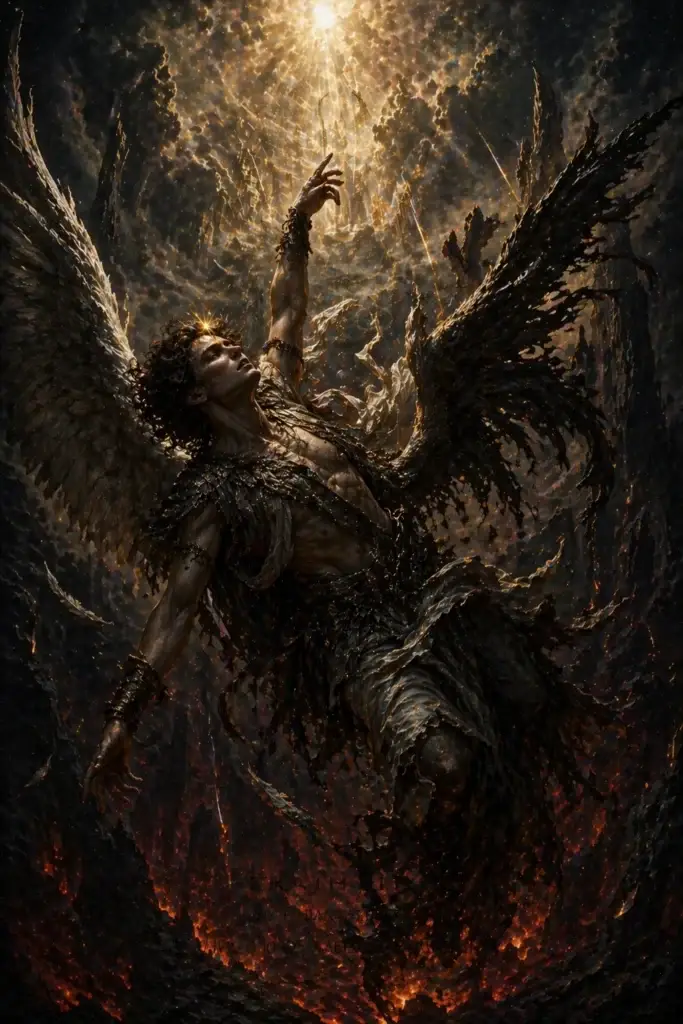
Lucifer
Lucifer is the fallen angel of the Christian tradition.
In Christian tradition, Lucifer is the figure of the highest fallen angel. The equation with Satan is medieval; originally „Lucifer“ (Latin for „light bearer“) is merely the name of the morning star and, in Isaiah 14:12, is applied figuratively to a fallen ruler.
The Church Fathers read this passage as the primal scene of the fall of the angels, thereby creating the central figure of medieval demonology.
In the modern era, Lucifer has undergone a complex reception: Milton’s Paradise Lost gives him dignity and tragic depth; Goethe’s Mephistopheles is an ironic descendant; in esotericism and modernity, Lucifer is at times interpreted positively as a symbol of rebellion against heteronomous authority.
Isaiah 14:12 as a key text
In the history of religion, the figure of Lucifer as a fallen angel goes back to a late-antique Christian interpretation of Isaiah 14:12. In its original prophetic context, the verse (How you have fallen from heaven, O morning star, O son of the dawn) refers to the Babylonian king and is a mocking lament over his political downfall.
The patristic interpretation since Origen (De principiis, ca. 230) reads it typologically as the fall of the angels: the Hebrew Helel ben Shahar is rendered in the Vulgate as Lucifer (Latin for „light bearer“).
Jerome identifies the verse with the pre-creation fall of the angel, thereby fixing the Lucifer-mythological tradition for the Latin Middle Ages.
Brief profile: Lucifer
Type: Fallen angel of light
Origin: Late-antique Christian interpretation of Isa 14
Texts: Isa 14, Lk 10:18, patristics, Milton
Period: 4th century to the present
Epithet: Light bearer, morning star, son of the dawn
Classification
The patristics of the 4th and 5th centuries interpret Isa 14:12 as the fall of the angels. Medieval theology (Thomas Aquinas) develops this further. Milton (17th century) creates the principal literary figure. Romanticism and modernity discover Lucifer as a symbolic figure of rebellion.
The Christian cultural sphere as a whole; especially present in Western European iconography and literature. In the modern era, worldwide through literature, painting and popular culture.
Isa 14:12; Lk 10:18; 2 Cor 11:14; patristics (Origen, Jerome, Augustine), Milton, Goethe, Byron, Romantic iconography, neo-esoteric literature.
Designation and spellings
Latin: Lucifer, „light bearer“ (from lux + ferre).
Hebrew (Isa 14:12): Helel ben Shahar, „Shining One, son of the dawn“.
Greek: Phosphoros, „bringer of light“.
Medieval: Lucifer, mostly identified with Satan.
The name is astronomical: morning star (Venus). Isaiah 14 is a mocking lament against a Babylonian king who fell from heaven as the „morning star“. The early Church read this typologically as the fall of the highest angel.
Characteristics
Appearance
Originally the most beautiful of the angels. After the fall: dark and disfigured (patristics) or dignified and tragic (Milton). Modern iconography ranges from the horned devil to the romantic, melancholic genius.
Behavior
Before the fall: the highest angel in God’s presence. At the fall: he wishes to be like God and incites rebellion. After the fall: tempter, ruler of hell, and at the same time a symbol of immeasurable loss.
Sphere of influence
Cosmic, as a key figure in the myth of the fall of the angels. Ethical, as a symbol of pride. Literary and cultural, as a touchstone of human self-empowerment.
Mythological origin
An astronomical name for Venus, theologically charged through Isa 14 and New Testament accounts of the fall. In patristics, developed into the original figure of evil.
Medieval angelic hierarchy and Dante
In the medieval angelic hierarchy according to Pseudo-Dionysius the Areopagite (De caelesti hierarchia, ca. 500), Lucifer originally belonged to the highest choir of the Seraphim, whose rebellion and fall are the paradigmatic example of pride (superbia).
Dante’s Divina Commedia (ca. 1308, 1320) places Lucifer in the ninth and deepest circle of hell (Cocytus), as a being with three faces on one head that gnaws on the three greatest traitors of humanity: Judas, Brutus and Cassius.
This position makes Dante’s Lucifer the standard iconographic form for several centuries.
Only John Milton’s Paradise Lost (1667) shifts the axis of sympathy: his Lucifer is a sublime tragic figure whose fall moves the reader; this reading shapes the Romantic reception of Lucifer (William Blake, The Marriage of Heaven and Hell, 1790; Lord Byron, Cain, 1821).
Profile: Lucifer
The most important aspects of Lucifer at a glance. You will find the detailed treatment of name, description, defense and parallels in the following sections.
Name of the morning star (Venus); applied typologically to the fall of the angels in Isa 14. In the Middle Ages, identified with Satan.
The aspiring, the proud, the intellectual elite (in patristics); as a literary figure: modern humanity in search of self-determination.
The most beautiful of the angels; dark after the fall. Milton’s Lucifer: dignified, tragic. Iconography varies from a devilish figure to a melancholic genius.
Temptation to pride and to self-empowerment. Causes the fall of the angels. At the same time a symbol of the tragic loss of divine closeness.
As with Satan: sacraments, prayer, invocation of saints, exorcism. Spiritual tradition: above all humility as a counter-means to Luciferian pride.
The Icarus motif (ancient), Prometheus (the revolt of the Titans), Samael (Jewish), Iblis (Islam), modern figures of rebellion (Byron’s Cain, Milton’s Satan).
Protective practice
Rituals of defense
As with Christian defense against demons in general. Particularly emphasized in monastic and ascetic contexts: humility as a deliberate virtue against pride, regular confession, lectio as a protective practice.
Conjurations
Formulas of exorcism mostly name Lucifer together with Satan. Medieval sermons and collections of exempla warn against superbia luciferina („Luciferian pride“).
Amulets and protective symbols
Depictions of Michael showing the fall of Lucifer have their own apotropaic power. The Benedictine medal with „VRS NSMV SMQL IVB“, the classic Latin protective formula against Satan / Lucifer.
Reception
Medieval iconography: Dante places Lucifer in the lowest circle of hell, in eternal ice. Medieval church painting depicts the fall as a powerful pictorial topos; Michael with the sword against the falling angel of light.
Milton’s Paradise Lost: John Milton’s epic (1667) draws a Lucifer of tragic greatness: „Better to reign in Hell than serve in Heaven.“ This figure shapes the modern literary reception.
Romanticism, Symbolism, modernity: Byron, Baudelaire, Stefan George see Lucifer as a symbol of human self-empowerment. In modern esotericism (Luciferianism) he is at times turned to the positive, a reversal not shared by mainstream theology.
Theological and literary treatment
Standard works on the Lucifer tradition: Jeffrey Burton Russell, Lucifer. The Devil in the Middle Ages (Cornell University Press, Ithaca 1984); Bernard McGinn, Antichrist. Two Thousand Years of the Human Fascination with Evil (Harper, San Francisco 1994).
For the literary treatment, Helen Gardner, Religion and Literature (Faber, London 1971); Christopher Ricks, Milton’s Grand Style (Clarendon, Oxford 1963).
The identification of Lucifer with Satan is standardized in patristics, but is occasionally debated theologically; the historian of religion Elaine Pagels (The Origin of Satan, 1995) argues for a more critical separation of the Jewish, model-related Satan tradition from the Christian-mythological Lucifer tradition.
Isaiah 14: the fall of the morning star
The name Lucifer has a precisely determinable origin.
It comes from the Latin Bible translation by Jerome, the Vulgate, and appears there in the Book of Isaiah, chapter 14, verse 12. The Hebrew word in this passage is helel ben shachar, which means roughly „Shining One, son of the dawn“ and designates the morning star, that is, the planet Venus in the morning sky.
Jerome rendered it as lucifer, „light bearer“, a common Latin word for the morning star.
The context of the passage is a mocking lament. Isaiah 14 is an oracle against the king of Babylon.
The text scoffs: „How you have fallen from heaven, you radiant morning star.“ What is meant is the fall of an arrogant earthly ruler who wished to rise above the stars and is cast down into the underworld. In its original sense it is not about a fallen angel.
Only the Christian interpretation linked this passage with a notion of the fall of a prideful angel.
Early Christian theologians such as Origen read Isaiah 14, together with Ezekiel 28, a lament over the king of Tyre, as a coded depiction of the fall of a prince of angels. The „morning star“ of the Babylonian mocking lament thus became the proper name of a fallen angel.
This history of interpretation is well documented and is widely shared by historical-critical scholarship. It shows that Lucifer as a proper name is not a biblical given, but the result of a long work of interpretation that solidified a poetic image into an independent figure.
Lucifer, Satan, devil: three terms and their merging
In the popular imagination, Lucifer, Satan and the devil are one and the same figure. In the history of religion, these are three terms of different origin that were only equated over the course of time.
Satan is a Hebrew word and means „adversary“ or „accuser“. In the Book of Job, the Satan is a member of the heavenly court, an accuser in God’s service, not an independent counter-god.
Devil comes via Greek from diabolos, likewise „slanderer, accuser“, with which the Greek Bible translation rendered the Hebrew satan. Lucifer, finally, is, as described, a Latin word from Isaiah 14.
The three strands grew together into a single figure in early Christian and medieval theology. Added to this was the account of the fall of the rebellious angels, which drew on scattered biblical allusions and intertestamental literature, such as the Ethiopic Book of Enoch.
The result was the closed notion: a once high angel named Lucifer who rose against God, was cast out of heaven with his followers, and has since seduced humankind as Satan or the devil.
Some ecclesiastical tradition still distinguishes slightly to this day between the angel before the fall, Lucifer, and the demon after the fall, Satan. Other currents use the names synonymously. For a precise understanding, it is important to keep the different origins in view rather than taking the merging for granted.
The legacy of the early Church: why Lucifer was also a saint’s name
An often overlooked finding shows how late the negative fixing of the name took place.
In the Latin Christianity of late antiquity, Lucifer was an ordinary personal name with nothing objectionable about it. The best-known bearer is Lucifer of Cagliari, a bishop of Sardinia in the 4th century, who appeared as an uncompromising opponent of Arianism. In parts of the tradition he is even listed as a saint.
In the Christian poetry of antiquity too, lucifer could be used unselfconsciously as a designation of the morning star, at times even in a positive sense referring to Christ.
In the Exsultet, the hymn of the Easter Vigil, Christ is spoken of as the true morning star; the Latin text here uses the word lucifer in its original, harmless meaning.
Only in the Middle Ages did the name finally establish itself as a designation of the fallen angel, so that it became impossible as a personal name. Scholarship sees in this a process in which the theological interpretation of Isaiah 14 gradually displaced the everyday meaning.
This finding is instructive for the history of religion. It demonstrates that the identity „Lucifer equals devil“ was not fixed from the outset, but developed over centuries. Anyone who hears the name today inevitably thinks of the devil; a Christian of late antiquity would first have thought of the morning star or of a bishop.
Milton’s Lucifer and Romanticism: the rise of a literary figure
Lucifer’s literary career is closely tied to John Milton’s epic Paradise Lost (1667). Milton depicts the fall of the angels and makes the figure he mostly calls Satan the dramatic protagonist of the first books.
His Satan is eloquent, strong-willed and tragic; the famous line that it is better to reign in hell than to serve in heaven sums up his defiance.
Milton certainly did not intend to portray a hero, yet the effect was ambivalent. As early as the 18th and especially the 19th century, Romantic poets and critics read Milton’s Satan as a fascinating, almost admirable figure of rebellion. William Blake formulated the provocative thesis that Milton was „of the devil’s party without knowing it“.
In Romanticism, the fallen figure of light became an emblem of the rebel, the seeker of freedom, the one rising up against an order perceived as tyrannical. Lord Byron, Percy Shelley and others took up the motif. This „sympathetic“ figure of Lucifer is a literary construction that departs far from the theological finding.
In modern popular culture, both are present: the threatening devil of the Christian tradition and the charismatic, ambivalent Lucifer of the literary line. Television series, novels and comics draw above all on the second.
For the study of religion, it is important to separate this layer of reception from the biblical and early-Church tradition rather than mixing them.
Further links
Further reading:
- Christianity
- Satan (often identical)
- Azazel (background)
Research literature
Further standard works in the literature index.
Frequently asked questions about Lucifer
Who is Lucifer in the Christian tradition?
Lucifer (Latin Lucifer, light bearer) originally designates the morning star Venus, the brightest star before sunrise. Only in the Vulgate translation of Isaiah 14:12 was the term applied to an angel cast down from heaven.
In the Christian Middle Ages, Lucifer merged with the figure of Satan into the fallen archangel who rebelled against God out of pride. In modern esotericism (Theosophy, Anthroposophy), Lucifer is interpreted in a more differentiated way as a Luciferian spiritual force of pride and self-overestimation.
What is the difference between Lucifer and Satan?
Historically they are two different figures. Satan comes from Hebrew (accuser) and at first appears neutrally in the Old Testament.
Lucifer is a Latin designation for the morning star which, through a translation of the passage Isaiah 14:12, was linked with a fallen angel figure. Only medieval theology merged the two into a single figure. Modern theological and esoteric currents often distinguish them again.