Erinyes, Spirit of the Greek Tradition
By Ralf Ittermann · last reviewed on
The Erinyes are a spirit of the Greek tradition.
The avengers, the pursuers of blood-guilt in the Greek world.
The Erinyes as pursuers of a mother’s blood
The Erinyes (Lat. Furiae, Ger. „Rachegöttinnen“, goddesses of vengeance) are personified in Greek mythology as three sisters, Alecto, Megaera and Tisiphone. They arise from the blood that dripped onto Gaia when the castrated Uranus fell (Hesiod, Theogony 183).
Their sphere of action is chiefly the pursuit of crimes against a mother’s blood, matricide, the murder of kin, and broken oaths sworn to parents.
Their paradigmatic scene is the pursuit of Orestes after the murder of Clytemnestra (Aeschylus, Eumenides). On Athena’s initiative the court of the Areopagus convenes, acquits Orestes, and integrates the Erinyes as the Eumenides („the Kindly Ones“) into the civic cult of Athens.
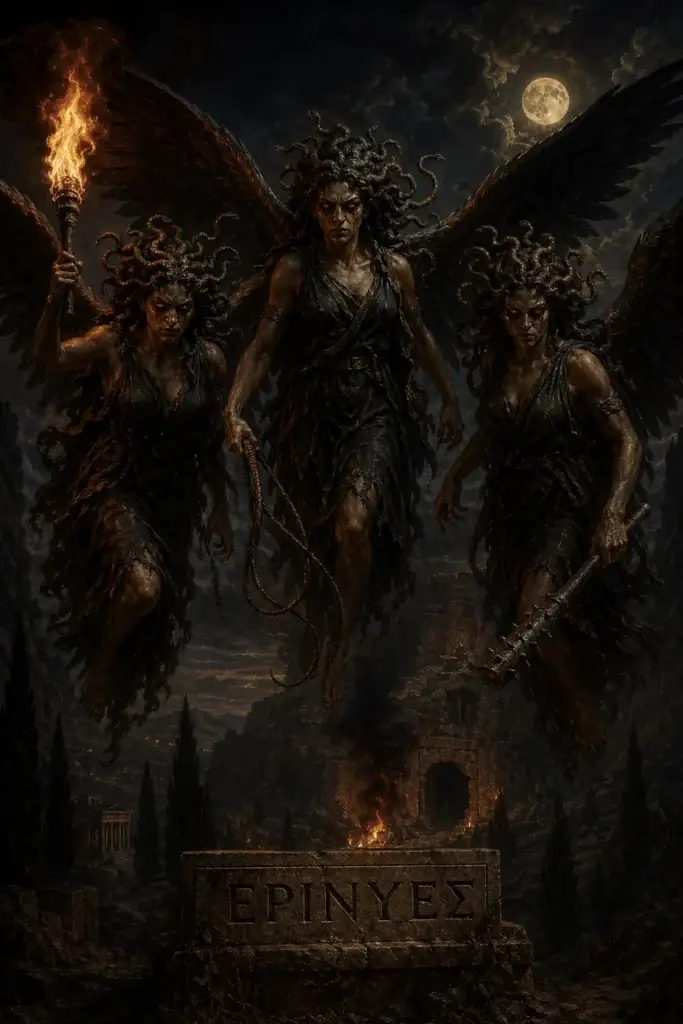
Iconography: black garments, snake hair, whip-like scourges, torches. In Roman cult they merged with the Furiae or Dirae.
The Erinyes are among the most archaic figures of Greek demonology. Three sisters, Alecto, Megaera and Tisiphone, born from the blood of the castrated Uranus, they pursue blood-guilt, perjury and offences against family piety. Where they strike, they drive the offender into madness until he is judged or ritually purified.
Their most prominent literary portrayal is found in Aeschylus’ Oresteia, where they pursue Orestes after the matricide all the way to Athens. There, through a divine verdict and cultic redefinition, they become the Eumenides, the „Kindly Ones“, one of the most classic transformations in ancient mythology.
The Erinyes in Aeschylus’ Oresteia
Aeschylus’ tragedy The Eumenides (458 BC) shows the Erinyes in their best-known dramatic form: as terrible female figures with snakes for hair, burning eyes and moist blood on their cheeks.
They pursue Orestes, who has killed his mother Clytemnestra, relentlessly across lands and seas. Aeschylus portrays them not as mere instruments of criminal law but as archaic deities with their own dignity and logic.
In the play they are finally appeased by Athena’s arbitration and integrated into the civic order of Athens; they become the Eumenides, the Kindly Ones. This transformation marks the shift from raw, unordered blood vengeance to institutionalised justice. The Erinyes represent the older, chthonic legal order, which is replaced by rational and democratic structures.
Brief profile: the Erinyes
Type: avenging demonesses, guardians of the order of blood
Origin: the blood of the castrated Uranus (Hesiod)
Names: Alecto, Megaera, Tisiphone
Texts: Homer, Hesiod, Aeschylus, Euripides, Virgil
Period: from the Archaic period to late antiquity
Warding off / reconciliation: rites of purification, Aeschylus’ transformation into the Eumenides, cult in Athens
Historical context
The earliest traces appear in Homer (Iliad, Odyssey) as avengers of perjury and blood-guilt. Hesiod provides the genealogy. Aeschylus’ Oresteia (458 BC) draws the classic figure. Euripides and Roman authors (Virgil, Seneca) carry the image forward.
The Greek cultural sphere. As the Eumenides they have an important sanctuary in Athens at the Areopagus and another at Sicyon. Roman reception adopts them as the Dirae and Furiae into the Latin repertoire.
The principal literary source is the Oresteia. Alongside it stand vase painting (Erinyes with snake hair and torches), inscriptions from the Eumenides cult, and rhetorical and philosophical references in Plato and later writers.
Name and variants
Greek: Ἐρινύες (Erinyes).
Euphemistically: Εὐμενίδες (Eumenides, „the Kindly Ones“), Σεμναί (Semnai, „the Venerable Ones“).
Individual names: Alecto (the never-resting), Megaera (the envious), Tisiphone (the avenger of murder).
The euphemism is characteristic: their power is so great that one does not wish to call them by their direct name. Their transformation into the Eumenides in Aeschylus’ drama is at the same time the founding of a cult, for they are not destroyed but ritually integrated into the order of the polis.
Description
Appearance
Winged women with snake hair, torches and whips; dark garments, blood-dripping eyes. In classical vase painting they are shown frontally, repellent yet with formal dignity. Not pretty creatures of the night like Empusa, the Erinyes are openly terrifying.
Behaviour
They pursue the offender systematically, often over years. They drive him into madness, deprive him of sleep, and lead him into isolation. Their power does not end with death: they also pursue souls into the underworld until satisfaction is achieved.
Sphere of action
Blood-guilt (especially within the family), perjury, offences against parental authority, the law of hospitality, and supplication for protection. Their field is the unforgivable moral transgression.
Mythological origin
From the blood of the castrated Uranus (Hesiod, Theogony), making them older than the Olympian gods. They represent a pre-Olympian, chthonic order of justice that sets limits even for the gods.
The Erinyes and Furies in ancient tradition
Hesiod’s Theogony names the Erinyes as the fruit of the blood of the fallen Uranus (Theogony 183–187); only in other versions are they considered daughters of Night.
Homer names them in the Iliad 9.571 as invisible punishers who follow hard upon the heels of a curse and perjury. The Romans adopted them as the Dirae (the Dreadful Ones) and stressed even more their connection to madness and bodily decay.
In the Aeneid, Virgil charges the Furies with mystical darkness: they guard the gates of the underworld and embody the very logic of vengeance in the cosmos.
In Hellenistic mystery cults and magical papyri they are invoked as a force to strengthen curses or to help avenge a broken oath. Their use in magical texts presupposes that the one cursing is in the right, otherwise the Erinyes turn against the curser himself.
Profile: the Erinyes
The most important aspects of the Erinyes at a glance. You will find the detailed treatment of name, description, warding off and parallels in the following sections.
From the blood of the castrated Uranus. Pre-Olympian, older than the Olympians, they stand for an archaic order of justice.
Those guilty of blood-guilt (especially within the family), perjury, offences against the law of hospitality, and disregard for parental authority.
Winged, snake hair, torches, whips, dark garment, bloody eyes. In the classical pictorial programme shown frontally, dignified yet terrifying.
Madness, sleeplessness, isolation, pursuit into the underworld. They bring not death but an unbearable continued existence until atonement.
Not warding off but reconciliation: rites of purification (katharmos), public trial (the Areopagus), and containment as the Eumenides cult. The polis binds their power through cult rather than by combating it.
Dirae/Furies (Rome), Gallu (Mesopotamia), Tzitzimime, Grim Reaper motifs; functionally also the Valkyries as executors on the battlefield.
Demonology in everyday life
Rites of reconciliation
A rite of purification after the shedding of blood (katharmos), usually through a pig sacrifice and ritual acts at a river or the sea. Whoever has been purified may enter the polis again.
Cult and invocation
In Athens at the Areopagus (the Hill of Ares) there was a Eumenides sanctuary that venerated the transformed Erinyes. Their power was cultically bound and at the same time acknowledged. In binding spells they are invoked as impersonal avengers.
Amulets and protective symbols
No apotropaic everyday amulets. Whoever wants to avoid the Erinyes must avoid blood-guilt. Their power cannot be limited by objects, only through ritual action and a court verdict.
The Erinyes, parallels in other cultures
Rome: the Dirae and Furiae are the direct Roman counterparts, prominent in Virgil’s Aeneid and Seneca’s tragedies. The motif remains structurally identical.
Mesopotamia: the Gallu of the underworld likewise enforce the cosmic order, though as messengers of death rather than as avengers of a moral transgression.
Modern reception: Freud’s superego takes up the motif of the pursuing inner voice. Literature and film return again and again to the Erinyes as a symbol of inescapable guilt.
The Erinyes as a cosmic force of vengeance and as mediators of atonement
The ancient understanding of the Erinyes was less personalised than functional: they embody not arbitrary cruelty but the unavoidable consequence of injustice and blood-guilt. They are, as it were, the bookkeepers of cosmic guilt, whom the universe itself follows.
Especially in Athenian law after Aeschylus they become symbols of restorative justice: no misdeed remains unatoned, yet no offender is without the possibility of rescue if he seeks and finds atonement.
This distinguished the Greek notion of the avenging deity from the pure retributive wrath of other cultures. The Erinyes demand reparation, not eternal damnation.
The Erinyes in the Oresteia of Aeschylus
The most impressive and most consequential portrayal of the Erinyes in ancient literature is the Oresteia of Aeschylus, a trilogy performed in Athens in 458 BC. In it the Erinyes are not merely powers that are mentioned but appear in person on stage as a chorus, above all in the third play, the Eumenides.
The plot leads from Clytemnestra’s murder of her husband Agamemnon, through the vengeance of their son Orestes, who kills his mother, to the consequences of this act of blood.
Because Orestes has slain his own mother, that is, because the blood of kin has been shed, the Erinyes pursue him. They are the avengers of a mother’s blood; they pursue Orestes from Argos to Delphi and on to Athens; they drive him into madness and leave him no rest.
Aeschylus depicts them as terrifying figures. Within the play it is reported that the mere sight of them threw the priestess of Delphi to the ground.
They sleep, they snort, they scent blood like hounds. Their claim is old, older than the younger Olympian gods, and they insist that their right, the right of blood vengeance, must not be touched.
The heart of the trilogy is the conflict between this old right and a new order. Apollo and Athena stand on the side of Orestes, the Erinyes on the side of unconditional atonement. The Oresteia is thus the central ancient testimony to how the Erinyes were understood as the embodiment of a pre-state, automatic retribution.
From curse to blessing: the transformation into the Eumenides
The decisive event at the end of the Oresteia is the transformation of the Erinyes into the Eumenides, the Kindly Ones. It is of great significance for the history of religion, because it shows how a culture does not abolish a threatening power but binds it into its own order.
In the Eumenides the case of Orestes is tried before a court on the Areopagus in Athens, which the goddess Athena establishes.
Citizens of Athens vote as jurors, the votes are tied, and Athena casts the deciding vote for the acquittal of Orestes. With this, for the first time, an ordered court has taken the place of endless blood vengeance.
The Erinyes are at first embittered by this verdict. They see their ancient office devalued and threaten to punish the land with infertility and plague. Athena negotiates with them.
She offers them a fixed place of cult in Athens, lasting honour from the citizens, and a new, beneficial task: they are to watch over fertility, the happiness of marriage and the flourishing of the city, and still to punish the wrongdoer, but now within the order of the state.
The Erinyes accept the offer and at the end of the trilogy proceed in a solemn procession to their sanctuary. From the pursuing spirits of vengeance the Eumenides have arisen, who indeed received a cult in Athens and elsewhere.
The tragedy thus interprets a real cult and at the same time supplies a meaning: the old power of retribution is preserved but made to serve the polis. The double name of these beings, Erinyes and Eumenides, holds these two sides together permanently.
Origin, number and names of the Erinyes
On the descent of the Erinyes the ancient sources give several differing accounts. The most influential version is found in Hesiod’s Theogony.
There the Erinyes arise from the blood of Uranus: when Cronus unmans his father Uranus and the drops fall onto the earth, Gaia, the earth gives birth to the Erinyes, together with the Giants and the nymphs.
This origin binds the Erinyes from the very beginning to a crime against kin, to the son’s revolt against the father.
Other traditions name Night, Nyx, as their mother, which places the Erinyes near the other dark powers, or they trace them back to the goddesses of the underworld. This variety is typical of Greek genealogies and shows that the Erinyes could be assigned to different strands of interpretation.
The number of the Erinyes was also not originally fixed. In the oldest texts, for instance in Homer and in Aeschylus, they appear as an indefinite plurality, as a host.
Only the later tradition, above all the Hellenistic and Roman, set their number at three and gave them names: Alecto, the unceasing one, Tisiphone, the avenger of murder, and Megaera, the envious or resentful one. In this threefold, named form they then appear in Roman poets such as Virgil.
There was also a widespread reluctance to call the Erinyes directly by name. People referred to them with veiling, appeasing names, namely as the Eumenides, the Kindly Ones, or as the Semnai Theai, the Venerable Goddesses, under which name they received a sanctuary at the Areopagus in Athens.
This linguistic caution is itself a testimony to the fear that these beings inspired.
Research literature
Further standard works in the literature index.
The protective practice described here is a religious-studies classification of historical traditions. iWell Guard ties in with this cultural-historical line of wearable protective objects and represents a contemporary form of it. More about the iWell Guard →