iWell Guard

Charon, God of the Greek Tradition

Charon is a god of the Greek tradition.

The ferryman of the underworld, guardian of the final threshold between life and death. Charon carries the souls of the dead across the rivers Styx and Acheron into the realm of Hades, a duty rather than a choice, and one that remains unfulfilled without the Obolus.

He is not death itself, but the guarantor of its irreversibility: once aboard Charon’s boat, there is no return.

Table of Contents

Charon - gods from the Greek tradition, historical and illustrative

Charon

At a Glance: Charon

Type: Greek mythological figure, ferryman of the dead
Pantheon: Greece (underworld), adopted by Rome
Function: Ferries the dead across the Acheron / Styx river into the realm of Hades
Main attributes: oar or pole, worn ferry, gaunt figure
Main cult sites: no temples of his own; present in funerary practice (Charon’s penny)
Distribution: vase painting, sarcophagus reliefs, the dialogues of Lucian

Historical Context

Period of the Texts

Charon is attested from the early 6th century BCE in literature (in the Hesiodic writings) and in imagery (on Attic vases). The principal flowering of the pictorial tradition falls in the 5th century BCE (classical Attic vase painting).

In the Roman period he is described as canonical by Virgil in the sixth book of the Aeneid. Lucian’s Dialogues of the Dead (2nd century CE) make him the most popular figure of the underworld. He survives in Byzantine Christianity as Charos (a personification of death).

Area of Distribution

Charon has no cult sites of his own; he is a figure of myth and practice. His distribution is nonetheless evident in a widespread Roman and Greek funerary practice: Charon’s penny (a coin placed in the mouth or on the eye of the deceased to pay the ferry fee).

Thousands of such coins are attested archaeologically. He remains present in modern Greek folk belief (Charos) to this day.

Source Situation

Central sources: Hesiod (fragmentary), Aeschylus (Seven against Thebes), Aristophanes (The Frogs, v. 180 ff., a comic Charon scene), Virgil Aeneid VI 295–330, Lucian Dialogues of the Dead.

Secondary literature: Sourvinou-Inwood, “Reading” Greek Death; Garland, The Greek Way of Death; Dietrich, Tradition in Greek Religion; Stevens, Charon’s Obol and Other Coins in Ancient Funerary Practice.

Designation and Spellings

Greek: Χάρων (Chaaron). The etymology is disputed, with possible derivations from *gher- (“to gleam, to burn” or “yellow-grey colour”), while a connection with Charis (grace) is rejected by most philologists. Roman counterpart: Charon (adopted unchanged from the Greek).

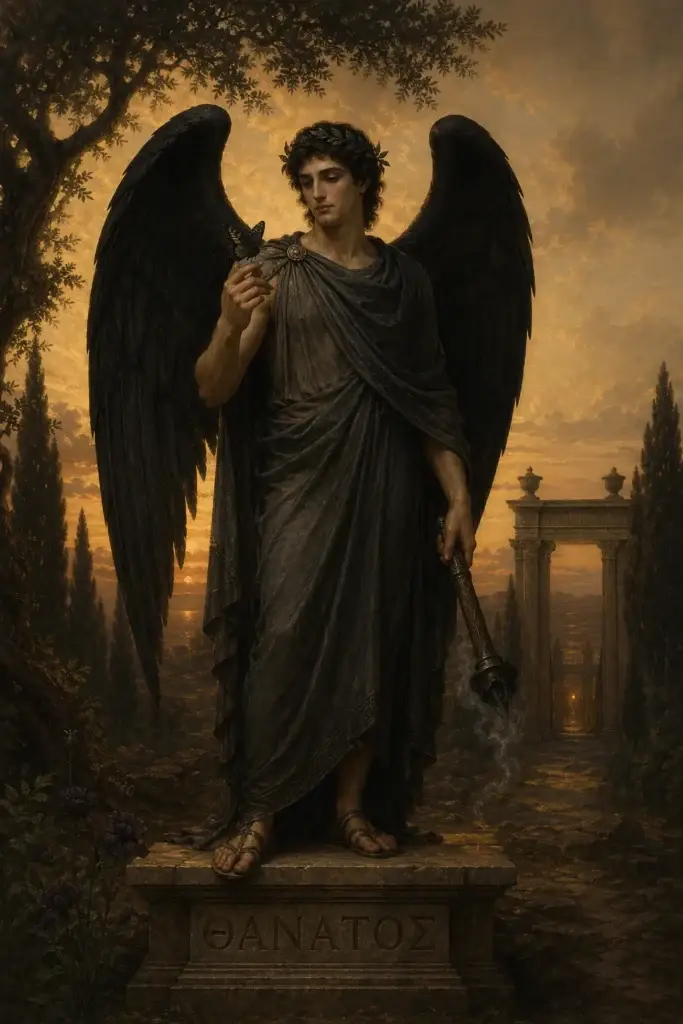
Etruscan: Charun, with a considerably more aggressive character, armed with snake and hammer, less a ferryman than a guardian and punisher. Related figures: Hermes Psychopompos (guide of souls as far as the underworld, but not the ferryman himself); Thanatos (death personified, brother of Hypnos).

Characteristics

Appearance

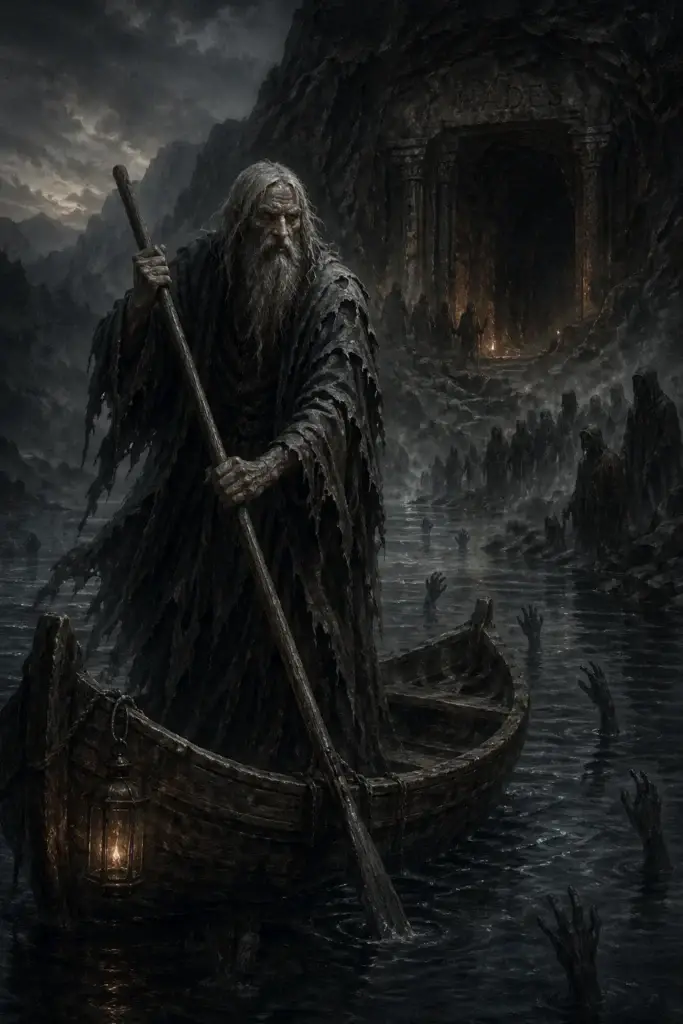
Charon is depicted as an old, emaciated man, with an unkempt beard and a hard, merciless expression. He wears a dark, pale robe or a torn chiton, often with a hood. His attributes are simple and functional: a long wooden boat hook (or oar), and at times a staff resembling a ferryman’s pole.

The boat itself is narrow and modest, built of planks, without a sail; only oar or pole determine its course. In vase paintings Charon often sits massively in the boat, the passengers stooped or standing.

Nature and Activity

In contrast to the just but distant Hades, Charon is the most immediately concerned with guiding the dead. He does not negotiate; his rule is simple: Obolus or not. Whoever arrives without a coin wanders for a hundred years along the near shore, accompanied by Thanatos (death) or Hermes, but uncarried.

His impatience is proverbial; in Aristophanes’ “Frogs” he is caricatured as a surly old fellow eagerly counting Obolus coins. Yet he follows strict rules: he cannot take the living, and even the god Hermes must negotiate.

Appearance and Symbolism

Charon is typically depicted as a grim, older man with wild hair and beard, often with winged sandals (like Hermes). He carries an oar or a pole with which he steers his skiff (boat) across the Styx. His clothing is shabby and dirty, not the splendid attire of the Olympians.

The Styx itself is his attribute, a river of the underworld. In vase paintings he is often shown together with Hermes Psychopompos (guide of souls), in direct competition or cooperation over the souls. His colour was dark, his gaze always fixed forward on the next load.

Profile: Charon

The most important aspects of Charon at a glance. The following fields summarise origin, function, appearance, occurrence, symbols and parallels.

Tradition

Charon is the son of Nyx (Night) and Erebos (the darkness of the underworld), one of the primordial daimones. Brother of Thanatos (death), Hypnos (sleep) and Eris (strife). He belongs to the generation of pre-Olympian beings of fate.

His area of responsibility is clearly delimited: his sole task is to ferry across the Acheron or Styx river. For the dead who lack burial he is considered inaccessible (the Aeneid episode concerning Palinurus).

Charon's Function

A purely ferryman function. He takes the deceased who were properly buried and who carry the ferry coin (obol) on the tongue, and ferries them to the far shore of the Acheron or Styx.

Whoever has no obol or died unburied must wait a hundred years on the near shore. He is neither judge nor escort; he is a pure transport official. In character surly and incorruptible.

Charon's Appearance

A gaunt, bearded figure of an old man with a still, grave expression. More demonic than divine. An oar or long pole in his hand, with which he pushes the ferry.

He wears a simple short loincloth, often with a conical pointed cap (pilos). The ferry is a simple flat skiff. In vase painting he is often depicted together with Hermes Psychopompos, who hands the dead over to him.

Charon's Veneration

Area of influence: Charon has no cult, but he is the recipient of the most important funerary practice: Charon’s coin (obol, in Rome obolus).

Thousands of such coins are documented in Greek, Hellenistic and Roman graves, from the 6th century BCE to the 4th century CE. In some regions the deceased was buried with two coins (one for the eye, one for the mouth). In modern Greek folk belief he remains present to this day as Charos.

Charon's Symbols

Oar, pole, ferry, coin (obol), loincloth, conical pointed cap (pilos), bearded face of an old man. Sacred waters: Acheron, Styx (in some traditions also Lethe and Cocytus). Sacred plant: asphodel (the flower of the underworld meadows). Sacred number: 1 obol as the fare.

Related Beings

Charos/Charon (modern Greek tradition, personification of death), Anubis (Egypt, guide of the dead), Hermes Psychopompos (Greece, guide of the dead, hands over to Charon), Yama (Hinduism, judge of the dead and first guide), Mictlantecuhtli (Aztec, sovereign of the realm of the dead Mictlan), Hel (Germanic).

The specific ferryman motif also appears in: Sucellos (Celtic, with a hammer at an Acheron-like crossing), with broader traces in Yama (in Tibetan Bardo conceptions).

Veneration in Everyday Life

Charon’s presence was omnipresent in Graeco-Roman funerary culture, yet not through temples or great festivals, but through everyday burial formalities.

The Obolus custom was central: at burial the deceased received a coin (usually a small danakes or obolus) placed on the mouth, under the tongue or on the eyes.

This was not a magical payment but a juridical principle, for without it Charon could not legally convey the soul and had to refuse it. Whoever had no family or was too poor to pay the Obolus faced wandering for a hundred years.

This led to public burial funds (especially in Athens), so that the destitute would not be excluded from the afterlife.

On vases (especially lekythoi, funerary offering vases) Charon was depicted in order to give visual form to the journey itself. Mourners deposited these vases in the grave or at periodic funerary meals (perideipna). Charon’s presence symbolised that the deceased were not lost but engaged in an orderly transfer.

Charon, Parallels in Other Cultures

Roman tradition: Charon is adopted unchanged. The Roman funerary rites (Lemuria, Parentalia) follow the same Obolus principle. Virgil anchors Charon deeply in Latin literature and makes him a symbol of the merciless boundary between this world and the next.

Etruscan Tradition

Charun is more aggressive, often depicted with mark, snake and hammer, less a ferryman than a guardian and punisher. Etruscan sarcophagus reliefs frequently show him in scenes of the handing over of souls, often in the company of other underworld demons. The Etruscan interpretation influenced the late Roman imagination of the underworld.

Mesopotamian tradition: An-na, the Akkadian ferryman of the underworld, fulfils a similar function. The material, however, is sparsely transmitted, and no direct historical influence is established. Functionally, nonetheless: a river separates the realms, and a ferryman administers the boundary.

Egyptian tradition: The Egyptian conveyance of the dead differed fundamentally: the soul was carried by the solar barque, not by a simple skiff. Anubis as guide of souls is more comparable to Hermes Psychopompos. Later Graeco-Egyptian syncretisms (e.g. in Graeco-Roman Egypt), however, show a blending: Charon could be understood as equivalent to Anubis.

Germanic tradition: Hel, the mistress of the underworld, conveys the dead, but without an independent ferryman. The material is sparse; Charon-like figures are not clearly attested in the Norse tradition.

Shamanic and Asian traditions: Many cultures have river ferrymen or graves that fulfil a similar barrier function (Japanese mythology, Taoist underworld architecture). Direct connections are speculative, yet the motif “boundary = river, ferryman = keeper of the rule” is universal.

The Obolus: Coins in the Mouth of the Dead

One of the best-known burial customs of the ancient world is connected with Charon, the placing of a coin as the ferry fare.

The literary sources, from Aristophanes’ comedy The Frogs to Lucian, speak of the naulon or danakē, the money that Charon demands for the crossing of the underworld rivers. Whoever could not pay, according to the conception, had to wait on the shore.

The archaeological evidence, however, is more complex than the popular notion of the “obolus under the tongue” suggests. Coins in graves are found in the Greek world from the classical period onward, but by no means everywhere. They lie sometimes in the mouth, sometimes in the hand, sometimes scattered in the grave.

In some regions and epochs the custom is frequent, in others almost unknown. Scholarship, such as the work of Susan Stevens, has shown that interpreting every single coin as Charon’s fare is too narrow. Coins could also enter the grave as a valuable offering, as a protective sign or for other reasons.

Nevertheless, the connection remains. The literary tradition and a portion of the archaeological finds support one another. The custom achieved a certain spread in the Roman period and continued to have effect into late antiquity.

For the history of religion the case is instructive: it shows how a narrated conception and a material practice reinforce one another, without the practice ever following the narrative completely and uniformly. The gap between myth and finding is here itself an object of research.

Iconography: From the Rough Old Man to the Winged Demon

Charon’s image changed considerably over the course of antiquity. In Greek vase painting of the 5th and 4th centuries BCE, especially on the white-ground lekythoi, he appears as a bearded, often poorly clad ferryman with oar or pole, waiting in a small skiff at the reedy shore.

He is surly, but not actually terrifying, rather a grumpy craftsman of the afterlife.

The Etruscan tradition shaped from this an entirely different figure. The Etruscan death demon Charun, whose name is related to the Greek Charon, appears on the wall paintings of Etruscan graves and on ash urns as a threatening figure with a large hammer, sometimes with animal ears, blue or pale skin colour and snakes.

He is no mere ferryman, but a violent companion of the dead.

In the Roman imperial period both traditions flowed together. The conception of a winged or demonic spirit of death, often called Charun, lived on in Italy, while the literary high culture knew the Virgilian Charon.

Virgil portrays him in the sixth book of the Aeneid as terribili squalore, of terrible filth, with fiery eyes and an unkempt beard, an old man of tough, raw age.

This depiction became the formative description for medieval and modern Europe. Dante made Charon the first guardian whom the sinners encounter, in the third canto of the Inferno. The transformation from the silent vase ferryman to the demonic old man can thus be traced over almost two millennia.

Charon's Position in the Geography of the Underworld

Charon is not the ruler of the realm of the dead, but a functionary within a larger system. Above him stands Hades, the god of the underworld himself, to whom the realm belongs.

Charon’s competence is spatially narrowly bounded: he brings the souls across the water that separates the world of the living from that of the dead. Depending on the passage, the sources name the Acheron, the Styx or the Cocytus as the river he travels.

On the far side his task ends. There the three-headed dog Kerberos keeps watch at the gate, and within, the judges of the dead Minos, Rhadamanthys and Aiakos decide the further path of the soul. Charon does not judge, he does not sort, he transports.

His only condition is formal in nature: the dead person must be properly buried and able to present the ferry fare. Unburied or destitute souls he turns back, which is vividly portrayed in the Aeneid, where the shades press at the shore and only the buried are allowed to cross.

This limited role has a meaning for the history of religion. Charon embodies the threshold as such, the act of transition, which belongs wholly neither to the world of the living nor to the world of the dead.

That a distinct figure is responsible for this single step shows how precisely the Greek conception articulated the stages of dying. Death was not a single moment but a path with stations, and Charon guarded the most important of them, the waterline between here and there.

Literature (Selection)

Classification & Protection

IILEVEL
The Protection Compass assigns this being to influence level II, Noticeable influence.

Against its influence, cross-cultural tradition names these protective means:

Compare in the Protection Compass →

Recommended protective means

iWell Guard

The simplest protective means in this collection: 41 layers of fine gold 999, platinum, silver and silicon, manufactured in Ruhla, Thuringia. It requires no activation, is bound to no person, and is effective within a radius of around 50 meters, even without being worn.

All protective means at a glance →