Marduk, god of the Mesopotamian tradition
By Ralf Ittermann · last reviewed on
Chief god of Babylon and imperial god of the Babylonian pantheon, risen from a local city god to the highest divine authority. Marduk stands at the centre of the Mesopotamian divine order as the victor in the struggle against chaos and creator of the ordered world.
His rise from city god of Babylon to Babylonian high god mirrors the political expansion of Babylon under Hammurabi and is anchored literarily in the Enuma Elish, the Babylonian creation epic.
Marduk is regarded as the tamer of chaos in Mesopotamian mythology. Marduk stands as Babylon’s imperial god and tamer of chaos, a double role that the following account examines step by step.
Brief profile: Marduk
Type: Mesopotamian chief deity, imperial god of Babylon
Pantheon: Babylon (chief god of the Babylonian pantheon), Assur (secondarily as Bel)
Function: creation, kingship, storm, justice, economy
Main attributes: winged dragon (Mushhushshu), spade (marru), tall horned diadem
Main cult sites: Babylon (Esagila temple with Etemenanki ziggurat), Borsippa (son Nabu)
Astronomical identification: Jupiter (Neberu)
Context
Marduk is attested since the Old Babylonian period (early 2nd millennium BCE) as a local city deity of Babylon. The main rise occurred under Hammurabi (ca. 1750 BCE) to become an imperial deity. In the Neo-Babylonian Empire (Nabopolassar, Nebuchadnezzar II) he was the absolute chief god.
The Enuma Elish (creation epic, 12th century BCE) establishes Marduk as creator of the world from the chaos dragon Tiamat. His temple complex Esagila with the ziggurat Etemenanki (the “Tower of Babel”) stood in Babylon.
The principal cult site was Babylon with the Esagila temple and the ziggurat Etemenanki. In addition, Borsippa (temple of his son Nabu), Sippar, and Nineveh (secondary).
The annual Akitu procession (New Year festival, in the month of Nisan) was the greatest Babylonian public festival; Marduk travelled in a solemn procession through the city, and the king renewed his mandate. With the Achaemenid and Seleucid periods came decline; in the 1st century CE the cult died out.
Central sources: the Enuma Elish (creation epic, 7 tablets), the Hammurabi stele (Marduk’s conferral of power), Erra epic, Neo-Babylonian royal inscriptions (Nabopolassar, Nebuchadnezzar II, Nabonidus). Secondary literature: Lambert, Babylonian Creation Myths; Sommerfeld, Der Aufstieg Marduks; Bottéro, La plus vieille religion; Black/Green, Gods, Demons and Symbols.
Designation and spellings
Akkadian: Marduk (MAR.DUK in cuneiform); possible origin: “calf of Utu” or “son of the light”; the etymology is contested. Epithets: Bel (“lord,” the later standard designation, especially in the Hellenistic phase), Merodach (Hebrew form), Lugal-dimmer-ankia (Sumerian equivalent: “king of the gods of heaven and earth”).
Theological 50 names: in the Enuma Elish, Marduk is granted 50 names, each one an assumption of the functions of other Babylonian gods, a symbol of his supremacy. Biblical reception: “Bel” in Jeremiah and Daniel; “Merodach” as the name of an idol in Hellenistic sources.
Description
Appearance
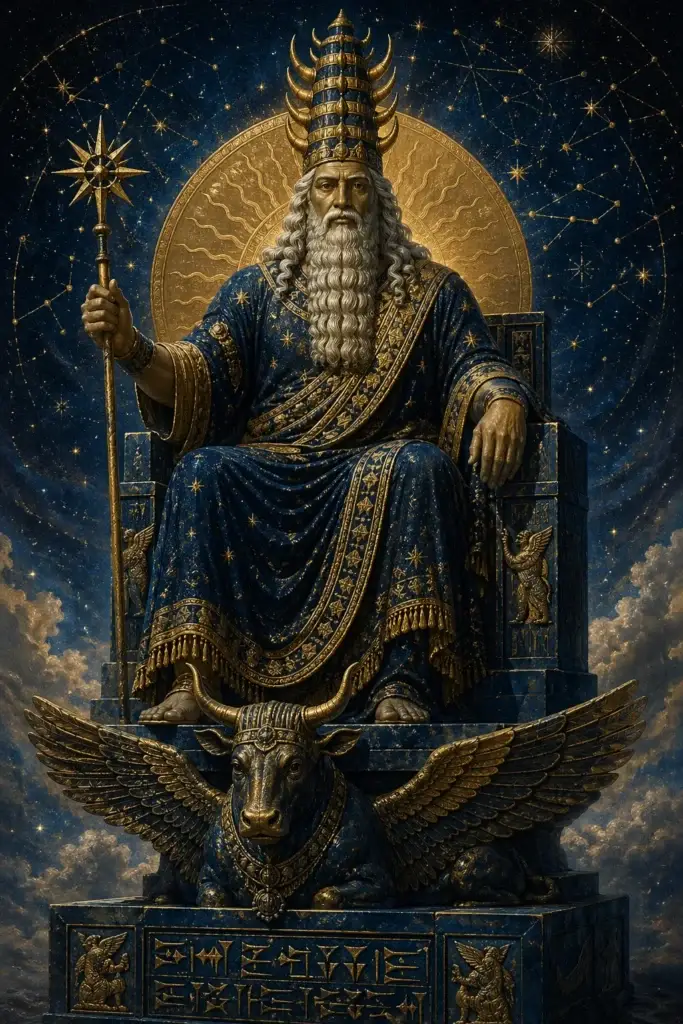
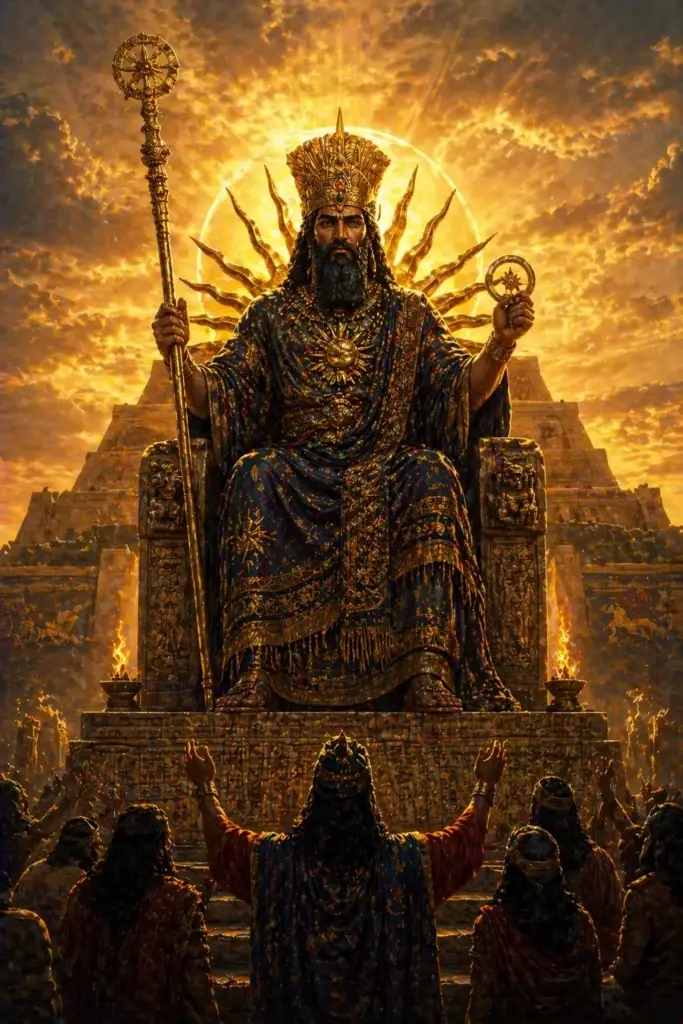
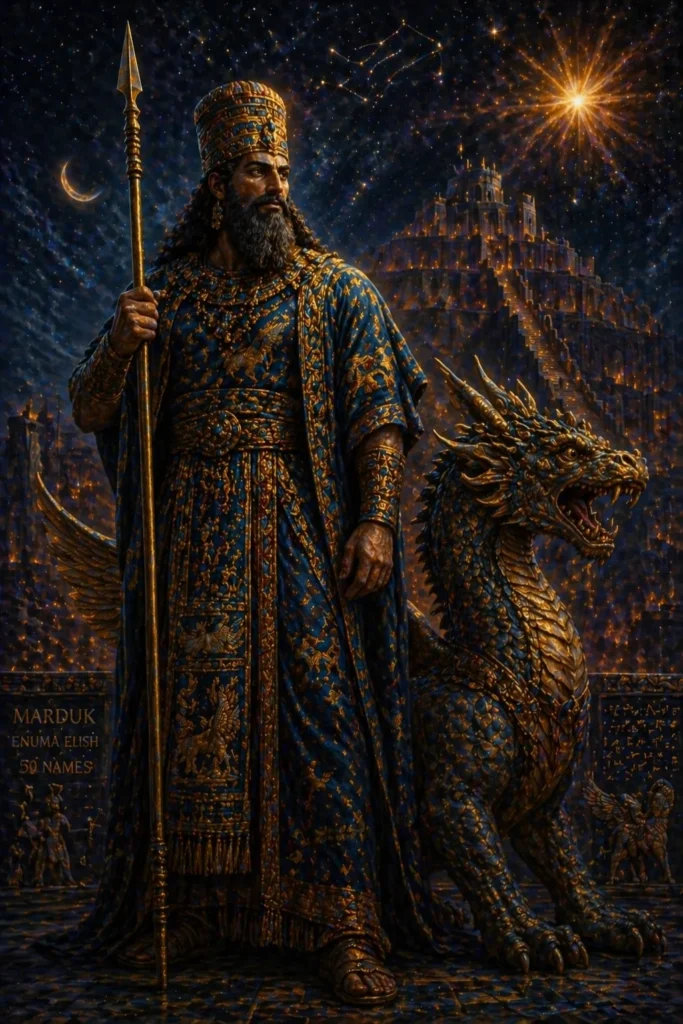
Marduk is typically depicted as a mature, bearded man, enthroned or striding, in royal garb. He wears the horned crown (agus) as a mark of his divinity. A halo surrounds his head.
In his hands he holds the spade Marru, the implement of creation and order, or a sceptre. The Mushhushshu dragon (also called Sirrush), a hybrid creature with a serpent’s head, the forelegs of a lion, and the hindlegs of a bird of prey, serves him as mount or guardian spirit.
Nature and activity
Marduk is not a primordial creator but the orderer of chaos. In the Enuma Elish he fights against the primal goddess Tiamat, defeats her, and creates heaven and earth from her body. By this he establishes the cosmos-ordering view of the world.
He is the guardian of justice, judge of the gods and protector of human order. As city god of Babylon he shaped the public ritual, above all the Akitu New Year festival, at which his supremacy was annually renewed.
Appearance and symbolism
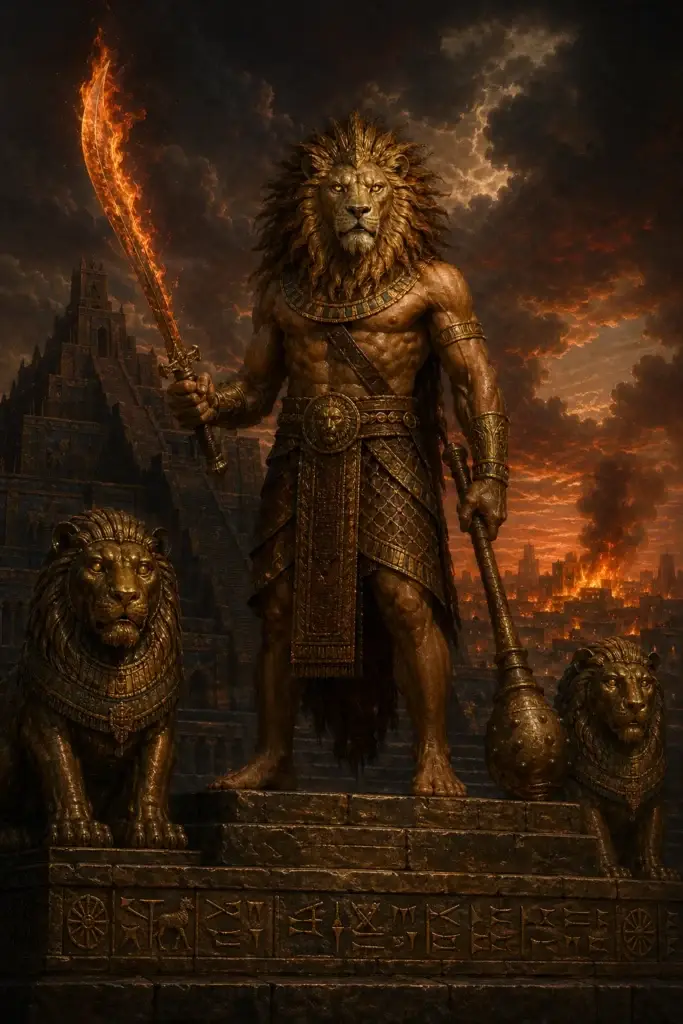
Marduk is depicted as a powerful, bearded man with a tall crown and robes that display his royal authority. He bears a golden sceptre and is often surrounded by golden or silver auras. At his side he carries the flaming sword or other weapons of war.
In his creative form he is often portrayed with a kind of creative light or energy. His sacred animal is the dragon Mushhushshu (or the five-headed dragon Ushum), a symbol of his dominance over chaotic force.
Profile: Marduk
The most important aspects of Marduk at a glance. The following fields summarise origin, function, appearance, veneration, symbols and parallels.
Marduk is the son of Ea (Enki, the water god) and Damkina. In the Enuma Elish he is the hero of the younger generation of gods, who fights against the primal goddess Tiamat (the chaos dragon) and defeats her; from her body he creates heaven and earth.
He is the father of Nabu (the scribe god) and consort of Sarpanitu. In his rise to imperial deity he receives the 50 names, which ascribe to him the functions of all other gods (theogonic consolidation).
Imperial god of Babylon; every king received his power from Marduk’s hand. Creator of the world (in the Enuma Elish), guarantor of cosmic order. Patron of the economy and prosperity of Babylon.
Storm and weather god (in his older local role). In personal cult also invocation for protection against illness, crime and demonic affliction; his star (Jupiter) was regarded as auspicious.
Anthropomorphic, as a bearded male figure with a tall horned diadem and a long, multi-layered robe. Characteristic attributes: spade (marru, his insignia, originally a farmer’s tool, then a symbol of the creator), bow, arrows, sword.
Companion animal: the Mushhushshu dragon (a snake, lion, bird composite creature), the most famous Marduk symbol on the Ishtar Gate of Babylon. On Neo-Babylonian reliefs he frequently stands with the spade in his hand.
Marduk's veneration
Sphere of effect: Marduk was invoked as chief god of Babylon in all areas, from the royal mandate through the annual Akitu procession to personal protection. Esagila was a destination of pilgrimage from across the empire.
The king received his confirmation in the annual Akitu ritual: he was humiliated by the high priest, then reinstated in his office through Marduk’s hand. The most important personal rites: petitionary prayers in illness, prayers of protection in personal crisis.
Marduk's symbols
Spade (marru), tall horned diadem, bow, arrows, sword, Mushhushshu dragon (companion animal), Esagila temple, Etemenanki ziggurat, winged sun disk (in some traditions). Sacred plant: tamarisk. Sacred star: Jupiter. Sacred number: 50 (the Marduk names).
Bel (Assyrian form of address, meaning simply “lord”), Ashur (Assyria, the Assyrian counterpart as imperial god), Anu (Mesopotamia, older father of the pantheon), Iuppiter Optimus Maximus (Rome, identified astronomically through Jupiter), Zeus (Greece, imperial and thunder god parallel), Indra (Hinduism, king of the gods with thunder and lightning), Thor (Germanic, partial), Hadad / Adad (Mesopotamia, weather god aspect).
Veneration in everyday life
Marduk was primarily a god of the state cult, not a deity of personal salvation or mystery rites. In the public sphere his veneration was decisive: royal accessions invoked Marduk’s blessing, contracts were concluded under Marduk’s eye, and oath formulas named him as overseer.
In the private household Marduk played a less central role. Personal piety was directed more towards protective spirits, the goddess Ishtar or the healing goddess Gula. Yet many Babylonians bore names containing “Marduk” (for example Merodach-Baladan: “Marduk has given a son”), an expression of the theological integration of Marduk into everyday thinking.
At the Akitu festival, the New Year festival, town and country celebrated the renewal of Marduk’s rule over the world; participation in the procession was an obligation for every Babylonian.
Marduk, parallels in other cultures
Greek tradition: Zeus as high deity and ruler over heaven and order. Both are not primordial creators but orderers of chaos after a battle against the older generation of gods. The thunderbolt function is more pronounced with Zeus, but the aspect of cosmic legal order is common to both.
Vedic and Hindu tradition: Indra as thunder god and leader of the Devas. The motif of the dragon fight (Indra against Vritra) is a fundamental parallel element of myth. Indra likewise bears a thunderbolt (Vajra) and is the guardian of cosmic order (Rta).
Egyptian tradition: Ra as sun god and seat of Maat (world order). While Marduk subdues chaos through a perpetrator combat narrative, in the case of Ra this happens in the cyclical nocturnal journey (battle against the serpent Apophis). The theological model, creator deity as orderer, is similar.
Hittite tradition: Teshub as weather god and high deity, known from the Kumarbi myth, shares the dragon fight motif with Marduk. Teshub’s battle against the serpent Illuyanka is a parallel to the Tiamat myth.
The Enuma Elish: the Babylonian creation epic
The most important source for Marduk’s rank is the Babylonian creation epic, named after its opening words Enuma Elish (“When on high”). It is transmitted on seven clay tablets, most of which come from the library of the Assyrian king Ashurbanipal at Nineveh, though they preserve older material.
The exact time of composition is disputed; much speaks for a composition in the second millennium BCE, possibly in the Old Babylonian or Middle Babylonian period.
The epic describes how, from the primal waters embodied by Tiamat and Apsu, the gods arise. When Tiamat declares war on the younger gods and raises an army of monsters, none of the older gods dares to confront her. Marduk declares himself willing, but demands as his price the highest royal rank among the gods.
The assembly of the gods grants him this position. Marduk defeats Tiamat in single combat, splits her body and forms heaven and earth from the two halves.
From the blood of the leader of the opposing gods, Kingu, humankind is created so that it may serve the gods. In conclusion, the gods build for Marduk the city of Babylon with the temple of Esagila.
The Enuma Elish is therefore less a neutral account of creation than a theological justification for the primacy of Babylon and Marduk. It explains why the world is ordered as it is, and why Babylon of all places should be its centre.
Tablet seven consists almost entirely of a litany of the fifty names of Marduk, in which the functions of other gods are attributed to him.
Esagila and Etemenanki: Marduk's temple and the Tower of Babel
Marduk’s cult was spatially bound to Babylon. His principal temple was called Esagila, “house whose top is high”. Next to it stood the stepped tower Etemenanki, “house of the foundation of heaven and earth”, a ziggurat conceived as a connection between the spheres.
Etemenanki is regarded by scholarship as the probable real model for the biblical narrative of the Tower of Babel.
The archaeological remains are heavily destroyed by ancient dismantling and modern interventions, yet ancient descriptions, for example in Herodotus, and cuneiform texts allow an approximate reconstruction. The Babylonian king Nebuchadnezzar II had the complex generously extended in the 6th century BCE.
In the Esagila stood the cult image of Marduk. This image was so closely bound up with the identity of the city that its abduction by enemies, for example by the Hittites and later the Assyrians, was regarded as a national catastrophe; its return was a triumph.
The statue was not a mere likeness but was regarded as the real presence of the god, which was cared for, clothed and fed.
Babylon also possessed the Processional Way, which led through the famous Ishtar Gate, faced with glazed bricks and animal figures. Along this street, at the New Year festival, moved the procession of the divine images. The monumental architecture of Babylon was thus stage and setting of the Marduk cult, not a mere backdrop.
The Akitu New Year festival: ritual, kingship and cosmic renewal
The most important festival cycle of the Marduk cult was the Akitu festival, the Babylonian New Year festival, which was celebrated in spring over about eleven days. Ritual texts from the late period survive, describing individual daily sequences, though with gaps.
Among the transmitted components is the recitation of the Enuma Elish before the cult image of Marduk. With this, the god’s victory over chaos was rendered liturgically present: the festival repeated and secured the order of the world. Also known is a scene in which the king must step before the cult image.
The high priest takes from him the royal insignia, strikes him in the face and makes him affirm that he has committed no injustice. Only thereafter does he receive the insignia back. This ritual bound earthly kingship to Marduk and placed it under divine control.
A further component was the great procession, in which the divine images were brought from the temples of various cities to Babylon and to a festival house outside the city. By this, the festival simultaneously demonstrated the primacy of Marduk and Babylon over the other cult sites of Mesopotamia.
Older scholarship, influenced by the so-called Myth and Ritual school, was fond of seeing in the Akitu festival a drama of the dying and resurrected god.
This interpretation is today regarded as overdrawn and poorly supported. The sober reading emphasises that the festival jointly confirmed the order of the cosmos, the position of Babylon and the legitimacy of the king.
From city god to imperial god: Marduk's historical rise
Marduk was originally no significant deity. In the oldest sources he appears as a local city god of Babylon, a town of no importance in the Early Dynastic period. His rise is closely linked with the political rise of Babylon.
The decisive impetus was given by the reign of Hammurabi in the 18th century BCE, when Babylon became the dominant power in Mesopotamia. Even thereafter the process remained in motion.
Theologically, Marduk was step by step endowed with functions that had previously belonged to other gods, above all to the old Sumerian king of the gods Enlil and the god of wisdom Ea, who appears in the epic as Marduk’s father.
The list of names in tablet seven of the Enuma Elish is the theological instrument of this transfer: by Marduk receiving the names and thereby the essential traits of other gods, he becomes the sum of the pantheon. Some scholars speak of a tendency toward monolatry, without Babylon ever attaining monotheism.
Marduk’s epithet was often simply Bel, “Lord”, a title that also appears in the Hebrew Bible as Bel, for example in the prophets Jeremiah and Isaiah, who mock the Babylonian god.
His son was the scribe god Nabu of Borsippa, whose own ascent accompanied that of Marduk. The historical record thus illustrates exemplarily how closely theology and the politics of power were interwoven in Mesopotamia.
Further links
Literature (selection)
Further standard works in the literature index.
Frequently asked questions about Marduk
Who was the god Marduk?
Marduk was the chief god of the Babylonian pantheon and is regarded as the creator of the world according to Babylonian conception. The Enuma Elish, the Babylonian creation myth, recounts how Marduk defeats the primal sea dragoness Tiamat and forms heaven and earth from her body. In the post-Akkadian period, Marduk took over the function of the Sumerian Enlil.
What is the Marduk festival?
The most important festival of Marduk was the Akitu, the Babylonian New Year festival in spring. The creation myth Enuma Elish was publicly recited, the image of Marduk was led from the Esagila temple in a procession through Babylon, and the king was confirmed anew in his office. The Akitu structured the Babylonian year.