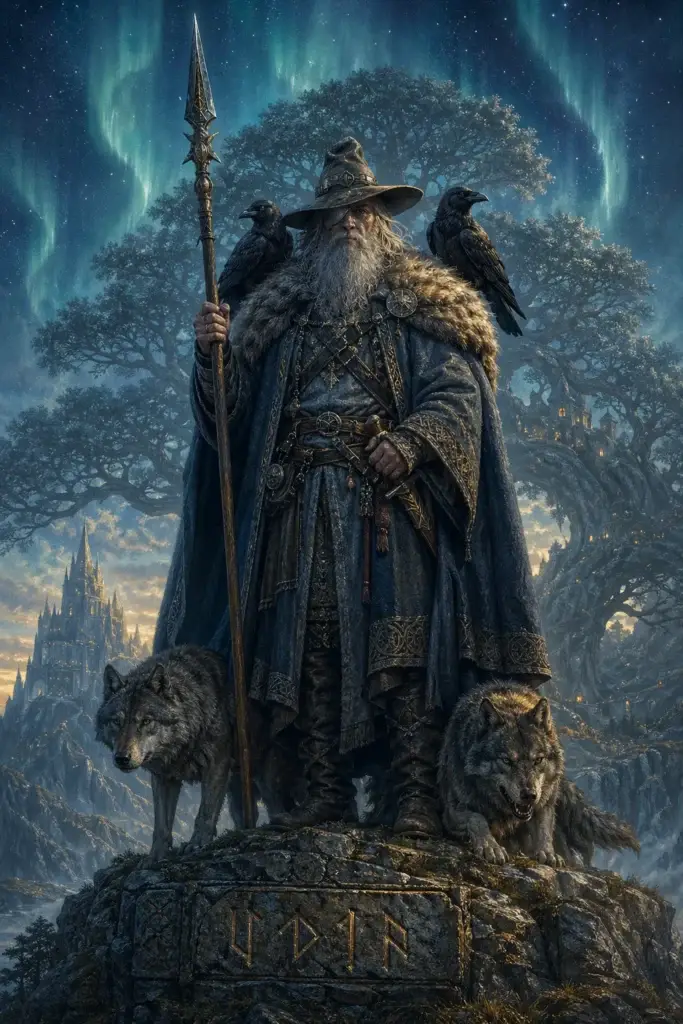
Loki, god of the Germanic tradition
By Ralf Ittermann · last reviewed on
Loki is the god of deception and chaos in the Germanic tradition. As the son of a giant and companion of the Æsir, he embodies the ambivalent, useful and dangerous at the same time.
In religious-historical terms, Loki is an example of the presence of liminal gods between order and chaos in Indo-European pantheons, comparable to the Aztec Tezcatlipoca or the Hindu Shiva.
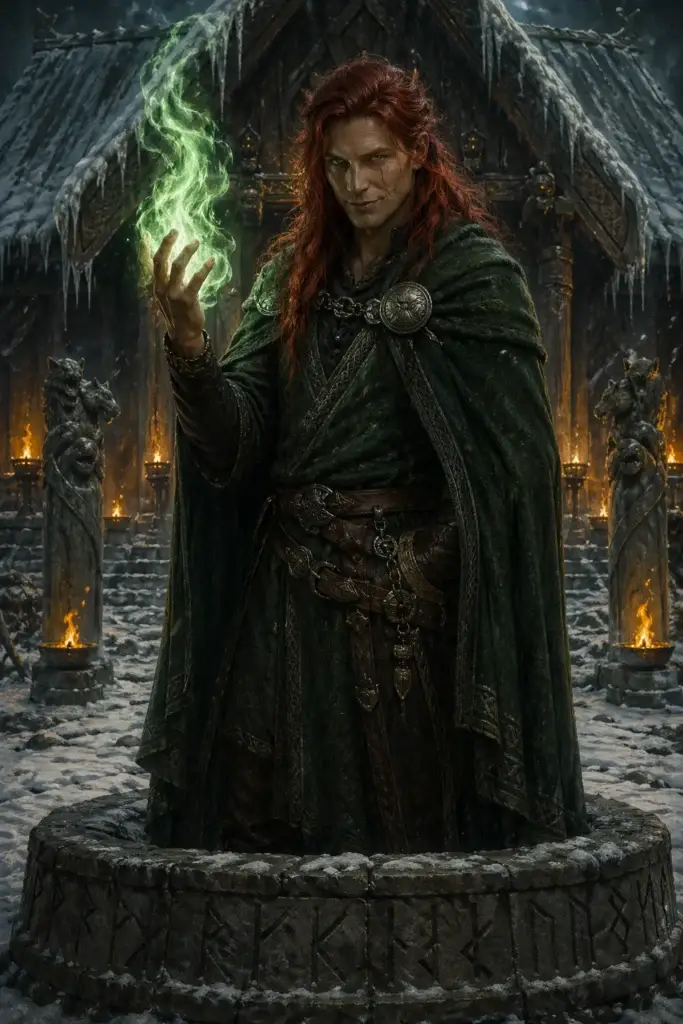
Loki
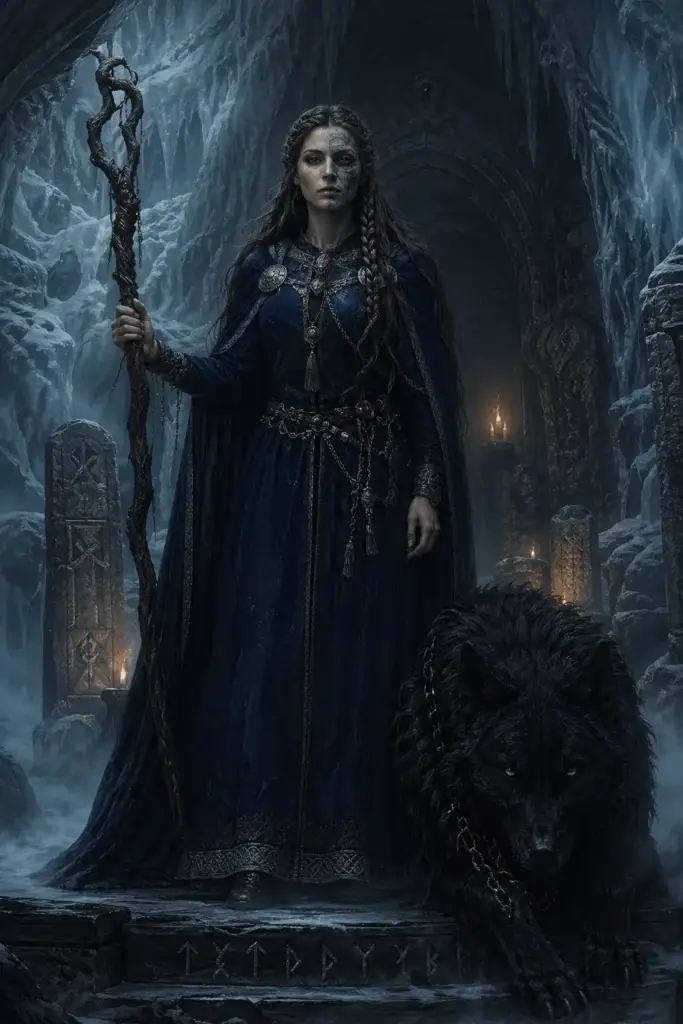
Loki is the trickster whose nature is profoundly ambivalent. He is both ally and adversary of the Æsir. His central aspects are cunning, mutability, destruction and renewal.
In myth he joins with the gods in useful deceptions (the acquisition of Sif’s golden hair, Thor’s hammer Mjölnir), yet ultimately leads to Ragnarök (the twilight of the gods). His children are Fenrir (the giant wolf), Jörmungandr (the Midgard serpent) and Hel (goddess of the underworld).
Sources: Snorri Sturluson‘s Prose Edda, the Poetic Edda (especially Lokasenna, Þrymskviða); archaeological finds are rare (no direct veneration of Loki as with Thor or Odin). Secondary literature: Rudolf Simek (Lexikon der germanischen Mythologie), Jan de Vries, Folke Ström, Georges Dumézil, Martin Noël Olsen. Loki has no known temples; his function is cosmic-narrative, not cultically venerated like other gods.
Classification
Loki’s story can be traced from the Viking Age picture stones through the Eddic poems of the Middle Ages to Snorri’s Prose Edda around 1220, and its basic features remain the same throughout: the cunning one who stands between gods and giants. The figure is present today as well, in research on Norse mythology as much as in popular adaptations, which reshape much but leave the bound trickster who holds out until Ragnarök clearly recognizable.
Knowledge of Loki was carried first by the poets of medieval Iceland: the Poetic Edda and Snorri Sturluson’s Prose Edda preserve the tales of the cunning companion of the gods in fixed literary form, recorded by learned authors for an audience versed in skaldic tradition. No evidence of an actual Loki cult with temples or offerings has been found; he lived in narrative, not in worship. In later centuries, his figure passed into Scandinavian folk tales and sayings, where he appears as a troublemaker and explanation for small mishaps, keeping his name familiar in rural storytelling long after the old religion had ended.
This clearly points to a central role in the self-understanding of the whole people. Trade, migration and cultural exchange contributed to the geographic spread and to the stable uniformity of veneration.
Primary sources: Snorri Sturluson’s Prose Edda (Gylfaginning: Loki’s genealogy and role; Skáldskaparmál: Loki narratives), the Poetic Edda (Lokasenna: Loki insults all the gods; Þrymskviða: Loki helps to retrieve the stolen hammer; Hyndluljóð: Loki’s descent), Völuspá: Ragnarök with Loki’s release. Period: oral traditions reaching back to the first century BCE, written down around 1200 CE. Researchers: Rudolf Simek, Jan de Vries (detailed interpretation), Georges Dumézil, Folke Ström, Wolfgang Meid. Of note: Loki has no archaeologically secured cult sites; his function is mythical, not cultic.
Name and variants
In the various sources and artistic traditions Loki is depicted with certain recurring iconographic elements that remain relatively constant across decades and across different geographic spaces.
These elements are not merely decorative or randomly chosen but are deeply coded symbolically and carry considerable meaning. They convey functions, sources of power, areas of responsibility and the cosmic role of the being.
The overall system functions like a sacred script or a coded image; it allows initiates or the culturally educated to grasp the essential deeper meaning and to understand it correctly. Colours, sacred objects or weapons, bodily attributes, specific accessories, all are significant and traditionally transmitted.
Description
Loki was not central to the religious practice of the Germanic peoples; a cult is not attested. There is no evidence of invocations, prayers or offerings to Loki.
The treatment of Loki in the Edda texts shows a fixed narrative order: the Lokasenna follows the regulated course of a contest of insults in Aegir’s hall, and his punishment after Baldr’s death, the binding with the entrails of his own son and the serpent placed above his head, is likewise presented in Snorri’s Prose Edda as the gods’ ordered legal consequence, not as an arbitrary act of violence.
The functions were manifold: some were preventive (warding off potential misfortune), some healing (alleviation of illness or suffering), some transformative (accompaniment through transitions between life stages).
Profile: Loki
The profile unfolds Loki’s nature through six perspectives: his mythological origin and role in the pantheon, his functions in narratives and myths (not cultic veneration as with other gods), his characteristic iconography as a trickster, the ambivalence of his powers and effects, comparable figures in other cultures and a concluding interpretation of his cosmic significance in the transition to the twilight of the gods.
Loki is a genuinely Germanic creation without a direct Indo-European precursor. His origin lies in Scandinavian mythology and is transmitted orally up to the recording in the thirteenth century.
Snorri presents him as a descendant of giants (son of the giant Fárbauti) but he is received into Asgard as the sworn brother of Odin and Thor. His cult was marginal or non-existent, in contrast to Thor and Odin. His narrative presence grows in the literature, especially in depictions of Ragnarök.
Loki was not venerated cultically as Thor or Odin were; no priests, no offerings, no temples. His function was mythical-narrative and was central in the tradition of the skalds (poets).
Because his name was associated with destruction, he was partly feared and avoided. In later Icelandic sagas and in Ragnarök prophecies his role was dramatised. He may possibly have been called upon in private omen incantations, but there is no evidence for this.
Loki has no iconographic standardisation like other gods. He is described as beautiful and malevolent at the same time, with the power of shape-shifting (hamramr). In the myths he assumes various forms: as a salmon, as an old woman, as a flame.
His attributes are fire and cunning, not weapon or sceptre as with other gods. In the Christian period he was associated with the Devil, a projection of monotheistic categories onto a polytheistic figure.
Loki was credited with the powers of cunning and deception, of transformation and of fire. He could change shape, become invisible and place the gods in embarrassing situations.
His words were weapons; the Lokasenna shows him as a powerful slanderer who damages all the gods with insults. At the same time he possessed constructive powers: he helped to procure the finest treasures (Sif’s hair, Thor’s hammer, Odin’s spear). His fire was both destructive and constructive.
Loki was not the object of invocation like other gods. People feared his power and tried to avoid or appease him. No offerings are attested. In the Lokasenna he is even cast out of Asgard and bound until Ragnarök.
The Germanic peoples regarded Loki as the embodiment of the chaotic and of destruction, less as a god to be venerated, more as a cosmic force to be understood and feared. His name was used in curses, but not in ordinary prayers.
Tezcatlipoca (Aztec) is a structural parallel, trickster, destroyer, ambivalent. Shiva in Hinduism shares the duality of destruction and creation. The Celtic Math fab Mathonwy displays trickster aspects but without Loki’s cosmic destructive role.
The Slavic Veles is a malign figure, but less differentiated than Loki. In contrast to these, Loki is explicitly not venerated in cult.
Loki, parallels in other cultures
Loki-like tricksters are found in many mythologies: the Greek Hermes as messenger of the gods and thief, the West African Anansi as spider-shaped creator-trickster, the Coyote of the North American Plains tribes, the Polynesian Maui.
Unlike these, Loki is deeply embedded in the cosmological structure of the Edda; he is not only a trickster but the father of the beings of doom, Hel, Fenrir and Jörmungandr.
Jewish tradition: In Jewish theology there is no god of deception or chaos like Loki. Satan (a later development) is a counter-power but not a god within a pantheon. Loki’s ambivalence and his mythical weight have no equivalent in monotheistic systems.
Greco-Roman world: Prometheus shares with Loki the qualities of cunning and of danger to the order of the gods, but he is a Titan, not an Æsir god. Hermes is trickster-like but less destructive. Ares embodies uncontrolled violence but not Loki’s cunning. There is no direct parallel in Greece or Rome.
Mesopotamia: No direct parallel. Marduk and Tiamat are adversaries, but not within a single pantheon as Loki and the Æsir are. Pazuzu is a demonic force but not cultically prominent in the manner of the Edda figures.
India and Asia: Shiva embodies destruction and transformation but does not share Loki’s role as outcast trickster. In Buddhism there is no equivalent figure. In early Indian texts, rakshasa (demons) are chaotic forces, but not within a divine hierarchy.
Loki's role in the death of Baldr
The death of Baldr belongs to the most densely transmitted episodes of Old Norse mythology and places Loki at the centre of a cosmic turning point.
Snorri Sturluson recounts in the Gylfaginning that Baldr was plagued by disturbing dreams. His mother Frigg therefore took an oath from all things not to harm Baldr, but overlooked the mistletoe, which she considered too young and insignificant.
Loki learned of this gap. He obtained the mistletoe, fashioned it into a projectile and handed it to the blind god Höðr, who stood apart from the assembly while the other gods amused themselves by hurling weapons at the invulnerable Baldr.
Guided by Loki, Höðr’s throw struck home, and Baldr fell dead to the ground. The sources emphasise that this was the greatest misfortune ever to strike gods and humans.
The second part of the episode intensifies Loki’s guilt. When Hermóðr rode into the underworld to request Baldr’s release, Hel set the condition that all things must weep for Baldr. Almost everything wept, but a giantess named Þökk refused. Snorri intimates that this was Loki in disguise. With this Loki prevented Baldr’s return for good.
Scholarship debates whether the older Eddic poetry assigned Loki the same central role as Snorri does. The Völuspá names Höðr as the slayer but is silent about Loki’s instigation. Some researchers, such as Anatoly Liberman, see Snorri’s elaboration as a literary condensation of various traditions.
What is certain is that the episode forms the bridge to the binding of Loki and ultimately to the events of Ragnarök. Those interested in related conceptions of fate will find points of connection at Hel and the Norse conception of the underworld.
The binding of Loki and his fate at Ragnarök
After the death of Baldr and the mocking of the gods in the Lokasenna, the Æsir seize Loki and subject him to a drastic punishment.
The sources relate that the gods brought forward three of his kin: Loki’s son Váli was transformed into a wolf and tore his brother Narfi apart. With Narfi’s entrails the gods bound Loki to three stone slabs.
The giantess Skaði fastened a serpent dripping venom above Loki’s face. Since then Loki’s wife Sigyn stands beside him and catches the venom in a bowl.
When she empties the full bowl, the venom strikes Loki, and his writhing, according to this mythological explanation, causes the earth to quake. This aetiological function, which explains earthquakes, is also known from bound monstrous figures in other mythologies.
In the eschatological tradition Loki remains bound until Ragnarök. Then he tears himself free.
The Völuspá and Snorri’s Gylfaginning describe how Loki steers the ship of the dead Naglfar, built from the nails of the deceased, and leads the enemies of the gods forward. On the battlefield Loki and Heimdall meet and slay one another.
It is notable that Loki’s children with the giantess Angrboða, the wolf Fenrir, the Midgard serpent and Hel, are central opponents of the gods in the final battle.
Scholarship has repeatedly discussed whether Loki was originally an ambivalent figure between Æsir and giants whose position shifted to the negative in the course of tradition. Georges Dumézil and later Jan de Vries have offered differing readings, without a consensus being reached.
Loki in the history of scholarship
Scarcely any figure of Norse mythology has provoked so many contradictory interpretations as Loki. Already in the nineteenth century, comparative mythology attempted to grasp him as a personification of nature.
Jacob Grimm and others saw him as a fire god, basing themselves on a supposed proximity of the name to the word logi (flame). This etymology is today regarded as linguistically untenable, since Loki and logi do not belong together.
In the twentieth century the focus shifted. Folke Ström in 1956 read Loki as a hypostasis of Odin, that is, as a separated aspect of the chief god.
Anna Birgitta Rooth examined the Loki tradition in a broadly conceived study in 1961 and emphasised the trickster character by drawing parallels to rogue figures of folklore. Georges Dumézil placed Loki within his tripartite functional scheme and compared him with the figure Syrdon from the Ossetian Nart sagas.
More recent scholarship, such as that of John Lindow and Jens Peter Schjødt, is more reserved with regard to large theories. It emphasises that the sources are scattered in time and region and that Snorri already wrote in the thirteenth century from a Christian distance.
Whether a Loki cult existed is contested. Place names that can be securely related to Loki are largely lacking, unlike those for Thor, Odin or Freyr.
An open problem remains the so-called Snaptun stone from Denmark, a tenth-century stone bearing a face whose lips appear to be sewn shut.
Many researchers interpret it as a depiction of Loki, because another narrative reports that dwarves sewed his mouth shut. The identification is, however, not certain. The discussion shows how slender the iconographic basis for Loki is.
Etymology and interpretation of the name
The name Loki has an unusually contested history. Older scholarship linked it with Old Norse logi meaning flame, yet by the laws of sound change this equation cannot be maintained. The long vowel in logi and the word formation do not fit Loki.
A widespread more recent interpretation starts from a root associated with knot, loop or closing. Anatoly Liberman has argued in several works for connecting the name with terms for knotting, which would fit the conception of Loki as a maker of nets.
In fact one episode reports that Loki invented the first fishing net and was himself caught by it. Other scholars remain sceptical and emphasise that none of the proposed etymologies is compelling.
Striking are the by-names under which Loki appears in the sources. He is called Loptr, which is related to air, and occasionally Hveðrungr. The designation Loptr has led some researchers to assume that Loki was associated with the element of air, comparable to the later popular image.
In more recent Scandinavian folklore a figure named Lokke or Lokje appears, who is associated with heat shimmer over fields and with spider threads. Whether these late attestations actually go back to the mythological Loki or represent a secondary connection is debated in scholarship.
The uncertainty about the name reflects the fundamental difficulty of classifying Loki. Unlike Odin or Thor, whose names and functions can be grasped clearly, with Loki even the linguistic basis remains open.
Loki in modern reception
The rediscovery of Norse mythology in the nineteenth century made Loki a fixed presence in European cultural history. Richard Wagner reworked him in his tetralogy Der Ring des Nibelungen as Loge, a half-divine fire spirit and cunning adviser to Wotan.
In doing so Wagner deliberately merged the mythological Loki with the flame figure, although philological scholarship already questioned this identification at the time.
In the visual arts of the nineteenth century Loki appears, for instance, in the work of Scandinavian painters and illustrators, often in the scene of his binding with Sigyn at his side. This depiction, which emphasises Sigyn’s faithfulness and Loki’s suffering, shaped the Romantic image of the figure.
In the twentieth and twenty-first centuries Loki was disseminated above all through popular culture. From 1962 the comic series of the Marvel publishing house introduced a Loki figure conceived as Thor’s adversary, who later developed into an ambivalent character.
The subsequent film adaptations and a series of his own considerably amplified this effect. This modern Loki figure, however, is only loosely connected with the mythological Loki. Family relationships, character and storylines were freely reshaped.
Loki is also present in fantasy literature, in video games and in heavy metal music. From a religious-studies perspective it is interesting that modern heathen currents, such as the Ásatrú milieu, have a divided relationship with Loki.
Some groups venerate him; others reject him as a destructive force. This internal debate shows that the ambivalent position of Loki, which already shaped the medieval sources, continues to take effect today.
Loki's shape-shifting and his offspring
A central characteristic of Loki in the sources is his capacity for transformation. He changes shape and even sex and, in various episodes, fathers or gives birth to extraordinary beings. The most famous of these stories concerns the horse Sleipnir.
When a giant built a wall for the gods, with his stallion Svaðilfari assisting him, Loki transformed himself into a mare, lured the stallion away and thus prevented the giant from keeping the agreed deadline. From this union Loki gave birth to the eight-legged horse Sleipnir, which later became Odin’s mount.
With the giantess Angrboða, Loki, according to Snorri’s account, fathered three beings decisive for the eschatology: the wolf Fenrir, the Midgard serpent Jörmungandr and Hel, mistress of the underworld.
This offspring makes Loki the progenitor of the most dangerous opponents of the gods. With his wife Sigyn he had moreover the sons Narfi and Váli, who play a cruel role in his binding.
Shape-shifting is not merely a narrative motif. It marks Loki’s special position between the fixed categories of Norse cosmology. Loki is by birth half giant but lives among the Æsir. He is male yet can give birth. He is a helper of the gods and at the same time their undoing.
Scholarship, for instance Jens Peter Schjødt, has worked out this transgression of boundaries as the actual essential feature of Loki. Unlike a classical trickster, who is above all cunning, Loki structurally embodies the principle of the dissolution of order. Precisely in this lies his function within the Norse worldview.
Further reading and links
- Germanic (cultural hub), overview of Germanic mythology
- Odin, the All-Father, with whom Loki is sworn brother according to the Lokasenna
- Thor, frequent companion of Loki in journey myths such as the Þrymskviða
- Freyja, robbed by Loki of the Brísingamen necklace in the Þrymskviða
- High deities, class overview
Sources and literature
Loki appears in Old Norse tradition as an ambivalent deity who, in the Eddic poems and the Prose Edda, figures as both companion and adversary of the Æsir.
He stems from a jötunn lineage but is received into the circle of the gods and is father of the wolf Fenrir, of Hel and of the Midgard serpent. In religious-historical terms his original function remains contested.
Frequent questions about Loki
Who is Loki in Norse mythology?
Loki is the most ambivalent figure of Norse-Germanic mythology, a shape-shifter and trickster, son of the giantess Laufey and not clearly affiliated with any single divine lineage.
He is regarded as the blood brother of Odin, yet is at the same time father of the three cosmic catastrophe-beings: the wolf Fenrir, the Midgard serpent Jörmungandr and the death goddess Hel.
Loki repeatedly brings the gods into difficulties and rescues them just as often. At Ragnarök, the end of the world, he stands on the side of the giants against the Æsir.
What is Loki’s role in the death of Baldr?
Loki’s darkest deed is the causing of Baldr’s death. Baldr, the radiant son of Odin, had been made invulnerable by his mother Frigg through an oath taken from all beings and plants, with the exception of the mistletoe, which was overlooked as too young.
Loki discovers the secret and persuades the blind Höðr to shoot at Baldr with a mistletoe arrow. Baldr dies and is taken down to Hel in the underworld. This deed leads to Loki’s punishment (his binding to a rock) and is a portent of Ragnarök.