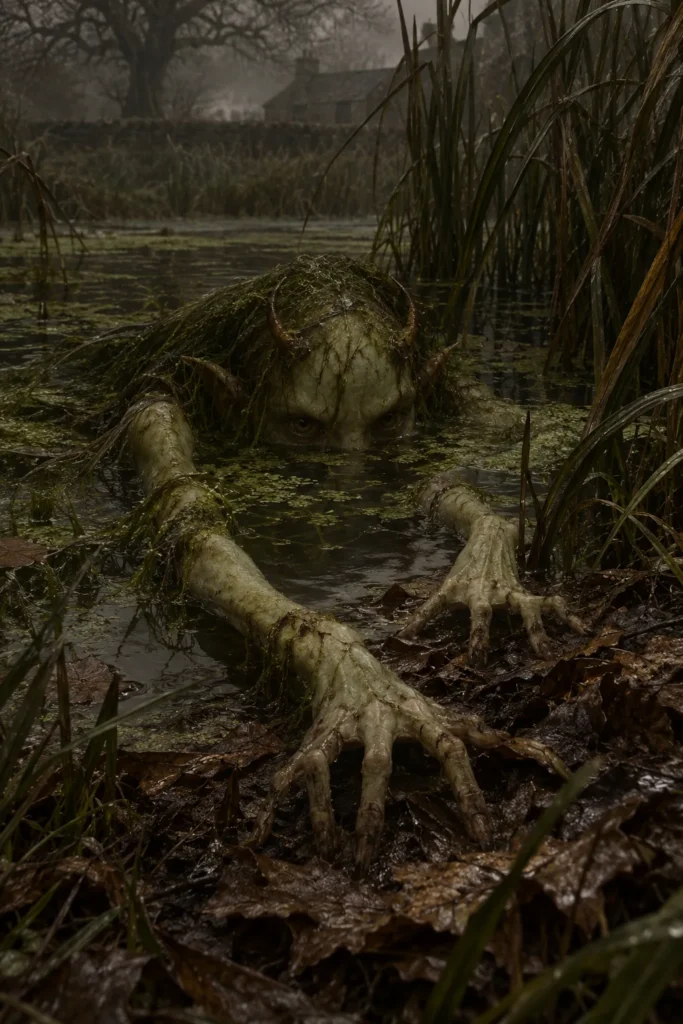
Jenny Greenteeth, the water witch beneath the duckweed
By Ralf Ittermann · last reviewed on
Jenny Greenteeth is a demoness of English tradition.
Green teeth beneath the duckweed, silently dragging children down.
Jenny Greenteeth is the water witch of north-west England: lying beneath the green duckweed cover of still ponds, she was said, in warnings given to children, to seize anyone who came too close to the edge and drag them silently under. The figure is a classic example of a warning character that turns a real danger into a person.
She is documented from the 19th century onwards in Lancashire, Cheshire, Merseyside and Shropshire, mostly as a threat against curious children at village ponds and disused, flooded marl pits. In this way, the danger of the water itself gained a name and a face: green teeth in place of a mere warning about deep, overgrown water.
Type: water witch, nursery bogey of ponds and marl pits
Origin: north-west England (Lancashire, Cheshire, Merseyside, Shropshire)
Texts: brief folkloric notes, plus Roy Vickery’s systematic surveys
Period: recorded since the 19th century, surveys continuing into the late 20th century
Appearance: usually imagined as invisible beneath the duckweed cover, depicted as a green-skinned old woman with long arms and sharp teeth

Area of origin and sources
Period of the Texts
Recorded since the 19th century, with surveys confirming it still in the late 20th century: the warning was passed down to children over generations.
Area of Diffusion
North-west England: Lancashire, Cheshire, Merseyside and Shropshire, with a particular focus around the region’s flooded marl pits.
Sources
Sparse but reliable: folkloric notes and, above all, Roy Vickery’s systematic surveys from the Liverpool area, which clarified the connection with duckweed.
Name and variants
English: The name varies between Jenny, Jinny and Ginny Greenteeth, alongside Wicked Jenny. In parts of north-west England, Jenny Greenteeth was also the name for duckweed (Lemna minor) itself, as Roy Vickery established in 1983 through surveys in the Liverpool area: the name referred to both the plant and the water witch alike.
Form and effect
Appearance
Jenny Greenteeth has scarcely any fixed form, for her power lies precisely in not being seen. Where storytellers do depict her, she is a gaunt old woman with green, slippery skin, hair like strands of water plants, overlong arms and the sharp green teeth that give her her name. Her true image, however, is the water’s surface itself: the smooth, pale-green duckweed cover that closes silently over a child and lies unbroken again moments later.
Effect
Jenny Greenteeth acts at still waters: village ponds, mill ponds and above all the flooded marl pits that, after marl extraction ended, lay scattered by the hundreds across the Lancashire and Cheshire landscape. She lurks beneath the plant cover at the edge, seizes an ankle or wrist with her long arms and drags the victim down without warning. Children are named as her chief victims, occasionally also old people.
Profile: Jenny Greenteeth
The most important aspects of the pond witch at a glance.
English nursery bogey of north-west England, classed by Katharine Briggs among the purpose-built warning beings with no older mythological background.
Children who approach still, overgrown waters; old people are occasionally also named as victims.
A gaunt green-skinned old woman with straggly hair, overlong arms and sharp green teeth, though usually imagined simply as invisible beneath the duckweed.
Still ponds, village ponds, mill ponds and above all flooded marl pits in Lancashire and Cheshire.
Keeping one’s distance is the only recorded protection; children were deliberately kept away from dangerous waters by invoking her name.
Peg Powler on the River Tees and the Grindylow of Yorkshire as her closest English relatives.
From nursery bogey to the name for duckweed
Jenny Greenteeth becomes tangible in 19th-century sources from Lancashire and the neighbouring counties; the name varies between Jenny, Jinny and Ginny Greenteeth, alongside Wicked Jenny. Jacqueline Simpson and Steve Roud note that children in Lancashire, Cheshire and Shropshire were kept away from ponds with her from the 19th century right up to living memory.
The close connection to the plant was clarified by the botanist and folklorist Roy Vickery in 1983 in the journal Folklore: surveys from the Liverpool area showed that in many places Jenny Greenteeth was simply the name for duckweed (Lemna minor), the small water plant whose closed cover makes a pond look like solid ground and closes over anything that falls in. Katharine Briggs classed the figure among the nursery bogies: beings adults never seriously believed in but which were meant to keep children away from dangerous ground.
From the frying pan to Harry Potter
Beyond folklore, the figure was brought to wider attention by the illustrated volume Faeries by Brian Froud and Alan Lee (1978), whose image of Jenny still resonates today. Terry Pratchett had his young witch Tiffany strike a Jenny Green-Teeth with a frying pan right at the start of The Wee Free Men (2003). Via the related Grindylows, the type also found its way into the Harry Potter novels, and in computer games and ghost stories the green-toothed old woman in the pond has become a familiar minor figure.
Jenny Greenteeth is the textbook case of an educational bogey figure: a being not worshipped, scarcely believed in by adults, and yet passed down over generations because it packages a measurable danger, drowning in overgrown pits, into a manageable story. Unlike Kelpie or Näcken, there is no older mythological layer here: folklore studies see her as a young, purpose-built creation that translates landscape experience, marl pits and duckweed, directly into a figure. It is precisely this that gives her value for research: through her, one can observe how demonisation functions as a technique of upbringing and protection, entirely without a religious framework.
The warning as the only protection
The recorded protection is disarmingly simple: keep your distance. There is no cult and no banishing formula against Jenny Greenteeth; the warning itself is the protective means, and its only rule is not to come too close to overgrown still waters and never to leave children unsupervised there. Within the wider context of English tradition, iron and salt are generally regarded as tried defences against the fairy and witch beings of the British Isles; neither is attested specifically for Jenny Greenteeth, since the danger lies in the water, not in the being. A worn amulet for children is more practical, carrying the figure’s warning function into everyday life.
Warning figures at pond and mere
English tradition knows several other child-snatching water beings: closest to Jenny Greenteeth is the equally green-skinned Peg Powler, who haunts the River Tees rather than ponds, and the Grindylow of Yorkshire. Considerably gentler is the Asrai of English tradition, a shy water being without Jenny’s malice.
Frequently asked questions about Jenny Greenteeth
Did people really believe in Jenny Greenteeth?
Adults hardly did: Katharine Briggs counts her among the bogey figures invented specifically for the purpose of warning. For the children threatened with her, however, the fear was very real, as surveys still showed in the 20th century.
Why green teeth of all things?
The green comes from duckweed: the closed carpet of duckweed looks like solid green ground and closes silently over anything that breaks through. In parts of north-west England, the plant itself was called Jenny Greenteeth; the witch’s teeth are the plant cover given bodily form.
Is Jenny Greenteeth found only in England?
The name belongs to north-west England, but the type of a warning figure at dangerous water is widespread, in England for instance as the Grindylow. What such figures share is the task of keeping children away from treacherous water.
Further links
Further reading:
- Peg Powler – the related water witch of the River Tees
- Grindylow – the related bogey figure of Yorkshire
- Asrai – the gentler English water being
- Iron, Salt, Amulet – traditional protective means
- Protection Compass – protective means at a glance
Literature (selection)
Further standard works in the bibliography.
Jenny Greenteeth legend and green water witch: two search terms for one and the same figure, who works less through her green teeth than through the duckweed beneath which she is never truly seen.