Peklenc, the dubious judge of the underworld
By Ralf Ittermann · last reviewed on
Peklenc is regarded as a god of Slavic tradition.
A popular judge of the dead, but scientifically a pseudo-deity. The profile flags Peklenc as a dubious figure, more a product of later folklore than of attested cult. Peklenc remains a disputed underworld figure among the Slavs, with scholarship divided on his origin.
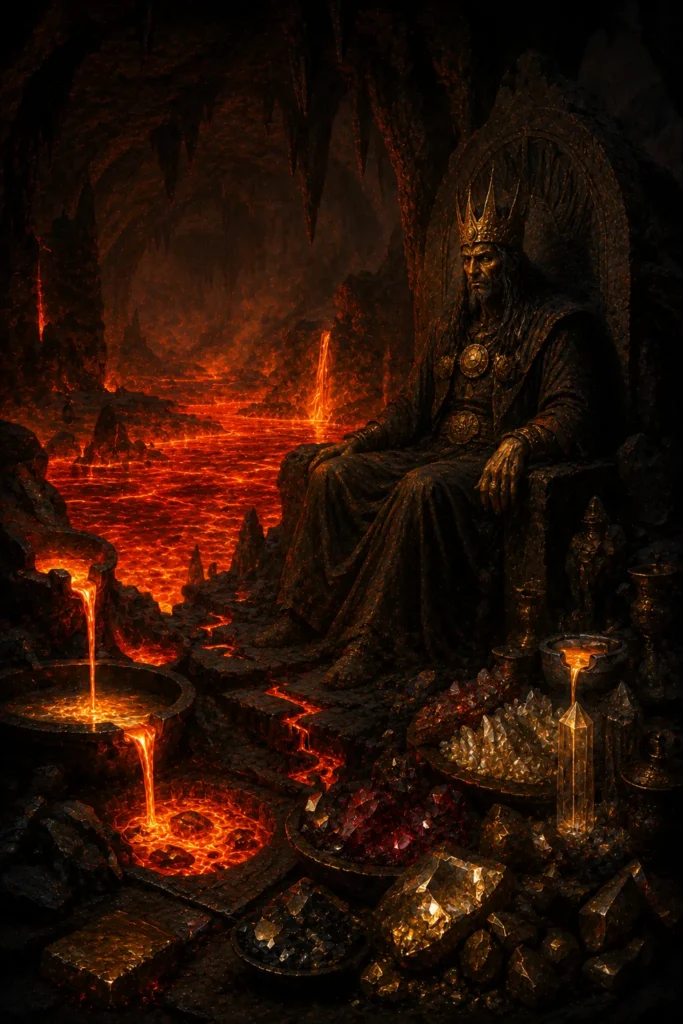
Peklenc is a Slovenian underworld and fire figure who appears in popular tradition as a strict judge of the dead and lord of the underground fire.
Importantly, and to be honest: in scholarly research Peklenc is regarded as a pseudo-deity, that is, probably a romantic construction of the 19th century without any reliable primary source. This page therefore presents both sides, the popular myth and its source-critical assessment.
Type: underworld and fire figure, classed in research as a pseudo-deity
Origin: allegedly Slovenian
Texts: popular secondary literature since the 19th century, no primary source
Period: 19th century to the present
Appearance: lord of the underworld and of the underground fire
Source context
Period of the Texts
The description circulates in popular secondary literature since the 19th century; a medieval primary source is entirely lacking.
Area of Diffusion
Allegedly Slovenian: the figure is attributed to the Slovenian region, although no old tradition can be demonstrated there.
Sources
Very weak: no primary source. The detailed description belongs to the sphere of romantic-Slovenian cabinet mythology, exemplified by Davorin Trstenjak.
Name and variants
Slovenian: The name is transparently Slavic, related to peklo, pitch, hell, and underworld, Slovenian pekel, hell; Peklenc means roughly the one belonging to the underworld. The fact that pekel already means hell in a Christian sense further speaks against a pre-Christian god.
Description
Appearance
A sound tradition is lacking. In popular texts, Peklenc appears as lord of the underworld who forges metals and precious stones in the underground fire and rules the underground waters. His symbolism is the underworld, volcanic fire, and judgment; all of this is unattested.
Effect
He is popularly credited with the role of a righteous, strict judge of the dead, with turning the cruel into stones and the quarrelsome into werewolves, and with opening chasms that swallow villages. This rich elaboration is characteristic of later invention and cannot be found in any primary source.
Profile: Peklenc
The key aspects of the disputed underworld figure at a glance.
Popular myth and Neopaganism: the figure originates from secondary literature since the 19th century, not from old tradition.
In popular texts, the dead, the underworld, and its treasures: judgment of the dead, forged metals and precious stones, underground waters.
Lord of the underworld and of the underground fire; a sound, source-based iconography does not exist.
Popular: strict judge of the dead, lord of earthquakes and the underworld, who opens chasms that swallow villages. None of this is historically attested.
No traditional cult, protective, or offering forms; corresponding claims would be invented.
Chthonic judges such as Hades, Rhadamanthys, and Pluto, or Vulcanus with his underground fire; parallels of exactly this kind served the romantic construction.
A name from hell: origin and the problem of sources
The name is transparently Slavic, related to peklo, pitch, hell, and underworld, Slovenian pekel, hell; Peklenc means roughly the one belonging to the underworld. A medieval primary source is lacking.
The detailed description circulates almost exclusively in popular online and secondary sources and belongs to the sphere of romantic-Slovenian cabinet mythology, exemplified by Davorin Trstenjak. The fact that pekel already means hell in a Christian sense further speaks against a pre-Christian god: an old god’s name would hardly build on a recent, Christian-shaped word.
Reception and assessment as a pseudo-deity
Today Peklenc survives almost only in online lists of gods, in fantasy, and in Neopaganism. In serious Slavic studies he is classed as a pseudo-deity.
In terms of religious studies, Peklenc is a textbook example of the distinction between attested tradition and romantic invention. The main error would be to present him as a securely attested Slavic underworld god: he belongs among the pseudo-deities, and the word pekel is moreover already Christian in origin.
No traditional cult forms
No cult, protective, or offering forms are recorded for Peklenc. Frankly, there is no historical substance here at all; corresponding claims would be invented. Anyone who encounters rituals for the underworld judge in popular texts is reading modern elaboration, not tradition.
Hades, Vulcanus, and the mechanism of invention
As an idea, Peklenc resembles chthonic judges and lords of the underworld such as the Greek Hades and Rhadamanthys, or the Roman Pluto and Vulcanus with their underground fire. Yet parallels of precisely this kind are the mechanism by which romantic authors constructed fitting Slavic counterparts. Within the genuine Slavic fire circle, by contrast, stand Svarožič as an attested theonym and Kresnik as a figure accessible through folklore; the cattle-theft legend surrounding Cacus shows another underground fire being from antiquity.
Frequently asked questions about Peklenc
Is Peklenc a genuine Slavic god?
According to current research, no. He is considered a pseudo-deity, most likely a Romantic-era construction of the 19th century.
Where does the rich underworld-judge mythology come from?
From popular secondary sources, not primary sources; it is characteristic of later invention.
What does the name mean?
Roughly the one belonging to the underworld or hell, from Slovene pekel, hell, a word already shaped by Christian usage.
Further links
Literature (selection)
Further standard works in the bibliography.
Peklenc is still presented today as a Slovenian underworld deity and lord of the subterranean fire; research, however, regards him as a cautionary example of how the 19th century invented its own gods.