Pakaa, wind master and inventor of the sail
By Ralf Ittermann · last reviewed on
Pakaa is a god of Hawaiian legend.
The wind master who calls the winds by name.
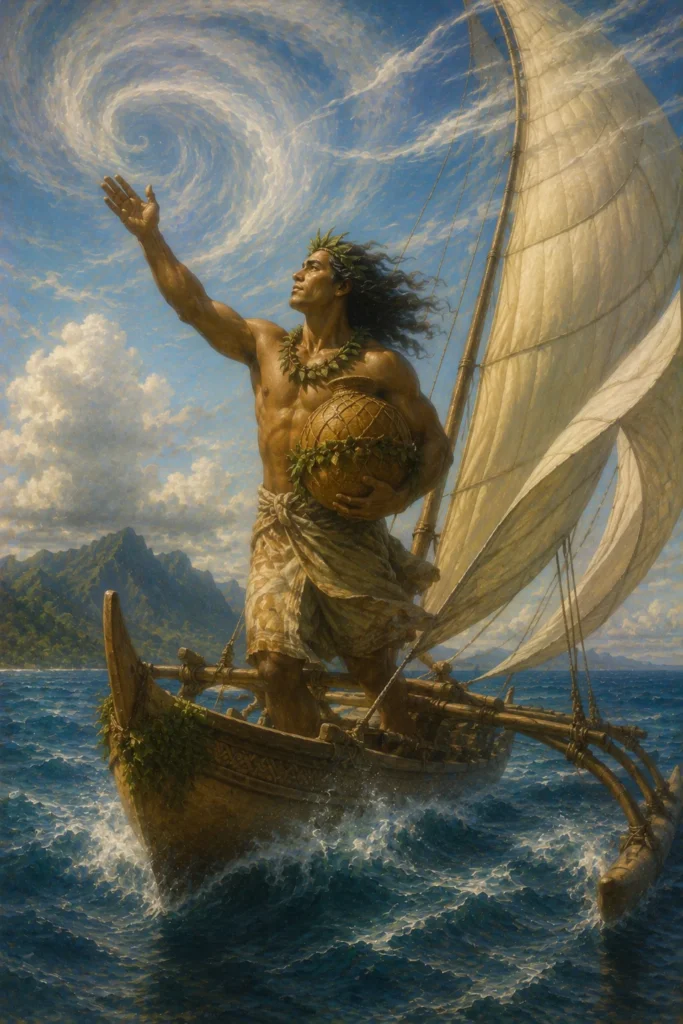
Pakaa, also spelled Paka’a in Hawaiian orthography, is in Hawaiian legend the culture hero of the winds and the inventor of the sail. He keeps the winds in a calabash, knows the names of all the winds and summons them through chant.
As the ideal servant, he serves the chief Keawenuiaumi. Wind power is a family inheritance: Pakaa inherits the calabash, the ipu o Laamaomao, from his grandmother, and his highly gifted son Kuapakaa carries it on.
Type: Wind culture hero and wind master
Origin: Hawaiian heroic legend, son of Kuanuuanu and Luukia, daughter of Laamaomao of Kauai
Texts: Moolelo no Pakaa, Kamakau from 1869, Nakuina
Period: Hawaiian tradition, put into writing from the 19th century
Appearance: human hero and servant with the wind calabash
Historical Classification
Period of the Texts
Hawaiian heroic legend, put into writing from 1869 by Samuel M. Kamakau; the book version is by Moses Kuaea Nakuina.
Area of Diffusion
Hawaii: The saga takes place in the courtly setting of the islands, between Kauai and the court of the chief Keawenuiaumi.
Sources
Good: The core source is the saga Moolelo no Pakaa; also Nakuina’s book version, in English The Wind Gourd of Laamaomao, and Beckwith.
Name and variants
Hawaiian: Pakaa, also spelled Paka’a, is a Hawaiian proper name with no generally attested transparent meaning. He is the son of the noble traveller Kuanuuanu and the commoner Luukia, daughter of Laamaomao of Kauai.
Hero, servant, wind master
Appearance
Pakaa is depicted as a human hero and servant, without a fixed iconic animal form. His emblem is the wind calabash, the ipu makani.
Effect
Pakaa keeps the winds in a calabash, the ipu o Laamaomao, which he inherits from his grandmother, and knows the names of all the winds; by calling them by name in chant he summons them. The narrative core is how the wrongfully banished, ideal courtier regains his position with the help of his highly gifted son Kuapakaa and the wind gourd.
Profile: Pakaa
The key aspects of the wind master at a glance.
Wind culture hero of Hawaiian heroic legend and a classic of Hawaiian literature, embodying the values of the ideal alii servant.
Seafarers and the courtly tradition: Pakaa serves the chief Keawenuiaumi and secures safe passage and wind.
Human hero and servant without an animal form; his emblem is the wind calabash, the ipu makani.
Keeper of the winds, knower of their names, inventor of the sail and other boat equipment.
An actual temple cult is not attested; the practical protection lies in wind knowledge and safe seafaring.
Moolelo no Pakaa: the saga of the banished courtier
Pakaa is regarded as a wind culture hero and inventor of the sail and other boat equipment; he is the son of the noble traveller Kuanuuanu and the commoner Laamaomao of Kauai. The core source is the saga Moolelo no Pakaa, transmitted among others by Samuel M. Kamakau from 1869, and the book version by Moses Kuaea Nakuina, in English The Wind Gourd of Laamaomao.
The narrative core is a courtly drama: the ideal servant is wrongfully banished and regains his position with the help of his highly gifted son Kuapakaa and the wind gourd. The wind knowledge, the names of all the winds and their chants, is the hero’s true power: whoever can call the winds decides every voyage.
A classic of Hawaiian literature
Pakaa is a classic of Hawaiian literature; Nakuina’s version is still reprinted today and taught in Hawaiian Studies, embodying the values of the ideal alii servant.
In religious-studies terms, Pakaa is a well-disposed culture hero who directs the winds for benefit, not a threatening being. Important clarifications: Pakaa and Laamaomao are occasionally confused, but Laamaomao is the ancestress and original owner of the calabash, Pakaa the heir; and he is more a culture hero and demigod than a supreme wind god.
Wind knowledge as protection
An actual temple cult is not attested for Pakaa; his role is that of wind and sail master. The practical protection lies in wind knowledge and safe seafaring: whoever knows the names of the winds and handles the sail correctly arrives safely. Further cult forms are not attested.
Calabash and wind bag: parallels
The wind-calabash motif links Pakaa with Laamaomao, the ancestress and original owner of the ipu o Laamaomao; the two are to be clearly distinguished, for she is the source of wind power, he her acting heir. Typologically, Pakaa is comparable to the Greek Aeolus, who keeps the winds in a bag, without any historical connection. Among the milder wind figures of the Pacific, Hine-Tu-Whenua, the goddess of favourable sailing winds, is close to him.
Frequently asked questions about Pakaa
Who is Pakaa?
The Hawaiian wind master and inventor of the sail, who keeps the winds in a calabash and calls them by name through chant.
What is the wind calabash?
The ipu o Laamaomao, in which the winds are kept and which Pakaa inherits from his grandmother.
Is Pakaa the same as Laamaomao?
No. Laamaomao is the ancestress and owner of the calabash, Pakaa the acting heir.
Further links
Further reading:
- Laamaomao – the wind ancestral deity and source of the calabash
- Aeolus – the Greek lord of the winds with the wind bag
- Hine-Tu-Whenua – the goddess of favourable sailing winds
- Amulet, Protective candle, Salt – traditional protective means
Literature (selection)
Further standard works in the bibliography.
As a Hawaiian wind culture hero and as the inventor of the sail, Pakaa combines divine heritage with practical skill: the calabash of his ancestress and the knowledge of the names of the winds turned a servant into the master of every voyage.