Hinn, the Dogs of the Djinn
By Ralf Ittermann · last reviewed on
The Hinn is a spirit of the Arabian tradition.
Weak pre-djinn class that appears as wild dogs.
The Hinn is a rare, low class of Arabian spirits, often described as pre-Adamite spirits or as particularly weak beings. It is marginally but genuinely attested in pre-Islamic poetry, in al-Jahiz, and in Islamic exegesis.
The Sufi al-Shibli called the Hinn the dogs of the Djinn: they appear as wild dogs. Al-Jahiz explicitly classed them as a weak type, whose abilities are limited to simple deceptions. It is precisely this modesty that makes the Hinn a revealing witness to the Arabian spirit world.
Type: Low, rare spirit class, often interpreted as pre-Adamite
Origin: Pre-Islamic Arabia, continued in Islamic exegesis
Texts: Pre-Islamic poetry, al-Jahiz, exegetical literature
Period: pre-Islamic and Islamic-exegetical
Appearance: partly as wild dogs

Textual history
Period of the Texts
The Hinn can be traced back to pre-Islamic poetry and was further elaborated in Islamic exegesis, among others by Ibn Kathir and Ibn Barrajan.
Area of Diffusion
Arabia: The Hinn belongs to the spirit landscape of the peninsula, though no more precise place of origin has been recorded.
Sources
Thin but real: pre-Islamic poetry, al-Jahiz and the exegesis. The detailed accounts found in occult blogs, by contrast, should be treated with caution.
Name and variants
Arabic: hinn. Two derivations compete: the root h-n-n, meaning to yearn or sigh, and Ibn Barrajan’s interpretation, according to which the Hinn awaited the creation of Adam. Both explanations point to an existence before humankind.
Appearance and behaviour
Appearance
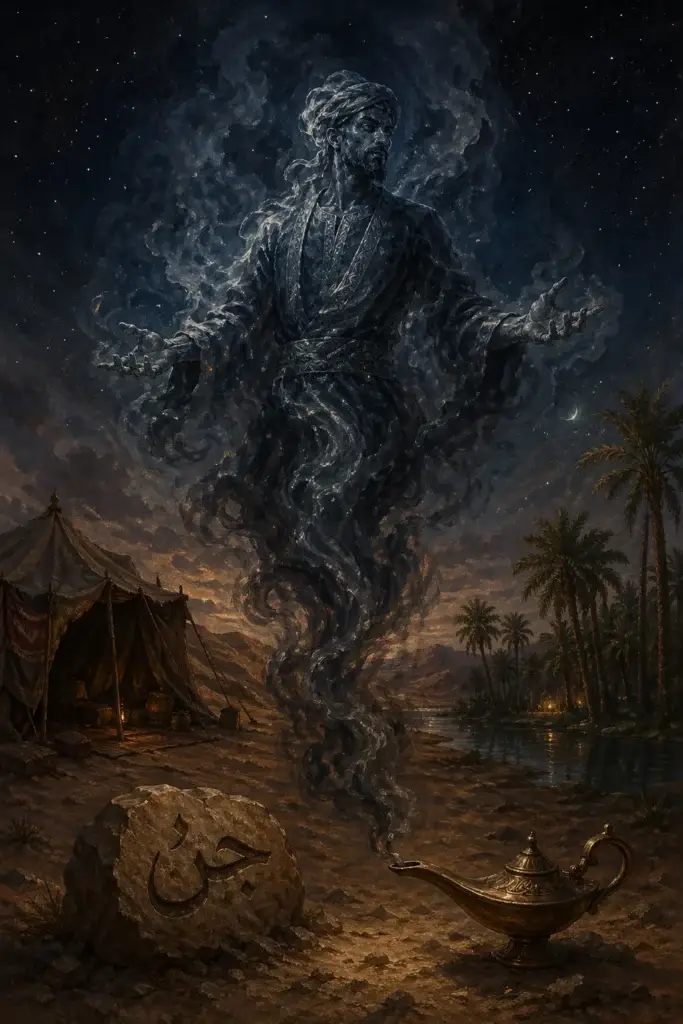
The Sufi al-Shibli calls the Hinn the dogs of the Djinn; they appear as wild dogs that roam the wilderness.
Effect
Hinn, Binn, Timm and Rimm are traditionally described as pre-Adamite or lower spirit classes, often as a sequence of earth’s inhabitants before humankind. Ibn Kathir counts the Hinn among the beings that shed blood before humans did. Al-Jahiz explicitly calls them a weak type, limited to simple deceptions.
Profile: Hinn
The key aspects of the lower spirit class at a glance.
A witness to the pre-Islamic layering of Arabia’s spirit world, partly adopted and partly marginalised by Islam; the Druze accept the existence of Hinn, Binn, Timm and Rimm.
Travellers in the wilderness: al-Jahiz credits this weak class with nothing more than simple deceptions.
Wild dogs: according to al-Shibli, the Hinn are the dogs of the Djinn, half animal, half spirit.
Simple deceptions; in the exegesis also the role of the earth’s inhabitants before Adam, who according to Ibn Kathir had already shed blood.
No dedicated ritual has been recorded; in practice, the hadith about wild dogs applies, throwing them food or driving them away.
Two derivations and a thin body of evidence
Two derivations compete for the name: the root h-n-n, to yearn or sigh, and Ibn Barrajan’s interpretation, according to which the Hinn awaited the creation of Adam. Both explanations place the Hinn before humankind, whether as sighing remnant beings or as waiting pre-inhabitants of the earth.
The Hinn is attested pre-Islamically in poetry and was further elaborated in Islamic exegesis; Ibn Kathir counts the Hinn among the beings that shed blood before humans did. Even so, the genuine body of evidence remains sparse. The elaborate accounts circulating in occult blogs should be treated with caution: they embellish what the sources only hint at.
Scholarly presence and assessment
The Hinn appears chiefly in scholarly overviews and in the Encyclopaedia of Islam; the elaborate four-element systems found in popular sources are a modern addition.
From a religious-studies perspective, the Hinn testifies to the layering of pre-Islamic spirit classes, which Islam partly adopted and partly marginalised. Important clarifications: taking the elaborate, systematised online accounts as classically attested is a mistake; the genuine body of evidence is sparse; and the neat assignment to elements is a modern systematisation.
The dog hadith as a practical approach
No specific protective ritual against the Hinn has been recorded, which fits their rank: against a class capable only of simple deceptions, no one needed heavy ritual defences. The practical approach follows the hadith about wild dogs: throwing them food or driving them away. Anyone who encountered a shaggy dog in the wilderness treated it correctly this way, whether it was an animal or a Hinn standing before them.
Sister classes and distinctions
The Hinn stands alongside its sister classes Binn, Timm and Rimm, which are traditionally described as a sequence of earth’s inhabitants before humankind; their existence is accepted by the Druze. Above it, the Hinn is distinguished from the Jinn and the Jann, with whom it shares membership in the Arabian spirit world, though not their power. The Shiqq also belongs to the lower forms of this world.
Frequently asked questions about the Hinn
What is a Hinn?
A rare, low class of Arabian spirits, often described as weak or pre-Adamite beings.
Are the Hinn dangerous?
Only to a limited extent; al-Jahiz calls them a weak type, capable of simple deceptions.
How do they appear?
According to al-Shibli, as wild dogs, the dogs of the Djinn.
Further links
Literature (selection)
Further standard works in the bibliography.
Traditionally described as both a lower class of Djinn and pre-Adamite spirits, the Hinn marks the lowest level of the Arabian spirit world: too weak for great harm, yet old enough to be thought of as existing before Adam.