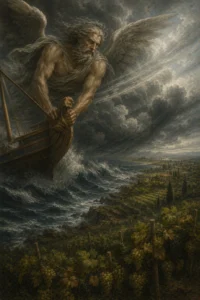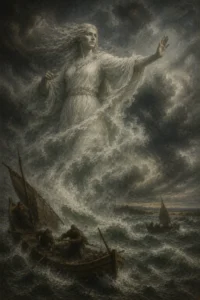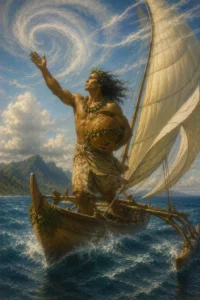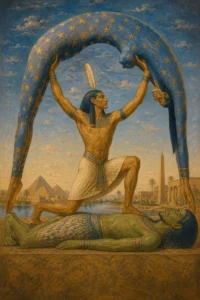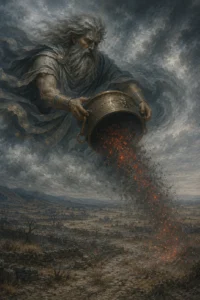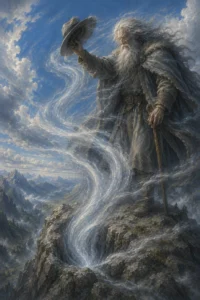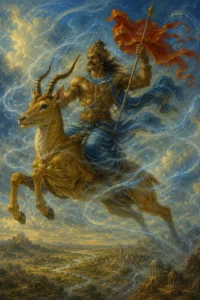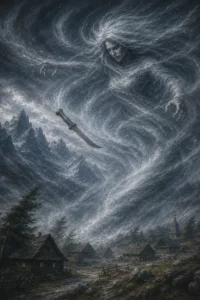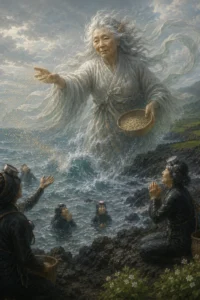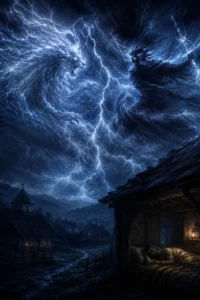
Beings that direct the wind, unleash storms, or are imagined as fleeting air elementals: from the Greek Anemoi and the Vedic wind god Vayu to the storm demons of the Caribbean and Oceania.
In practically every seafaring and agricultural culture, wind was regarded as a force that decided harvest and journey, and it was accordingly seldom interpreted as a mere weather phenomenon but mostly as an acting being with its own will. Wind gods and storm demons, together with air elementals and bird beings, form the four main types within this group of beings.
When the wind bears a name.
Type: nature spirit Class: Air and Wind Spirits Distribution: Cross-cultural (Europe, Asia, Oceania, the Americas, Africa) Main characteristics: directional binding (cardinal winds), power over storms and weather, invisibility, winged or bird-like form Related subcategories: wind gods, storm demons, air elementals, bird beings
Wind spirits differ from pure weather gods of lightning and thunder in that their effect is bound to a direction: north, south, east, and west wind are regarded in numerous cultures as distinct, often characterially opposed beings, rather than as variants of a single wind god.
The Greek Anemoi follow exactly this pattern: Boreas as the cold north wind, Notos as the moist south wind, Zephyros as the mild west wind, and Euros as the unpredictable east wind, each with its own character, genealogy, and cult.
In the iWell-Guard classification, air and wind spirits form the subclass of nature spirits bound to the element of air and to the phenomenon of wind, and like all groups of beings in this lexicon, they belong to the subclasses of the general Spirits main class.
They differ from pure sky gods (cosmic overall order without wind specificity) and from storm gods in the narrower sense (lightning and thunder rather than air movement). Within the group, research distinguishes wind gods with a fixed cult site, directionless storm demons, elemental air beings of early modern natural philosophy (sylphs), and bird beings whose flight makes the wind visible.
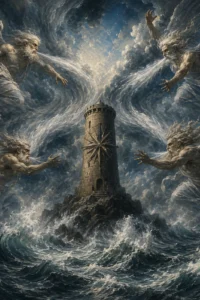
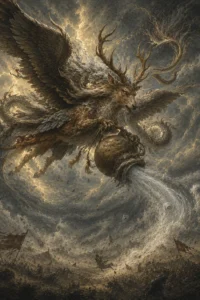
The Greek Anemoi form a well-systematised ensemble of wind gods from antiquity: Hesiod and later authors assign each of the four main winds a fixed place at the Tower of the Winds in Athens, among them Boreas and Zephyros. Their father Aiolos is regarded by Homer as the keeper of all winds, which he holds captive in a bag, an early literary version of the motif of the ‘tamed wind’.
The Vedic Vayu occupies a special position in the Indian pantheon: as the breath of the world (prana), he links cosmic wind movement with life force, a connection that recurs structurally in the Chinese concept of qi and the Greek pneuma, without any direct historical connection being demonstrable.
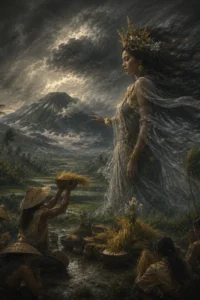
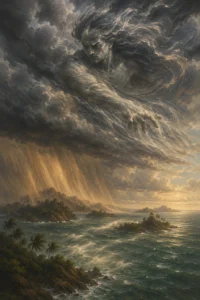
Mesoamerican traditions feature two influential storm deities: Ehecatl, a wind form of Quetzalcoatl, and Hurakan, the Maya storm god, whose name entered the English word ‘hurricane’ via Spanish. The Caribbean Taíno culture venerated Guabancex, a storm goddess whose wrath was unleashed in hurricanes and who was preceded by two messengers (Guataubá and Coatrisquie).
The Chinese Fei Lian is usually described as a bird- or deer-like composite creature with a serpent’s tail; the Aztec Tezcatlipoca likewise takes on a wind form in one of his four manifestations. The Maori of New Zealand know Tawhirimatea as the god of storms, who, according to tradition, fought against his siblings because they allowed the separation of sky and earth.
North American traditions feature numerous distinct wind beings: the Navajo wind spirit Niltsi is regarded as a messenger who carries news between the worlds, while the Iroquois Gaoh commands the four main winds in the form of four animals (bear, panther, moose, eagle).
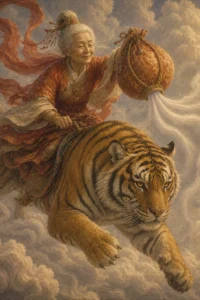
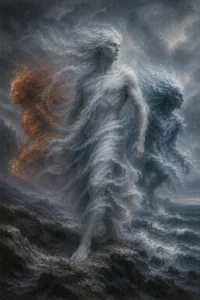
The Japanese and Korean wind goddess Feng Po Po (of Chinese origin) is usually depicted riding a tiger and carrying a wind bag. In early modern European elemental theory (Paracelsus, 16th century), the sylph appears as a bodiless air elemental, a systematisation considerably younger than most of the wind deities gathered here, but one that still resonates in today’s fantasy literature.
The Greek Anemoi are continuously attested from Hesiod’s Theogony (around 700 BCE) and the Tower of the Winds of Andronikos of Kyrrhos (1st century BCE, with relief depictions of all eight winds). The Vedic Vayu already appears in the Rigveda (c. 1500 to 1200 BCE) as an independent deity with numerous hymns.
Mesoamerican wind deities are documented through codices (Codex Borbonicus, Codex Vaticanus) and Spanish mission chronicles of the 16th century, though the source material is heavily filtered by colonisation. North American wind beings such as Niltsi and Gaoh derive predominantly from oral tradition, which was first recorded in writing by ethnologists in the 19th and 20th centuries, requiring correspondingly greater methodological caution in interpretation.
Air and wind spirits fall under Protection Layer 2 of the iWell-Guard mantra (see function overview). Intrusive, unsettling air influences are classified by the protective shield as a burdensome effect.
The iWell-Guard position follows the historical observation that wind beings were interpreted ambivalently in most cultures: as life-giving breath and, at the same time, as destructive storm. The protective idea is directed against the turbulent side of the wind, not against its life-giving side.
Additional source references can be found in the bibliography.
The wind-spirit concepts documented here are a scholarly classification of cross-cultural ideas.
Against approaching storms and restless air beings, many cultures employed acoustic and ritual means: the ringing of bells against hail and thunderstorms, consecrated holy water for sprinkling house and field, and spoken prayers before going out to the fields. The Protection Compass classifies such traditions in cross-cultural comparison.
iWell Guard stands in this tradition of portable protective objects, manufactured in Germany and with a documented material architecture (41 layers, real gold, platinum, silver, 30-day right of return).
Not a medical device. No promise of healing. Personal perceptions may vary.