The Moirai: Clotho, Lachesis and Atropos
By Ralf Ittermann · last reviewed on
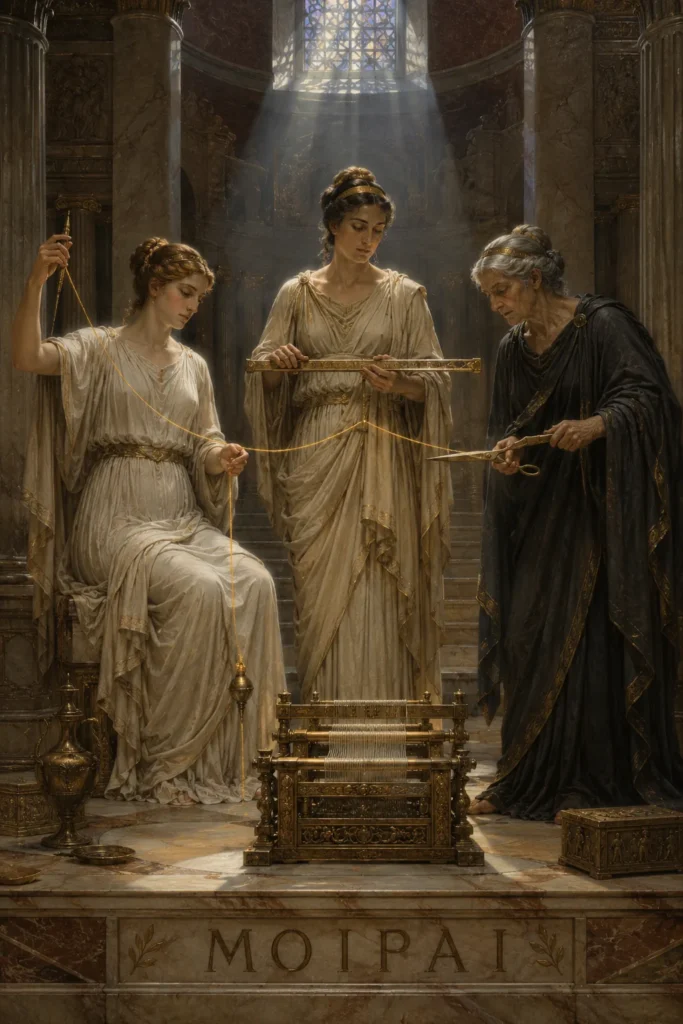
The Moirai are the three goddesses of fate of Greek mythology: Clotho spins the thread of life, Lachesis measures it, Atropos cuts it off. They embody the inescapable finitude of every human life.
Classification
The Moirai are among the oldest and at the same time most abstract deities of Greek religion.
They are the personifications of fate, that power which sets the measure of every human life and which even the Olympian gods can oppose only to a limited degree. In the classical tradition they appear as a triad, bearing the names Clotho, Lachesis and Atropos.
From the perspective of religious studies, the Moirai are a particularly instructive example of the personification of a concept. The Greek word moira at first means share, part, that which is measured out.
From this notion of what is allotted to the individual there developed the idea of divine figures who carry out this measuring out. The Moirai thus stand at the boundary between an abstract idea and a deity venerated in cult.
The most important early source is once again Hesiod’s Theogony, which fixes their descent. Homer already knows the notion of allotted fate, but often conceives of moira more as an impersonal power than as a clearly defined group of goddesses.
In Plato, in the closing myth of the Republic, the three Moirai appear in an elaborate scene as daughters of Necessity. In tragedy, in the great Attic poets, they are frequently named powers. The visual arts depicted them from the archaic period onward.
Name and etymology
The generic name Moirai derives from the Greek word moira, meaning share, allotted lot, fate. It belongs to a word family that denotes distributing and measuring out.
The moira is therefore originally not the goddess but the portion of life measured out to a person. Only personification turned this into the goddess of fate, and the plural, the Moirai, yielded the group of goddesses.
The three individual names are speaking names, each denoting an activity at the thread of life. Clotho means the spinner, from a word for spinning the thread. Lachesis means the allotter or the one who gives the lot, from a word for casting lots and measuring out.
Atropos means the unavoidable or the unturnable, literally the one who cannot be turned from her purpose. In the later, systematizing tradition, a fixed distribution of roles was assigned to these names: Clotho spins, Lachesis measures, Atropos cuts off.
This clear division of labour is, however, an ordering stipulation of post-Homeric times. In the oldest sources the functions are distributed less strictly.
In Latin the Moirai correspond to the Parcae, whose names Nona, Decuma and Morta were originally connected with birth in the ninth or tenth month and with death, but were then equated with the Greek Moirai. The equation of the Moirai and the Parcae decisively shaped the post-antique image of the three sisters of fate.
Description and iconography
In ancient art the Moirai are usually depicted as three women, often in a serious, dignified bearing. Their age is given variously; in some depictions they appear as mature or aged women, in others without distinct marks of age.
Their distinguishing attributes are the tools of thread work: the spindle, the thread, the distaff, and in the later tradition also a pair of shears or a cutting tool for Atropos.
The dominant image is that of spinning. Human life is conceived as a thread that the Moirai produce, measure and finally sever. The length of the thread corresponds to the span of life, the cutting means death.
This image is highly vivid and has shaped the entire later conception of the thread of life. In Plato’s account the three Moirai sit on thrones, clothed in white garments, crowned, and together turn the great spindle of the world.
In vase painting and in relief depictions the Moirai often appear at important fateful events, such as births or weddings, but above all at the birth of significant figures. They are then the powers that set the lot of the newborn.
In Roman times, as the Parcae, they belonged to the widespread pictorial motifs on sarcophagi, where they symbolized the finitude of life. The strict division of roles among the three, one spins, one measures, one cuts, is above all a pictorial scheme of post-classical and post-antique art.
Mythological narratives
Concerning the descent of the Moirai there are two traditions standing side by side, which already appear in Hesiod’s Theogony. According to one, they are daughters of Nyx, the Night, and thus belong to the dark, primordial powers that issue without a father from the Night, together with Death and other gloomy figures.
According to the other version, also handed down by Hesiod, they are daughters of Zeus and Themis, the goddess of established order. In this genealogy they are sisters of the Horae and stand for the orderly, lawful allotment of fate.
The two descents reflect two conceptions of fate: the uncanny power stemming from the Night and the justice bound up with divine order.
The Moirai appear in numerous myths as powers that determine the course of life. One of the best-known tales concerns Meleager. At his birth the Moirai appeared and foretold that the boy would live as long as a particular log was not burned up in the hearth fire.
His mother Althaea snatched the log from the fire and kept it. Years later, in her anger over the death of her brothers at Meleager’s hand, she threw the log into the fire, and her son died at the moment it was consumed.
Another well-known episode concerns Admetus. Apollo obtained from the Moirai that Admetus might escape death if another went into death in his place. That Apollo could persuade the Moirai at all happened, according to the tradition, with the help of wine, with which he beguiled them.
The episode shows that the fate set by the Moirai could in rare cases be deferred but not truly annulled: in the end someone had to die the death after all.
Their relationship to Zeus was the subject of ancient debate. In some accounts Zeus ordains fate and the Moirai carry it out; he then bears the epithet Moiragetes, the leader of the Moirai.
In other accounts fate stands even above Zeus. This tension was not resolved in antiquity; it belongs to the matter itself: fate is a power whose relationship to the highest deity fundamentally remained open.
Cult and veneration
The Moirai were venerated in cult at various places in Greece, though mostly not with large, independent temple complexes, but rather in connection with other deities or at special sites.
Altars and sanctuaries are attested, among other places, in Corinth, in Sparta, in Thebes and in Olympia. In Delphi they stood in close connection with the sanctuary of Apollo, the sanctuary.
The cult of the Moirai was closely tied to the transitions of human life, above all to birth and to marriage. At the birth of a child the Moirai were held to be present, since at that moment the lot of life was set.
At weddings, prayers and offerings were addressed to them, so that they might measure out a good destiny to the couple. In burial and in mourning they likewise played a role as the powers that had severed the thread of life.
The offerings for the Moirai consisted, as far as is handed down, often of bloodless gifts, of flowers, honey and similar gifts, which places them near other chthonic deities. In some places they were venerated together with Zeus, with the Eumenides or with deities of birth.
On the whole their cult was widespread but inconspicuous: it accompanied the decisive turning points of life without requiring great public festivities. This distribution across the whole of life corresponds to their nature as powers that act not at one place but at every fate.
Protective practice and the apotropaic
The relationship of the human being to the Moirai was marked by the insight into the inescapability of their working. Unlike against harmful spirits, one could not truly protect oneself against the fate set by the Moirai.
Greek religion therefore offered no apotropaic practice in the sense of a warding off, but rather forms of approach, of petition and of ritual acknowledgement.
At birth and marriage, the two turning points of life at which the Moirai were thought to be especially near, prayers and offerings were addressed to them, so that they might measure out a favourable lot.
These rites were not a warding off, but the attempt to secure the goodwill of the powers of fate before the lot was cast. In popular belief the notion persisted that the first days after a birth were especially delicate, because the fate of the child still hung in the balance.
To address the Moirai with the embellishing epithet of the well-disposed or the gracious belonged to a widespread religious linguistic practice that sought to make fearsome powers milder through an appeasing designation. The same practice is found with the Erinyes, who were invoked as the Eumenides, the well-meaning ones.
Moreover, the Greek wisdom tradition, above all tragedy, taught insight into the limits of the human being: to accept what the Moirai measured out counted as a sign of maturity.
The attempt to transgress one’s own lot by force led, in the mythical narratives, regularly to misfortune. Protection from the Moirai consisted ultimately not in a ritual, but in a measured conduct of life.
Parallels in other cultures
The notion of fate-determining powers, often in a female triad and often connected with the image of spinning, is widespread in the Indo-European cultures. Comparative research sees here a common heritage.
The closest correspondence is the Roman Parcae, who were so completely equated with the Moirai that the two groups can scarcely be separated any longer in the tradition.
In Norse mythology there are the Norns, who at the foot of the world tree determine the fate of human beings; they too are, in the best-known tradition, three in number and connected with spinning and weaving.
In the Baltic and the Slavic regions there are corresponding women of fate who appear at the birth of a child and set its lot.
The image of the thread of life, which is spun, measured and cut off, is here the connecting element. It links the everyday activity of spinning, in antiquity connoted as female, with the notion of the finitude of life.
Research has recognized in this an old Indo-European motif that found its own forms in various linguistic and cultural areas.
Beyond the Indo-European area, other cultures too know deities of fate who set the measure of life, without, however, the spinning motif standing at the centre everywhere.
Within this broad family of motifs the Moirai are the Greek form, distinguished by the fixed number of three, the speaking individual names and the close connection to philosophical reflection on necessity and freedom.
Present-day reception and research
The Moirai are among the mythical figures whose image has remained alive into the present. The motif of the three sisters of fate who spin and cut through the thread of life has become, by way of the Roman Parcae and of medieval and modern literature and art, a fixed component of European pictorial language.
In the poetry of the modern era, in drama and in the visual arts, they appear again and again as a symbol of transience and of inescapability.
In popular culture the three women of fate are a recurring motif, in literature, film and games, often with a blending into the Norns or the witches of other traditions.
Idioms such as the image of the thread of life or of the thread that is cut off go back directly to the notion of the Moirai.
Religious-studies research has examined the Moirai from several points of view. In the foreground stands the question of the Greek concept of fate and its relationship to the world of the gods, especially to Zeus, a question that already occupied Erwin Rohde and, after him, numerous researchers.
Alongside this stands the study of personification: how does a goddess arise from the concept of what is measured out? Walter Burkert and Martin Persson Nilsson placed the Moirai within the overall account of Greek religion, Timothy Gantz sifted through the sources, Fritz Graf treated their position in mythology.
The Moirai remain a key example of how the Greeks thought about necessity, death and the limits of human action.
Literature (selection)
- Erwin Rohde: Psyche. Seelencult und Unsterblichkeitsglaube der Griechen (1894)
- Walter Burkert: Griechische Religion der archaischen und klassischen Epoche (1977)
- Martin Persson Nilsson: Geschichte der griechischen Religion (1941-1950)
- Timothy Gantz: Early Greek Myth. A Guide to Literary and Artistic Sources (1993)
- Fritz Graf: Griechische Mythologie. Eine Einführung (1985)
- Martin Litchfield West: Hesiod. Theogony. Edited with Prolegomena and Commentary (1966)
Related key terms: Moirai Clotho Lachesis Atropos fate thread of life Parcae spindle.
iWell Guard and protective traditions
iWell Guard ties in with the cultural-historical tradition of wearable protective objects, in the tradition of Greece and many other cultures worldwide. 41 layers, solid gold, platinum, silver, made in Germany. 30-day right of return.
Personal experiences may vary. Not a medical device. Not a promise of healing.