Lada, Slavic Goddess of Love
By Ralf Ittermann · last reviewed on
In the Slavic pantheon, Lada is the goddess of love, beauty, marriage and spring. Unlike the gods of the Vladimir sextet, Lada is not directly attested in any older chronicle, and only the late-medieval chronicle of Jan Długosz names her as a counterpart of Mars; her name first appears in late-medieval Polish sermon literature and in folk wedding and spring songs.
For this reason, her existence as an independent goddess is contested in current scholarship. Aleksander Brückner regarded her as a mere song refrain, while Aleksander Gieysztor and Boris Rybakov saw her as a genuine goddess whose trace survived in folk tradition. This page presents both positions and follows today’s cautious consensus.
Source Situation and Scholarly Dispute
The oldest mentions of Lada come from Polish synodal decrees and sermon literature of the 15th century. The decree of the Synod of Łęczyca (1420) prohibits dancing and singing at Pentecost and in doing so names the invocations “Łado, łado!”.
Similar prohibitions appear in Jan Długosz’s “Annales seu cronicae incliti Regni Poloniae” (1455 to 1480), which describes Lada as the Polish equivalent of Mars and places an entire Polish list of gods alongside her. This list is problematic for the history of religion because Długosz partly constructed the Slavic pantheon on a Roman model.
Aleksander Brückner (“Mitologia słowiańska”, 1918) firmly rejected the existence of Lada as a goddess. For him, “łado” is a song refrain, comparable to the German “lalala”, which was later wrongly personified by clergy. This skeptical position was long dominant in the 20th century and was largely adopted by Henryk Łowmiański.
Aleksander Gieysztor (“Mitologia Słowian”, 1982) and Boris Rybakov, by contrast, argued for the existence of Lada.
Gieysztor points to the frequency and distribution of the Lada invocations from the Baltic to the Balkans, to parallels in Latvian mythology (Laima, goddess of fate), and to the structural necessity of a goddess of love and spring within the reconstructible pantheon.
More recent scholarship (Jiří Dynda, Michael Shkapa) tends toward a middle position: Lada was probably an East Slavic and Polish folk figure who did not necessarily belong to the official pantheon of Kievan Rus, but was anchored in folk religiosity.
Name and Etymology
The name “Lada” is derived from Proto-Slavic “*lada” (“beloved, woman, order”), with connections to Old Russian “ladъ” (concord, harmony), Serbian “lada” (woman, beloved) and Czech “ladný” (graceful).
In Russian usage, “lad” has retained the meaning “peace, order, concord” into modern Russian. The etymological connection with the North Germanic Aesir goddess Frigg/Frigga (from Indo-European “*priH-“, to love) has occasionally been discussed, but is not linguistically compelling.
Function and Appearance
As far as can be reconstructed from the folk-religious sources, Lada is the goddess of love, marriage, female beauty and spring. She is invoked in spring songs, mentioned in the wedding rite, and celebrated in circle and round dances (“khorovody”).
In Ukrainian and Polish folklore she is often the protective goddess of young girls and unmarried women, and her veneration coincides with the customs of May. In the oldest surviving songs she frequently appears with a male companion figure named “Lado” or “Lel”, whose status as an independent god is likewise contested.
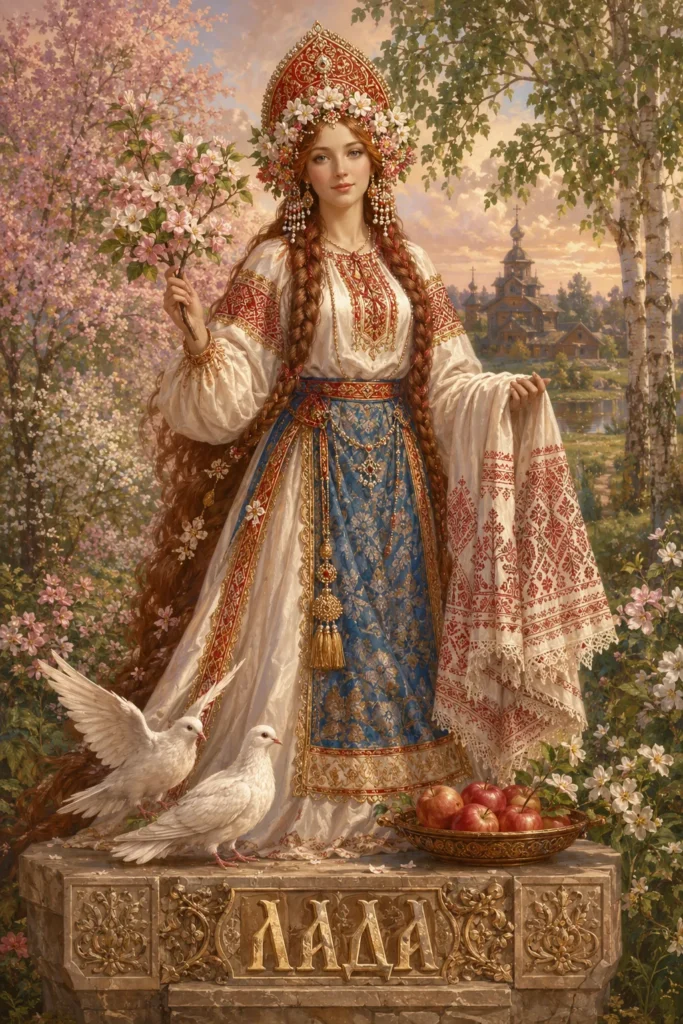
The visual arts began to refer to Lada only with the Romantic folk movement of the 19th century, depicting her as a fair-haired young woman in a white wedding gown, often with a wreath of flowers and accompanied by swans. This iconography is a modern construction and has no direct medieval models.
Veneration and Folk Custom
The most important trace of Lada is the invocation “Łado, łado!” (also “Lada, Lada!” or “Łado, Łado, jary Łado!”) in spring and wedding songs. These refrains are documented in large numbers in Polish, Ukrainian, Belarusian and Russian song collections of the 19th century.
In “Poeticheskiye vozzreniya slavyan na prirodu” (1865 to 1869), Aleksander Afanasyev gathered numerous examples. The critical folkloristics of the Soviet era (Vladimir Propp, Boris Putilov) examined part of these collections for authenticity and distinguished between archaic folk sources and literarily influenced ones.
In the May and Pentecost customs of many Slavic regions, girls’ round dances, wreath-throwing and the setting adrift of wreaths were widespread practices in which Lada was invoked.
The Ukrainian “Hahilki” round dance, the Polish “Stado” and the South Slavic “Lazarice” customs belong to this complex. Whether these customs derive directly from an old cult of Lada or are general vegetative spring rituals cannot be decided with certainty.
Wedding and Family Cult
Lada appears in wedding songs as the protective goddess of the bride and of the young marriage. In some regions the bride was called “Lada”; the Polish love song “O Łado, Łado” is a classic example.
In South Slavic folklore, “lada” remains a term of endearment for the beloved to this day. This linguistic trace supports the thesis of an original goddess of the marital order whose name passed into profane usage.
Classification in the History of Religion and Parallels
Structurally, Lada corresponds to the functions filled in other Indo-European pantheons by goddesses of love and beauty: Freya (Germanic), Aphrodite (Greece), Venus (Rome), Lakshmi (Hinduism), Hathor (Egypt).
Unlike these, Lada is not secured by monumental temples or dogmatic myths; her reality remains anchored in folk religion. This situation is not unusual in the history of religion: the Baltic Laima, too, who shares structural similarities with Lada, is primarily attested through folklore.
Vladimir Toporov brought together the Slavic Lada with the Latvian Laima and the Hittite Hannahanna in an Indo-European and Anatolian stratum; this deep-structuralist reconstruction is methodologically ambitious and in parts contested. Boris Rybakov attempted to place Lada within an archaic “Great Goddess” stratum of the Eastern Slavs; this construction, too, is regarded as overreaching.
Afterlife and Modern Reception
In the 19th century, Lada became a prominent figure of Slavic Romanticism. Adam Mickiewicz, Juliusz Słowacki and Ukrainian poets such as Ivan Franko referred to her in their works.
In the music of the 19th and 20th centuries (Mussorgsky, Stravinsky), allusions to Lada appear, especially in “The Rite of Spring” (1913), which alludes to the spring round dance. In the visual arts of Polish Modernism (“Młoda Polska”), Lada is a recurring figure.
The modern Rodnovery movement (Neopaganism) has made Lada the central female deity of a reconstructed pantheon. From the perspective of the history of religion, this revival is a new construction that draws on folk tradition and the Romantic collections, not on a continuous cult practice.
Sources
Synodal decree of Łęczyca (1420). Jan Długosz, “Annales seu cronicae incliti Regni Poloniae” (1455 to 1480), Book I. Polish sermon literature and synodal decrees of the 15th century. Ukrainian, Belarusian and Russian song collections of the 18th and 19th centuries, in particular the collections of Aleksander Afanasyev and Pavel Chubinsky.
Aleksander Brückner, “Mitologia słowiańska”, Kraków 1918 (critical, skeptical position). Aleksander Gieysztor, “Mitologia Słowian”, Warsaw 1982. Boris Rybakov, “Yazychestvo drevnikh slavyan”, Moscow 1981 (with reservations).
Vladimir Toporov and Vyacheslav Ivanov, “Issledovaniya v oblasti slavyanskikh drevnostey”, Moscow 1974. Henryk Łowmiański, “Religia Słowian i jej upadek”, Warsaw 1979. Vladimir Propp, “Russkie agrarnye prazdniki”, Leningrad 1963. Jiří Dynda, “Slovanské pohanství ve středověkých latinských pramenech”, Prague 2017. Michael Shkapa and further contributions in “Studia Mythologica Slavica”, Ljubljana since 1998.
The Brückner Controversy
Aleksander Brückner (1856 to 1939), the most important Polish Slavist of his generation, dominated the Lada question in the scholarship of the early 20th century.
In “Mitologia słowiańska” (1918) and in several detailed essays he held the thesis that “Lada” was not the name of a god but merely a song refrain, comparable to the onomatopoeic interjections “hej”, “dana” or “lalala” that occur in many Slavic folk songs.
Brückner’s argument rested on the absence of any mention in the main medieval sources, on the appearance of similar refrains in non-religious contexts, and on the supposition that 15th-century clergy had misunderstood the unfamiliar refrain as the name of a god.
This skeptical position long dominated the image of Lada in 20th-century scholarship. Henryk Łowmiański adopted it in essence in his classic work “Religia Słowian i jej upadek” (1979), and more recent critical scholars of religion such as Stanisław Urbańczyk have also defended the Brückner line.
The arguments for it are methodological caution in dealing with late folk evidence and an awareness that Slavic reconstructions of religion often rest on a weak source base.
The Counter-Position of Gieysztor and Rybakov
Aleksander Gieysztor (“Mitologia Słowian”, 1982) substantially modified the Brückner thesis. He argues that the frequency and geographical distribution of the Lada invocations, from the Baltic to the Balkans, from Poland to the southern Balkans, can hardly be explained by a single onomatopoeic refrain.
The structural similarity with the Latvian Laima (goddess of fate and love) and the etymological connection to Proto-Slavic “lada” (beloved, woman) speak for a genuine goddess of love and the marital order who was anchored at least in West and East Slavic folk religion.
Boris Rybakov went even further and positioned Lada in his main works as the central mother deity of a reconstructed Slavic pantheon.
His argumentation is rich in material but methodologically problematic; many of his identifications (Lada with a spring vegetation goddess, with a protective deity of marriage, and with a cosmic creator) are regarded in present-day scholarship as excessive. Critical Slavic studies have rejected Rybakov’s maximalist position.
More recent scholarship (Jiří Dynda, Michael Shkapa, the circle of “Studia Mythologica Slavica”) tends toward a middle position: Lada probably existed as a folk-religious figure, but was not necessarily a member of the official East Slavic imperial pantheon of Kievan Rus. Her veneration was popular and rural, not courtly and cultic.
The Polish Source Tradition: Długosz
A special role is played by the Polish list of gods given by Jan Długosz in his “Annales seu cronicae incliti Regni Poloniae” (composed 1455 to 1480). Długosz lists a Polish pantheon with the names Jesza (corresp. Jupiter), Lada (corresp. Mars), Dziedziłela (corresp. Venus), Nyja (corresp. Pluto), Dziewanna (corresp.
Diana) and Marzanna (corresp. Ceres). This list is problematic for the history of religion: it clearly follows the Roman scheme of divine names and looks in part like a humanist construction in which Długosz wished to attribute to the Poles a pantheon equal to that of the Romans and Greeks.
It is notable that Długosz identifies Lada as male (as Mars). This stands in contradiction to the folk-religious tradition, in which Lada is clearly female.
Present-day scholarship interprets this discrepancy partly as an indication of the figure’s dual gender (parallel to a male “Lado” and a female “Lada” in the songs), partly as evidence of the constructed nature of the Długosz list.
Aleksander Brückner regarded Długosz as unreliable; Aleksander Gieysztor saw in him at least an important piece of circumstantial evidence for Polish folk religiosity of the late Middle Ages.
Lada and Łado in the Wedding Songs
In the Polish, Ukrainian, Belarusian and South Slavic wedding songs, “Lada” (or “Łado”) usually appears as an invocation in the refrain. The form varies: “Łado, łado!”, “Łado-Łado, dany-łado!”, “Oj Lado moje”.
The fact that the invocation can take not only a female but also a male form (“Łado” as a male vocative form) has led to discussion of a divine pair “Lada-Łado”. Boris Rybakov and some more recent authors have reconstructed this pair figure; Aleksander Brückner regarded it as a construction without historical basis.
The wedding songs themselves are transmitted in collections of the 18th and 19th centuries. Vuk Karadžić, Aleksander Afanasyev, Pavel Chubinsky and other folklorists have gathered hundreds of examples.
In a typical passage the bride is declared to be Lada, or the bride’s parents are asked for a blessing “in the name of Lada”. How far these invocations have a religious background must be examined in each individual case; in many instances they are traditional formulas without an active religious function.
Lada and the Latvian Laima
An important comparative figure is the Latvian Laima, the goddess of fate and birth in the Baltic pantheon. Laima is well attested in Latvian folk songs (dainas) and is invoked as the goddess of fate who determines the destiny of the newborn.
Structural parallels to the Slavic Lada are the connection with wedding and birth, the reference to spring, and the female, invocable character. Vladimir Toporov systematically evaluated this parallel in his Indo-European, Baltic and Slavic comparative research and posits a common Indo-European stratum behind both figures.
A further comparative figure is the Anatolian-Hittite Hannahanna (“Grandmother”), a mother goddess of fertility and birth. This deep-structuralist reconstruction remains hypothetical; it does show, however, that the Lada discussion is embedded, beyond the Slavic sphere, in a larger Indo-European field of research.
Lada in Modern Reception
With the rise of Slavic national Romanticism in the 19th century, Lada became one of the most prominent figures of the rediscovered paganism. Adam Mickiewicz, Juliusz Słowacki, Cyprian Norwid and Ukrainian poets such as Ivan Franko referred to her in their works.
In the painting of the Polish “Młoda Polska” movement (“Young Poland”, c. 1890 to 1918), Lada is a recurring figure; Stanisław Wyspiański and Jacek Malczewski took up Lada motifs.
In the music of the 19th and early 20th centuries, Lada is present in various East Slavic works, most significantly in Igor Stravinsky’s “The Rite of Spring” (1913), which alludes to the spring round dance.
In the contemporary Rodnovery and Neopagan movement, Lada is a central female principal deity. From the perspective of the history of religion, this modern veneration is to be assessed as a new construction.
The South Slavic Lazarice Tradition
A remarkable trace of the Lada tradition is found in the South Slavic “Lazarice” tradition, which is observed in Serbia, Bulgaria and Macedonia around the Orthodox feast of Lazarus (Lazareva Subota, on the Saturday before Palm Sunday).
Young girls, dressed in white folk costume and adorned with wreaths of flowers, go from house to house, sing spring and wedding songs with Lada invocations, and receive eggs, money and small gifts in return.
This tradition was still alive in many South Slavic villages in the 20th century and is maintained in some places to this day.
In the study of religion, the Lazarice tradition is a classic case of Christian-pagan overlay. The Christian name (Lazarus) was imprinted on a pre-Christian spring tradition centered on girls’ round dances, Lada invocations and vegetation symbols.
Vuk Karadžić first documented this tradition in the 19th century; Sergej Tokarev placed it within his general theory of East Slavic spring religiosity.
Gender Roles and the Slavic Wedding Ritual
Lada’s central role in the Slavic wedding ritual sheds light on the function, in the history of religion, of gender-role constructions in pre-Christian Slavdom.
Unlike many Indo-European pantheons, in which the principal goddesses frequently also fulfill warlike or royal functions (Hera, Juno, Athena), Lada is a focused, gender-role-specific deity: her sphere is that of the woman in marriage, love and family.
This functional limitation could point to a relatively late specialization or to a different structural logic of the Slavic pantheon.
In the Slavic wedding songs, broadly documented in the collections of Aleksander Afanasyev and Pavel Chubinsky, the bride is frequently addressed as “Lada”.
This identification of the bride with the goddess is a classic example of the ritual elevation of the wedding as a sacred act, in which the bride attains divine status for the duration of the festival. In “Russkie agrarnye prazdniki”, Vladimir Propp described similar phenomena at harvest festivals and vegetation rites.