Evil Eye, ayin hara, mati and nazar
By Ralf Ittermann · last reviewed on
The evil eye, Hebrew ayin hara, Arabic al-ayn, Turkish nazar, Italian malocchio, is the belief that a single malicious glance can cause harm to another person. The belief has been documented in more than sixty cultures and has produced a rich repertoire of protective objects.
What the evil eye is
The evil eye is the belief that a person can cause harm to another through a single, often envious or malicious glance. In the accounts that have been handed down, the harm ranges from illness and misfortune to death, from a spilled jug of milk to the actual death of an infant.
Belief in the evil eye is one of the most widespread and at the same time oldest concepts of harm in human history. The American folklorist Alan Dundes documented it in more than sixty cultures, from Ireland to India, from Morocco to Mexico, a breadth that scarcely any other folk belief reaches.
At its core stands an explanatory model for unspecified misfortune. When a child suddenly falls ill, a cow stops giving milk, or a wedding begins under bad omens, the folk tradition of many cultures does not first look for a natural cause but for a social one.
Who was watching? Who gave a compliment? Who was envious? From this search for clues, an entire complex of protective objects, warding gestures, and prophylactic practices develops.
Names across cultures
In the Hebrew-speaking world the evil eye is called ayin hara, translated simply as “evil eye.” In the Arabic world it is al-ayn, often short for al-ayn al-hasud, the envious eye.
In the Turkish and Persian world it is nazar or nazar boncuğu, literally “glance bead,” the word serving for both the belief and the protective object.
In the Greek cultural sphere it is mati, in Italian malocchio, in Spanish mal de ojo, in Romanian deochi. In the South Asian sphere it is drishti dosha in the Sanskrit tradition, nazar in Hindi-Urdu.
This linguistic diversity shows that this is not the tradition of a single culture, but a convergent concept that arose independently or through exchange in many religions and folk communities.
Early evidence
The oldest documented references to the evil eye reach back to the third millennium BCE. From ancient Sumer and Akkad, incantation texts have survived that name the harmful eye and speak protective formulas against it. In ancient Egypt, the Horus eye wadjet belongs to the oldest protective symbols directed against a dangerous eye.
Wadjet amulets made of faience and semi-precious stones are found in tombs and dwellings from several dynasties.
In the Hebrew Bible the term ayin hara appears several times, for example in Proverbs 23:6 and 28:22. In the Talmud, the evil eye is discussed in detail in Bava Metzia 107b. Rav, a figure of the Babylonian Talmud, states there that of one hundred deaths, ninety-nine were caused by the evil eye and only one by natural causes, a statement that later interpretation understands as rhetorical exaggeration, yet which shows the weight of the subject.
In the Quran, protection against envious beings appears in Surah 113 Al-Falaq and in Surah 114 An-Nas; both protection surahs are recited in everyday Islamic life against al-ayn.
Ancient written sources
In Greco-Roman antiquity, Pliny the Elder in his Naturalis Historia and Plutarch in his Quaestiones Convivales describe the evil eye as a phenomenon deserving serious attention.
Plutarch devotes a whole treatise to it, in which he discusses theories of how a glance could act physically, for instance through fine particles emitted by the eye. These ancient discussions are important for cultural history because they show that even educated observers took the belief seriously.
Middle Ages and folk belief
In medieval Europe the evil eye became a factor in witch trials. Women suspected of witchcraft were often confronted with the accusation that they had caused harm through their gaze, whether to livestock, infants, or men.
In the Malleus Maleficarum of 1486 the evil eye is discussed as evidence. This connection of folk belief and criminal law led to many convictions in the early modern period.
In Jewish folk tradition, extensive protective practices developed in parallel, such as adding the phrase “bli ayin hara,” in German roughly “without evil eye,” after any positive statement about a child or an undertaking.
In the Arabic world, praise was given with the addition of “mashallah,” which places the compliment under God’s protection and is thus meant to guard against the hasud, the envious observer.
Protective objects against the evil eye
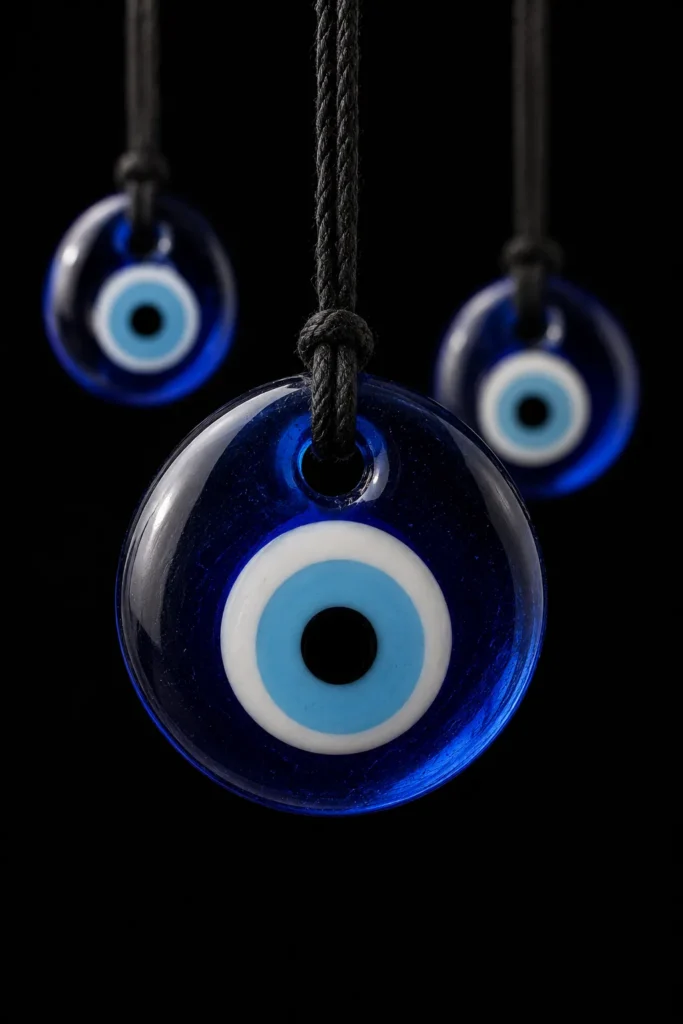
Against the evil eye, an entire range of protective objects has developed over millennia. The best known today is probably the nazar boncuğu, the Turkish blue glass eye with concentric circles in blue, white, and black.
It is regarded as the image of the evil eye itself, reflecting harm back through mirroring. In the Greek cultural sphere it is the mati, often worn as a small blue eye on a chain or bracelet.
The Hamsa, the hand of Fatima or Chamsa, belongs to the same protective family. It is often depicted with an eye at its center, which doubles the protective effect. Regionally specific objects are also found, such as the Italian cornicello, a twisted horn of coral or gold worn in southern Italy against malocchio.
In Jewish folk tradition, red threads are added, worn on the wrist or attached to baby cradles. In the South Asian world, black dots made of coal are painted by mothers on their baby’s forehead, small deliberate imperfections intended to deprive the observer’s eye of any reason for envy.
Iconography of the protective eye
The nazar boncuğu has its own visual language. The concentric circles in blue, light blue, white, and a black dot at the center form an eye that mirrors the observer back.
Glassblowing workshops in the Turkish city of Izmir and its hinterland have refined the form over centuries. Similar eye objects exist in the Persian, Greek, and Armenian worlds; all share the basic idea of an apotropaic mirror.
In modern jewelry design, the eye has developed into a universal motif, appearing in collections from America to Australia, often without the wearers knowing the original religious background.
Warding gestures
In addition to objects, many cultures know warding gestures.
In southern Europe the mano fica is a fist with the thumb tucked between the index and middle finger; in southern Italy there is also the mano cornuta with the index and little finger extended and the middle fingers folded in. Both gestures serve as protective formulas.
In Jewish and Islamic traditions, spitting, often three times in symbolic suggestion, is an act of warding off an unwanted compliment. Salt on the threshold belongs to Mediterranean as well as northern European protective gestures.
Classification in religious studies
Scholarly engagement with the evil eye began in the 19th century with ethnological travel accounts, but only established itself as a serious folklore field through the studies of Alan Dundes in the 1980s. His anthology The Evil Eye, A Folklore Casebook of 1981 brings together thirty essays from various cultural contexts.
Clarence Maloney provided a comprehensive ethnological synthesis in 1976 with The Evil Eye. John H. Elliott examined the phenomenon in the biblical world in his four-volume series Beware the Evil Eye.
These studies do not dismiss the belief as superstition but treat it as a coherent cultural system that fulfills social functions, above all the management of envy in communities with scarce resources.
Pop culture and fashion
Since the 2010s, the blue eye has become one of the most successful jewelry motifs in the Western mainstream. Kim Kardashian displays it regularly in public, Gigi Hadid wears it, and young brands from Istanbul, Athens, and Tel Aviv export it worldwide.
The connection between fashion and the original protective meaning has often been lost in the process, which has prompted criticism from some cultural historians and representatives of the cultures of origin.
At the same time, the trend shows that the symbol holds a significance for modern wearers that goes beyond pure fashion. The eye as a reminder of the possibility of envy and of the desire for a protective gesture is evidently a concept that does not disappear even in a secularly and scientifically shaped world.
Classification in the iwell-guard lexicon
The evil eye is a cross-cutting entry in the iwell-guard lexicon. It connects protective objects from multiple cultures and provides the shared functional background for many wearable protective items, from Pazuzu pendants to Bes figurines, the Hamsa, and the Mezuzah.
Understanding the evil eye as a concept also helps to understand why these protective objects have been worn across so many cultures over such a long period of time.
Literature and sources
- Alan Dundes (ed.): The Evil Eye, A Folklore Casebook. Garland Publishing, New York 1981.
- Clarence Maloney (ed.): The Evil Eye. Columbia University Press, New York 1976.
- John H. Elliott: Beware the Evil Eye, The Evil Eye in the Bible and the Ancient World. 4 volumes, Cascade Books 2015 to 2017.
- Plutarch: Quaestiones Convivales 5,7. Ancient discussion on the mechanism of effect.
- Pliny the Elder: Naturalis Historia 7,16. Ancient accounts of eye-caused harm.
- Babylonian Talmud, Bava Metzia 107b. Rabbinic discussion of ayin hara.
- Edward Westermarck: Ritual and Belief in Morocco. Macmillan, London 1926. Early study of the Maghreb.
External links for the detail page:
- JSTOR entry Dundes 1981
- Encyclopaedia Iranica entry “Cheshm-zakhm” on the Persian term
- Encyclopaedia Judaica entry “Evil Eye”
- British Museum, collection of apotropaic eye amulets
- Musée du Quai Branly Paris, collection of protective objects from the Mediterranean region
Comparing the terms ayin hara, mati, malocchio, and nazar shows that the evil eye is not an isolated concept belonging to a single culture, but rather an interpretive pattern for envy, harm, and misfortune that is widespread across the Mediterranean, the Near East, and southern Europe.
The comparison reveals different protective practices, amulet forms, and ritual countermeasures, each anchored in religious and linguistic history.