Vajrakilaya, god of the Tibetan tradition
By Ralf Ittermann · last reviewed on
Vajrakilaya (Dorje Phurba in Tibetan) is a wrathful yidam of the Tibetan Buddhist schools, especially the Nyingma tradition. Depicted with three faces and six arms, he carries the magical ritual dagger (phurba). His practice serves to overcome inner and outer obstacles.
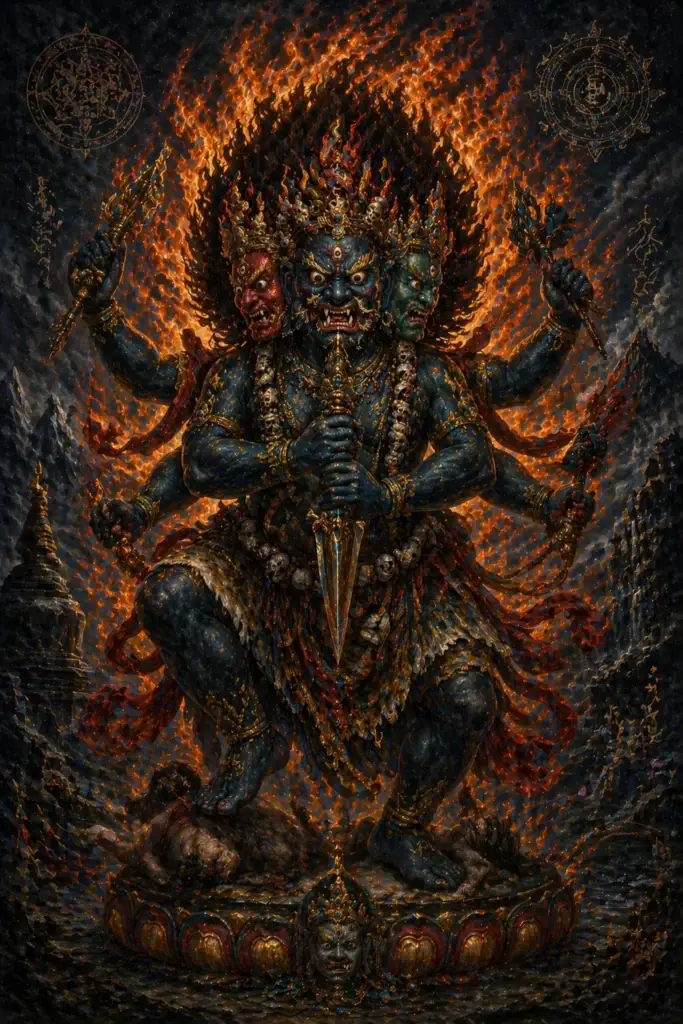
Vajrakilaya
Vajrakilaya is invoked in meditations to penetrate resistances and to destroy illusion. The phurba weapon symbolizes diamond-clear cognition. His black or indigo-colored form and his ritual-magical practices are central in Tantric Buddhism. Temples and sacred places are protected through the placement of phurbas.
Type: Vajrayana Buddhist wrathful yidam, „vajra dagger“ subduer of obstacles
Pantheon: Tibetan Buddhism (especially the Nyingma and Sakya traditions)
Function: Destruction of demonic obstacles, special protection for Padmasambhava’s Dharma tradition
Main attributes: Three heads (variously colored), six arms, phurpa dagger (Vajrakilaya symbol), tiger-skin loincloth
Main cult sites: Principal Nyingma monasteries, especially Mindrolling, Pelyul, Dorje Drak
Tibetan: Dorje Phurba („vajra dagger“)
Context
Vajrakilaya (Sanskrit, „vajra dagger“) is one of the most important wrathful yidams of the Vajrayana tradition. Mythological root: Padmasambhava (8th c. CE) uses the Vajrakilaya practice to destroy the obstacles to his mission of establishing Buddhism in Tibet.
Main flourishing period of the Vajrakilaya tradition: from the 8th c. in the Nyingma school, later also adopted by Sakya. In every Nyingma lineage one of the three root yidams: Eight Sadhana Teachings (Kagye), Vajrakilaya, and another yidam tradition.
Main cult sites: all principal Nyingma monasteries with their own Vajrakilaya sadhana traditions (Mindrolling, Pelyul, Dorje Drak, Kathok, Shechen). Mindrolling in particular as the largest seat of Vajrakilaya practice.
Present in many Nyingma monastic complexes in Bhutan and Nepal. Internationally present in Nyingma centers worldwide. Vajrakilaya drub-chen (large ten-day practice gatherings) take place annually in many monasteries.
Central sources: Vajrakilaya Tantra, various Terma texts (teachings hidden by Padmasambhava and later rediscovered by tertöns). Main lineages: Northern Treasure (Jangter), Southern Treasure (Lhoter), Mindrolling lineage.
Secondary literature: Mayer, A Scripture of the Ancient Tantra Collection. The Phur-pa bcu-gnyis; Boord, The Cult of the Deity Vajrakîla; Lopez, Religions of Tibet in Practice; Linrothe, Ruthless Compassion.
Designation and Spellings
Vajrakilaya is depicted with particular iconographic elements that are symbolically encoded and carry deep meaning. These elements centrally convey the functions, sources of power, areas of responsibility and cosmic role of this entity.
The visual system allows initiates and the culturally educated to grasp the deeper meaning. Colors, sacred objects or weapons, bodily attributes, specific accessories, all are significant and traditionally transmitted. The system remains stable and recognizable across generations, which points to fundamental archetypal structures.
Description
Vajrakilaya was central to the religious practice and everyday understanding of Tibet. People turned to this entity in critical situations or at particular ritual times of the year, with structured rituals, prayers or offerings. The practice was precisely transmitted and often led by priests or specialists.
The continuity of these practices over many generations shows that they were regarded as effective and necessary. The functions were manifold: preventive (warding off misfortune), healing (alleviation of suffering), transformative (accompaniment through transitions) and protective (continuous watch).
Profile: Vajrakilaya
The most important aspects of Vajrakilaya at a glance. The following fields summarize origin, function, appearance, veneration, symbols and cultural parallels.
Vajrakilaya is the wrathful manifestation of the enlightened activity of all Buddhas. In tantric theogony, he arises from the uncreated Buddha mind. Main myth: Padmasambhava travels to Yangleshö (near Pharping in the Kathmandu Valley, Nepal) and meditates there on Vajrakilaya in order to subdue the demons that seek to prevent his mission in Tibet.
From this meditation arises the Vajrakilaya practice, which he later transmits further in Tibet and preserves in the form of termas (hidden treasure teachings) for future generations.
Destroyer of all demonic obstacles. Special protection for the Padmasambhava lineage and for practitioners of the highest Vajrayana levels. In a personal practice context: the phurpa (Dorje Phurba) symbolizes the piercing of the three root poisons (desire, hatred, ignorance) within the practitioner, not an external enemy, but the inner obstacles. Patron of the tertön tradition.
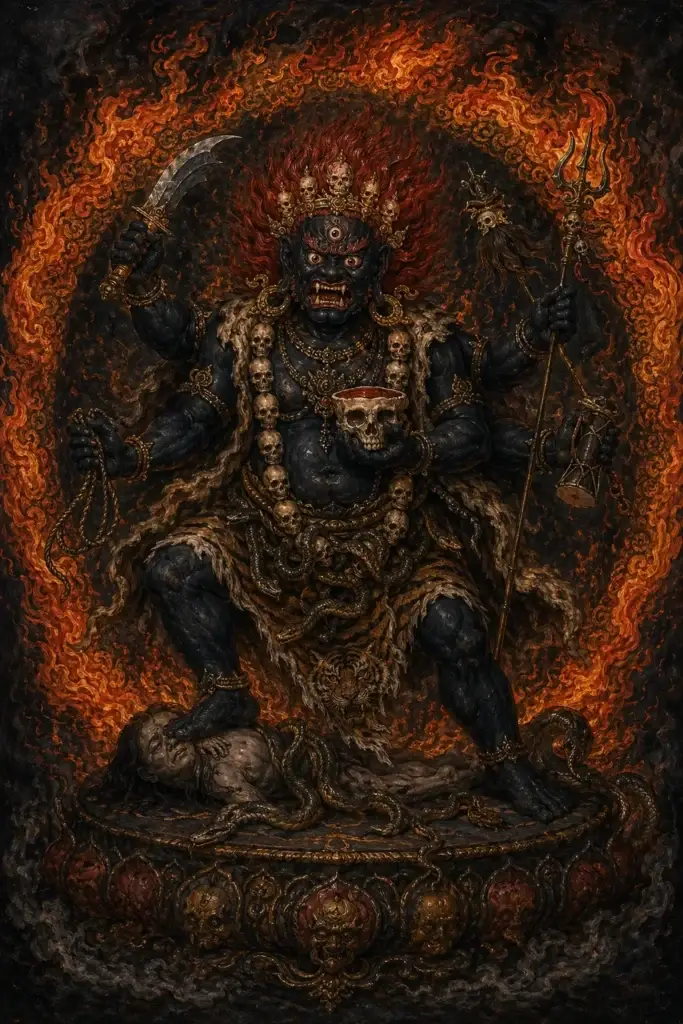
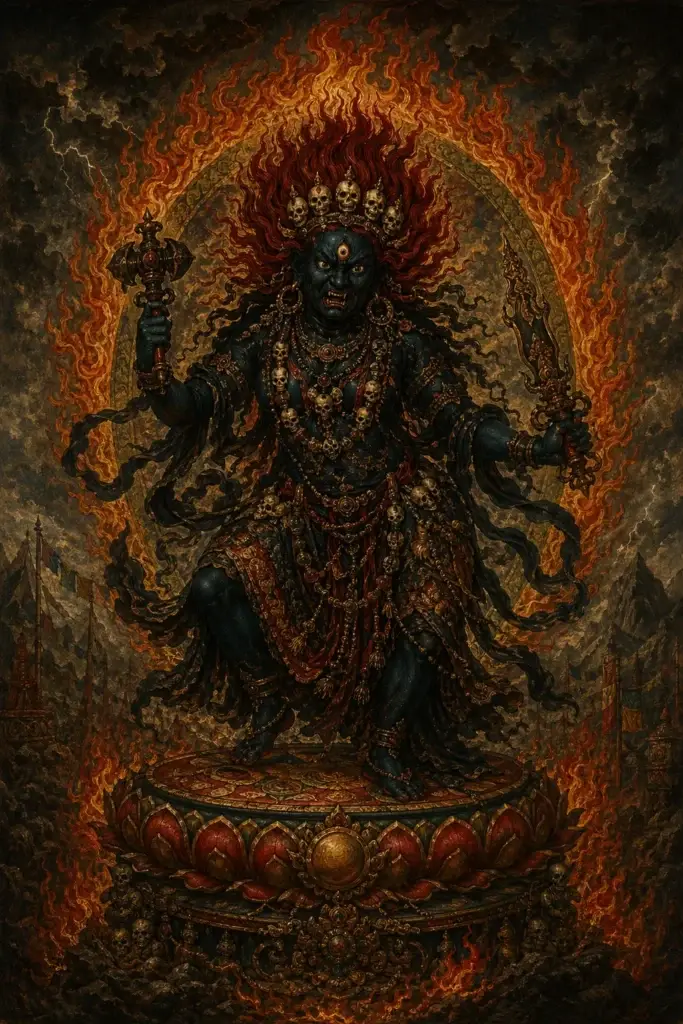
Wrathful male body, very muscular, three heads in different colors (main head dark blue, right white, left red), each with three eyes and a gaping mouth.
Six arms: in the upper hands phurpa daggers (Vajrakilaya’s special tool, three-edged ritual daggers), in the lower hands khatvanga, skull cup, trishula. Tiger-skin loincloth, bone ornaments. In yab-yum form with his consort Diptachakra. He stands in a dynamic bow-step pose upon vanquished demonic beings, within a flaming aureole.
Sphere of action: Vajrakilaya is venerated in every Nyingma monastery. Drub-chen (large ten-day practice gatherings) carry out communal Vajrakilaya practices. He is central in the personal tantric practice context, especially in the removal of obstacles before important phases of practice.
The phurpa dagger itself is a sacred tool that is used ritually in Vajrakilaya practice; tantric practitioners often carry smaller phurpa pendants as protective amulets.
Phurpa (three-edged ritual dagger, main attribute), three heads (dark blue, white, red), six arms, khatvanga (skull scepter), skull cup (kapala), trishula, tiger-skin loincloth, bone ornaments, flaming aureole. In yab-yum form: consort Diptachakra. Sacred plants: none specific. Sacred mantra: Om Vajra Kili Kilaya Sarvabighân Vâm Hūm Phat.
Padmasambhava (Buddhism, his principal practitioner), Mahakala (Buddhism, related wrathful form), Yamantaka (Buddhism, related wrathful yidam), Hayagriva (Buddhism, related wrathful form), Bhairava (Hinduism, root concept).
Functionally unique through the phurpa symbolism, the tool of inner piercing as the main attribute. Global peg/dagger symbolism for the removal of obstacles exists in several traditions, but is unique in Vajrakilaya’s depth and specificity.
Defense in Everyday Life
Veneration rituals
Vajrakilaya (Tib. Dorje Phurba) is one of the most powerful wrathful yidam deities of Tibetan Vajrayana, especially central in the Nyingma school, but also venerated in Sakya. Padmasambhava (Guru Rinpoche, 8th c.) is regarded as the chief propagator of this practice in Tibet.
The Vajrakilaya sadhana comprises complex phurba visualizations, vase initiations (bumpa) and tantric chants. The main practice days are the 10th and 25th day of the lunar month (tshes-bcu) (cf. Boord, The Cult of the Deity Vajrakila).
Mantras
The main Vajrakilaya mantra „Om Vajra Kīli Kīlaya Sarva-Vighnan Bam Hūm Phaṭ“ is recited for the removal of obstacles. The root sadhana derives from the Vajrakilaya-mūla-tantra. Padmasambhava’s Vajrakilaya practice instruction in the Khandro Nyingthig collection is the standard text.
Amulets and protective symbols
Phurba (three-winged ritual dagger, 8 to 30 cm) of bronze, iron or wood, a central ritual instrument. Tibetan protective amulets (srung-ba) with rolled-up Vajrakilaya mantras in copper cylinders are worn around the neck. Wrathful Vajrakilaya as a three-headed, six-armed deity upon prostrate demon bodies.
Vajrakilaya, Parallels in Other Cultures
Jewish tradition: The archangel Uriel with the flaming sword and the concept of the golem-creator share with Vajrakilaya the wrathful protective function and the penetration of the demonic.
Greco-Roman world: Ares as god of war and Apollo as averter of plague carry aspects of wrathful power, yet not the same meditative-magical structure as Vajrakilaya.
Germanic tradition: Donar/Thor with his hammer and the Valkyries with their spears share aspects of the weapon as a destroyer of obstacles, though in a less tantric-inward dimension.
Hinduism: Kali, Bhairava and Chamunda as wrathful forms embody similar wrathful, obstacle-destroying energy in Hindu Tantra traditions.
The Ritual Dagger and the Name Vajrakilaya
The name Vajrakilaya, in Tibetan Dorje Phurba, is composed of two images. Vajra, Tibetan dorje, denotes the diamond scepter, the emblem of the indestructible, awakened mind.
Kilaya, Tibetan phurba, is the three-edged ritual dagger or peg. The name thus combines the symbol of unshakable enlightenment with the tool that holds fast, fixes and pierces.
This connection is fundamental to understanding Vajrakilaya. The deity is conceived from its ritual implement. The three-edged dagger, the phurba, is used in Tantric Buddhism to bind harmful forces to a place and to subdue them there.
The three sides of the blade are interpreted as the overcoming of the three root poisons, that is, desire, hatred and delusion. Vajrakilaya is, as it were, the deification of this tool and its function: the embodiment of awakened power that pierces and pins down destructive tendencies.
Vajrakilaya is among the most important wrathful deities of Tibetan Buddhism, especially of the Nyingma school, but also of the Sakya tradition. He is counted among the eight Herukas of the Kagye, the collection of eight sadhana teachings traced back to Padmasambhava.
His significance lies in the fact that his practice is regarded as especially effective against severe obstacles. In a tradition that does not deny obstacles but works on them vigorously, Vajrakilaya holds a firm place among the powerful protective practices.
Padmasambhava and the Transmission of the Phurba Practice
The Tibetan tradition closely links Vajrakilaya with Padmasambhava, the eighth-century Indian master who, according to tradition, anchored Buddhism in Tibet.
According to the accounts, Padmasambhava practiced the Vajrakilaya practice in present-day Nepal, in a cave near the Asura Cave close to Pharping, and with its help overcame severe obstacles that stood in the way of his work.
This narrative is not merely a saint’s legend but establishes the authority of the entire Vajrakilaya tradition in Tibet.
Padmasambhava is said to have passed the teachings on to his closest disciples, among them the Tibetan master Yeshe Tsogyal, who in the tradition is regarded as a companion in the circle of King Trisong Detsen and in the Nyingma tradition as the keeper and transmitter of many teachings.
Through this lineage and through later rediscovered treasure texts, the Terma, the practice branched into numerous lines of transmission.
Research into Tibetan religious history, such as the work of Robert Mayer and Cathy Cantwell, has examined the textual history of the Vajrakilaya tantras in detail.
It shows that the tradition goes back to an Indian core, but was greatly expanded in Tibet, where it grew into one of the richest collections of ritual literature of all.
This branching explains why there is not one single Vajrakilaya form, but many, which differ in details of the iconography and the sadhana. Those interested in related wrathful deities will find further examples of this density of transmission in the milieu of the Tibetan schools.
Iconography and the Meaning of the Wrathful Form
In Tibetan art, Vajrakilaya appears as an extremely wrathful figure, usually dark blue, with several heads, six arms and wings. His lower body often tapers into the form of the three-edged dagger, so that the deity and its tool merge pictorially.
In his hands he holds vajra, flames and the phurba. He stands or strides upon prostrate figures that personify the subdued obstacles. He is frequently depicted in union with his consort, which in the tantric pictorial understanding expresses the inseparability of method and wisdom.
According to the tradition’s own self-understanding, the wrathful appearance is not an expression of anger. It is interpreted as an active, vigorous form of compassion that intervenes where gentle means do not suffice.
The terrifying quality of the figure is directed not against living beings but against the inner forces, desire, hatred and delusion, that block the path to liberation. This interpretation is important, because the wrathful deities of Tibetan Buddhism are easily misunderstood from the outside.
The ritual practice of Vajrakilaya comprises visualization, mantra recitation and the handling of the phurba, in part also larger monastic rituals with dance and offerings. According to traditional understanding, it presupposes an empowerment by a qualified teacher and a corresponding preparation.
The material transmission ranges from thangka paintings through bronze figures to the artfully crafted ritual daggers themselves, which may be made of metal, wood or bone and are regarded in the monasteries as consecrated objects.
The close connection of deity, image and implement makes Vajrakilaya an illuminating example of the tantric understanding of ritual objects.
Further Links
Sources and Literature
Further standard works in the literature index.