Krishna: Avatar of Vishnu and Teacher of the Bhagavadgita
By Ralf Ittermann · last reviewed on
In Hinduism, Krishna is regarded as the eighth avatar of Vishnu and at the same time as an independent supreme deity. As teacher of the Bhagavadgita and hero of the Mahabharata, he shapes Bhakti devotion to this day. His figure combines cosmic theology with accessible personal devotion.
Classification
Krishna ranks among the most significant figures of Hinduism. In the classical doctrine of the ten principal incarnations of Vishnu, the so-called Dashavatara, he is listed as the eighth avatar.
At the same time, his standing clearly exceeds this classification: in important theological currents, particularly within Krishna Bhakti and the Gaudiya tradition, he is regarded not as a mere partial manifestation but as Svayam Bhagavan, the supreme deity itself, from which the other avatars proceed.
This dual position makes Krishna especially instructive from the perspective of religious studies. He is anchored both in the expansive narrative works of the epic and is an object of systematic theology.
The sources range from the Mahabharata through the Bhagavadgita to the Purana texts, above all the Bhagavata Purana, which elaborates the stories of his childhood and youth in detail.
For the history of religion, Krishna is a key to understanding the Bhakti movement, that form of devotion which places personal, emotionally borne devotion to a deity at its center. Over the centuries, the veneration of Krishna has deeply shaped regional languages, poetry, music, and dance in India.
Historical research assumes that several older strands of tradition converged in the figure of Krishna. A distinction is usually made between a heroic Krishna Vasudeva, connected with the region around Mathura and the Vrishni clan, a divine cowherd from the pastoral traditions around Vrindavan, and a childlike Krishna of the later Purana literature.
Inscriptional evidence from the pre-Christian era, such as the Heliodorus pillar near Besnagar, attests a Vasudeva cult already in the second century BCE. The merging of these strands into a unified figure extended over many centuries and was largely complete only with the Bhagavata Purana.
Name and Etymology
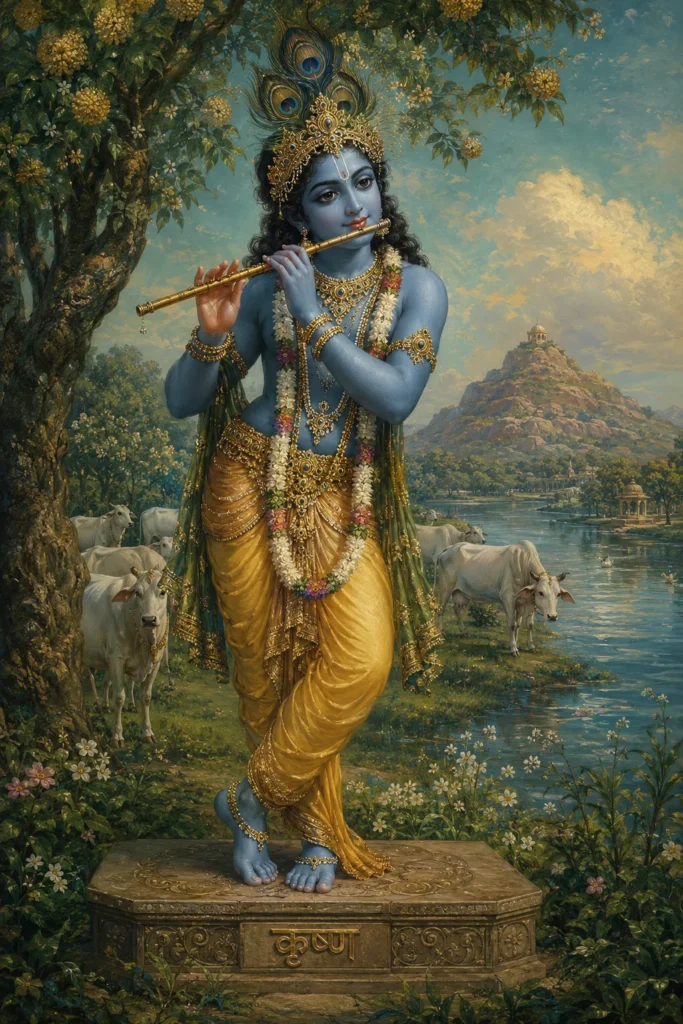
The name Krishna means literally in Sanskrit the dark one, the black one, or the dark blue one. It refers to the characteristic skin color with which the figure is depicted in text and image.
This color is interpreted variously in the tradition, for instance as a sign of the immeasurable and incomprehensible, or as a reference to the dark blue of the vast sky and the ocean.
Krishna bears a large number of epithets, each highlighting particular aspects of his activity. Govinda and Gopala refer to his role as a cowherd. Vasudeva designates him as son of Vasudeva.
Madhava and Kesava are further common forms of address, referring partly to defeated adversaries and partly to his connection with Vishnu. Murari names him the conqueror of the demon Mura, Damodara recalls the episode in which the foster mother Yashoda binds the child to a mortar with a rope.
The diversity of names is no coincidence but an expression of the theological idea that the individual designations open up different levels of relationship between the devotee and the deity. In Bhakti practice, the repeated utterance of the divine names, the Nama-Japa, holds central significance.
Collections such as the Vishnu-Sahasranama, which enumerate a thousand names, serve meditative recitation. In the Gaudiya tradition, the name itself is held to be not different from the deity, so that its invocation is understood as the immediate presence of Krishna.
Description and Iconography
The pictorial tradition mostly depicts Krishna as a youthful, graceful figure with dark blue skin. Characteristic are the transverse flute in his hands, a peacock feather in his hair, and a yellow garment.
He often stands in a slightly bent posture, the so-called Tribhanga, the threefold bend of head, torso, and legs, which lends his appearance liveliness and movement.
The depiction changes according to life stage and narrative context. As a child he appears crawling with a lump of butter in his hand, as a youthful cowherd surrounded by the cowherd girls, the Gopis, as a mature prince in royal ornament, or as Arjuna’s charioteer on the battlefield.
In the latter scene his role as teacher of the Bhagavadgita comes to the fore.
Important accompanying figures are his companion Radha, who in later theology becomes the embodiment of supreme devotion, as well as his elder brother Balarama. Attributes such as the discus Sudarshana and the conch shell connect Krishna iconographically with Vishnu and underscore the identity of the two figures.
Regional pictorial traditions have developed their own emphases. In the North Indian miniature painting of the schools of Kangra, Mewar, and Basohli, Krishna appears above all as a lover in the round dance with the Gopis, embedded in a stylized landscape.
In South Indian bronze art, the dancing Krishna or the child Krishna reaching for the butter predominates. In the temples of the Pushtimarga tradition he is venerated as Shri Nathji in a distinct image form lifting Govardhana. This iconographic diversity shows how closely image and theological interpretation are linked in the veneration of Krishna.
Mythological Narratives
The narratives surrounding Krishna comprise a broad spectrum of episodes that can be roughly divided into childhood, youth, and his later activity as prince and counselor.
According to the transmitted account, Krishna is born to remove the tyrannical king Kamsa, to whom it had been prophesied that he would die at the hands of a child of his sister. To protect the newborn, he is brought on the night of his birth to foster parents in the cowherd village of Gokula.
Numerous wondrous deeds are transmitted from his childhood. Krishna subdues the serpent Kaliya, which had poisoned a stretch of the Yamuna, by dancing on its heads.
He lifts Mount Govardhana like an umbrella to protect the pastoral community from a storm sent by Indra, thereby teaching them to venerate the nearby natural world rather than a distant sky god.
As a child he kills a series of demons whom Kamsa sends out, among them the nurse Putana and the whirlwind demon Trinavarta. A frequently cited scene shows how the foster mother Yashoda beholds the entire universe in the child’s mouth.
The stories of his youth in the region around Vrindavan describe his play with the Gopis. The nocturnal round dance, the Rasa-Lila, in which Krishna multiplies himself so that each Gopi believes him to be at her side, is interpreted in Bhakti theology as a symbol of the union of soul and deity.
The love between Krishna and Radha, developed above all in the poetry of the Gitagovinda by Jayadeva, is regarded as the highest expression of the devoted relationship. Finally Krishna leaves Vrindavan to move to Mathura and kill Kamsa.
In the Mahabharata, Krishna appears as an ally of the five Pandava brothers. His best-known appearance is the instruction of Arjuna before the great battle of Kurukshetra. Arjuna hesitates to fight against relatives and teachers.
In the Bhagavadgita, a section of the epic, Krishna sets out for him the fulfillment of duty, the paths of action, of knowledge, and of devotion, as well as the permanence of the soul.
In the eleventh discourse he shows Arjuna his cosmic universal form, the Vishvarupa, in which the entire world simultaneously arises and passes away. This text is among the most commented religious works of India.
Krishna’s later life is marked by the founding of the city of Dvaraka, by kingship, and finally by the downfall of his clan. After the battle, the people of the Yadava disintegrate in internal struggles.
His death by an arrow that strikes him by accident in the foot ends his earthly period of activity and ushers in, according to traditional chronology, the beginning of the present world age, the Kali-Yuga.
Cult and Veneration
The veneration of Krishna is very differently pronounced from region to region and has produced numerous schools over the course of history. In North India, the pilgrimage sites of Vrindavan and Mathura are central points of reference, since they are connected with his childhood and youth.
In West India the temple city of Dvaraka is significant; in the south, the temple of Udupi, among others, is considered an important center; in the east the Jagannath temple of Puri, in which Krishna is venerated in an independent image form.
In Maharashtra, the temple of Pandharpur with the figure of Vithoba, a form of Krishna, is an important pilgrimage site of the Varkari movement.
Several Bhakti traditions are theologically foundational. The Gaudiya Vaishnava school, shaped in the sixteenth century by Chaitanya, emphasizes loving devotion and the communal singing of the divine names, the Sankirtana. The Pushtimarga tradition, which goes back to Vallabha, places service to the child Krishna at its center.
The school of Nimbarka interprets the relationship of Radha and Krishna philosophically. Alongside these stand older currents that interpret Krishna within the framework of general Vishnu veneration. The theological question of whether Krishna is an avatar of Vishnu or himself the supreme deity divides these schools to this day.
The festivals of the yearly cycle shape public devotion. Janmashtami celebrates the birth of Krishna with nocturnal devotions, the breaking of the fast, and in some regions the custom of seizing a high-hung pot of butter.
Holi, the spring and color festival, is closely connected with the love games of Krishna and the Gopis. In Vrindavan and Mathura, the Ras-Lila is performed as ritual theater, in which young performers embody episodes from the life of Krishna.
The veneration of Krishna has produced a rich artistic culture.
This includes religious poetry in regional languages, such as the songs of Surdas in the Hindi area or those of Mirabai in Rajasthan, as well as miniature painting, temple theater, and classical dance forms such as Kathak, in which episodes from the life of Krishna are performed.
These artistic forms of expression are not mere additions but are themselves part of religious practice.
Theological Classification
The theological interpretation of Krishna moves between two poles. On the one side stands the avatar doctrine as the Bhagavadgita formulates it: Vishnu takes on an earthly form whenever the right order, the dharma, decays and injustice gains the upper hand.
In this view, Krishna is the eighth of a series of descents whose purpose is the protection of the pious and the restoration of world order.
On the other side stands the doctrine of Svayam Bhagavan, according to which Krishna is not part of a series but its origin, from which Vishnu himself also proceeds.
With this elevation is connected the theology of Bhakti. It distinguishes various basic attitudes in which the devotee can turn to the deity, for instance as servant, as friend, as parent, or as lover.
The Gaudiya tradition rates the loving devotion of the Gopi as the highest of these attitudes, because it seeks nothing for itself. Radha thereby becomes the embodiment of this perfect devotion and at the same time the feminine side of the divine.
From the perspective of religious studies, it is noteworthy that Krishna theology makes play, the Lila, a central concept. The activity of the deity is understood not as purpose-bound action but as free, purposeless play.
Creation too appears in this interpretation as Lila. The ethical question of how the love play with the Gopis relates to moral order was answered in the tradition by the distinction between divine play and human norm, yet remained an object of ongoing interpretation.
Parallels in Other Cultures
Comparative religious studies has related various motifs in the Krishna material to narratives of other cultures.
The motif of the threatened divine child who is brought to safety from a ruler to whom his downfall has been prophesied is found in numerous traditions, for instance in the childhood story of Moses or in ancient heroic legends.
Such parallels prove no direct dependence but point to recurring narrative patterns that are described in research as myth types.
Within the Indian religious sphere, Krishna is closely tied to the figure of Vishnu, from whom he proceeds as avatar. Relationships also exist with other pastoral deities and with figures who combine cosmic order and personal attention.
The contrast with Shiva makes it possible to describe two different theological emphases of Hinduism, the ascetic pole of Shiva and the world-affirming, playful pole of Krishna.
The motif of the divine cowherd who is at once lover and ruler was compared in older research with Mediterranean pastoral deities.
The devoted love mysticism of Krishna Bhakti has also prompted scholars of religion to comparisons with mystical currents of other religions. Such comparisons are conducive to insight but must preserve each tradition’s own doctrinal logic.
Earlier Western interpretations that classified Krishna broadly as a love or nature deity are today regarded as reductive. Recent research instead emphasizes the historical complexity of the figure, in which older local traditions, epic heroic legend, and systematic theology have converged.
Contemporary Reception and Research
Krishna is extraordinarily present in contemporary Indian culture. His stories appear in film, television, comics, and digital media. The multi-part television adaptations of the Mahabharata and dedicated Krishna series reached audiences of millions.
Janmashtami is observed as a public festival in many regions. The Bhagavadgita is read and commented on as a philosophical text far beyond religious circles.
Through reform movements of the nineteenth and twentieth centuries as well as through international Krishna Bhakti organizations, the veneration has also found dissemination outside India. The International Society for Krishna Consciousness, founded in 1966, carried the Gaudiya tradition into Western countries.
From the perspective of religious studies, the question is discussed of how transmitted traditions change under the conditions of globalization and migration and how such movements relate to their Indian origins.
Academic research examines Krishna from text-historical, philological, and social-historical perspectives. At the center stand the emergence and stratification of the sources, the question of the historical roots of the Vasudeva cult, the development of Bhakti theology, and the role of regional cults.
Also examined is how the veneration of Krishna crossed social boundaries, since the Bhakti poetry often deliberately addressed broad, including non-privileged, sections of the population. The figure of Krishna thus remains a central object of Indology and of comparative religious studies.
Literature (Selection)
- Gavin Flood: An Introduction to Hinduism (1996)
- Wendy Doniger: The Hindus. An Alternative History (2009)
- Klaus K. Klostermaier: A Survey of Hinduism (2007)
- John Stratton Hawley: Krishna, the Butter Thief (1983)
- Friedhelm Hardy: Viraha-Bhakti. The Early History of Krsna Devotion in South India (1983)
Related key terms: Krishna Vishnu Bhagavadgita Mahabharata Vrindavan Bhakti Gopis Govinda.
iWell Guard and Protective Traditions
iWell Guard ties in with the cultural-historical tradition of wearable protective objects, in the tradition of Hinduism and many other cultures worldwide. 41 layers, solid gold, platinum, silver, made in Germany. 30-day right of return.
Personal experiences may vary. Not a medical device. No promise of healing.