Vishnu, god of the Hindu tradition
By Ralf Ittermann · last reviewed on
Vishnu is a god of the Hindu tradition.
The preserver of the universe, the thousand-armed god of protection.
Vishnu
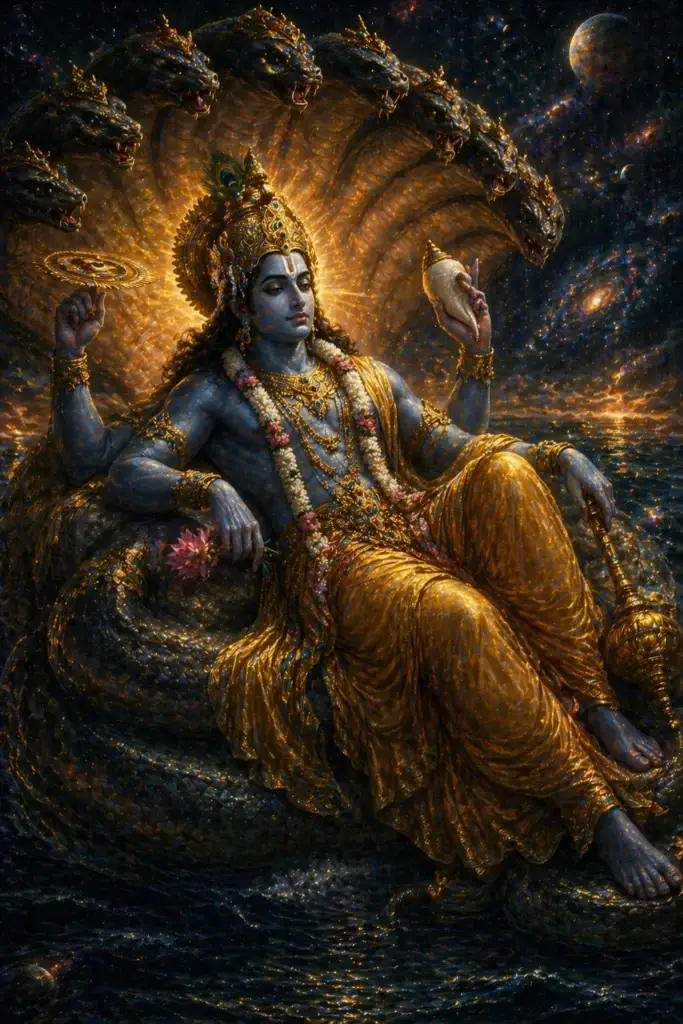
Vishnu is the second god of the Trimurti. While Brahma creates and Shiva destroys, Vishnu preserves and maintains the cosmic order. With his blue skin, the chakra in his hand and resting on his serpent *Ananta*, he embodies stability and grace.
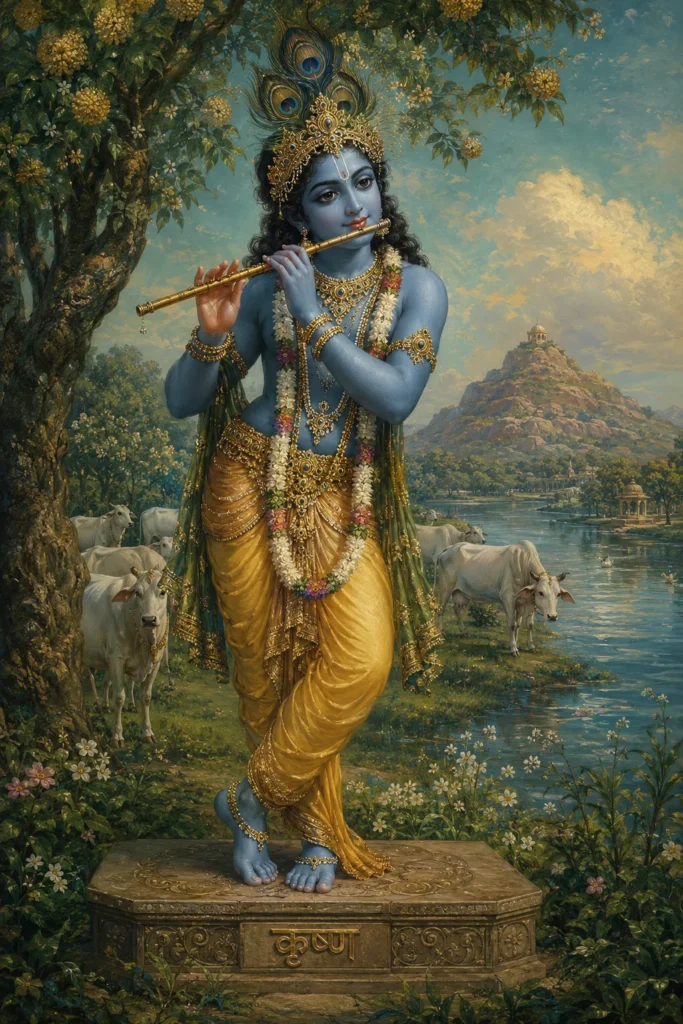
Yet Vishnu is not a static god: he repeatedly incarnates as avataras on earth to combat evil, as Krishna, as Rama, as a fish, as a lion. Faith in Vishnu lies at the heart of modern Hinduism.
Quick overview: Vishnu
Type: Hindu principal deity, preserver of the cosmic order, one of the three gods of the Trimurti
Pantheon: Hinduism (especially Vaiṣṇavism), Buddhism (in syncretistic traditions)
Function: preservation of the world between creation (Brahma) and destruction (Shiva), incarnation as an avatara in times of crisis
Main attributes: four arms holding the conch (Shankha), the discus (Sudarshana Chakra), the mace (Gada) and the lotus (Padma)
Main cult centres: Tirupati (Andhra Pradesh), Srirangam (Tamil Nadu), Vrindavan (Krishna), Puri (Jagannath), Badrinath (Himalaya)
Dašâvatâra: Matsya, Kurma, Varaha, Narasimha, Vamana, Parashurama, Rama, Krishna, Buddha, Kalki
Classification
Period of the texts
Vishnu appears in the Rigveda (1200–900 BCE) as a minor solar god, his principal myth in this early period being the three steps with which he traversed the universe.
He rose to the rank of a principal deity in the Brâhmaṇa texts and especially in the first millennium CE through the Purâṇas. In the Mahabharata (composed c. 4th century BCE to 4th century CE), the Bhagavadgita (Bh.G.) is the central theological text of the Vaiṣṇava tradition: Krishna, the eighth avatara of Vishnu, reveals to Arjuna the teaching of devotion (Bhakti).
The ten avataras (Dašâvatâra) are canonically defined in the Bhâgavata Purâṇa (10th century CE).
The Tirupati temple in Andhra Pradesh is today statistically one of the most-visited religious sites in the world (more than 30 million pilgrims per year); the ISKCON movement (Hare Krishna) has spread the cult of Vishnu-Krishna globally since the 1960s.
Area of distribution
Principal cult sites in India: Tirupati / Tirumala (Andhra Pradesh, Venkateshvara form, the largest pilgrimage magnet in the world), Srirangam (Tamil Nadu, Ranganatha form on the island in the Kaveri, the largest functioning Hindu temple complex in the world), Vrindavan and Mathura (Uttar Pradesh, the region of Krishna avatara’s birth), Puri (Odisha, Jagannath form with the famous Rath Yatra chariot festival), Badrinath (Uttarakhand, the principal Himalayan cult site) and Dwarka (Gujarat, the royal city of Krishna).
The 108 Divya Desams are the most important Vaiṣṇava sanctuaries in the Tamil &Saacute;rî Vaiṣṇava tradition. Internationally there are more than 800 ISKCON temples in more than 100 countries.
Source situation
Central sources: Rigveda (hymns 1.22, 1.154 ff. 7.99–100), Viṣṇu Purâṇa (the principal source for the theogonic tradition), Bhâgavata Purâṇa (the classical Krishna source, twelve Skandhas), Mahabharata (especially the Bhiṣma-Parva with the Bhagavadgita), Ramayana (the principal source for the Rama avatara) and the Pañcarâtra texts (the standard theological Vaiṣṇava collection).
Secondary literature: Hopkins, The Hindu Religious Tradition; Doniger, Hindu Myths; Michaels, Der Hinduismus. Geschichte und Gegenwart; Bryant (ed.), Krishna. A Sourcebook; Matchett, Kṛṣṇa, Lord or Avatâra?; Hawley, Three Bhakti Voices.
Name and variants
Vishnu is typically depicted as a beautiful, dark-blue man, often with four arms. In the upper right hand he carries the chakra (Sudarshana), a sharp-edged discus weapon. In the upper left the conch (Shankha), in the lower right the mace (Gada) and in the lower left a lotus.
Around his neck hangs the gemstone Kaustubha. He rests on the world serpent Ananta or Shesha, or sits in his heaven Vaikuntha. His consort is Lakshmi, the goddess of prosperity.
Description
Vishnu preserves the dharma, the cosmic order and justice. Whenever the world falls into chaos he appears in a new form (avatara) and restores the balance.
Krishna in the Bhagavad Gita teaches duty (dharma); Rama in the Ramayana exemplifies the ideal ruler. Vaishnava veneration is frequently bhakti-oriented, an emotional and devoted love of god. Temple pilgrimages, mantras and feast days (Rama Navami, Janmashtami for Krishna) run through the Hindu year.
Appearance and symbolism
Vishnu is depicted with four arms holding the conch, the discus, the mace and the lotus. His blue or black skin colour refers to the infinite. He often sits on Shesha, the world serpent, or rides the bird Garuda. His paradise Vaikuntha is described as the highest realm.
Profile: Vishnu
The most important aspects of Viṣṇu at a glance. The following fields summarise origin, function, appearance, veneration, symbols and cross-cultural parallels.
Vishnu is one of the three principal deities of the Hindu Trimurti (Brahma as creator, Vishnu as preserver, Shiva as destroyer), a theological concept systematised in the Purâṇas. He is the consort of Lakshmi (prosperity and beauty) and of Bhûmi (earth), two of his shaktis.
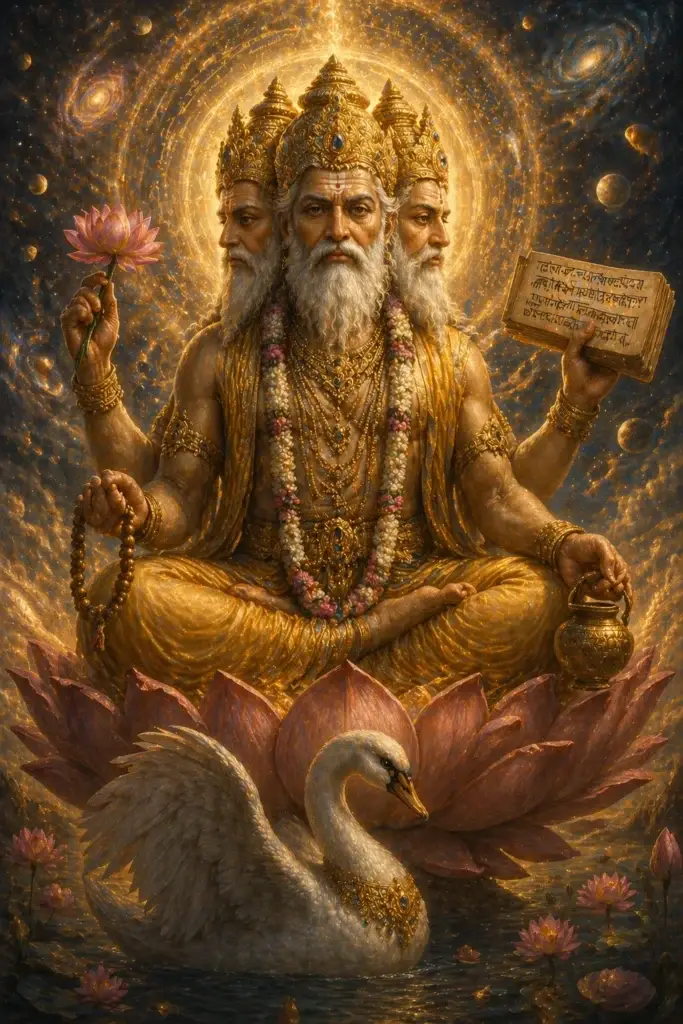
His mount is Garuda, the eagle-man and arch-enemy of the serpents. Vishnu sleeps on the world serpent Šeṣa (also called Ananta, „the endless one“) in the cosmic milk ocean; from his navel springs the lotus on which Brahma sits and creates the next world.
He appears in ten principal avataras (Dašâvatâra): Matsya (the fish, saviour of the deluge), Kurma (the turtle), Varaha (the boar, who lifts the earth), Narasimha (the lion-man), Vamana (the dwarf), Parashurama (the axe-wielding brahmin), Rama (the ideal king), Krishna (the divine lover and teacher), Buddha (integrated as an avatara in one tradition) and Kalki (the future end-time avatara).
Preserver of the cosmic order (dharma). In every Yuga (cosmic age), when the imbalance between dharma and adharma grows too great, Vishnu incarnates in an avatara: Krishna in the Mahabharata war, Rama in the Ramayana, Buddha as a reformer.
In personal bhakti cult the central relationship is one of love between devotee and god; Vishnu is the most important bhakti deity alongside Shiva and Devi.
In the Višiṣṭâdvaita theology of Ramanuja (12th century), Vishnu is the highest Brahman, with whom the individual soul enters a loving union. He is the patron of fulfilling duty at the right moment (Krishna’s teaching in the Bhagavadgita).
Anthropomorphic, as a beautiful young male figure with blue skin (a symbol of cosmic infinity, of sky and sea), four arms, dressed in a golden-yellow dhoti (loincloth) and splendid brocade, with crown and jewellery (the Kaustubha gemstone on his chest, the Vanamâlâ flower garland).
The four attributes symbolise cosmic functions: Shankha (the conch Pâñcajanya, the primordial sound Om), Sudarshana Chakra (the discus, time and fate), Gada (the mace Kaumodaki, intellectual power) and Padma (the lotus, pure creation).
His seated posture is Padmasana on a lotus, or he reclines on the serpent Šeṣa in the milk ocean (the Anantashayana form). In avatara form he appears as Krishna, youthfully beautiful with a flute, as Rama with bow and arrow, as Narasimha lion-headed and wrathful.
Sphere of action: Vishnu is invoked in every phase of life, at birth, marriage, illness and death. Daily pujas are performed in Hindu households at the domestic altar (with a Vishnu or Krishna image or a Shaligrama stone).
Principal festivals: Vaikuntha Ekadashi (December/January), Vamana Jayanti, Krishna Janmashtami (the birth of Krishna, August/September, one of the largest Hindu festivals) and Rama Navami (the birth of Rama).
In the ISKCON tradition the Hare Krishna mantra (Hare Krishna Hare Krishna, Krishna Krishna Hare Hare) stands at the centre of daily practice.
Tirupati receives more than 50,000 pilgrims each day; the voluntary offering of hair (tonsure) makes the temple the largest donor of human hair in the world. In cases of illness, special Vishnu mantras are recited (the Viṣṇu-sahasranâma, the thousand names of Vishnu).
Shankha (the conch Pâñcajanya), Sudarshana Chakra (the discus), Gada (the mace Kaumodaki), Padma (the lotus), Garuda (his eagle mount), the serpent Šeṣa (his resting place in the milk ocean), the Tulsi plant (sacred), the Shaligrama stone (a natural stone as an embodiment of Vishnu), the yellow-golden dhoti, the blue skin colour, the crown and the Kaustubha gemstone.
Sacred numbers: 10 (the avataras) and 1000 (the Sahasranâma). Sacred plants: tulsi (basil), the banyan tree and the lotus.
Krishna and Rama (his own principal avataras with worldwide sub-traditions), Indra (the Vedic royal god, subordinated to Vishnu in the Purâṇas), Bishnu/Bisnu (a Buddhist-Tibetan adaptation), Marduk (Mesopotamia, preserver of the cosmic order, sharing common features with Vishnu), Zeus (Greece, king of the gods as preserver), Iuppiter Optimus Maximus (Rome) and Ahura Mazda (Persia, the cosmic god of truth).
Functionally, every preserver deity that intervenes actively in times of crisis (theophany) shares Vishnu’s functions.
Protection in everyday life
Rituals of veneration
Alongside Shiva and Brahma, Vishnu is the second god of the Trimurti, preserver and protector. The veneration of Vishnu (Vaishnavism) is one of the largest currents within Hinduism. Daily pujas are performed in the temple and at the domestic altar with tulsi leaves, sandalwood paste and cooked rice.
Principal festivals: Janmashtami (the birth of Krishna), Rama Navami (the birth of Rama) and Vaikuntha Ekadashi (in the month of Margashira). Pilgrimage destinations: Tirupati (Andhra Pradesh), Puri (Jagannath) and Vrindavan (Krishna).
Mantras and invocations
The Ashtakshara mantra „Om Namo Narayanaya“ (Narayana Upanishad) is the central mantra of Vaishnavism. The Vishnu Sahasranama (the thousand names from Mahabharata 13.149) is recited daily. The Bhagavad Gita (Mahabharata 6.23-40) is considered the central Vishnu/Krishna theology. The Vishnu Purana and the Bhagavata Purana are the canonical narrative texts.
Amulets and protective symbols
The tulsi mala (a necklace of tulsi wood) and saligram stones (black ammonite fossils from the Gandaki river in Nepal) are Vishnu’s sacred stones.
Shankha (the triton conch), Chakra (the discus), Gada (the mace) and Padma (the lotus) are his four symbols. The urdhva pundra (three vertical forehead lines in white, yellow and red) is the Vaishnava identifying mark.
Vishnu, parallels in other cultures
Vishnu’s role as preserver resembles that of Zeus among the Greeks (the keeper of the world) or that of Odin among the Northern Europeans (who wanders in many forms).
His incarnations recall the incarnation of Christ, yet they are more numerous and continuous. In modern Western esoteric traditions Vishnu is sometimes understood as an archetype of grace and redemption. The Bhagavad Gita is a philosophical classic well beyond the bounds of Hinduism.
The teaching of the avataras
A central element of Vishnu theology is the teaching of the avataras, the “descents”. It holds that Vishnu embodies himself in a particular form in the world whenever the cosmic and moral order, the dharma, is threatened.
The classical formulation of this idea stands in the Bhagavadgita (chapter 4), where Krishna explains that he creates himself anew from age to age in order to protect the good, destroy the evildoers and restore the dharma.
The most widespread enumeration recognises ten principal avataras, the dashavatara.
They include the fish Matsya, who survives the flood; the turtle Kurma; the boar Varaha; the man-lion Narasimha; the dwarf Vamana; Parashurama; Rama, the hero of the Ramayana; Krishna; in many lists the Buddha; and Kalkin, the still-awaited avatara at the end of the present age.
The number and composition of the list nevertheless varies between texts and traditions. Some sources count more avataras, others arrange them differently. The inclusion of the Buddha is regarded by scholarship as a process by which a competing religious figure was theologically classified and appropriated.
In terms of the study of religion, the teaching of the avataras explains how Vaishnavism was able to integrate numerous originally independent regional and mythical figures into a unified system.
Krishna and Rama, each of whom possesses his own large cult and narrative tradition, are thus understood as manifestations of the one Vishnu. The doctrine is therefore an effective theological instrument of integration. Separate entries treat the most important avataras, for example Krishna and Rama.
Iconography: attributes, mount and companions
The pictorial depiction of Vishnu is strongly fixed and rich in meaning. The god is usually shown with four arms in which he holds his characteristic attributes. These include the conch shankha, the discus chakra bearing the name Sudarshana, the mace gada and the lotus blossom padma.
Each of these attributes carries a symbolic meaning; the discus, for instance, is regarded as a weapon against the powers of disorder, and the conch is associated with the primordial sound.
Vishnu’s skin colour is described as dark blue or blue-black, recalling the vastness of sky and ocean. On his chest he often bears the curl shrivatsa and the jewel kaustubha. His mount is Garuda, a mighty eagle-like being, half man and half bird.
A second, equally widespread pictorial form shows Vishnu reclining. In this depiction, often called Anantashayana, he rests on the many-headed world serpent Shesha or Ananta, which floats on the cosmic primordial ocean. From his navel grows the lotus on which Brahma sits. At his feet his consort Lakshmi is often seated.
These iconographic conventions have remained remarkably stable since antiquity and are found at temples throughout South Asia and in the South-East Asian sphere of influence.
One of the most famous surviving pictorial works is the relief of the reclining Vishnu at Angkor and in the cave complex of Mahabalipuram. The firmness of this visual language made the god immediately recognisable across regions, languages and centuries.
From minor Vedic god to highest deity
Vishnu’s position has changed considerably in the course of Indian religious history. In the oldest texts, the Vedic hymns, Vishnu is present but plays a comparatively subordinate role.
There he is associated above all with the “three steps” with which he traverses the cosmos, a deed that links him with vastness and with the penetration of cosmic space. The centre of the Vedic religion, however, is occupied by other deities, such as Indra and Agni.
In the course of the first millennium before our common era and in the centuries that followed, Vishnu rose to become one of the two great supreme deities of Hinduism. Several developments contributed to this process.
Older, originally independent deities and heroic figures, such as Narayana, Vasudeva-Krishna and Bhagavat, merged with Vishnu or were assigned to him. Out of these currents, Vaishnavism developed as a broad religious tradition.
The great epics, the Mahabharata with the embedded Bhagavadgita and the Ramayana, together with the Puranas, especially the Vishnu Purana and the Bhagavata Purana, gave Vaishnavism its theological and narrative foundation.
In them Vishnu appears as the god who preserves the world, who intervenes again and again through his avataras in a saving manner and who is accessible to the faithful through devotion, bhakti.
From the perspective of the study of religion, this rise is a good example of the fact that the ranking within the Hindu pantheon is not static, but has shifted over long periods of time through mergers, theological elaboration and changes in piety.
Vishnu and Lakshmi: the divine couple
In the Hindu tradition, Vishnu is almost always thought of together with his consort Lakshmi, also called Shri. Lakshmi is the goddess of fortune, prosperity, abundance and beauty. Their close connection is so fundamental that a separate theological school, the Shri Vaishnava tradition, places it at the centre of its teaching.
In mythology, Lakshmi appears during the churning of the milk ocean, one of the most famous puranic narratives, in which gods and demons together churn the primordial ocean in order to win the drink of immortality.
Many precious things rise from the ocean, among them Lakshmi herself, who chooses Vishnu. Wherever Vishnu appears in his avataras, Lakshmi too is, according to widespread belief, present in a corresponding form: at Rama’s side as Sita, at Krishna’s side as Rukmini.
The theological significance of this couple goes beyond a mere pairing of god and consort. In the Shri Vaishnava theology, which has its centre in South India, Lakshmi is considered the mediator between the believer and Vishnu.
She receives the petitions of human beings and intercedes before the Lord, and her compassion softens the severity of the divine judgement. Vishnu and Lakshmi are thus thought of as two and at the same time as an inseparable unity.
From the perspective of the study of religion, this couple displays a basic trait of Hindu piety: the highest deity is not understood in isolation but as a relational reality, and the feminine side of the divine, the shakti, is essential to the efficacy and accessibility of the god.
Further reading and links
Literature (selection)
Frequently asked questions about Vishnu
Who is Vishnu in Hinduism?
Vishnu is the preserver god of the Trimurti, alongside Brahma (the creator) and Shiva (the destroyer) the second of the great gods. He is typically depicted with blue skin and four arms, holding the conch (Shankha), the discus (Sudarshana Chakra), the mace (Gada) and the lotus.
Vishnu sleeps in the cosmic primordial ocean on the world serpent Shesha; when the world is in danger he awakens and incarnates as an avatara. His consort is Lakshmi (the goddess of fortune), and his mount is the eagle Garuda.
What are the ten avataras of Vishnu?
The Dashavatara (ten avataras) are Vishnu’s incarnations in critical world periods: Matsya (the fish, who saves the Vedas), Kurma (the turtle, churning myth), Varaha (the boar, who lifts the earth), Narasimha (the man-lion, who kills Hiranyakashipu), Vamana (the dwarf, who outwits Bali), Parashurama (the warrior brahmin), Rama (the hero of the Ramayana), Krishna (the teacher of the Bhagavadgita), Buddha (regarded as an avatara of Vishnu in the Hindu understanding) and Kalki (the coming avatara at the end of the world).
Krishna and Rama are the most popular avataras.