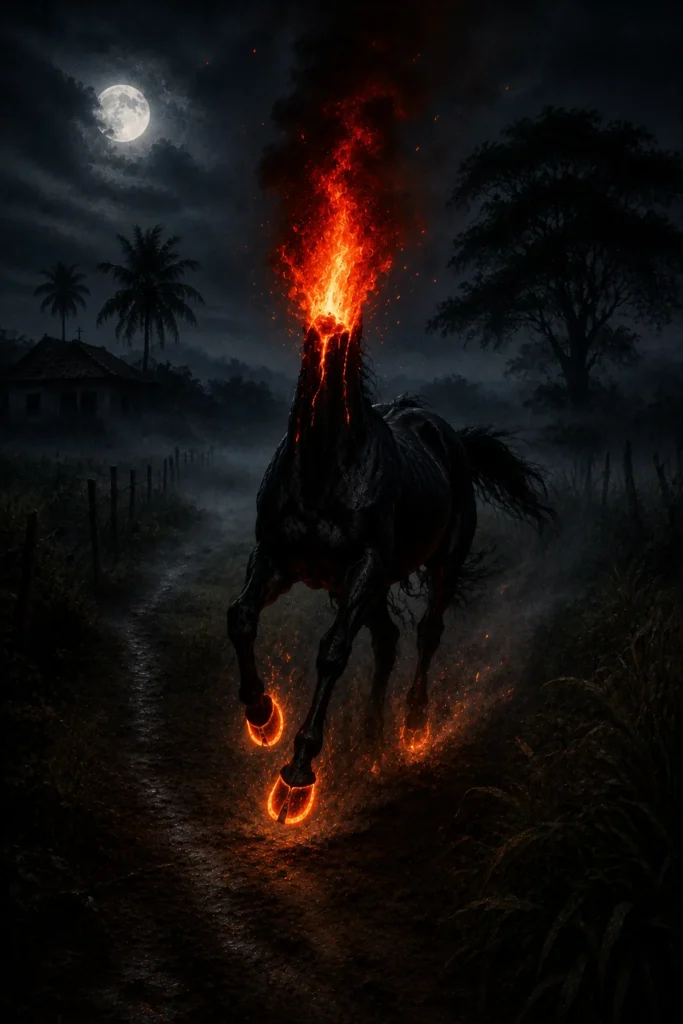
Ipupiara, the hairy terror of the colonial chronicles
By Ralf Ittermann · last reviewed on
Ipupiara is a demon from Brazilian tradition.
A beastly water being that capsizes boats and kills. The tradition describes a hairy water being that, in the colonial chronicles of Brazil, capsizes boats and kills. The title identifies Ipupiara as a water demon of Tupí tradition.
The Ipupiara is a male, monstrous water being of the colonial chronicles, forerunner of the Iara: hairy, dog-headed, kills people at the water’s edge with raw violence.
Main source: Gândavo 1576, report of a killing in 1564 in São Vicente.
Type: monstrous water being, forerunner of the Iara
Origin: Tupí coast of Brazil
Texts: Anchieta 1560, Gândavo 1576
Period: 16th century
Appearance: hairy, dog-headed

Source context
Period of the Texts
16th century: earliest mention around 1560, main source Gândavo 1576.
Area of Diffusion
Coast of the Captaincy of São Vicente, later the entire coast of Brazil.
Sources
Sparse: Gândavo’s chronicle of 1576 and Câmara Cascudo’s later systematisation.
Name and variants
Old Tupí: y water, pupe inside: Ipupiara means the one dwelling in the water, according to Gândavo a water demon.
Appearance
Appearance
Hairy, with a dog-like head, breasts and a fish tail, more sea lion-like than fish-like.
Effect
A violent predator: it capsizes boats and devours the soft tissue of its victims, unlike the later Iara.
Profile: Ipupiara
The most important aspects of the water demon at a glance.
One of the oldest myths of Brazil’s Tupí colonial era.
Fishermen and people at the water’s edge along the coast.
Hairy, dog-headed, with a fish tail, sea lion-like.
Pure mortal danger: boats capsize, victims are killed.
No ritual defence, only resistance through force.
Forerunner of the Iara, related to Boto Encantado and Yacuruna.
The water demon before the Iara
The name comes from Old Tupí and means the one dwelling in the water; Gândavo translated it in 1576 as water demon.
The figure only transformed into the female Iara over the colonial centuries.
Local veneration and place in the mythical canon
In São Vicente, the Ipupiara is considered one of the oldest myths of Brazil, the root of the Iara.
Gândavo’s water demon remains a lethal border being without benevolent traits.
Resistance instead of ritual
The colonial chronicles report defence through force; a protective practice is not documented for the Ipupiara.
Protective means: salt, protective circle, amulet.
Forerunner, not a relative
Frequently asked questions about the Ipupiara
Is the Ipupiara the same as the Iara?
No, it is its forerunner: the monster preceded the Iara.
Is there a historical account?
Yes, Gândavo describes a killing in São Vicente in 1564.
Further links
Internal links:
Literature (selection)
More in the bibliography.
Ipupiara Tupi: this is what colonial tradition calls Brazil’s original water demon, a lethal monster whose terror first made the later Iara possible.