Akkorokamui, the giant red octopus kamuy of the bay
By Ralf Ittermann · last reviewed on
Akkorokamui is a god of Ainu tradition.
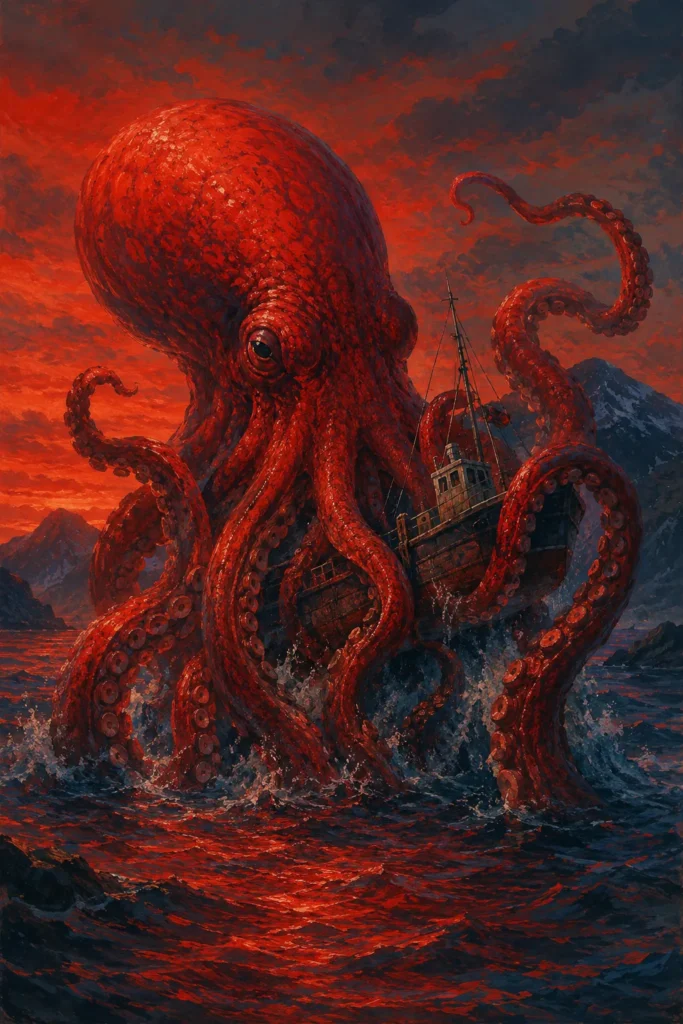
A giant red octopus that swallows boats.
Akkorokamui is the giant red sea god of the Ainu, an octopus-like being of Uchiura Bay on Hokkaidō. As lord of the bay he is both feared and revered: he can swallow boats whole.
The name at-kor-kamuy is usually interpreted as ‘god holding threads’, the threads referring to the tentacles. The earliest written record comes from the missionary John Batchelor around 1900, whose version tells of three fishermen attacked by a giant octopus.
Type: sea god and octopus kamuy, lord of Uchiura Bay
Origin: oral Ainu tradition of Hokkaidō
Texts: recorded in writing around 1900 by the missionary John Batchelor, sources are thin
Period: transmitted orally, in writing from around 1900
Appearance: a huge, entirely red octopus that colours sea and sky
Source context
Period of the Texts
Carried orally in the Ainu tradition of Hokkaidō, first recorded in writing around 1900 by the missionary John Batchelor.
Area of Diffusion
Uchiura Bay in southwestern Hokkaidō is considered his own domain, which he rules as lord of the bay.
Sources
Thin: at its core, the tradition rests on a single source, John Batchelor’s record, on which much of the later popular literature is also based.
Name and variants
Ainu: at-kor-kamuy is usually interpreted as ‘god holding threads’, the threads referring to the tentacles. Kamuy is the Ainu term for a divine being, related to the Japanese kami.
Form and effect
Appearance
Akkorokamui appears as an entirely red octopus, whose body, when its arms are stretched out, is said to span about one hectare, and whose red colours the sea and sky. The red is a signal colour for danger and blood, and the eight-armed form combines creation and destruction.
Effect
Akkorokamui can drag boats and people into the depths. At the same time, tradition ascribes to him a capacity for regeneration, the regrowing of limbs as in the real octopus; an invocation as a healing power for humans is historically hardly attested and stems predominantly from modern popular literature.
Profile: Akkorokamui
The key aspects of the sea god at a glance.
Ambivalent sea kamuy of the Ainu tradition of Hokkaidō, both feared and invoked.
Fishermen and boats of Uchiura Bay.
A huge, entirely red octopus with eight arms, whose colour tinges sea and sky.
Swallows boats and people in the bay.
Respectful invocation and offerings, among them the carved willow wands known as inau.
The Japanese Umibōzu as a boat-threatening relative and, according to the origin legend, Repun Kamuy, who once drew him into the bay.
The thread-holding god and two origin legends
The name at-kor-kamuy is usually interpreted as ‘god holding threads’, the threads referring to the tentacles; kamuy is the Ainu term for a divine being, related to the Japanese kami. The earliest written record comes from the missionary John Batchelor around 1900, who passed down a version in which three fishermen were attacked by a giant octopus.
Two origin legends circulate: in one, the sea god Repun Kamuy, in answer to prayers, drew a giant spider-like being into the bay, where it transformed into a huge octopus and became lord of the bay; in the other, a goddess let her underskirt fall into the sea, whose eight cords became eight arms. Sources outside Batchelor are thin, and much popular literature builds on this single source.
From Ainu kamuy to pop-culture kraken
Akkorokamui appears in video games such as Final Fantasy and in the Persona series as an opponent, and is often depicted in cryptozoology and popular culture as a Japanese kraken. He has thus become, beyond the Ainu context, a fixed motif of modern monster culture.
Akkorokamui is a typical Ainu kamuy: not strictly divided into good and evil, but an ambivalent power that demands respect and an exchange of gifts. He embodies the marine environment as an animate counterpart within the animistic kamuy cosmos. The written tradition is filtered through Batchelor’s missionary perspective and should be read with caution: it rests at its core on this single source, and the heavily elaborated healing interpretation stems mostly from modern popular literature, which is why it should be treated with corresponding caution.
Invocation and offerings rather than fixed protective rites
Concrete, well-documented Ainu protective rituals against Akkorokamui are scarcely recorded. What is attested is the general Ainu way of dealing with the kamuy through respectful invocation and offerings, among them the carved willow wands known as inau. A specific practice for warding off this being is not securely attested; the approach follows the exchange of gifts with which the Ainu met their animate natural powers. In the spirit of this respectful invocation, a worn amulet for crossing the bay, offerings of incense and salt are considered the traditional protective means for dealing with the powers of the sea.
Sea monsters and sea gods compared
As an Ainu kamuy, Akkorokamui does not belong to the circle of Japanese sea deities around the dragon god Ryūjin and the fishing god Ebisu; closer to him is the boat-threatening Umibōzu. As a huge, devouring sea monster he is also related to the Nordic kraken and the biblical Leviathan, and within Ainu mythology he is closely linked to Repun Kamuy, who, according to the origin legend, drew him into the bay.
Frequently asked questions about Akkorokamui
Is Akkorokamui a god or a monster?
Both. In the Ainu worldview he is a kamuy, at once ambivalent, dangerous and worthy of reverence, without a clear division into good and evil.
Where does the red colour come from?
It is said to colour sea and sky and serves as a warning sign, interpretable as blood and danger. The red is the being’s most striking feature.
Is the healing power historically attested?
Only weakly. The elaborated interpretation as a power of healing and self-healing stems mostly from modern popular literature, while the source-based foundation is slight.
Further links
Further reading:
- Repun Kamuy – the Ainu god of the open sea, who according to legend drew him into the bay
- Umibōzu – the boat-threatening sea spirit of Japan
- Amulet, Smoke cleansing, Salt – traditional protective means
- Protection Compass – protective means at a glance
Literature (selection)
Further standard works in the bibliography.
Those searching online for Akkorokamui Ainu legends or giant octopus of Japan invariably arrive at the same figure: the red octopus kamuy of Uchiura Bay, who swallows boats.