Nang Mai, the tree ladies of Thailand
By Ralf Ittermann · last reviewed on
The Nang Mai are spirit ladies of Thai tradition.
The tree ladies who inhabit and protect Thailand’s ancient trees.
Nang Mai, the lady of the tree, is the collective term for the female tree spirits of Thailand. They form a category, not a single figure: each Nang Mai inhabits a particular tree and protects it.
Their dual nature shapes how people relate to them: a good Nang Mai warns her human of danger, an evil one lures men in order to bind or kill them. Felling or using an inhabited tree without rites is considered dangerous; the best-known individual figures of this category are Nang Ta-khian and Nang Tani.
Type: Collective category of female tree spirits
Origin: Pre-Buddhist animism, absorbed into Buddhist-animist syncretism
Texts: Oral tradition, systematically documented by Anuman Rajadhon
Period: pre-Buddhist to present
Appearance: one spirit lady per particular tree, individual figure depending on the tree species

Context of the tradition
Period of the Texts
The belief is pre-Buddhist animist and survives within Buddhist-animist syncretism; the tree cult was first systematically documented by the Thai folklorist Anuman Rajadhon.
Area of Diffusion
Thailand, Laos and Cambodia: wherever large and old trees are regarded as ensouled and honoured with cloths and offerings.
Sources
Well documented: the works of Anuman Rajadhon on Thai customs, along with McDaniel’s study of Thailand’s world of spirits and monasteries.
Name and variants
Thai: nang, woman or lady, and mai, tree or wood: the tree lady or lady of the tree. The name does not denote a single figure but the whole category of female tree spirits of Thailand.
Appearance and behaviour
Appearance
Nang Mai is a category, not a single figure: female spirits, each inhabiting a particular tree, whose individual form depends on the species of tree. The idea symbolises the animate nature of large and old trees, and both the danger and the blessing of felling them.
Effect
The Nang Mai have a dual nature: a good Nang Mai warns her person of danger, while an evil one lures men in order to bind or kill them. Felling or using the tree without rites is considered dangerous.
Profile: Nang Mai
The key aspects of the tree spirits at a glance.
Tree cult of Thailand’s Buddhist-animist syncretism, with roots reaching back to the Brahmanic-Indian tree cult.
People who fell or use trees, along with travellers and residents near large old trees.
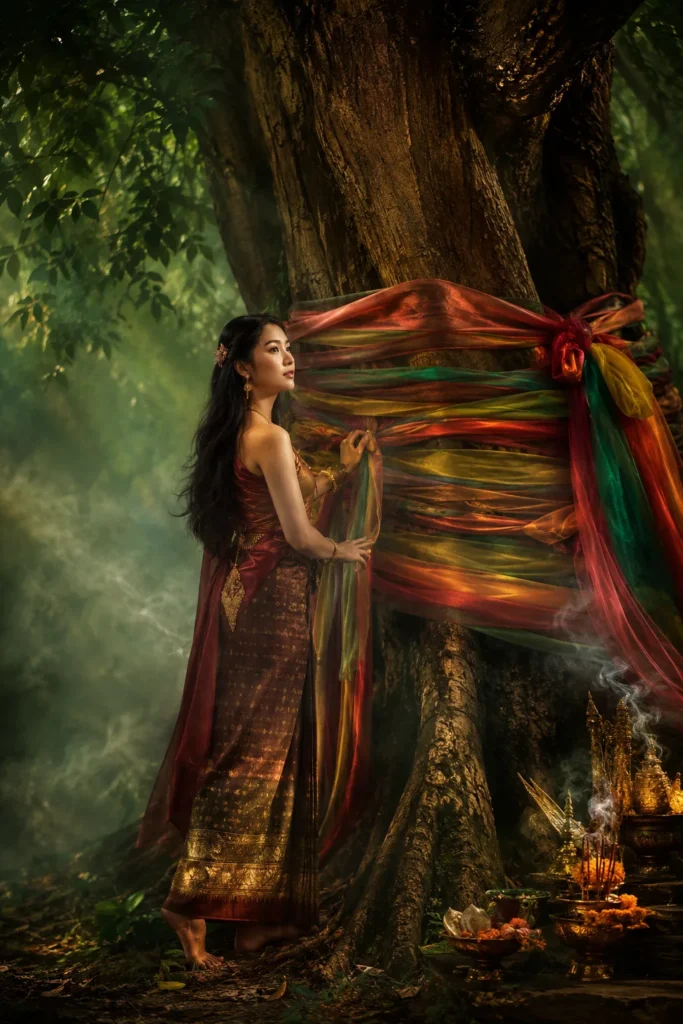
Female spirit within the tree, differing by tree species; the visible sign of an inhabited tree is the coloured cloths wrapped around its trunk.
Each inhabits and protects a particular tree; they may warn their person or lure and harm men.
Coloured cloths around the trunk, incense, flowers and food offerings at the foot of the tree, requests for permission and a monk’s blessing; no felling without rites.
Nang Ta-khian and Nang Tani as the best-known subtypes, along with the Greek Dryads and the Japanese Kodama.
From the Indian tree cult to Thailand's tree lady
The name combines nang, woman or lady, and mai, tree or wood: tree lady or mistress of the tree. Behind it lies a pre-Buddhist animism that has been absorbed into Thailand’s Buddhist-animist syncretism; the tree cult has roots that, via textile and offering customs, reach back to the Brahmanic-Indian tree cult.
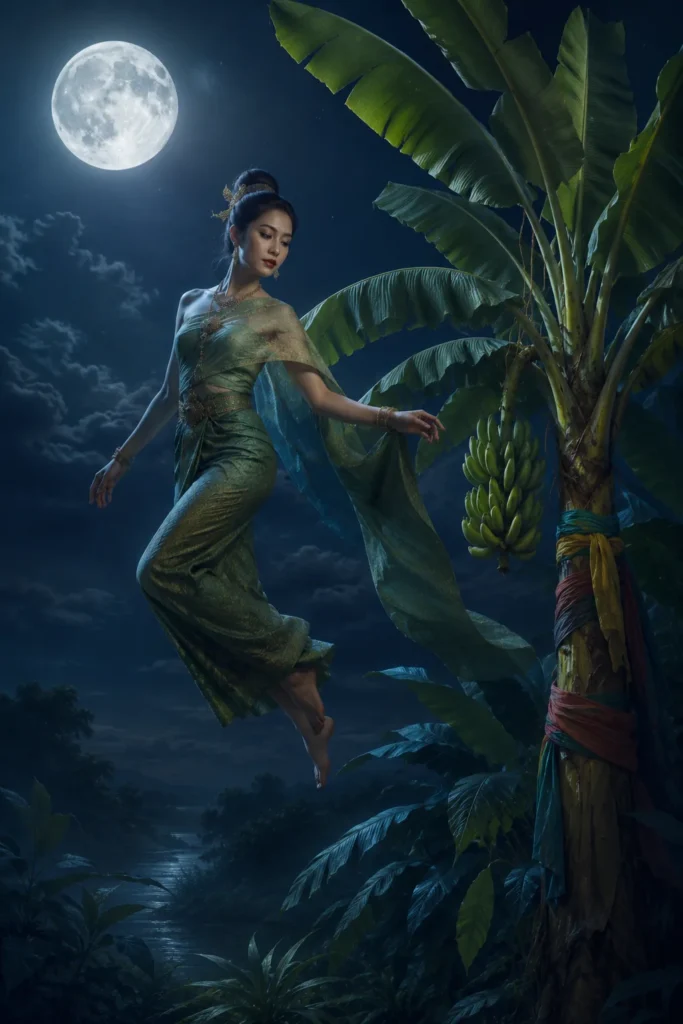
The custom was first documented systematically by the Thai folklorist Anuman Rajadhon. As a category, Nang Mai brings together the female tree spirits, each inhabiting a particular tree; the best-known individual figures are Nang Ta-khian in the Ta-khian tree and Nang Tani in the wild banana tree.
Reception and classification
As an umbrella term, Nang Mai appears mainly in folklore overviews; its concrete presence in popular culture comes through the individual figures Nang Ta-khian and Nang Tani, who appear in Thai films.
From a religious-studies perspective, the Nang Mai are an expression of the tree cult within animist-Buddhist syncretism and the collective category of female tree spirits. Two clarifications belong here: Nang Mai is not a single spirit but an umbrella term whose subtypes bear their own names. And despite sharing the name element nang, lady, the bringer of good fortune Nang Kwak is not a tree spirit but a distinct figure in the Thai world of belief.
Cloths, offerings and tree ordination
Well attested is the tying of coloured cloths around the trunk as a sign of veneration, a custom originally derived from the Indian tree cult. Alongside this come incense, flowers and food offerings at the foot of the tree, sometimes at a small shrine; permission is requested, a monk’s blessing is obtained, and trees are not felled without rites. A related custom is tree ordination, in which a tree is symbolically wrapped in a saffron-coloured robe and ordained like a monk, so that harming it is considered a serious offence.
Tree ladies and tree spirits compared
The Nang Mai correspond to the Greek tree nymphs, above all the Dryad, the Japanese Kodama, and the Indian Yakshi and Yaksha, the tree and nature spirits. Within Thailand, Nang Ta-khian, the spirit of the Ta-khian tree, and Nang Tani, the spirit of the banana tree, are the best-known subtypes.
Frequently asked questions about the Nang Mai
Is Nang Mai a single spirit?
No, it is an umbrella term for the female tree spirits of Thailand; Nang Ta-khian and Nang Tani are subtypes with their own names.
Are the Nang Mai dangerous?
They are ambivalent: protective and warning towards their own people, but seductive and harmful when an evil Nang Mai lures men or her tree is felled without rites.
How does one show respect?
Through a coloured cloth around the trunk, offerings at the foot of the tree, asking for permission, and the principle of never felling a tree without rites.
Further links
Further reading:
- Nang Ta-khian and Nang Tani – Thailand’s best-known tree ladies
- Kodama – the Japanese tree spirit as a counterpart
- Censing and Purification, Amulet, Protective circle – traditional protective and ritual means
- Protection Compass – protective means at a glance
Literature (selection)
Further standard works in the bibliography.
As Thailand’s female tree spirits, the Nang Mai gather the country’s ancient tree cult into a single category: each mistress of the tree binds a particular tree to respect and ritual, making its felling without permission a dangerous transgression.