Makiawisug, the quiet neighbours of Mohegan Hill
By Ralf Ittermann · last reviewed on
The Makiawisug are spirits of Mohegan tradition.
The little people who guard healing knowledge and expect gifts. The profile describes the Makiawisug as quiet neighbours of Mohegan Hill who guard healing knowledge and expect small gifts in return.
Makiawisug are the little forest beings of the Mohegan who live in the woods and around Mohegan Hill in south-eastern Connecticut and guard plant and healing knowledge. Gifts are left for them and one does not speak loudly of them; whoever shows respect receives knowledge and favour, whoever disregards them is punished.
The tradition is a living oral tradition that has been recorded and authorised by the Mohegan Nation itself. This page deliberately follows only what the Nation itself has published; further ritual details are not set out.
Type: Little forest beings, guardians of earth, plant and healing knowledge
Origin: Living oral Mohegan tradition
Texts: Tradition recorded and authorised by the Mohegan Nation
Period: oral tradition continuing to the present
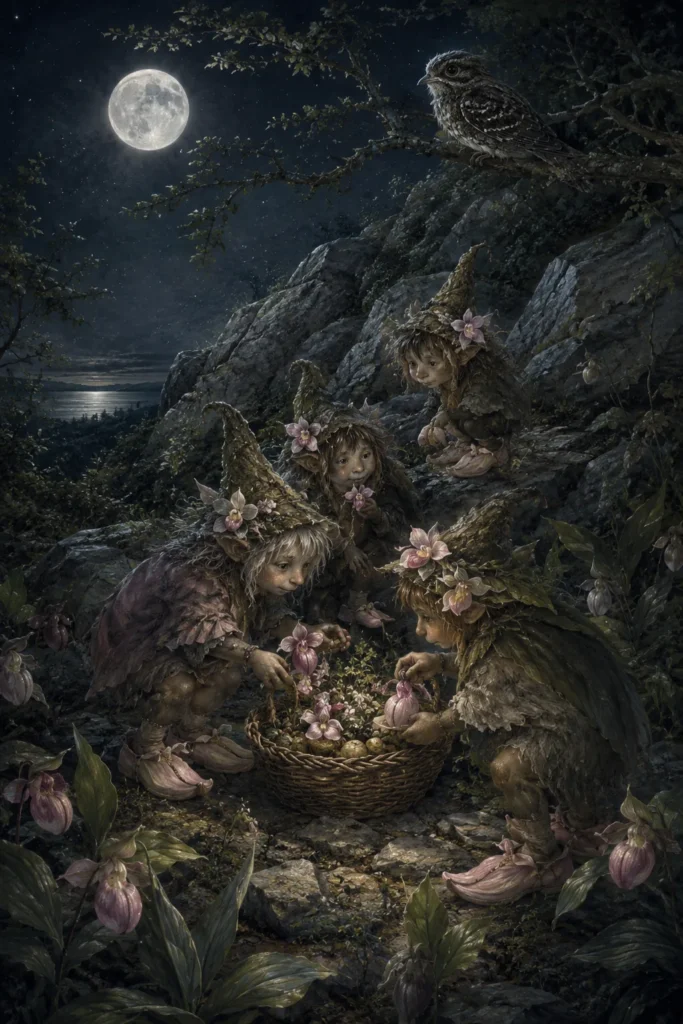
Appearance: small, nocturnal forest beings wearing lady’s slipper blossoms as shoes
Sources and tradition
Period of the Texts
A living oral Mohegan tradition, recorded by the Mohegan Nation itself; it is part of the Nation’s present-day identity, not purely historical.
Area of Diffusion
The territory of the Mohegan and, in part, the Pequot in south-eastern Connecticut, with Mohegan Hill and its rocks as its centre.
Sources
Sound and authorised: the authoritative source is the Mohegan Nation itself, supplemented by the books of Mohegan author Melissa Tantaquidgeon Zobel.
Name and variants
Mohegan: The name Makiawisug means whip-poor-will moccasins, after the whip-poor-will bird, whose call announces their coming, and after the lady’s slipper blossoms they wear as shoes.
Form and meaning
Appearance
The Makiawisug are small, nocturnal nature beings, closely connected to the whip-poor-will, the lady’s slipper orchid and the rocks of Mohegan Hill.
Effect
They embody guarded healing and plant knowledge and the reciprocity between humans and nature: whoever gives and shows respect receives knowledge and favour, whoever forgets or offends becomes ill or is punished. On the positive side, they taught corn cultivation and the use of healing plants and keep the earth well; punitively, they can root to the ground anyone who stares at them directly by pointing a finger, while taking their belongings. At night they collect the gifts that have been left out.
Profile: Makiawisug
The key aspects of the little people at a glance.
Living oral tradition of the Mohegan, recorded and authorised by the Nation; part of present-day Mohegan identity.
The Mohegan community: according to tradition, the Makiawisug taught corn cultivation and the use of healing plants and maintain a gift exchange with the community.
Small, nocturnal forest beings who wear lady’s slipper blossoms as shoes; the call of the whip-poor-will announces their coming.
Guarding earth, plant and healing knowledge; favour for the respectful, punishment such as being rooted to the ground for anyone who stares at them or disregards them.
Leave gifts in small baskets in the forest, do not look at them directly and do not speak loudly of them, especially not in summer.
The Pukwudgie is the ambivalent, dangerous counterpart: the Makiawisug are fundamentally benevolent guardians and teachers, while it is an unpredictable wilderness spirit.
Granny Squannit and the medicine woman: the authorised legend
According to the authorised Mohegan legend, when English settlers disrupted traditional life, many Mohegan forgot to bring gifts to the Makiawisug, whereupon both Mohegan and Makiawisug fell ill. A medicine woman was then led into the underground world of the little people and healed their ancient, powerful leader Granny Squannit.
The details of this account are presented here only to the extent that the Mohegan Nation itself has published them. The legend links colonial disruption to the breaking of reciprocity between humans and nature and the illness that followed; the restoration of the gift relationship brings healing.
Reception and classification
The Makiawisug are present chiefly at a regional and literary level, not charged with popular culture the way the Pukwudgie is. The 1997 children’s book Makiawisug. The Gift of the Little People and the literary works of Mohegan author Melissa Tantaquidgeon Zobel keep the tradition alive.
In terms of religious studies, the Makiawisug belong to the belief in the little people as a forest and nature-spirit tradition with a pronounced ethic of reciprocity and healing. They are guardians of the land and of healing knowledge; the legend links colonial disruption to the breaking of human-nature reciprocity and the resulting illness. It remains important that they are part of living Mohegan identity, not purely historical, and that further ritual details are deliberately not set out, out of respect.
Gifts, baskets and the etiquette of respect
Well documented and confirmed directly by the Mohegan Nation is the practice of leaving gifts: small baskets of food such as corn cakes and berries are left in the forest, for which small baskets were specially made. One should not look directly at the Makiawisug, since staring is considered rude and is punished, and should not speak loudly of them, especially not in summer, when they are most active. The basic attitude is respect and reciprocity; further ritual details are deliberately not set out.
Little people of North America and Europe
Other indigenous little people include the Yunwi Tsunsdi of the Cherokee, helpful beings who nonetheless punish disrespect, as well as the Pukwudgie and the Mikumwess of the Mi’kmaq. European equivalents include dwarves, gnomes and goblins as well as the Irish Aos Sí; in Mesoamerica, the Alux represents the same type. A shared motif is the small, elusive being that embodies natural power and an ethic of reciprocity.
Frequently asked questions about the Makiawisug
What does the name Makiawisug mean?
Whip-poor-will moccasins, after the bird whose call announces their coming, and the lady’s slipper blossoms they wear as shoes.
How should you approach them properly?
Leave gifts in small baskets, do not stare at them directly and do not speak of them loudly, especially not in summer.
Why are they important to the Mohegan?
According to tradition, they taught maize cultivation and knowledge of healing plants, and stand for the respectful reciprocity between humans and nature; the tradition remains alive to this day.
Further links
Literature (selection)
Further standard works in the bibliography.
As little people of the Mohegan and keepers of healing knowledge, the Makiawisug stand for a reciprocity still practised today: gifts in small baskets in exchange for knowledge, favour and well-tended land.