Notos, rain-bringer of late summer
By Ralf Ittermann · last reviewed on
Notos is a god of Greek tradition.
The wet south wind, blessing according to Hesiod and terror of seafarers.
Notos, in Roman tradition Auster, is the Greek god of the wet south wind and one of the four principal winds. He brings the storms and rain of late summer and early autumn.
His reputation is twofold: for Hesiod, Notos counts as a god-sent blessing, yet seafarers fear him for his gusts and rainstorms. According to tradition, he dwells in the mythical south, in Aithiopia.
Type: God of the wet south wind, one of the four principal winds
Origin: Greek mythology, son of Astraios and Eos
Texts: Hesiod, Theogony; Orphic Hymn 82; Ovid, Metamorphoses
Period: Hesiod and Homer through to the imperial era
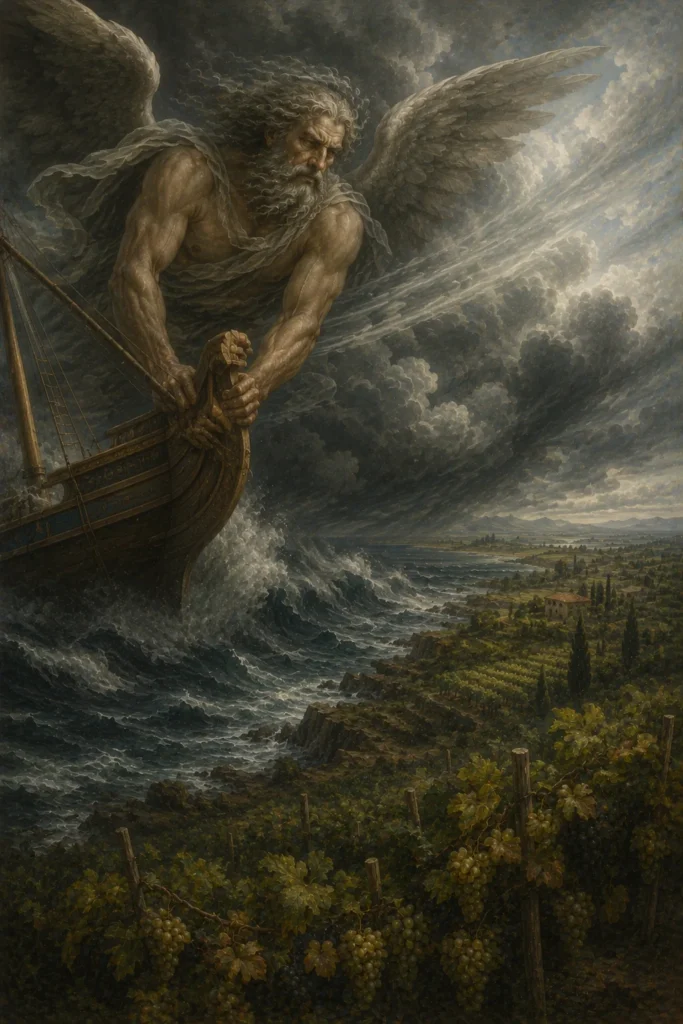
Appearance: man with wet wings and dripping beard

Source context
Period of the Texts
Attested from Hesiod and Homer through to the imperial era; the imperial-era Orphic Hymns still invoke him liturgically.
Area of Diffusion
The Greek cultural sphere; his mythical dwelling lies in the far south, in Aithiopia.
Sources
Good: Hesiod and Ovid are the main witnesses, along with Homer in the Iliad and Odyssey and the Orphic Hymn 82.
Name and variants
Greek: Nótos, south wind, associated with moisture; in Roman tradition he corresponds to Auster.
Appearance and behaviour
Appearance
In Ovid, Notos has wet wings, a dripping beard and a cloud-veiled head, and presses rain clouds from his hands; he is the classic bringer of rain. On the Antioch mosaic he personifies late summer.
Effect
Notos is the wet, storm-bringing wind of late summer and early autumn. Hesiod warns sailors of his gusts and of the autumn rain of Zeus; in the flood of Ovid’s Metamorphoses he is the instrument of the deluge.
Profile: Notos
The key aspects of the south wind at a glance.
One of the four principal winds of the Greeks, in Hesiod explicitly a blessing sent by the gods.
Sailors and farmers: he brings the rain for the fields and the feared gusts of early autumn.
A man with wet wings, a dripping beard and a cloud-veiled head, pressing rain clouds from his hands.
Storm and rain of late summer and early autumn; in Ovid’s flood the instrument of the deluge.
Orphic Hymn 82 invokes him with incense as a beneficial rain-giver; besides this, there were collective offerings to the winds.
Notos is the south wind and Auster, not the south-west wind Lips and Africus, and not the east wind Euros.
Between blessing wind and deluge
Notos is the son of Astraios and Eos, explicitly named in Hesiod, Theogony 378 to 380 and 869, where he is called a great blessing sent by the gods. Homer names him in the Odyssey and the Iliad; according to tradition he dwells in the mythical south, in Aithiopia.
Roman poetry expanded upon his darker side: in Ovid, Notos presses rain clouds from his hands, and in the flood of the Metamorphoses he is the instrument of the deluge. Thus the blessing wind of Hesiod became the storm and rain topos of epic poetry.
Auster in epic poetry and weather lore
The name Auster has remained a technical term; Notos himself is a fixed rain and storm topos of Roman epic and ancient weather lore.
From the perspective of religious studies, Notos shows the ambivalence of the south wind as both a blessing sent by the gods and a feared bringer of storm and rain. It is important to distinguish him: Notos is the south wind and Auster, not to be confused with the south-west wind Lips and Africus or with Euros.
Incense for the rain-giver
Orphic Hymn 82 to Notos invokes him with incense as a beneficial rain-giver; this is a liturgical invocation. An independent temple cult, by contrast, is not widely attested: Notos belongs mostly to the collective cults of the Anemoi with their wind offerings.
South winds and rain-bringers compared
Notos corresponds to the Roman Auster and stands alongside his brothers Boreas, Zephyros and Euros; he is to be distinguished from the neighbouring south-west wind Lips. Functionally, he is related to the hot, humid southern-wind sphere of the Scirocco and the Chamsin, and as a rain-bringer he resembles other storm- and rain-bringing wind deities. An overview of the family is given on the page of the Anemoi.
Frequently asked questions about Notos
Which wind is Notos?
The south wind, Roman Auster, wet and storm-bringing in late summer and early autumn.
Is Notos good or bad?
Both: Hesiod calls him a blessing sent by the gods, yet sailors fear him for his gusts and rainstorms.
Was Notos worshipped?
He was invoked in Orphic Hymn 82; a dedicated temple cult barely existed, rather collective offerings to the winds.
Further links
Further reading:
- Greece – all beings of the Greek cultural sphere
- Anemoi – the wind gods at a glance
- Boreas, Lips – the north wind and the neighbouring south-west wind
- Amulet, Protective candle, Salt – traditional protective means
- Protection Compass – protective means at a glance
Literature (selection)
Further standard works in the bibliography.
As the Greek south wind, Notos shows how closely blessing and danger lie together: a rain-bringing storm wind soaks the fields of one and sinks the ships of another, and both belong to his office.