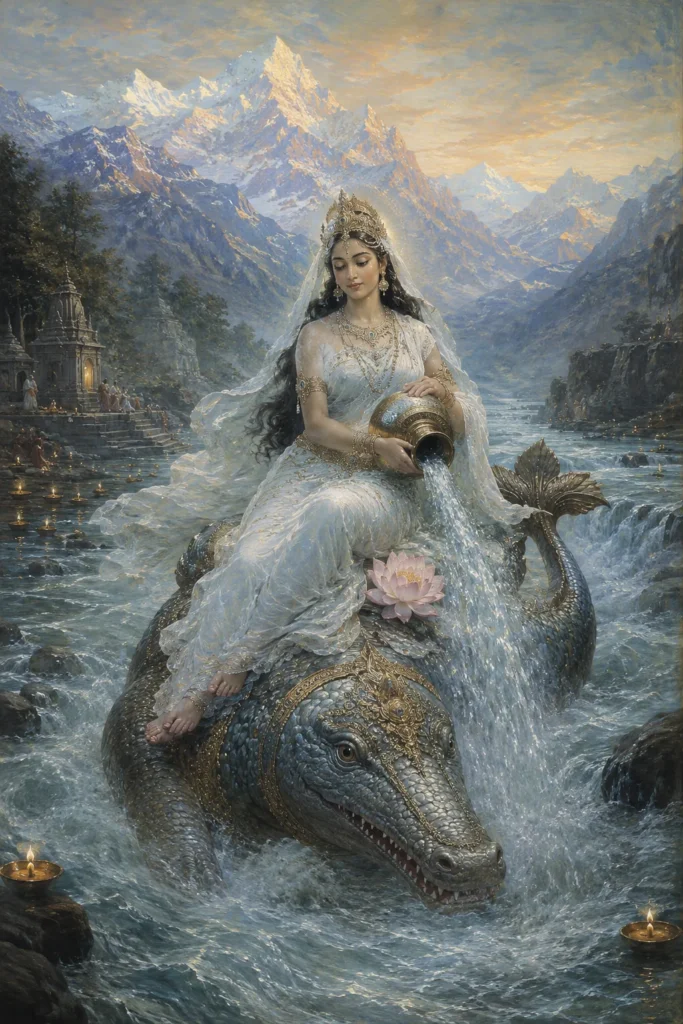
Vayu, Breath of Life of the Vedic World
By Ralf Ittermann · last reviewed on
Vayu is a god of the Hindu tradition.
Wind, breath of life and guardian of the northwest.
Vayu is the Vedic-Hindu god of wind and of the breath of life, prana. He is closely linked to Indra, is the first god to receive the soma at the soma sacrifice, and as a guardian of the world he watches over the northwest direction.
Vayu is already present in the Rigveda, where he is joined with Indra to form the dual deity Indra-Vayu; in the Upanishads he is venerated as Prana, the breath of life of the world. He is regarded as the father of Hanuman and of Bhima, both known for superhuman strength.
Type: God of wind, air and the breath of life, guardian of the world in the northwest
Origin: Indian subcontinent, Vedic tradition
Texts: Rigveda, Upanishads, epics and Puranas
Period: Rigveda through to present-day practice
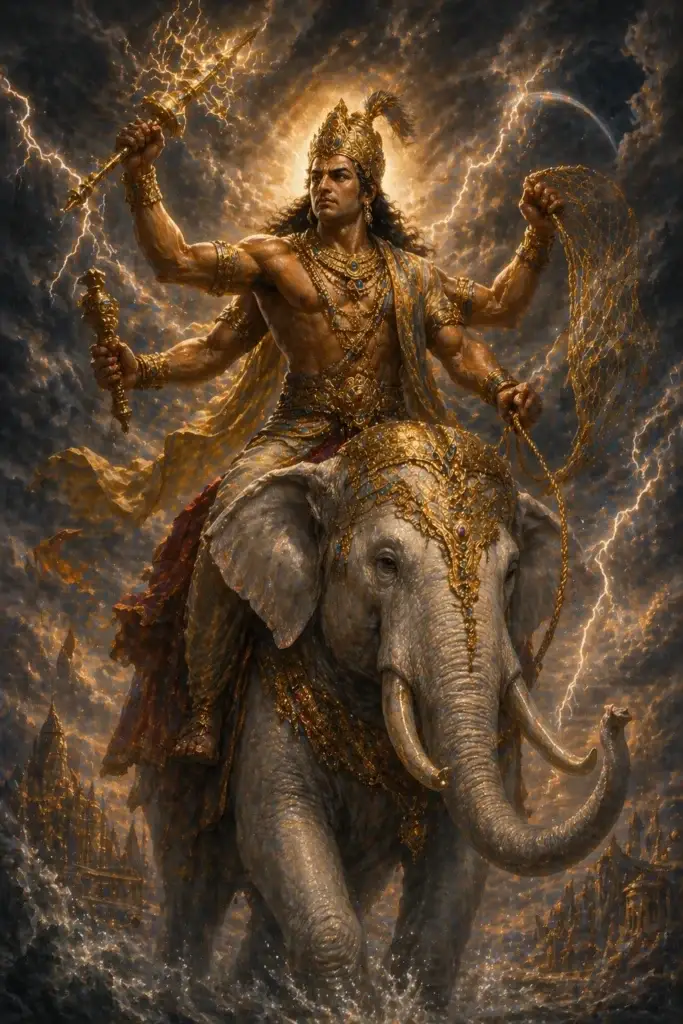
Appearance: powerful figure with a banner, riding a gazelle

Historical Background
Period of the Texts
The tradition spans from the Rigveda through the Upanishads, epics and Puranas to present-day practice in pranayama and Vastu directional lore.
Area of Diffusion
The Indian subcontinent; as guardian of the northwest, Vayu is anchored in the temple cosmology of the entire Hindu world.
Sources
Very good and rich in primary sources: the Rigveda, the Upanishads, the Ramayana and the Mahabharata, alongside the classic handbooks of Vedic mythology.
Name and variants
Sanskrit: vayu means wind or air, from the root va, to blow. Epithets include Vata, the blower, Pavana, the purifier, Prana, the breath of life, and Anila. All these names refer to the same deity, not a trio.
Form and effect
Appearance
Vayu is later depicted iconographically as a powerful figure, often carrying a banner or flag, riding a gazelle or antelope; as a natural force he is the ever-present wind and breath.
Effect
Vayu is wind, air, movement and the breath of life. As a Dikpala or Lokapala, a guardian of the world, he watches over the northwest direction; he mediates between heaven and earth and embodies strength, speed and purification. As father of Hanuman in the Ramayana and of Bhima in the Mahabharata, he stands behind two figures of superhuman strength.
Profile: Vayu
The key aspects of the wind god at a glance.
A Vedic deity with an unbroken presence: linked with Indra in the Rigveda, venerated in the Upanishads as Prana, the breath of life of the world.
Ritual, yoga and temple cosmology: Vayu is invoked for vitality and breath, connected to prana in yoga and ritual.
A powerful figure with a banner or flag, riding a gazelle or antelope; as a natural force, the ever-present wind and breath.
Wind, air, movement and the breath of life; as guardian of the world in the northwest, mediator between heaven and earth, embodying strength and purification.
At the soma sacrifice, Vayu is the first god to receive the soma; as directional guardian deity of the northwest, he is firmly embedded in ritual and temple cosmology.
Functionally comparable to the Maori storm god Tawhirimatea and the Greek Aiolos; related is the Avestan Vayu or Vata.
From the Rigveda to the Guardians of the World
Sanskrit vayu means wind or air, from the root va, to blow; epithets include Vata, the blower, Pavana, the purifier, Prana, the breath of life, and Anila. Vayu is already present in the Rigveda, where he is closely joined with Indra as the dual deity Indra-Vayu, and is the first god to receive the soma at the soma sacrifice.
In the Upanishads he is venerated as Prana, the breath of life of the world; later cosmology makes him a Dikpala or Lokapala, guardian of the world in the northwest direction. In the epics he appears as a father: Hanuman in the Ramayana bears the epithet Vayuputra, son of the wind, and Bhima belongs to the Pandavas of the Mahabharata.
Afterlife and interpretation
Vayu remains present throughout, from the Vedas through the epics to present-day practice in pranayama and Vastu directional lore; the veneration of Hanuman carries the connection to Vayu forward to this day.
From a religious-studies perspective, Vayu is powerful but predominantly benevolent and ordering, associated with the breath of life, purification and directional protection; the destructive potential of wind is present but not his main character. Three clarifications are important: Vayu, Vata and Pavana are names of the same deity, not a trio. Despite the close pairing of Indra-Vayu, he is not identical to Indra. And the storm troop of the Marut, as well as Rudra, are to be distinguished from him.
Directional protection, soma and the breath of life
As a Lokapala, Vayu is embedded in ritual and temple cosmology, as directional guardian deity of the northwest; he is invoked, among other things, for vitality and breath, with reference to prana in yoga and ritual. Unlike many other wind beings, there is a real, broadly documented cultic and textual connection here: from the soma sacrifice of the Vedic period to present-day breathing practice in pranayama.
Vayu between Iran, Greece and the Pacific
Functionally, Vayu is comparable to the Maori storm god Tawhirimatea and the Greek lord of winds Aiolos; as breath of life he touches on the Iranian Vayu or Vata of the Avestan tradition, with which a well-established Indo-Iranian kinship exists. As a sacrificial and wind god, he is also closely related to the fire god Agni; through the Buddhist pictorial tradition, his figure was carried forward as far as the Japanese Fujin.
Frequently Asked Questions about Vayu
What does the name Vayu mean?
Wind or air, from the root va, to blow; epithets include Vata, the blower, Pavana, the purifier, and Prana, the breath of life.
Is Vayu the same as Indra?
No. Despite the close Vedic pairing as the dual deity Indra-Vayu, they remain two distinct deities.
Whose father is Vayu?
Of Hanuman and Bhima, both known for superhuman strength; Hanuman bears the epithet Vayuputra, son of the wind.
Further links
Further reading:
- Hinduism – all beings of the Hindu world of belief
- Agni – the fire god at Vayu’s side in the Vedic sacrifice
- Tawhirimatea, Aiolos – wind gods of other cultures
- Smoke cleansing, Protective candle, Amulet – traditional protective means
- Protection Compass – protective means at a glance
Literature (selection)
Further standard works in the bibliography.
As the Vedic wind god and god of life-breath, Vayu links natural force and interiority like scarcely any other figure: the same wind that sweeps across the subcontinent is thought to become tangible in every person’s breath.