Salamander, the fire being of Paracelsus
By Ralf Ittermann · last reviewed on
The Salamander is a spirit of European tradition.
The fire creature of antiquity, an elemental spirit in Paracelsus.
The salamander is the fire creature par excellence in European tradition and was declared the elemental spirit of fire in early modern natural philosophy. From the ancient belief that the amphibian could live in fire, Paracelsus made a fiery elemental being.
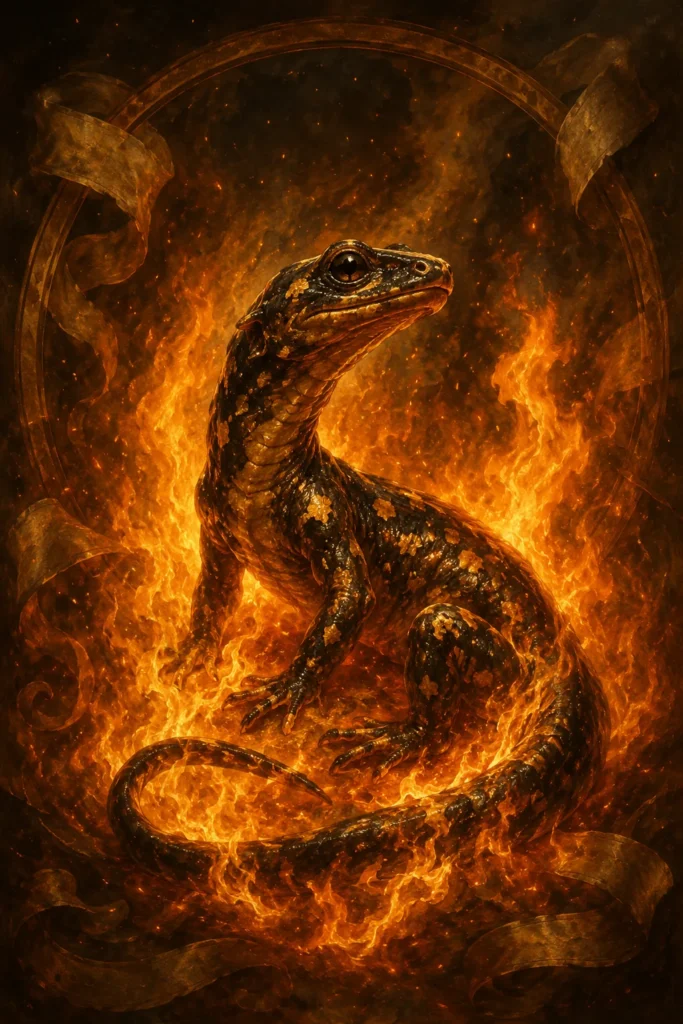
Thus the salamander has two faces: the lizard-like creature that sits in flames without burning, and the slender, fiery spirit of elemental doctrine that dwells in fire.
Type: fire creature of ancient natural history, elemental spirit of fire in Paracelsus
Origin: ancient natural history, bestiaries, early modern natural philosophy
Texts: Aristotle, Pliny the Elder, Paracelsus
Period: antiquity to the Renaissance and modern era
Appearance: lizard-like creature in fire, as elemental spirit a fiery figure
Textual history
Period of the Texts
From ancient natural history in Aristotle and Pliny, through the medieval bestiaries, to the elemental doctrine of Paracelsus in the 16th century.
Area of Diffusion
Originally the Mediterranean region, later the whole of Europe; through alchemy and emblem books the salamander became pan-European cultural knowledge.
Sources
Good: a broad textual and pictorial tradition from Pliny’s Naturalis historia to Paracelsus, along with modern symbol and demon studies.
Name and variants
Name: Salamander originally denotes the lizard- or amphibian-like creature of ancient natural history to which life in fire was attributed; the incombustible fibre asbestos was interpreted as salamander wool. The zoological name of the fire salamander preserves the old myth in its name to this day.
Form and Activity
Appearance
In animal form, the salamander is a lizard- or amphibian-like being that sits in flames without burning. As an elemental spirit, it is imagined as a slender, fiery figure that dwells in fire. It is the emblem of fire and incombustibility.
Effect
The salamander inhabits and embodies fire. In Paracelsian doctrine, like the other elemental spirits, it stands between humans and pure spirits and is bound to its element.
Profile: Salamander
The key aspects of the fire elemental at a glance.
European scholarly tradition: ancient natural history, medieval bestiaries and the elemental doctrine of the Renaissance.
Fire itself: the salamander inhabits and embodies its element and is bound to it.
Lizard-like creature that sits unharmed in flames; as an elemental spirit, a slender, fiery figure in fire.
Emblem of incombustibility and steadfastness; in heraldry and emblem books the sign of a being not to be destroyed by fire.
No cult: the salamander belongs to natural philosophy, alchemy and symbolism, not to ritual.
From Pliny to Paracelsus
The belief goes back to ancient natural history: Aristotle and Pliny the Elder report that the salamander is so cold that it extinguishes fire and lives in fire. In the Middle Ages, the creature became, in bestiaries, an emblem of the incombustible; the incombustible fibre asbestos was interpreted as salamander wool.
The decisive step was taken by the physician and natural philosopher Paracelsus in the 16th century: he assigned a spirit to each of the four elements and allotted the salamander to fire. Thus the fabled creature of natural history became a systematic building block of elemental doctrine, a being between humans and pure spirits, bound to its element.
Afterlife in heraldry, alchemy and fantasy
The salamander is firmly anchored in alchemy, emblem books and modern fantasy; in role-playing games and literature it is a standard fire being. The zoological name of the fire salamander preserves the old myth in its name.
From a religious-studies perspective, the salamander is a prime example of how a lasting symbol can arise from faulty observation of nature. Two clarifications: the real fire salamander has nothing to do with fire; the belief rests on ancient misinterpretations. And in Paracelsus, the salamander becomes part of a systematic thinking about elemental spirits that orders nature and the spirit world, without establishing a religious cult.
Symbol rather than cult
The salamander has no cult of its own; it belongs to the realm of natural philosophy, alchemy and symbolism, not to ritual. In heraldry and emblem books it became the sign of a steadfast being not to be destroyed by fire; the French king Francis I bore it as his personal emblem. This use is symbolic, not cultic.
The fourfold system of elemental spirits
The salamander stands alongside other fire creatures of tradition, such as the Greek pyrausta, the fire insect, and the phoenix as fire bird. As an elemental spirit, it forms, together with the gnome (earth), the undine (water) and the sylph (air), the Paracelsian fourfold system; the sylph is thus its sister elemental on the side of air.
Frequently asked questions about the salamander
Can a salamander really live in fire?
No. The belief goes back to ancient misinterpretations; the real fire salamander has nothing to do with fire.
What is an elemental spirit?
According to Paracelsus, a being bound to an element; the salamander is assigned to fire, the undine to water, the sylph to air, and the gnome to earth.
Did the salamander have a cult?
No. It belongs to natural philosophy, alchemy and symbolism, not to religion and ritual.
Further links
Further reading:
- Sylph – the sister elemental of air
- Pyrausta – the Greek fire insect
- Protective candle, amulet, salt – traditional protective means
- Protection Compass – protective means at a glance
Literature (selection)
Further standard works in the bibliography.
As the elemental spirit of fire, the salamander is the most learned of all fire beings: not an object of cult but of natural philosophy, while the real fire salamander unites myth and zoology in a single name to this day.