Utukku: Mesopotamian spirits of the dead and underworld demons
By Ralf Ittermann · last reviewed on
Utukku is not a single being but a collective term for a class of Mesopotamian spirit beings. They moved between the underworld and the world of the living, were regarded as the cause of illness and misfortune, and stood at the center of an extensive body of incantation literature.
Overview
The term Utukku belongs to the vocabulary of Mesopotamian demonology. It does not denote a single, clearly defined figure but rather an entire category of spirit beings that played an important role in the texts of Mesopotamia over the course of centuries.
Utukku could be malevolent as well as, in certain contexts, neutral or protective beings, yet in everyday religious life the dangerous, harmful Utukku stood in the foreground.
The Mesopotamian world of ideas knew numerous classes of demons and spirits. Alongside the Utukku appeared beings such as the Etemmu, the spirits of the dead in the narrower sense, as well as further groups of demons.
The boundaries between these categories were fluid, and the texts do not always keep the terms strictly separate. Utukku could be understood as spirits of the deceased who found no rest, but equally as independent demonic powers without human origin.
In terms of religious history, the Utukku are significant because the Mesopotamian understanding of illness, misfortune, and death can be read from them. Suffering was often interpreted not as a purely physical event but as the working of supernatural powers. The Utukku were among the beings to whom such workings were ascribed.
Name and Etymology
The term is attested in Sumerian as udug and was adopted into Akkadian as Utukku. The exact basic meaning of the Sumerian word has not been clearly established. It generally denotes a spirit being or a demon and can, depending on the context, refer to very different beings.
Characteristically, the word rarely stands alone. In the texts it usually appears with a qualifying addition. The evil variant is called Utukku Lemnu in Akkadian, that is, an evil Utukku.
By contrast, an Utukku could also be described as favorable or protective. This twofold division shows that the term first of all names a kind of being whose moral orientation is established only by the qualifier.
In the scholarly literature, Utukku is occasionally rendered in a general sense as demon or spirit. These translations are approximations, since the Mesopotamian concept is not identical with modern notions of demons. The plural, which refers to an entire group of such beings, plays a special role in the incantation texts.
Description and Iconography
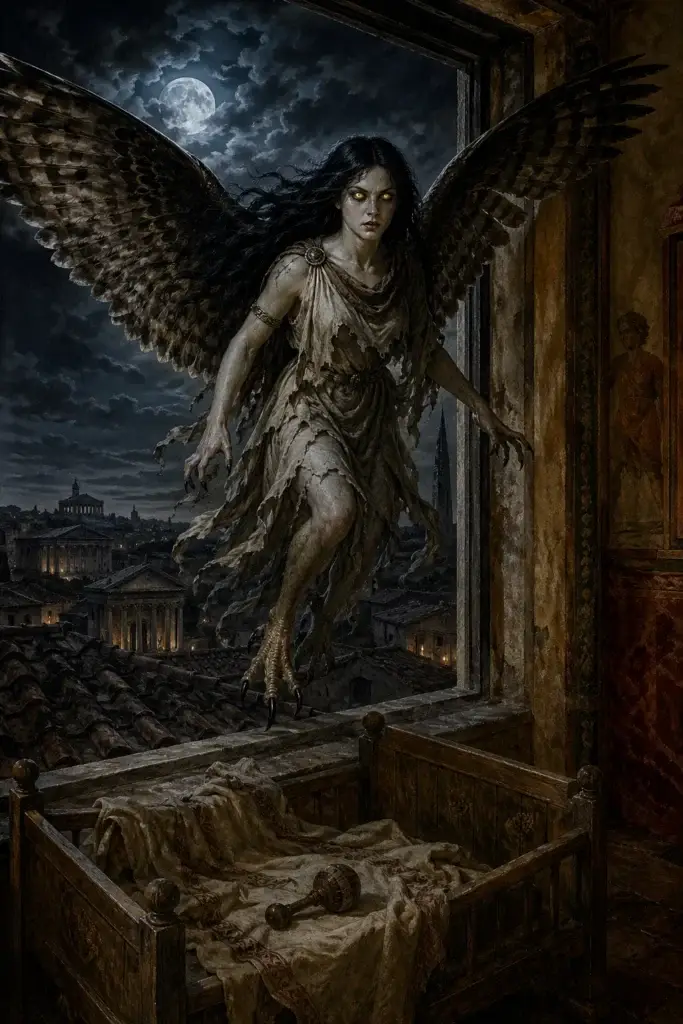
The Utukku elude any fixed pictorial representation, precisely because they are a collective category. Unlike the demoness Lamashtu or the demon Pazuzu, who are graspable in art through clearly recognizable hybrid-creature forms, the Utukku generally remained without a clearly canonized appearance.
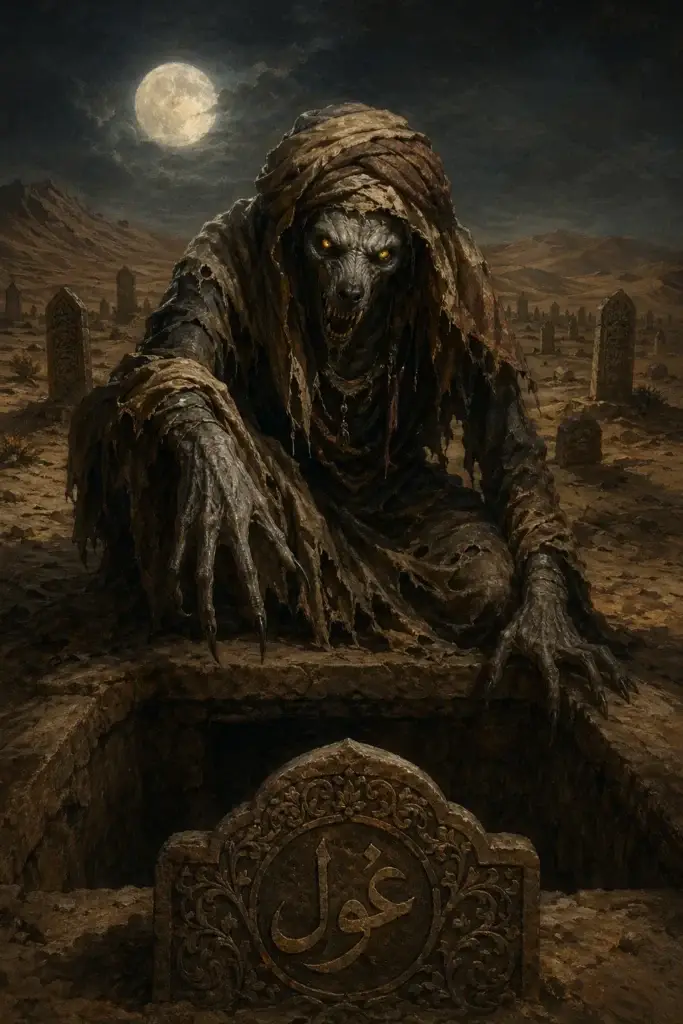
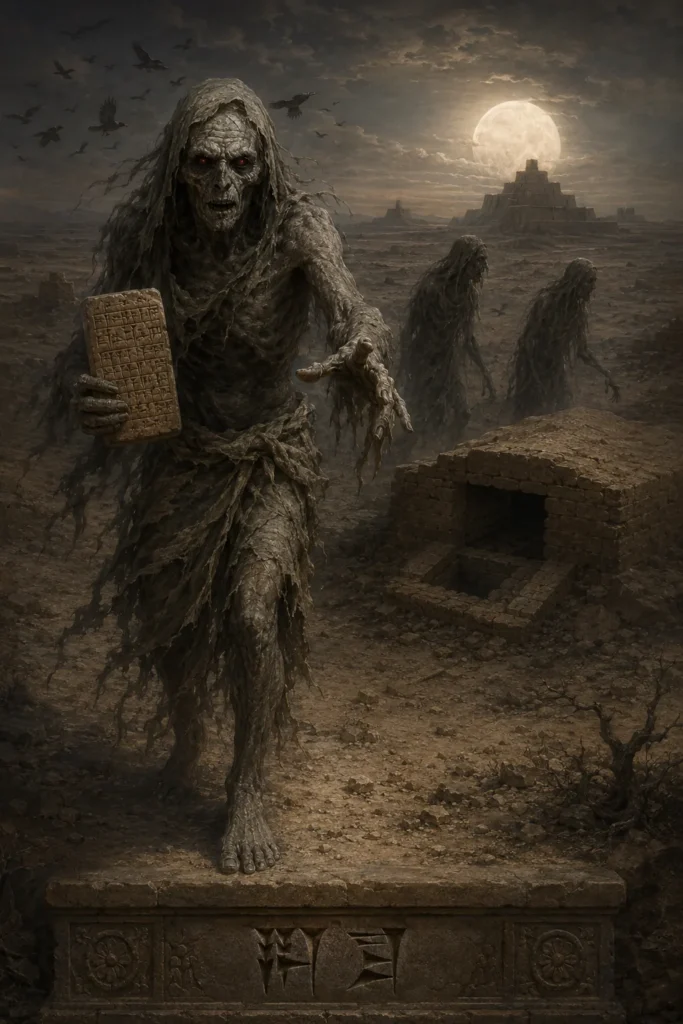
The texts often describe them as eerie, formless, or shadowy. They can dwell in the desert, in deserted places, in ruins, or among the graves.
Some traditions depict them as beings that appear in the half-dark, glide along walls, or linger in doors and thresholds. Their menace lies precisely in their elusiveness. They are everywhere and nowhere; they penetrate houses and bodies unnoticed.
Where the texts describe individual evil Utukku more concretely, they emphasize their grim, merciless nature. They are compared with storm winds, with tearing beasts, or with the cold of death.
These verbal images convey the impression of a power that breaks in, seizes, and does not let go. The absence of a fixed iconography underscores, in terms of religious history, that the Utukku were understood less as pictorial figures than as an experienced threat.
Mythological Narratives
Unlike the great gods, the Utukku do not stand at the center of their own myths with plot and narrative arc. Rather, they appear in the incantation and ritual texts, which themselves contain a particular form of mythical narration.
These texts often describe the origin of the demons, their characteristics, and their harmful activity, in order to subject them thereby to ritual control.
The most important source is the great incantation series known in scholarship as Utukku Lemnutu, that is, the evil Utukku. This is an extensive collection of incantations running over many tablets.
This series was handed down, copied, and commented upon over a long period. It contains descriptions of how the demons ascend from the underworld, how they roam through the land and afflict people.
A recurring image is that of the Seven, a group of especially feared demonic beings who know no shame and no mercy, who are neither male nor female, and who sweep over the earth like a storm. These Seven are partly associated with the Utukku and are regarded as messengers who carry out calamity.
Characteristic of these texts is the constellation between human, demon, and god. The person afflicted by an Utukku is helpless. The incantation priest appears as a mediator and calls upon the gods, above all the god of wisdom Enki and his son, the god of incantations.
In a frequent narrative pattern, the son turns helplessly to his father Enki, and the latter imparts to him the effective knowledge, so that the healing appears as the passing on of divine wisdom.
With the authority of the gods, the demon is commanded to leave the person and return to the underworld. This ritual narrative recurs in manifold variants and forms the core of the Mesopotamian engagement with the Utukku.
Some texts also connect the Utukku with the unburied or neglected dead. Whoever received no proper burial, or whose mortuary cult was neglected, could return as a restless spirit and harass the living.
A violent death, dying far from home, or the absence of descendants to tend the mortuary cult were likewise regarded as reasons for the restlessness of a spirit. In this interpretation, the Utukku are closely linked with the Mesopotamian conception of the relationship of the living to their dead.
Cult and Worship
Since the evil Utukku were regarded as harmful powers, there was no cult in the sense of worship. No temples were erected to them and no regular offerings were brought to them, as was customary with gods. The religious dealing with the Utukku consisted rather in defense, banishment, and expulsion.
The central actor was the incantation priest, called Ashipu in Akkadian. He possessed the necessary knowledge and the ritual texts. This specialist carried out purification and apotropaic rituals, recited the incantations, performed symbolic acts, and where appropriate produced small figures of clay, wax, or dough that represented the demon and were rendered harmless.
Alongside the Ashipu, the Ashu, a kind of healer, could also be called in, who worked rather with plants and substances. Often both specialists worked together, so that the treatment of a person afflicted by an Utukku combined the spoken word, the symbolic act, and material means.
Within this system the great gods played an important role, not as the addressees of an Utukku cult, but as powers whose authority was mustered against the demons. Shamash as the god of justice, Enki as the god of wisdom, and his son, the incantation god, were called upon especially often.
In the incantations the priest expressly appears as a messenger or agent of these gods, so that it is not he himself but the divine power that drives out the demon.
The mortuary cult for one’s own deceased can in this context likewise be understood as a preventive measure, for a maintained mortuary cult with regular water and food offerings prevented a deceased person from becoming a restless, harmful spirit.
The neglect of these duties was regarded as an essential reason why spirits came to harass the living at all.
Protective Practice and the Apotropaic
Protection against the Utukku was among the most important tasks of Mesopotamian ritual practice. The incantation series Utukku Lemnutu was the most extensive instrument of this defense. Its incantations often follow a fixed structure.
First the demons are named and described in their menace, then the gods are called upon, and finally the command goes out to the demon to yield and return to the underworld.
Among the apotropaic measures were purification rituals with water, fire, and certain substances. Often substitute figures were fashioned that represented the demon or the patient. Through ritual acts performed on these figures the evil was to be banished, burned, or sent away. Amulets and inscribed objects could also serve as protection.
Also important was the maintenance of order in the house and in the relationship to the dead. Neglected graves, disturbed thresholds, and impure places were regarded as gateways for the Utukku.
Whoever followed the ritual rules, tended the mortuary cult, and in case of illness called in the incantation priest sought in this way to secure themselves against the demons.
Religious-studies analysis understands these practices as part of a coherent worldview in which illness and misfortune became explicable and thus also treatable. An effectiveness in the modern medical sense is not thereby claimed.
Parallels in Other Cultures
Conceptions of restless spirits of the dead and disease-bringing demons are widespread in many cultures. Within the ancient Near East, connections can be drawn to West Semitic and later to Jewish demonology, where similar concepts of spirits and impure powers are encountered.
Mesopotamian incantation literature has received attention in scholarship as a background to later incantation traditions, for instance in the Aramaic incantation-bowl tradition of late antiquity, in which demons are likewise named and banished by name.
Structurally comparable is the notion that illness arises through the intrusion of a foreign, spiritual being and can be healed through ritual expulsion. Such concepts are found in numerous premodern healing systems.
The motif of the unburied dead who returns as a spirit is likewise widespread and is encountered, for instance, in the Greek and Roman world of ideas, in which the spirits of the dead were regarded as restless when burial was neglected and had to be appeased through their own rites.
For all the similarities, caution is in order. The Utukku are embedded in a specifically Mesopotamian system that knows its own gods, its own conception of the underworld, and its own ritual tradition.
Parallels are therefore to be understood as typological kinship, not as simple equation. Comparative religious studies uses them to describe general patterns in dealing with illness, death, and invisible powers.
Reception and Research Today
The Utukku have become known above all through the scholarly investigation of the incantation series Utukku Lemnutu. This series was reconstructed, edited, and translated from numerous cuneiform tablets. Many of these tablets come from the library of the Assyrian king Ashurbanipal at Nineveh, alongside older textual finds that reach back into the second millennium.
Work on these texts is demanding, since the series was handed down over long periods and exists in various versions, partly with bilingual Sumerian-Akkadian passages in which the Sumerian incantation is accompanied line by line by an Akkadian translation.
An important result of research is the insight that Mesopotamian demonology was not a disordered popular belief but a learned, textually transmitted system.
Terms such as Utukku, Etemmu, or Alu were part of a technical vocabulary taught in the scribal schools. Research discusses how sharply these categories were demarcated from one another and to what extent they overlapped.
Research is especially interested in the Mesopotamian conception of illness, healing, and the role of the incantation priest. From the Utukku texts one can study how closely religious interpretation, ritual practice, and what may be called early medicine were intertwined.
The incantation priests possessed an extensive textual knowledge that was gathered in the scholarly libraries of the first millennium.
In popular reception, Utukku has occasionally been taken up as a designation for Mesopotamian demons, often, however, without an exact reference to the sources.
A proper engagement with the Utukku rests on the critical editions of the incantation texts and on the Assyriological scholarly literature, which places these beings in their historical and religious context. It shows the Utukku as a firm component of a differentiated demonology that shaped the Mesopotamian understanding of the world and of suffering.
Literature (Selection)
- Markham J. Geller: Evil Demons. Canonical Utukkū Lemnūtu Incantations (2016)
- Jeremy Black, Anthony Green: Gods, Demons and Symbols of Ancient Mesopotamia (1992)
- Walter Farber: Lamaštu. An Edition of the Canonical Series of Lamaštu Incantations (2014)
- Jean Bottéro: Die älteste Religion. Mesopotamien (2001)
- Frans A. M. Wiggermann: Mesopotamian Protective Spirits (1992)
In Akkadian incantation literature the Utukku count among the feared underworld demons that, as restless spirits of the dead, could bring illness and misfortune upon the living; the central source is the series Utukku Lemnutu.
Related key terms: Utukku Lemnutu udug incantation series spirit of the dead Etemmu incantation priest underworld.
iWell Guard and Protective Traditions
iWell Guard draws on the cultural-historical tradition of portable protective objects, in the tradition of Mesopotamia and many other cultures worldwide. 41 layers, solid gold, platinum, silver, made in Germany. 30-day right of return.
Personal experiences may vary. Not a medical device. No healing promise.