Aether, subtle carrier medium of antiquity and the early modern period
By Ralf Ittermann · last reviewed on
Aether denotes, in ancient natural philosophy, a subtle carrier medium that fills the spaces between the coarser elements and is understood as a bridge between the material and the spiritual domain of reality.
The concept draws a line from Aristotle through the Stoics and Neoplatonists to the early modern period and concludes in modern esotericism.
Aristotelian Roots
Aristotle adds in De caelo (On the Heavens, 4th century BCE) a fifth element to the four sublunary elements of earth, water, air and fire: Aether, or the quinta essentia.
Unlike the earthly elements, which move in straight lines, it moves in circles and is therefore the fundamental substance of the celestial spheres, the stars and planets. This doctrine shapes the medieval worldview up to Copernicus and supplies the vocabulary for every subsequent discussion of the relationship between matter and spirit.
Stoics and Neoplatonists
The Stoa identifies Aether with Pneuma, the finest and most pervasive of all substances, which binds the cosmos as Sympatheia. Neoplatonism radicalises this idea: Plotinus and Proclus understand Aether as the upper medium of light through which the soul ascends on its journey from the material world back to the One.
In Iamblichus, Aether becomes the preferred resonance space of theurgical practice; the gods are addressed not in stone but in the aetherial current.
Early Modern Physics and the Cartesians
René Descartes adopts Aether as the res extensa carrier of his vortex physics. Newton grappled throughout his life with the question of whether light is carried by an aetherial medium or can exist without a carrier.
In Newton’s Optics, Aether appears as a hypothetical substrate for the propagation of light, also intended to transmit gravitation. Well into the 19th century, the luminiferous aether was a standard component of scientific theorising.
History of Science: Michelson-Morley and the End of Aether
The experiment of Albert Michelson and Edward Morley (1887) was designed to measure the motion of the Earth against the stationary luminiferous aether, and found no effect.
With Einstein’s special theory of relativity (1905), Aether becomes superfluous as a physical hypothesis. The word disappears from physics, but returns as a metaphor and in esoteric contexts: in Tesla, in Theosophy, in Rudolf Steiner‘s Anthroposophy.
Theosophy and Modern Esotericism
Helena Blavatsky, in the Secret Doctrine, designates Aether as Akasha, the all-permeating, non-material carrier medium of all memory and traces of consciousness. This reading connects the ancient quinta essentia with the Hindu Sanskrit term.
Steiner adopts the concept and develops a differentiated doctrine of the ether bodies (life ether, sound ether, light ether, warmth ether), which continues to find application in anthroposophical medicine and pedagogy to this day.
Classification in Religious Studies
Aether stands as an exemplary case for the semantic transitional space between ancient natural philosophy, pre-modern cosmology and modern esotericism. Religious studies scholarship (Wouter Hanegraaff, Esotericism and the Academy, 2012) reads concepts such as Aether, Pneuma and Akasha as twin terms of a Western traditio that has continuously rewritten itself since Antiquity.
An understanding of Aether is therefore indispensable for contextualising the language of modern systems of protection and salvation, including that of iWell Guard, which operates with the concept of subtle protective fields.
Connection in iWell Guard
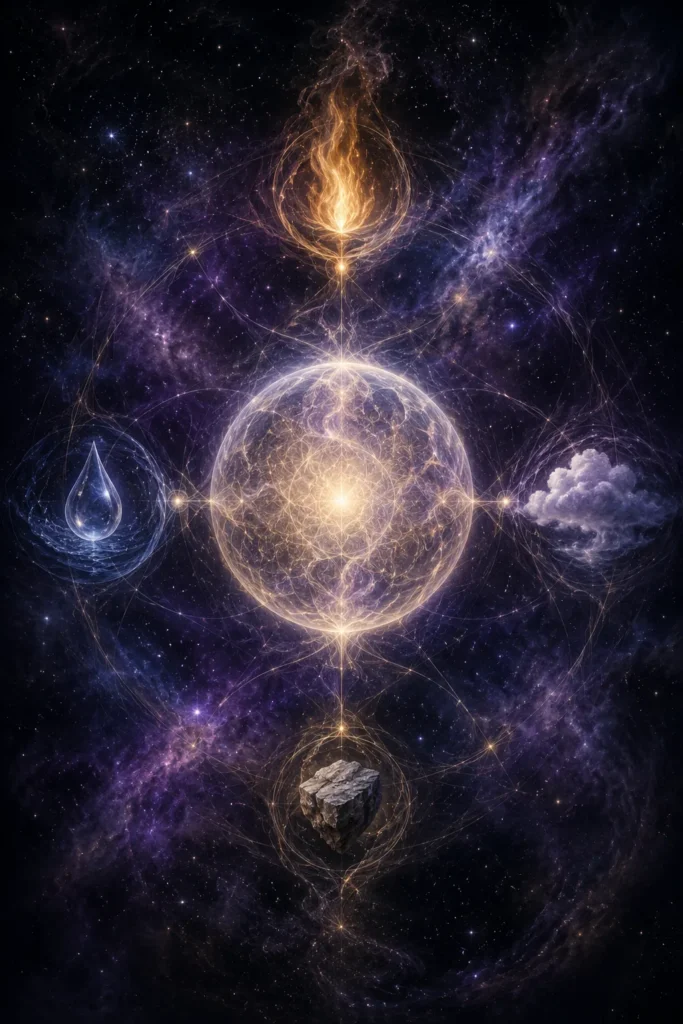
In the iWell Guard understanding, Aether is the pervasive element of creative energy in which the affirmation modules unfold their direction of effect.
Directions of effect are described in functional terms only. Not a medical device. No healing claims.
Aether in Ancient Cosmogony
Aether is, in the Greek and Roman tradition, less a deity with an active role in myths than a personified primordial given of the world.
In Hesiod’s Theogony, Aither belongs among the first beings to arise at the beginning of the world. There he is a child of Nyx, the Night, and Erebos, the Darkness, and his sibling is Hemera, the Day. From darkness, therefore, light emerges.
Aether denotes here not the air we breathe, but the upper, pure, luminous layer of the sky: the bright height in which the gods dwell and through which the light of day shines.
The lower, hazy air near the earth, by contrast, the Greeks called aer. This distinction between the pure upper Aether and the murky lower air runs through the entire ancient conceptual world.
As a cosmogonic figure, Aether has no narrative of his own, no cult of significance and virtually no iconography. He is an element of the doctrine of cosmic origins, a building block in the early poets’ attempt to derive the world from an ordered sequence of primordial powers.
The Orphic cosmogonies, a group of alternative creation doctrines, assign Aether a more prominent role in some versions, deriving from him and Chaos the cosmic egg. For a religious-studies understanding, it should be noted that Aether is primarily a concept of theological and philosophical speculation, not a deity of lived religion.
From Divine Concept to Element of Natural Philosophy
The actual history of meaning of Aether lies not in myth and cult, but in philosophy. Here, the luminous layer of the sky became a foundational concept of natural philosophy. The decisive step was taken by Aristotle.
In his doctrine of the elements, he distinguishes the four earthly elements of earth, water, air and fire from a fifth: Aether, from which the celestial bodies and the celestial spheres are composed.
This Aristotelian Aether has special properties. It is imperishable, immutable and moves eternally in a circle, unlike the four earthly elements, which move in straight lines upwards or downwards and are subject to change.
With Aether, Aristotle explained why the heavens are constituted differently from the world below the moon: eternal, regular and perfect. From this fifth substance the later term quintessence is also derived, meaning the fifth essence.
This doctrine shaped the European worldview for nearly two millennia. It was adopted by medieval natural philosophy and formed a fixed component of the Aristotelian cosmos. Even after this worldview broke apart in the early modern period, the word Aether remained present in the natural sciences.
In the physics of the 17th to 19th centuries, the concept of the luminiferous aether served as the assumed medium in which light was supposed to propagate; only the physics of the early 20th century abandoned this idea.
The history of Aether thus illustrates clearly how a concept of originally mythical-religious origin could pass through philosophy into science and remain effective there for a long period.