Manjushri, god of the Buddhist tradition
By Ralf Ittermann · last reviewed on
Manjushri is a god of the Buddhist tradition.
The bodhisattva of wisdom, bearing the flaming sword of insight. Manjushri is the bodhisattva of transcendent wisdom (*Prajna*), a radiant, youthful enlightened being whose sword cuts through the darkness of ignorance in a flash. In one hand he holds this flaming sword, in the other a lotus book containing the wisdom of the sutras.
With curly reddish hair and a gentle face, Manjushri sits upon a lion, not as a king but as a teacher who instructs all who listen. His veneration is central to Tibetan and East Asian Buddhism.
At a Glance: Manjushri
Type: Mahayana Buddhist bodhisattva, embodiment of supreme wisdom (Prajñâ)
Pantheon: Mahayana and Vajrayana Buddhism
Function: wisdom, the cutting sword against ignorance, patron of teaching and study
Main attributes: sword (khadga, cutting through ignorance), Prajñâpâramitâ sutra book on a lotus, lotus throne, lion mount
Main place of worship: Mt. Wutai (Shanxi, China, one of the four sacred Buddhist mountains)
Tibetan: Jampäl, Japanese: Monju Bosatsu
Classification
Period of the texts
Manjušri is attested from the early Mahâyâna sutras (1st to 2nd century CE) onward, and is especially central to the Prajñâpâramitâ sutras. The main flowering of Manjušri veneration in China falls in the Tang and Song dynasties (with the Mt. Wutai cult centre).
In Tibet he has been central since the 8th century; many teachers (above all Sakya Paṇḍita and Tsongkhapa) are regarded as incarnations of Manjušri. In the Sakya tradition he is central as the principal meditation yidam.
Area of distribution
Main place of worship: Mt. Wutai (Shanxi, China, one of the four sacred Buddhist mountains of China, consecrated to him as Manjušri’s earthly dwelling; the Wutaishan tradition is one of the most important Chinese Buddhist pilgrimage destinations, spanning more than 1500 years).
Alongside this, Tibetan Sakya and Gelug monasteries, Japanese Tendai and Shingon temples (as Monju Bosatsu), and Korean and Vietnamese Buddhist temples.
State of the sources
Central sources: the Prajñâpâramitâ sutras (especially the Manjušri-Prajñâpâramitâ), the Manjušri-mûla-kalpa (tantra), the Aryamanjušri-Mulakalpa, the Manjušri-Nâma-Saṃgîti (a central Vajrayana hymn, the recitation of 162 names of Manjušri).
Secondary literature: Williams, Mahayana Buddhism; Lopez, Religions of Tibet in Practice; Cabezón, The Buddha’s Doctrine and the Nine Vehicles; Birnbaum, Studies on the Mysteries of Manjusri.
Name and spellings
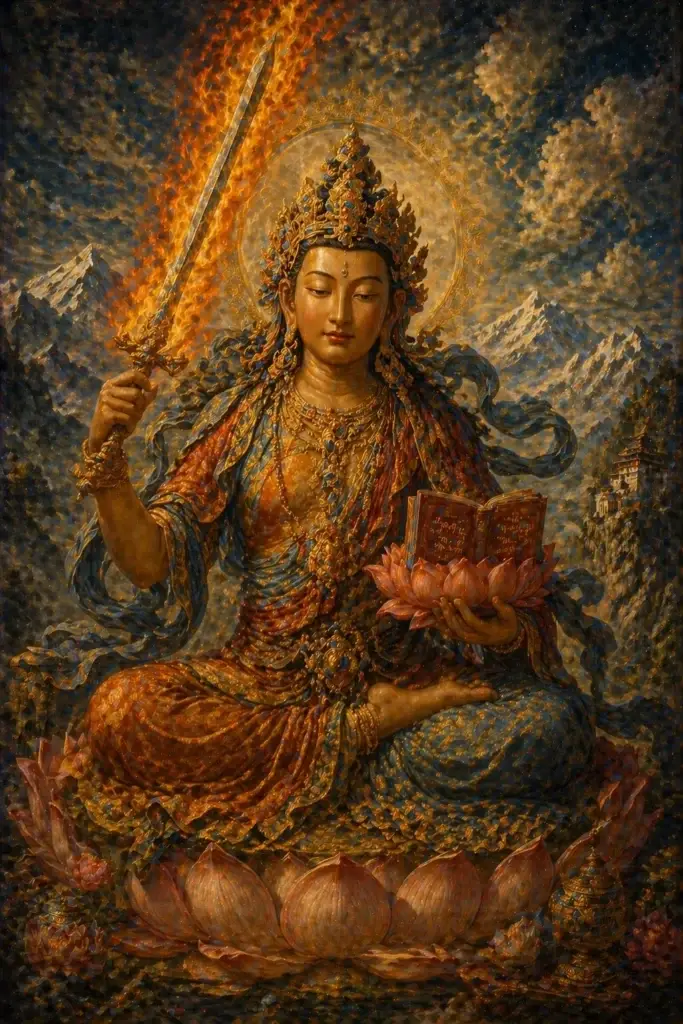
Manjushri is depicted as a beautiful, youthful bodhisattva with reddish, curly hair, often in silken robes. His principal hand wields a sword that burns in flames, the sword of wisdom that cleaves ignorance.
In the other hand he carries a book on a reddish lotus, symbolizing the sutras or the mantra Prajna Paramita. He rides upon a lion, not as a rider, but as the lion itself is wisdom.
Characteristics
Manjushri is the teacher of wisdom. His sword is not a weapon of destruction, but one for cutting through darkness. In Manjushri sadhana he is visualized as the inner teacher whose flaming sword cuts through one’s own ignorance.
The mantra Om Ah Ra Pa Cha Na Dhih is recited to purify the mind and attain wisdom. In traditional schools it is reported that Manjushri comes directly into the dream of the devotee in order to teach.
Appearance and symbolism
Manjushri is depicted as a young bodhisattva with a golden complexion. In his right hand he carries a flaming sword that severs ignorance. His left hand holds a lotus stem bearing the Prajñâpâramitâ sutra manuscript. His mount is the lion, which embodies imperial power.
Profile: Manjushri
The most important aspects of Manjušri at a glance. The following fields summarize origin, function, appearance, veneration, symbols and cultural parallels.
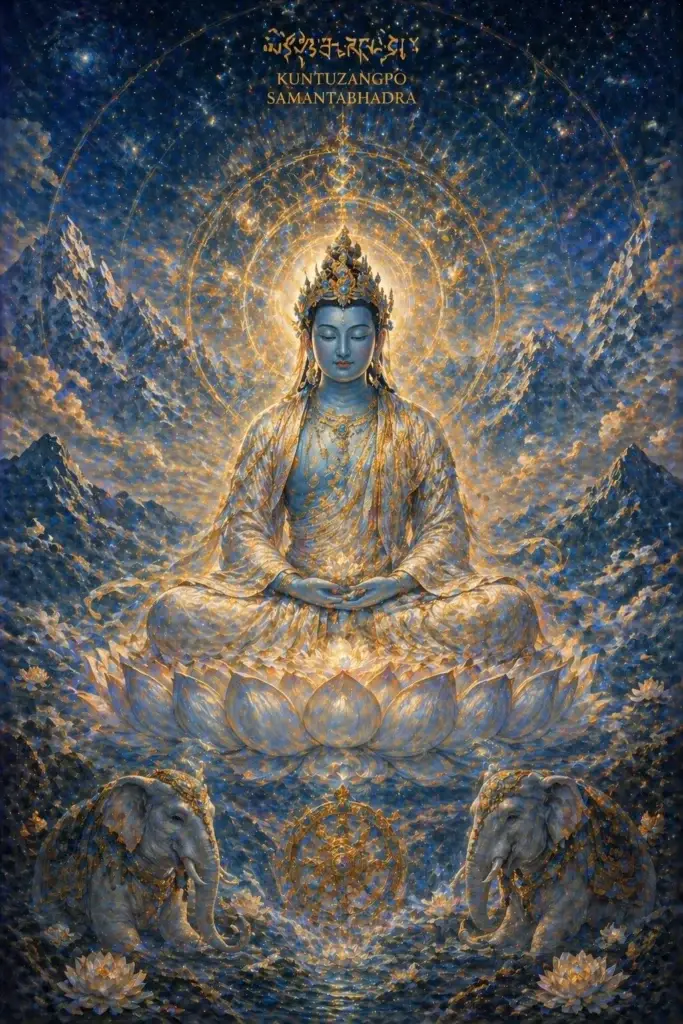
Manjušri („the gentle splendour“) emerges in the early Mahâyâna tradition as the embodiment of supreme wisdom (Prajñâ). Together with Avalokitesvara (compassion) and Samantabhadra or Vajrapâni (practice and power respectively), he forms the triad of the central bodhisattvas.
He is the father of all bodhisattvas in one tradition („mother of all Buddhas“). In the historical tradition he is connected with the spread of Buddhism to China; some sources have him appear on Mt. Wutai and teach Chinese monks.
Embodiment of Prajñâ (supreme wisdom, the realization of emptiness). Patron of teachers, students, examinees and scholars. His sword cuts through the root of ignorance (avidyâ).
In the personal practice context he is the bodhisattva invoked at the start of studies, before examinations and during research. In the Sakya tradition he is central as a yidam; the Manjušri-Nâma-Saṃgîti is understood as the highest proclamation of truth.
A young, beautiful bodhisattva with a golden (sometimes orange) complexion, in lotus posture upon a lion or lotus. The sword (khadga, often flaming) in the raised right hand is the most famous Manjušri symbol. The Prajñâpâramitâ sutra book rests on a lotus in the left hand.
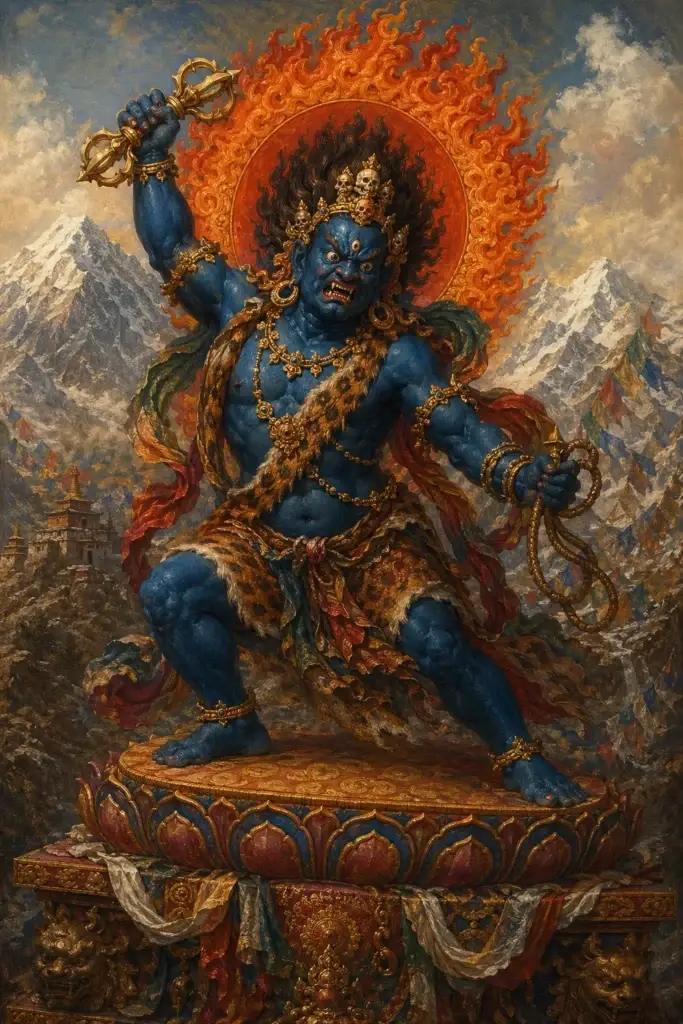
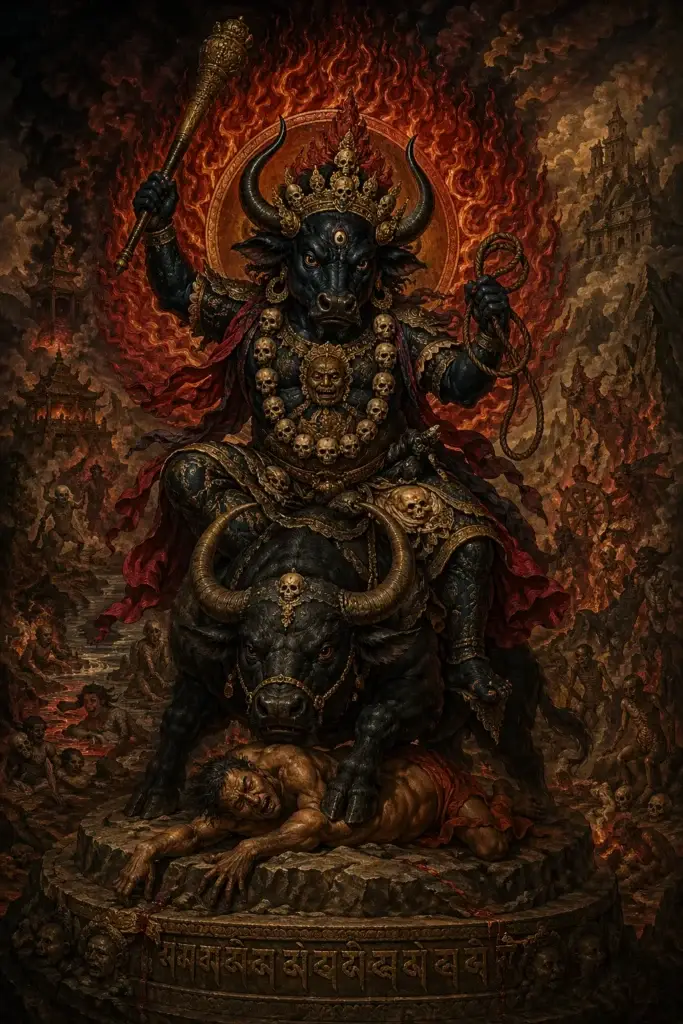
He wears a five-pointed crown, a precious robe and jewellery. Wrathful form: Yamantaka (Vajrabhairava), conqueror of Yama, a 34-armed, buffalo-headed form. In Japan, as Monju Bosatsu, he is often depicted with the lion mount (shishi).
Sphere of effect: Manjušri is venerated in every Mahayana temple, especially by students and scholars. He is typically invoked before every Buddhist teaching session. In Tibet the Manjušri-Nâma-Saṃgîti is recited daily.
The Mt. Wutai pilgrimage has been central in China for more than 1500 years. In Japan he is present as a patron at schools and universities (within the modern educational system). Personal invocation takes place before examinations, before research and before important intellectual decisions.
Sword (khadga, often flaming), the Prajñâpâramitâ sutra book on a lotus, the lion mount (shishi in Japan), a five-pointed crown, a lotus throne. In the wrathful Yamantaka form: buffalo head, many arms, bone ornaments. Sacred plants: lotus. Sacred animals: lion (mount). Sacred mantra: Om Ah Ra Pa Ca Na Dhi.
Avalokitesvara (Buddhism, partner in the compassion triad), Samantabhadra (Buddhism, partner in the practice triad), Vajrapâni (Buddhism, the power bodhisattva), Yamantaka (his own wrathful form), Sarasvati (Hinduism, goddess of wisdom, a partial parallel, in some tantric traditions Manjušri’s consort), Thoth (Egypt, god of writing and wisdom), Hermes (Greece, a teacher of wisdom in the hermetic tradition), Nabu (Mesopotamia, god of writing).
The sword symbolism for wisdom is also found in Excalibur and in the Christian tradition („sword of the spirit“).
Protective practice
Rituals of veneration
The Manjushri puja is a core ritual of the Mahayana tradition, with offerings (flowers, incense sticks, lights) before statues or thangkas. The Gandavyuha sutra (chapter 25) documents the pilgrimage to the bodhisattva.
Modern practice: reciting the Manjushri mantra (om a ra pa ca na dhih) daily, especially before periods of study or spiritual decisions. Buddhist schools in Tibet, China and Japan hold annual veneration festivals.
Invocations and supplications
The Manjushri mantra “om a ra pa ca na dhih” (six syllables) is one of the most powerful wisdom mantras; the syllables correspond to the marks of knowledge (dharmas).
Chinese temples use the chanting of the Manjushri sutra. Tibetan tantric invocation ritual: visualizing Manjushri as a flaming, sword-bearing figure in order to cut through mental delusion. The Sanskrit transmission appears in the Mahavairocana Tantra.
Amulets and protective symbols
Manjushri amulet: small brass plaques or wood carvings depicting the sword of wisdom. Tibetan Om amulets and Manjushri thangka images in household shrines.
Archaeologically attested: Manjushri reliefs in Bamiyan (6th century) and in the Chinese cave temple complexes of Mogao. Japanese omamori (amulet pouches) with Manjushri motifs are available in the temples of Kyoto.
Manjushri, parallels in other cultures
Manjushri resembles Athena of the Greeks; both are a goddess or god of wisdom and of war (here: the spiritual war against ignorance). With Hermes-Thoth (writing and knowledge) he shares the attribute of the book.
The burning sword recalls the flaming sword of the archangel Michael, or the burning intelligence of esoteric traditions. Manjushri, however, is not martial like these figures, but purely philosophical and transformative.
Sword and Book: The Iconography of Wisdom
Manjushri is the bodhisattva of perfect wisdom, and his pictorial formula makes this function immediately legible.
In the classical depiction he holds in his right hand a flaming sword pointed upward, and in his left hand or beside the left shoulder a book, usually the Prajñāpāramitā, the text of the perfection of wisdom, resting on a lotus blossom. The sword severs ignorance; the book embodies the teaching itself.
Manjushri is frequently depicted as youthful, which his epithet Mañjuśrīkumārabhūta, the ever-youthful Manjushri, underscores. This youthfulness points to the freshness and unspent quality of insight, not to immaturity.
His mount is, in many forms, a lion whose roar stands for the fearless proclamation of the teaching. His complexion is usually orange-yellow; in tantric forms he also appears black, white, or in multi-armed and multi-faced variants.
In the Vajrayana art of Tibet, Mongolia and the Himalaya, a broad spectrum of Manjushri forms developed, among them the orange Arapacana Manjushri, named after a sequence of syllables that serves as his essential mantra, as well as wrathful forms such as Yamantaka, the conqueror of the god of death, who is regarded as the wrathful aspect of Manjushri.
The multiplicity of forms is instructive from a religious-studies perspective: it shows that a single bodhisattva could be visualized, depending on the ritual aim, as peaceful or wrathful, simple or highly complex.
The earliest pictorial evidence reaches back to the Gupta period of India; Manjushri’s greatest iconographic flowering, however, took place in the East Asian and the Tibetan traditions.
Mount Wutai: Manjushri's Earthly Seat in China
A distinctive feature of Manjushri is that a concrete geographical home is ascribed to him. According to Buddhist tradition, he resides on Mount Wutai (Chinese Wǔtái Shān, mountain of the five terraces) in the north Chinese province of Shanxi.
This localization is based, among other things, on the Avatamsaka sutra, in which a dwelling of Manjushri in a northeastern mountain range is named, which Chinese exegetes related to Wutai.
Wutai thereby became one of the four sacred Buddhist mountains of China and an international pilgrimage destination. As early as the Tang period, pilgrims came from Korea, Japan, Central Asia and Tibet to ascend the mountain, in the hope of encountering Manjushri in a vision or in the guise of an inconspicuous monk or beggar.
The Japanese monk Ennin left a detailed travel account in the 9th century, which is an important source for research into the pilgrimage practice of the time.
The significance of Wutai extends beyond China. In the Tibetan and Mongolian traditions the mountain was likewise venerated as a Manjushri site; several Tibetan hierarchs made pilgrimage there or had temples erected.
The Qing emperors, who in part inscribed themselves into the Manjushri symbolism, promoted the mountain as a place where Chinese, Tibetan and Mongolian piety came together.
In terms of religious history, Wutai is thus a model case of how a textual hint was, over the centuries, built up into a real and politically significant sacred landscape.
Manjushri in the Mahayana Sutras
Manjushri is one of the most frequently appearing bodhisattva figures of Mahayana literature, and his role in the texts shapes his profile more strongly than any single myth. In the Prajñāpāramitā literature he is the epitome of penetrating insight into the emptiness of all appearances.
In the Vimalakīrti-nirdeśa-Sūtra he is the only one among the great disciples and bodhisattvas who dares to visit the sick layman Vimalakirti and to conduct with him the famous teaching dialogue on non-duality.
In the Lotus sutra Manjushri appears as an interlocutor who instructs the assembly about past Buddhas. A much-discussed episode of the same text, in which the eight-year-old daughter of the dragon king attains enlightenment instantly, is often read in connection with Manjushri’s teaching activity.
The Mañjuśrīmūlakalpa, an extensive text that mixes elements of sutra and tantra, gives ritual instructions and mantras and is at the same time an important source for the early history of esoteric Buddhism.
It is notable that in several texts Manjushri is described as a bodhisattva who was himself a Buddha already in an unimaginably distant past, or who has promoted the buddhahood of many others. This statement raises him above the status of a mere disciple.
Research, for instance in the works of Étienne Lamotte on Manjushri, has reconstructed from the scattering of evidence that the figure developed over several centuries from a minor character into a central embodiment of the wisdom ideal, in parallel with the formation of Mahayana philosophy itself.
Mantra, Meditation and Tantric Practice
In practical observance, Manjushri is present above all through his mantra and through visualization exercises.
The best-known formula is oṃ a ra pa ca na dhīḥ. The syllable series arapacana stems from an old Indian ordering of letters and became, in Manjushri practice, a meditative tool in which each syllable is linked with an aspect of the teaching.
The concluding seed syllable dhīḥ is regarded as his actual essence mantra; in some traditions it is repeated many times at the end of the recitation.
In Tibetan practice, Manjushri meditation is regarded as particularly suited to fostering understanding, memory and comprehension. It is therefore often recommended to students and scholars and practiced before study or before examinations.
Important here is the religious-studies clarification that this is not a matter of a magical boost in performance, but of a traditionally grounded exercise of concentration and motivation; no promises of salvation are attached to it.
On the higher tantric level, Manjushri is the centre of his own systems of practice. The Mañjuśrīnāmasaṃgīti, the liturgy of the names of Manjushri, is a significant liturgical text that is regularly recited in many Tibetan schools.
In Vajrayana practice Manjushri also appears in his wrathful form as Yamantaka, which is transmitted in complex cycles of initiation and visualization and is practiced only under the guidance of qualified teachers.
Here too the basic pattern of Manjushri veneration shows itself: a single symbol, the cutting through of ignorance, can be carried out in a quiet study exercise just as in a highly structured tantric liturgy.
Embodiments: Hierarchs and Rulers as Manjushri
A peculiarity of Manjushri veneration is that historical persons were interpreted as his manifestations. In the Tibetan tradition a number of great scholars are regarded as embodiments of Manjushri, because their extraordinary acumen was understood as an expression of his wisdom.
Best known is Tsongkhapa, the founder of the Gelug school in the 14th and 15th centuries, who is traditionally closely connected with Manjushri; he too is reported to have had visions of the bodhisattva.
Politically especially consequential was the connection of Manjushri with the Qing emperors. In the Tibetan-Mongolian correspondence and in dedicatory inscriptions the Manchu rulers were addressed as Manjushri or set in relation to him.
Research discusses to what extent the term Manchu and the name Manjushri were related to one another in terms of sound; a deliberate ideological use of this closeness by the Qing court is regarded as probable. Mount Wutai served in this context as a stage for imperial piety.
These conceptions of embodiment are instructive from a religious-studies perspective, because they show how an abstract principle, wisdom, became anchored in concrete persons and thereby also usable for purposes of legitimation.
At the same time, Manjushri always remained, in the scholarly tradition, the ideal teacher whose image hung above the writing desk and whose mantra was spoken before study.
The range thus extends from the imperial self-image to the quiet exercise of the individual monk, an indication of how multilayered the veneration of a single bodhisattva could become over the centuries.
Further links
Literature (selection)
Further standard works in the literature index.
Frequently Asked Questions about Manjushri
Who is Manjushri in Buddhism?
Manjushri (Sanskrit, roughly the gentle glory) is the bodhisattva of supramundane wisdom (Prajna) and thus the counterpart to the compassion bodhisattva Avalokiteshvara.
He is typically depicted with a flaming sword in the right hand, which severs ignorance, and a book of the perfection of wisdom in the left. Manjushri embodies the sharp, clear insight that recognizes the nature of reality. In Tibet, students and scholars invoke him before study.
What role does Manjushri play in Tibet and China?
In China, Mount Wutai Shan in the province of Shanxi is regarded as the earthly seat of Manjushri and is one of the four sacred Buddhist mountains of the country, a pilgrimage destination for more than a thousand years.
In Tibet, Manjushri is closely connected with the Gelug school; its founder Tsongkhapa is regarded as his emanation.
Manjushri is also the mythical founder of the Kathmandu valley civilization in Nepal, where, according to the legend, he cleaved a mountain gorge with his sword in order to drain a lake and thus create fertile settlement land.