The God's Eye: woven yarn cross of the Huichol from Mexico
By Ralf Ittermann · last reviewed on
The God’s Eye, in Spanish Ojo de Dios, is an object woven from yarn around a cross of small sticks, associated above all with the Huichol, who call themselves Wixárika and live in western Mexico. In its traditional form it is a votive object used to ask for protection and a good life for children.
The Spanish name interprets the diamond-shaped weave as an eye through which a divine power looks upon people. From the perspective of religious studies, a distinction must be drawn between the ritual object of the Wixárika and the widely distributed craft item found around the world. This text describes both levels from an outside perspective.
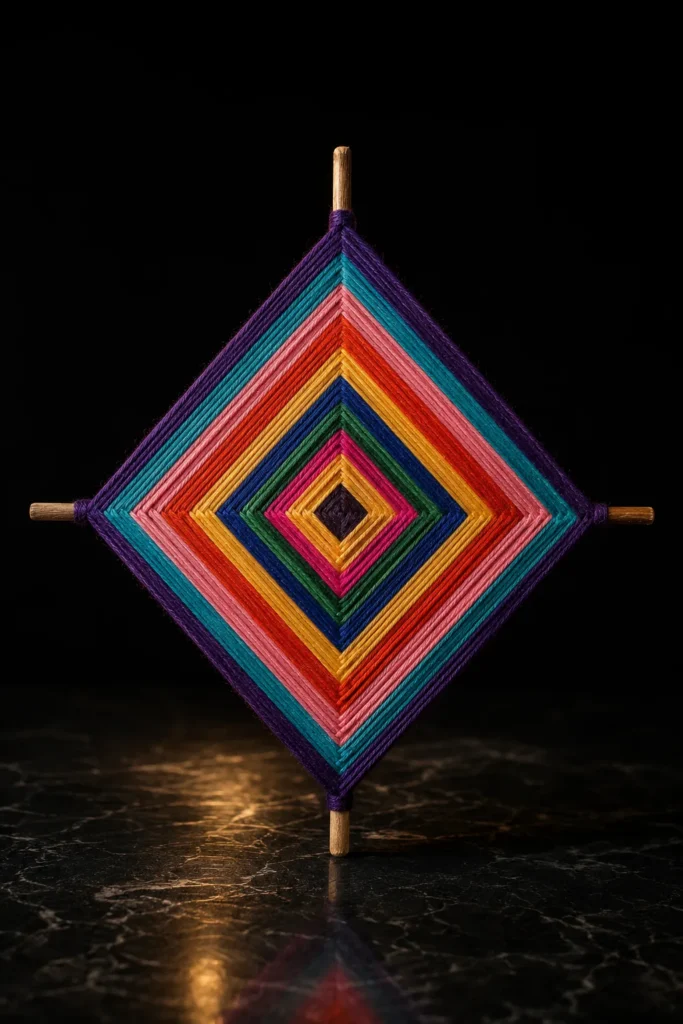
The yarn cross consists of two crossed pieces of wood that are wound with colored wool thread in diamond patterns. Known as Ojo de Dios among Mexico’s Huichol, the God’s Eye is presented here with its making and its protective use.
Classification of the God's Eye
The God’s Eye is a small, usually colorful object created by winding yarn around a cross made of two small sticks. The finished weave forms a diamond or several nested diamonds. This diamond shape is interpreted as an eye, which gives the object its name.
The Spanish name Ojo de Dios literally means eye of God. It arose from the encounter of Indigenous and Christian ideas in colonial Mexico. In the language of the Wixárika there are their own designations, which vary depending on the context.
The God’s Eye is associated above all with the Wixárika, who live in the states of Jalisco, Nayarit, Durango and Zacatecas in western Mexico. Neighboring peoples also know related yarn objects. An exclusive attribution to a single group is therefore too narrow.
In its traditional meaning, the God’s Eye is a votive object. It is made in order to direct a request to the deities, often the request for protection, health and a good life for a child. It is thus an object of lived piety.
In religious studies, the God’s Eye belongs to the broader context of protective symbols and votive offerings. It combines the idea of a protective gaze with the practice of bringing a concern before the deity in a visible object.
Important for a factual account is the separation of two levels. On one side stands the ritual object of the Wixárika with its religious meaning, on the other the widely distributed craft item, which has largely lost its original meaning.
Origin and history
The practice of winding yarn around crosses of small sticks is old in western Mexico. Similar objects are known from various regions of Mesoamerica, and some researchers suspect roots in pre-Hispanic times. Written evidence, however, begins only with the colonial period.
The Spanish name Ojo de Dios reflects the colonial encounter of Indigenous religion and Christianity. Missionaries interpreted the diamond-shaped weave as a divine eye watching over people. In this way an older Indigenous object became linked with Christian imagery.
Precise statements about pre-Hispanic history are difficult, because yarn is perishable and is hardly preserved archaeologically. Today’s knowledge therefore rests above all on ethnographic accounts of the 19th and 20th centuries.
An important source is the Norwegian researcher Carl Lumholtz, who visited the Wixárika around the turn of the 20th century and documented their material culture in detail. His records lastingly shaped the scholarly picture of the God’s Eye.
In the 20th century the God’s Eye spread far beyond Mexico. It became known first in the United States, then worldwide as a craft and educational object. This spread increasingly detached the object from its religious meaning.
Today the traditional votive object of the Wixárika and the global craft item exist side by side. Both bear the same name, yet they differ clearly in function and meaning. This dual existence shapes the history of the God’s Eye in the 20th and 21st centuries.
Form, material and making
The basic form of the God’s Eye consists of two small sticks, often of wood, joined into a cross. Yarn is wound around this cross so that a diamond-shaped surface gradually emerges. Changes of color produce concentric patterns.
The traditional materials are wooden sticks and yarn made of wool or plant fibers. In today’s craft practice, sticks of other woods and yarns of cotton or synthetic fiber are also used. The colors are often strong and high in contrast.
Elaborate God’s Eyes have several crosses rather than a single one, and their diamonds interlock. In this way many-part, star-shaped structures arise. Such complex forms require skill and belong to the more demanding works.
In the ritual context of the Wixárika, the making is bound to the request connected with the object. The making is part of the prayer and follows its own ideas about occasion and timing. These ideas are not documented in a generally accessible way.
Research describes that for a child a further cross may be added over several years, so that the object grows with the child. Such accounts vary regionally and should not be generalized as a fixed rule.
This text deliberately gives no step-by-step instructions for making a ritual God’s Eye. Only the general construction is described. The ritual making is bound to ideas that belong to the religion of the Wixárika and cannot be imitated from the outside.
Religious and mythological background
The religion of the Wixárika is marked by a close connection of deities, natural forces and ancestors. Sun, fire, rain, maize and the deer, as well as the sacred peyote cactus, belong to the central figures of their tradition. The God’s Eye stands in this context.
The diamond-shaped weave is interpreted as an eye through which a divine power sees people and watches over them. The protective gaze here is no mere image, but an expression of the idea that the deities take part in the world of humans.
As a votive object, the God’s Eye combines a request with a gift. Whoever makes a God’s Eye and lays it down at a sanctuary thereby directs a concern to the deity and at the same time gives something of themselves. This combination of request and gift characterizes votive practice.
Often the request concerns the well-being of children. The God’s Eye is made so that a child may grow up, stay healthy and lead a good life. It thus belongs to the realm of family piety and of care for the next generation.
In religious studies, the God’s Eye can be compared with other votive offerings, for example with the metal plaques described in the article on Milagros. In both cases a concern is brought before the sacred power in a visible object.
It is important that the religious meaning is bound to the life-world of the Wixárika. Outside this context, the God’s Eye loses its votive meaning. The global craft item shares with the ritual object only the outer form, not the religious function.
Ritual use and bearers
In the ritual use of the Wixárika, the God’s Eye is made to express a request and is laid down at sacred places. Such places can be caves, springs, mountains or specially built sanctuaries. The laying down is part of the pilgrimage and of prayer.
The making can be linked to the life course of a child. Some accounts describe that at birth or in the first years of life a God’s Eye is begun and later added to. Such practices vary regionally.
The bearers of the ritual practice are above all families and religious specialists of the Wixárika. At larger ceremonies, experienced singers and ritual leaders play an important role. The God’s Eye is one of several votive objects here.
Besides the God’s Eye, the Wixárika know other elaborate objects, for example tablets covered with yarn and items decorated with glass beads. These objects belong to a shared religious and artistic context.
The global craft item has no ritual use in the narrower sense. It is made in schools, summer camps and in craftwork, often as a decorative object or as an exercise in handling color and thread. Its meaning lies in the making itself.
Between these two ways of use lies a clear difference. The ritual God’s Eye is part of a religion with its own rules, the craft item is a secular object. To carry both under one name requires the willingness always to keep this difference in mind.
Regional variants and related objects
Within Mexico, besides the Wixárika, other peoples also know yarn objects related to the God’s Eye. The exact execution, the colors and the meaning can differ. A uniform tradition across all groups does not exist.
Comparable objects of yarn and small sticks are known from various regions of Latin America. Some researchers draw connections to ritual objects of other cultures, yet such comparisons often remain speculative and do not replace careful individual examination.
Within the work of the Wixárika, the God’s Eye stands alongside other forms of religious art. The picture tablets covered with yarn, the so-called yarn paintings, are a well-known example. They translate visions and narratives into colorful images.
In popular perception the God’s Eye is often grouped with other woven or wound protective objects. The dreamcatcher also appears in such groupings. In religious studies, however, these are separate traditions.
The global craft item has produced numerous variants of its own. The range extends from the simple school project to the elaborate wall decoration. These variants belong to the modern history of reception, not to the religion of the Wixárika.
Anyone wishing to place the God’s Eye in the broader context of protective and votive objects will find further examples in the protective symbols section. The God’s Eye shows here how a religious object can become a worldwide craft.
Meaning as a protective object
From the inside perspective of the Wixárika, the God’s Eye is regarded as protective because it establishes a connection to a watching divine power. The protective gaze through the eye stands for the participation of the deity in the life of the person, especially in the life of children.
Protection here is closely bound to the request. The God’s Eye protects not through itself, but because it brings a concern before the deity and trusts in its answer. It is the expression of a relationship, not a self-acting object.
In religious studies, the idea of protection can be described as a form of coping with worry. The worry about a child, about health and about a good life finds in the God’s Eye a visible expression and an ordered action.
This text makes no statements about actual protective effects. It describes only what meaning the Wixárika ascribe to the object. Healing promises and assurances of effect are expressly excluded.
The global craft item often carries the label of a protective symbol, yet it lacks the religious context from which the idea of protection comes. In this use, the protective meaning is usually a decorative motif without a ritual basis.
It remains to be noted that the protective meaning of the God’s Eye has its full sense only within the religion of the Wixárika. Outside this context the object remains a piece of craftwork, whose protective interpretation survives only in the memory of its origin.
History of research, ethical questions and cultural appropriation
The scholarly engagement with the God’s Eye began with the ethnographic study of the Wixárika. Carl Lumholtz documented their material culture around 1900; later researchers such as Robert Zingg and Stacy Schaefer deepened the picture of their religion and art.
With the spread of the God’s Eye as a craft item in the 20th century, the object increasingly moved out of its religious context. In schools and summer camps it became a popular handicraft, whose origin was often mentioned only briefly or inaccurately.
This raises questions of cultural appropriation. When a religious object of an Indigenous community becomes an arbitrary decorative item, the original meaning is lost. Some voices see in this a disregard for the culture of origin.
At the same time, the situation is complex. The Wixárika themselves sell craftwork, including God’s Eyes, and thereby earn part of their livelihood. The market for Indigenous art can therefore also provide an economic basis.
What matters ethically is therefore the distinction of whether a God’s Eye is made and sold by members of the Wixárika or whether it is an arbitrary imitation without connection to the culture of origin. This distinction concerns recognition and income.
A serious account names the origin of the God’s Eye, separates ritual and secular use, and avoids presenting the craft item as equivalent to the ritual object. Respect shows itself here above all in the precision of the description.
Reception today
Among the Wixárika, the God’s Eye remains part of a living religion. It is made, laid down at sanctuaries and used in the course of pilgrimages and festivals. This practice exists alongside the production of craftwork for sale.
Worldwide, the God’s Eye is known as a craft object. In many countries it is a fixed part of creative activities for children and adults. In this use, the making with color and thread is in the foreground.
In esoteric and home-decoration culture, the God’s Eye is sometimes offered as a protective or lucky object. In religious studies this is a modern form of reception, which takes over the label of the protective symbol without continuing the religious context of the Wixárika.
Museums and art exhibitions show God’s Eyes and other works of the Wixárika as examples of Indigenous art. Such exhibitions can promote knowledge of the culture of origin, provided they classify the religious meaning factually.
For the Wixárika, the sale of craftwork is also an economic question. The international market for Indigenous art offers income, but at the same time exposes the communities to the pressure of adapting their objects to the expectations of buyers.
For interested readers, a conscious approach to the God’s Eye is advisable. Anyone who acquires such an object can look for an origin from the community of origin. Further protective and votive objects are presented in the protective symbols section.
Literature (selection)
Related key terms: God’s Eye Ojo de Dios Huichol Wixárika Mexico yarn object votive offering stick cross Indigenous art peyote request for protection popular piety.
iWell Guard and protective traditions
iWell Guard stands in the cultural-historical line of portable protective objects, to which the God’s Eye also belongs. A modern companion for people who live with protective symbols: made in Germany, 41 layers of solid gold, platinum and silver, with a 30-day right of return.
Personal experiences may vary. Not a medical device. No healing promise.