Yakshini, spirit of the Hindu tradition
By Ralf Ittermann · last reviewed on
The nature spirit between fertility and threat.
Yakshini is a spirit of the Hindu tradition.
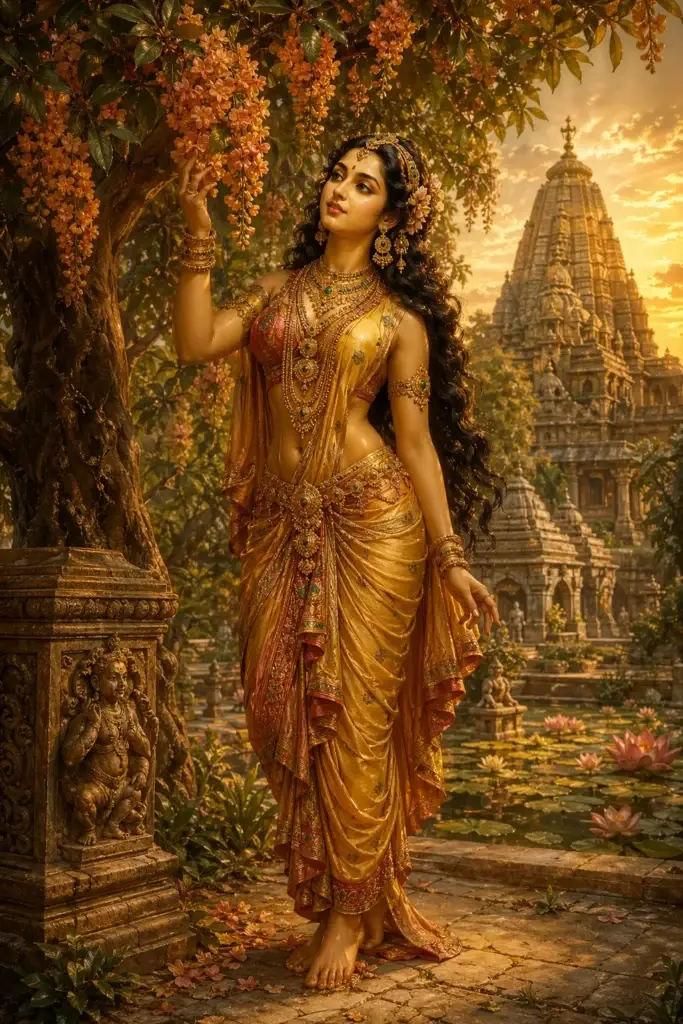
The Yakshini (female Yaksha) is one of the most ambivalent figures in Indian mythology. As a nature spirit bound to trees, springs, and treasures, she is generally benevolent: a protective figure, a fertility symbol, and a classic motif on temple columns (Salabhanjika, the woman at the tree).
In folk tradition and Tantric practice, however, she also appears in threatening form: as a child-snatcher, seductress, and bringer of tree death.
The Yaksha class (male and female alike) stands at the threshold between the divine and the demonic; their lord is Kubera, god of treasure and guardian of the north, associated with the Himalayan Yaksha realm of Alaka.
In Buddhist tradition, Yakshinis are often converted and become protectors of the Dharma. In Jainism they form a fixed system of 24 protective goddesses (Shasana-Devatas) of the 24 Tirthankaras. Celebrated in literature: Kalidasa’s Meghaduta, in which an exiled Yaksha sends a message to his Yakshini via a cloud.
Vedic Origins and Epic Development
The Yakshini appears first in the Vedas as a nature being without a clear gender category. In the Rigveda, Yakshas are mentioned as incorporeal or semi-corporeal powers, often in connection with prosperity and vegetation. With the great epics, the Mahabharata and Ramayana, Yakshinis become independent characters.
They appear as companions, seductresses, and guardians of sacred sites. A central text is the Yaksha Prashna, a philosophical dialogue in the Mahabharata in which a Yaksha poses mystical questions. The Yaksha figure there is male, yet the Yakshini assumes similar functions: she is a guardian of boundaries and a bearer of hidden knowledge.
Quick Overview: Yakshini
Type: Nature spirit, ambivalent protective power
Origin: Kubera’s retinue, pre-Indoaryan tree and water cults
Texts: Mahabharata, Puranas, Kalidasa’s Meghaduta, Jaina texts, Tantras
Period: Vedic to present
Connections: Kubera (god of treasure), 24 Jaina Tirthankara protective goddesses
Context
Archaeologically attested from the Maurya period (ca. 3rd century BCE) with numerous Yakshini statues. Literary sources in the Mahabharata, Puranas, and Kalidasa (4th/5th century CE). The Jaina tradition provides systematic treatment. Tantric Yakshini sadhana from the first millennium CE onward. Modern folklore studies document an unbroken living tradition.
Indian subcontinent; the Jaina tradition is particularly present in Gujarat, Rajasthan, and Karnataka. Southeast Asian reception occurs mainly through Buddhist missions, with Yakshinis attested at Borobudur, Angkor, and Thai temples.
Mahabharata, Puranas, Kalidasa’s Meghaduta, Jaina texts (Kalpasutra, Tiloyapannatti), Tantric Yakshini sadhana manuals, and the iconographic wealth of temple reliefs.
Name and Spelling Variants
Sanskrit: yakṣiṇī (feminine), yakṣa (masculine).
Etymology: possibly from yakṣ meaning “to be swift” or “to sacrifice“; root uncertain.
Jaina 24: a fixed list of Shasana-Devatas, including Ambika, Padmavati, and Chakreshvari.
Well-known Yakshinis in Hindu tradition: Hidimba (Mahabharata, also classified as Rakshasi), Punyajani, and various Tantra figures.
The Jaina tradition systematized the Yakshini concept by assigning a female protective deity to each of the 24 Tirthankaras. This creates a closed system of female protective powers prominently displayed in Jaina temples.
Description
Appearance
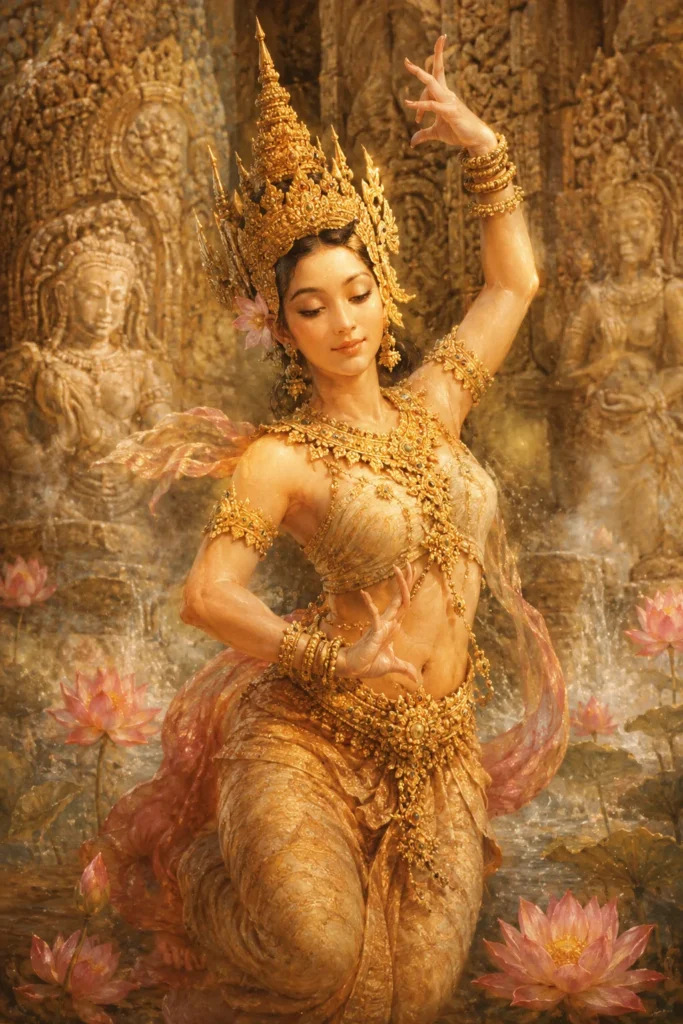
Beautiful, full-breasted, broad-hipped, with pronounced fertility symbolism. The standard motif is the Salabhanjika: a Yakshini leaning against a shala tree, one hand on a branch. Often depicted with a tree, spring, or treasure pot. In her negative aspect: eyes flashing, nails sharp, hair unbound.
Behavior
Fundamentally benevolent as a guardian. She can bestow fertility, reveal treasures, and protect ascetics. In her negative variant: she seduces young men, drains their vital force, and brings destruction to trees. In Tantric practice, she may be bound to service through a binding ritual.
Domain
Trees (especially shala, ashoka, peepal), springs, treasures, and crossroads. In Jaina temples she serves as protective goddess of the Tirthankaras. In Tantric practice she is associated with specific sadhana sites.
Mythological Classification
Part of Kubera’s retinue, the god of treasure and guardian of the north whose realm, Alaka, lies in the Himalayas. Dynastically connected to the Rakshasas (Kubera’s half-brother Ravana is a Rakshasa). In the Jaina tradition she stands alongside the omniscience (kevala-jnana) of the Tirthankaras.
Buddhist Adaptation and Tantric Specialization
In Buddhism, Yakshinis become Dharma protectors and are associated with Dakinis. In Tantric systems, a concentrated practice of 36 Yakshinis exists, each with specific magical powers and ritual functions.
These 36 embody various aspects of enlightenment: courage, compassion, wrath, and the thirst for knowledge. Tantric texts present the Yakshini as a potential practitioner, not merely as a supernatural being. She can be enlightened and can enlighten others.
Profile: Yakshini
The most important aspects of the Yakshini at a glance.
Kubera’s retinue and pre-Indoaryan tree and water cults. In the Jaina tradition systematized as 24 protective goddesses of the Tirthankaras.
Guardian of trees, springs, treasures, ascetics, and the faithful. In her negative aspect: children, young men, and those who fell trees.
Beautiful, full, laden with fertility symbolism; the Salabhanjika motif with the tree. In her negative form: flashing eyes and sharp nails.
Positive effects: fertility, protection, bestowal of treasure. Negative effects: seduction, child-snatching, and tree death. Tantric binding for Siddhis.
Respectful treatment of trees and springs, offerings at peepal and ashoka trees, Jaina mantras to the 24 Shasana-Devatas, Tantric Yakshini sadhana under the supervision of a guru.
Cult and Tantric Practice
Iconography in Temples
The Salabhanjika motif is one of the most popular pictorial motifs in Indian art, found from Sanchi (1st century BCE) and Bharhut to Khajuraho and Belur. The Yakshini at the tree stands for fertility, prosperity, and blessing.
Jaina Protective Goddesses
The 24 Shasana-Devatas form an integral part of Jaina temple cult. Ambika (for Tirthankara Neminatha), Padmavati (for Parshvanatha), and Chakreshvari (for Rishabhanatha) are particularly well known. Their veneration remains alive to this day.
Tantric Yakshini Sadhana
Tantric texts describe 36 or more Yakshinis who can be bound through mantras. The practice is considered powerful but dangerous; incorrect performance is said to lead to madness and death. In the teaching of classical Tantric gurus, Yakshini sadhana is permitted only under strict supervision.
Parallels and Modern Reception
Antiquity and Indo-European Parallels
The Greek nymphs and Dryads share the tree- and water-binding motif. Roman nymphae follow the same pattern. Apsaras, as Hindu celestial figures, are distantly related.
Buddhist Appropriation: In Buddhist tradition, Yakshis are often converted and become Dharma protective figures. Hariti, who originally devoured children, is converted through the Buddha’s intervention and becomes a protector of children.
Modern Reception: Kerala folklore and Malayalam cinema know a particularly rich Yakshi tradition, typically as a beautiful, solitary, and dangerous nocturnal figure. Literature and film draw on the motif continuously. In Neo-paganism and ecological spirituality, Yakshinis are invoked as protectors of trees.
Iconographic Features and Artistic Traditions
In the Indian and Southeast Asian artistic tradition, Yakshinis are often recognized by specific attributes: jewelry made from plants, fertility signs such as fruits or infants held in the arms, and often one hand raised in Abhaya-mudra (the gesture of protection). She frequently stands beside sacred trees, particularly the ashoka tree.
In Khmer-Cambodian art the Yakshini appears as a dancer or guardian of temple entrances. A famous example is the Yakshini statue from Patna, created in the Maurya period. This classical iconography distinguishes the Yakshini from demonic female beings such as the Rakshasi: the Yakshini emanates positive power, not fear.
The Yakshini in Early Indian Art
The Yakshinis belong to the earliest and most richly documented supernatural beings in the history of Indian art. Already in the period between the 3rd and 1st centuries BCE they appear as prominent figures in architectural sculpture, long before the great divine images of classical Hinduism had taken shape.
Famous examples are the Yakshini figures on the toranas, the gateway arches, of the Buddhist stupa at Sanchi and at the stupa of Bharhut.
Characteristic is the Yakshini’s connection to the tree. A widespread pictorial formula shows her as Shalabhanjika, a woman grasping a branch of a flowering tree, often in a pose in which her foot touches the trunk.
This gesture was associated with an ancient belief according to which a woman’s touch causes a tree to burst into bloom. The Yakshini here is fertility and vegetative force made visible. The figures are modeled as full and sensuous, with broad hips and heavy jewelry, underscoring their role as embodiments of growth and abundance.
Noteworthy is that these Yakshini figures appear on Buddhist and later also on Jaina buildings.
The Yakshas and Yakshinis were evidently so firmly rooted in popular piety that the great religions did not displace them but incorporated them into their pictorial programs, generally in a serving or protective function at the margins of the sacred precinct.
Scholarship therefore regards the early Yakshini representations as important testimony to the popular-religious stratum that preceded and accompanied classical Indian high religion.
Yakshinis in Buddhism and Jainism
Both Buddhism and Jainism integrated the Yakshinis into their conceptual world, in markedly different ways. In Buddhism, Yakshinis frequently appear as protective beings who become followers of the Buddhist teaching.
Narrative texts feature Yakshinis who are initially dangerous but are then converted by the Buddha or by monks and subsequently grant protection. The best-known example is Hariti, a child-snatching Yakshini who, after her conversion, becomes a protector of children and women in childbirth.
In Jainism, the Yakshini received a particularly developed and ordered position. A pair was assigned to each of the twenty-four Tirthankaras, the Jaina liberated teachers: a male Yaksha and a female Yakshini, regarded as attendant protective deities.
These Yakshinis bear individual names and individual attributes and are regularly depicted in Jaina temple art. Particularly prominent are Ambika, the Yakshini of Tirthankara Neminatha, and Chakreshvari, assigned to the first Tirthankara Rishabha. These figures became independent cult objects to whom lay people offered veneration and petitions for worldly well-being.
This development illustrates a recurring pattern in Indian religious history. The ethically and ascetically oriented high religions kept their highest salvific figures free from worldly concerns while leaving alongside them an ordered space for popular protective beings such as the Yakshinis, to whom concrete wishes for children, health, and prosperity could be directed.
The Yakshini thus became a mediating figure between the high teaching and the everyday needs of the faithful. Related protective functions are found among other beings of the Hindu environment.
The Ambivalent Yakshini: Beauty, Seduction, and Danger
Alongside the benevolent fertility and protective figure, Indian tradition places a decidedly more dangerous Yakshini, and both aspects belong inseparably together.
In numerous narratives, in Sanskrit literature as well as in later folk traditions, the Yakshini appears as an extraordinarily beautiful woman who seduces solitary travelers, Brahmins, or ascetics. In some stories this encounter is fatal; in others it leads to an ambivalent bond.
This dual nature is not a contradiction but corresponds to the fundamental character of the Yakshas and Yakshinis. They belong to the sphere of rampant, abundant life, and this life is simultaneously attractive and unpredictable.
The Yakshini embodies the force of vegetation and of sexuality, and both resist complete control by the social and religious order. From the ascetic perspective of many Indian texts, the beautiful, seductive Yakshini is precisely a trial and a danger, because she can divert the ascetic from his path.
The magical and Tantric tradition forms a distinct layer. In certain texts of the later medieval magical literature, Yakshinis appear as beings that a practitioner can summon and bind through rituals.
A summoned Yakshini is then supposed to grant wealth, protection, knowledge, or the fulfillment of wishes, sometimes in a role that lies between that of a subservient spirit and a supernatural companion.
Such texts often enumerate a fixed number of named Yakshinis, each with her own specific abilities. This ritual-magical Yakshini belongs to the domain of learned esotericism and must be distinguished from the older art-historical and popular-religious figure, even though both bear the same name.
Kubera and the World of the Yakshas: The Pantheon of the Yakshini
The Yakshinis are not isolated individual beings but part of an entire race of semi-divine beings, the Yakshas. At their head stands, in classical Indian mythology, Kubera, also called Vaishravana, lord of the Yakshas and at the same time god of wealth and the hidden treasures of the earth.
Kubera belongs to the Lokapalas, the guardians of the cardinal directions, and is assigned to the north. His realm in mythic conception lies in the Himalayas, with the city of Alaka.
Within this order, the Yakshinis have their fixed place as the female members of the Yaksha race. They are Kubera’s retinue, his servants and companions, and they share with him the connection to wealth and earthly treasures.
The close bond of the Yakshas to mineral deposits, trees, water, and fertile land explains why the Yakshinis are associated with both vegetation and prosperity. Both, the flowering tree and the hidden treasure, belong to the sphere of the earth.
The Yakshas and Yakshinis thus occupy an intermediate position in the Indian cosmos. They are subordinate to the high gods but far superior to humans; they are immortal or long-lived, endowed with supernatural powers, but bound to specific places and tasks.
Scholarship regards them as a class of local deities and nature spirits incorporated into the pan-Indian system without entirely losing their place-bound, popular character.
For an understanding of the individual Yakshini, this embedding is important: she is never merely a seductress or merely a protective goddess, but always a member of the vast web of earth-bound powers under Kubera’s sovereignty.
Sources and Literature
Further standard works in the literature index.
The protective practice described here represents a scholarly classification of historical traditions. iWell Guard connects to this cultural-historical lineage of wearable protective objects and constitutes a contemporary form of it. More about the iWell Guard.