iWell Guard

Dryads, the tree nymphs of Greek rural life

The Dryad is a spirit of the Greek tradition.

Tree nymph of groves, springs and ancient oaks.

SpiritGreece

Table of Contents

Dryad, spirit of Greek tradition
Dryad

Dryads are the tree nymphs of the Greek tradition. Their name derives from drys, the Greek word for tree, and especially for the oak; over the course of tradition it became a collective term for nymphs of trees in general.

As friendly, place-bound nature beings, dryads belong to the everyday belief system of ancient rural life: shepherds, farmers and travellers offered them small gifts, and sacred groves stood under their protection. Unlike the Hamadryad, who is strictly bound to a single tree, the dryad lives among trees and groves.

At a glance: Dryad

Type: tree nymph, collective term for nymphs of trees
Origin: Greek world, archaic poetry
Texts: Homeric Hymns, Callimachus, Ovid, dedicatory inscriptions and votive reliefs
Period: 8th century BC to late antiquity
Appearance: youthful female figure of the tree, often with a leaf wreath

Textual history

Period of the Texts

The evidence ranges from archaic poetry to the imperial era: nymphs have been a fixed part of Greek religion since Homer, and Callimachus and Ovid carry the dryads on into the Roman and post-antique world.

Area of Diffusion

The whole of the Greek world with its groves, individual trees, springs and grottoes; later joined by Roman reception.

Sources

Well attested: poetry from the Homeric Hymns to Ovid, along with dedicatory inscriptions and votive reliefs; the research is developed by Larson and Burkert.

Name and variants

Greek: dryas, from drys, tree and especially oak. From the nymph of the oak tree, the term became, over the course of tradition, the collective name for tree nymphs in general; the conceptual ordering of the nymph classes only became fixed in post-classical scholarship.

Appearance and behaviour

Appearance

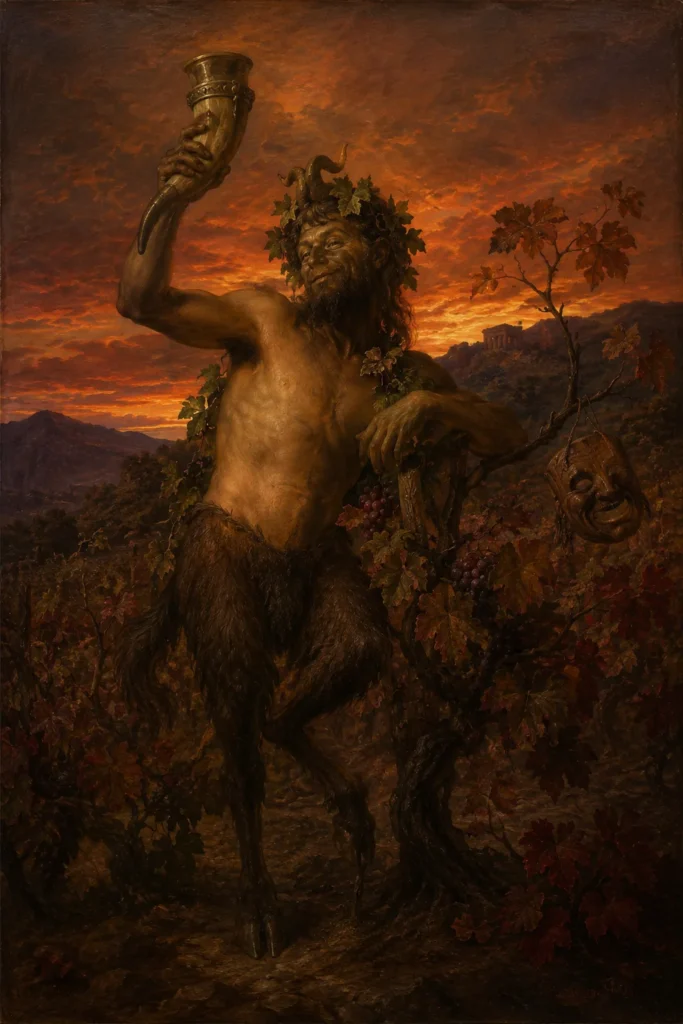
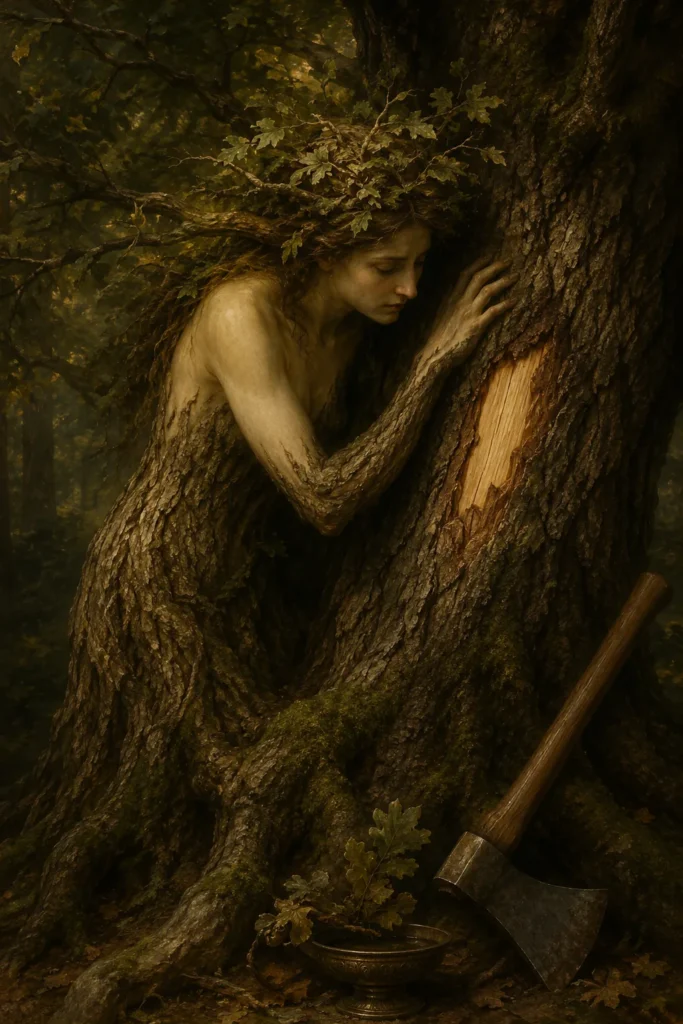
There is no fixed iconography for individual dryads; art shows nymphs as youthful female figures in a round dance, on votive reliefs usually in groups of three alongside Pan or Hermes. Poetry conceives of the dryad as the woman of the tree: stepping out of the trunk, with foliage in her hair, in the colours of bark and leaves.

Effect

Dryads guard trees, groves and the springs that rise there. To rural folk they were regarded as givers of shade, water and good growth. Their darker side is punishment for wrongdoing: in Ovid, the dryads bring the complaint before Demeter when Erysichthon fells her sacred oak, and the goddess punishes him with insatiable hunger. The sources tell of no indiscriminate harm against people.

Profile: Dryad

The key aspects of the tree nymph at a glance.

Cultural Context

Part of the general nymph cult, the everyday religion of the Greek countryside: grotto sanctuaries, dedicatory reliefs and inscriptions attest to private devotion rather than large temples.

Responsible for

Trees, groves and the springs that rise there; their addressees are shepherds, farmers, woodcutters and travellers.

Depiction

Youthful female figures in a dance, usually in groups of three on votive reliefs alongside Pan or Hermes; in poetry, stepping out of the trunk with leaves in their hair.

Function

Givers of shade, water and growth; at the same time plaintiffs and the cause of divine punishment when sacred trees are wronged.

Cult

Offerings of milk, oil, honey and fruit, trees adorned with ribbons and wreaths, grove regulations preserved in inscriptions against felling and stripping leaves.

Distinctions

The Hamadryad is bound to a single tree, the Meliai belong to the ash, the Oreads to the mountains.

From Homer to the nymph cult of the grottoes

Nymphs have been a fixed part of Greek religion since Homer: the Iliad mentions mountain nymphs who plant elms at the grave of Eetion, and the Odyssey knows altars and grottoes dedicated to them. The Homeric Hymn to Aphrodite describes nymphs who are born together with firs and oaks, live long lives, and whose lives fade away when their tree dies; here lies the core of the tree nymph concept. The conceptual ordering, Naiads of water, Oreads of the mountains, dryads of trees, only became fixed in post-classical scholarship.

The cult of the nymphs is well documented archaeologically: dedicatory reliefs show the nymphs’ dance with Pan and Hermes, and grotto sanctuaries such as the Vari Cave in Attica attest to private devotion; there, in the 5th century BC, Archedemos of Thera, seized by the nymphs, immortalised himself. In literature, Callimachus and above all Ovid carry the dryads on into the Roman and post-antique world. Alongside them stand the Meliai, the ash nymphs born from the blood of Uranus.

Lasting influence and interpretation

Through Ovid, the dryads became a fixed part of European culture: the Renaissance and Baroque populated gardens and paintings with tree nymphs, and 19th-century painting, for instance in the work of John William Waterhouse, gave them a rapturous form. Fantasy fiction continues to present dryads as protectors of the forest; today they often serve as a symbol of ecological thinking.

In the study of religion, nymphs belong, according to Walter Burkert, to the lower deities who directly embody numinous nature; Jennifer Larson has described their cult as the everyday religion of the countryside, carried by shepherds and farming families rather than by great sanctuaries. The dryad condenses the idea of the tree soul, which comparative research has traced through many cultures since Mannhardt and Tylor. A distinction remains between the broadly attested nymph cult and the more literary elaboration of individual tree-nymph figures in poetry. Antiquity also knew nympholepsy, being seized by nymphs, which turned people into eccentrics or seers.

Offerings, ribbons and grove statutes

The tradition of interaction is cultic, not defensive: people offered the nymphs milk, oil, honey and fruit, adorned sacred trees with ribbons and wreaths, and observed the statutes of sacred groves, which made felling and stripping foliage punishable offences; such grove statutes survive in inscriptions. Anyone who had to work in a grove secured protection through prayer and an offering of atonement; Cato’s Roman treatise on farming preserves a formal atonement sacrifice together with a prayer to the unknown deity of the grove, to be made before clearing could take place. Here, human protection lies in avoiding sacrilege.

Tree guardians in other traditions

Tree and forest beings with a guardian function are attested worldwide: the Slavic Leshy rules over the forest as a whole, Japan has tree souls in the form of the Kodama, whose felling brings misfortune; nearby stands the mountain forest spirit Tengu. The German Moss People share the close bond with trees. Within Greece, the Hamadryad and the Meliai stand closest to the dryad.

Frequently asked questions about the dryad

What is the difference between a dryad and a hamadryad?

Dryad became a collective term for tree nymphs living around trees and groves. The hamadryad is conceived more narrowly: she is born with a single tree and dies with it. In the sources, however, the boundary is fluid.

Were dryads actually worshipped?

Yes, as part of the general nymph cult. Grotto sanctuaries, votive reliefs and inscriptions attest to offerings such as milk, oil, honey and fruit, as well as decorated trees and protected groves. There was no dedicated temple cult; their worship remained local and popular in character.

Are dryads dangerous?

Not according to ancient belief. They are considered benevolent spirits of place. Matters become serious only in the case of sacrilege: according to the stories, whoever fells sacred trees or desecrates groves brings punishment upon themselves, as happened to Erysichthon.

Further links

Recommended internal links:

Literature (selection)

A selection of key sources and studies:
  • Larson, Jennifer: Greek Nymphs. Myth, Cult, Lore. Oxford 2001.
  • Burkert, Walter: Griechische Religion der archaischen und klassischen Epoche. Stuttgart 1977.
  • Mannhardt, Wilhelm: Antike Wald- und Feldkulte. 1877.

Further standard works in the bibliography.

Thus the dryads connect Greek mythology with present-day thinking about nature: as a tree nymph, the dryad gives the tree a face, and her grove remains the archetype of the protected place.

Classification & Protection

ILEVEL
The Protection Compass assigns this being to influence level I, Minor influence.

No specific protective means is recorded in the tradition for this being.

Compare in the Protection Compass →

Recommended protective means

iWell Guard

The simplest protective means in this collection: 41 layers of fine gold 999, platinum, silver and silicon, manufactured in Ruhla, Thuringia. It requires no activation, is bound to no person, and is effective within a radius of around 50 meters, even without being worn.

All protective means at a glance →