Protective Colors: Colors with a Defensive Meaning
By Ralf Ittermann · last reviewed on
In many cultures, certain colors are credited with a defensive meaning. Blue, red and black appear especially often as protective colors, each with its own reasoning.
This article places the principle of the protective color within the study of religion and traces its presence from antiquity to its reception today. In doing so, it distinguishes between historically documented custom and modern interpretation.
Classification: What a Protective Color Is
A protective color is a color that is credited with a defensive meaning. It is used on objects, clothing, jewelry or buildings with the expectation of keeping harmful influences away.
What is distinctive about the protective color is that the meaning is bound to the color itself and not to a particular motif. A blue ribbon, a red cord or a person dressed in black carries the color as the bearer of the interpretation.
Which color counts as protective depends heavily on the culture. Blue, red and black are the most common protective colors, yet other colors can take on this role regionally as well.
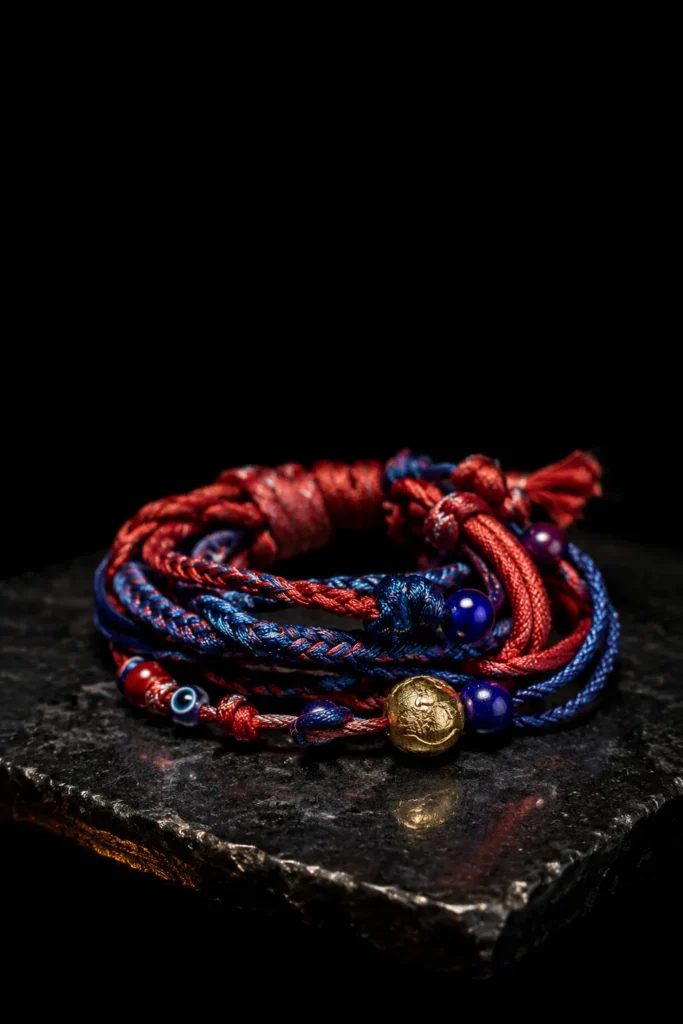
The protective color rarely appears on its own. Most often it is tied to an object, such as a bead, a ribbon, a stone or a piece of cloth. The color then reinforces the meaning ascribed to the object.
Within the protective symbols, the protective color belongs to the properties that make an object into a protective sign. It stands alongside material, form and motif.
The protective color is therefore less an independent symbol than a recurring principle. It shows that not only image and material, but the color too, can be the bearer of a defensive interpretation.
The protective color is rarely unambiguous, since the same color can be interpreted very differently across cultures. What counts as protective in one tradition may be associated with mourning or danger in another. This ambiguity belongs to the nature of color symbolism.
Origin and Historical Depth of the Protective Colors
The association of colors with meanings is very old. Even in early cultures, color pigments were obtained and used deliberately, for example in burials and in cult practice. Particular ideas became attached to colors early on.
The meaning of a color often related to the difficulty of obtaining it. Some dyes were rare and precious, others readily available. These differences shaped the regard for individual colors.
In many regions, blue was a color that was hard to produce. Certain blue pigments and blue glass pastes were considered valuable. This preciousness is one background to the special standing of the color blue.
Red is the color of blood and fire and is among the oldest colors in use. Red ocher is known already from prehistoric contexts, which shows the deep history of this color.
Black is the color of night, darkness and mourning. In many cultures it was associated with death, yet at the same time it was used in protective customs, which shows its twofold meaning.
Overall, it becomes clear that the defensive interpretation of colors reaches across long periods and many cultures. Which color counted as protective varied from region to region.
With the invention of synthetic dyes in the nineteenth century, color became generally available and lost part of its former preciousness. This change also altered the handling of colors in custom. The old regard for rare shades can today be reconstructed mainly from older sources.
The Underlying Idea of the Protective Color
With blue, one important idea is the link to the sky and to water. Blue was associated with vastness, clarity and purity. This connection made the color a preferred protective color in several cultures.
In the Near East and the Mediterranean region, blue is closely tied to warding off the gaze regarded as harmful. The blue eye bead, the Nazar Boncugu, is the best-known example of this connection.
With red, the link to blood and life is central. Red counted as the color of vital force. Some traditions understood a red color as a means of diverting harmful influences from a person or binding them.
Red was also associated with fire, which itself counted as cleansing and defensive. A red color could therefore be understood as a piece of this power of fire.
With black, a widespread idea is concealment. A black color is considered inconspicuous and, according to some notions, can withdraw a wearer from the gaze regarded as harmful.
The ideas described here are cultural and historical explanations. They describe why certain colors were given a defensive meaning, and they document a belief. They are not proof of any effect. Scholarship describes the idea without confirming it.
With blue, several traditions also involve the notion that this color rarely appears in living nature. It was precisely the unusual quality of a deep blue that could contribute to its being credited with a special meaning. The color thus counted as conspicuous and significant at once.
Examples from Antiquity and the Near East
In pharaonic Egypt, colors were firmly linked with meanings. Blue and green tones were associated with the sky, water and renewal, and blue amulets and beads are attested many times over.
In Egypt, blue glass paste and the blue stone lapis lazuli were used for jewelry and amulets. Both materials carried a special meaning on account of their color and their preciousness.
In Mesopotamia, colored stones and glass pastes were used for amulets. The color of a stone was often part of its ascribed meaning and not merely decoration.
In the Near East, the blue eye bead against the gaze regarded as harmful is widespread. The connection of blue color and eye motif reaches far back in the region.
Red dyes were used in antiquity for clothing, jewelry and painting. In some contexts a red cord or a red ribbon appears with a meaning that goes beyond ornament.
These examples show that colors in the ancient Mediterranean and the Near East were not understood as merely decorative. They stood within a web of meanings to which the protective interpretation attached itself.
In the Greek and Roman world too, red was closely tied to the realm of life and of transitions. At weddings, red cloths and red veils appear, and red dyes were used for clothing of significance. The color there carried a meaning that went beyond mere ornament.
Examples from European Folk Magic
In European folk magic, the color red plays a striking role. Folklore collections report on red ribbons and red cords that were placed on children, animals and bridal couples.
A red ribbon was tied around the wrist of newborns or knotted to the cradle. Cattle too were given red ribbons. These customs are handed down in many regions of Europe.
Blue appears in European folk magic, among other things, in the form of blue beads and blue glass elements. They were attached to clothing and jewelry and associated with warding off the gaze regarded as harmful.
Black is strongly associated with mourning in Europe. In some customs, black clothing or a black element was worn together with a protective interpretation, for example at funerals.
Reports about color-bound customs document the expectations of the users and not a proven effect. They show that colors were understood as bearers of a meaning that conferred a sense of security.
With the decline of magical household custom, many of these practices lost their everyday role. The red ribbon for newborns persisted longer as a custom in some areas.
Folklore collections further record the use of green and white elements in particular protective customs. Green was associated with growth and vital force, white with purity. These examples show that European folk magic charged colors beyond blue, red and black with meaning as well.
Examples from Asia and Other Cultures
In China, red is the most important protective and fortune color. Red envelopes, red cords and red ribbons are used at festivals and at life transitions. Red signs on doors also belong to the custom.
In South Asia, a red cord tied around the wrist is credited with a protective meaning. Red marks on the forehead and red powders also belong to the ritual sphere.
In the Near East and in Turkey, the blue eye bead is widespread. The color blue is closely linked there with warding off the gaze regarded as harmful and shapes numerous protective objects.
In various cultures, a black mark, such as a black dot on a child’s face, is given a diverting meaning. It is meant to draw the gaze away from the child.
Across these regions, it becomes clear that several colors were associated with defense in many cultures. Which color takes on this role varies from tradition to tradition.
The variety of examples makes clear that the protective color is to be understood as a principle. It arises wherever a color is given a special meaning on account of its associations.
In the East Asian color order, yellow too carried high significance, since in China it was long reserved for the imperial sphere. In ritual contexts, yellow papers and yellow paper strips appear, to which a protective interpretation was ascribed. The color order was thus closely tied to social and cosmological ideas.
Use in Ritual and Everyday Life
Protective colors were mostly applied in everyday life by way of objects. A dyed ribbon, a colored bead or a dyed piece of cloth carried the color and with it the ascribed meaning.
Color-bound customs were often tied to life events. At birth, marriage and in childhood, colored ribbons and beads were applied, because these phases of life counted as especially vulnerable.
The protective color was often worn on the body. A red ribbon around the wrist or a blue bead at the neck accompanied the wearer to changing places and was meant to stay with them lastingly.
On buildings, protective colors appear in the form of colored coats of paint, colored doors and colored elements on windows. In some regions, blue-painted doors and window frames are associated with a protective interpretation.
Some customs combined the application of a protective color with spoken words or with a particular point in time. The color was then part of a larger act.
There is no uniform ritual order for protective colors. Which color was used when and how depended on region and tradition, which folklore research has recorded many times.
Ideas also played a role in the dyeing itself. In some traditions, the time of dyeing or the origin of the dye counted as significant. Such requirements show that not only the finished color but also its production could be bound into the custom.
Related Forms of Protection and Distinctions
The protective color stands in close connection with the pictorial amulets. Many amulets and talismans carry a particular color that belongs to their ascribed meaning. Color and motif then work together.
Closely tied to the protective color is the blue eye bead. In the Nazar Boncugu, the blue color and the eye motif are inseparable. The bead shows how color and image can merge into a single protective sign.
The protective color differs from the apotropaic material. With salt and iron, the meaning applies to the material. With the protective color, it applies to the color, which can be applied to very different materials.
There is a boundary with purely decorative coloring. Colored clothing or a colored coat of paint does not necessarily carry a protective interpretation. What is decisive is whether the color is credited with a defensive function.
The protective color is further to be distinguished from color as a mere mark of rank or mourning. Black as a color of mourning, for example, follows in the first instance a social convention and not a defensive interpretation.
Placing it within this neighborhood helps to define the protective color precisely. It is a property that can make objects into protective signs, and it differs from material, motif and mere ornament.
Within the protective colors there is also a connection to the form in which a color is worn. A ribbon, a cord and a bead are themselves bearers of a meaning. With the protective color, the color and the chosen form work together and cannot always be clearly separated from one another.
The Reception of Protective Colors Today
Some color-bound customs are alive to this day. The blue eye bead is widespread in the Mediterranean region and beyond. Red ribbons continue to be placed on children in several cultures.
In modern esotericism, colors are often associated with properties and effects. There are numerous color teachings that ascribe particular powers to individual colors. Such ascriptions are not proven.
These present-day color teachings should be viewed critically. Colors are to be understood as cultural symbols with a long history of meaning, not as bearers of verifiable effects.
In advertising and design, color effects are used, but in the sense of perception and mood. This psychologically described effect is to be distinguished from the magical protective interpretation.
For the study of religion, protective colors are an instructive example. They show how visible features of the world, the colors of sky, blood and night, could become the basis of defensive interpretations.
Anyone who engages with protective colors today finds in them above all a topic of cultural history. A measured approach separates the documented history of the customs from modern promises of effect that do not withstand scrutiny.
Linguistic research too has addressed color terms and has shown that cultures divide their colors differently. Which tones count as one color and which meaning they carry is culturally shaped. This finding supports the observation that the choice of a protective color turns out differently from region to region.
Literature (Selection)
Related key terms: protective colors color symbolism blue red black red ribbon blue bead color defense apotropaic.
iWell Guard and Protective Traditions
iWell Guard stands within the cultural and historical line of wearable protective objects, to which the protective color also belongs. A modern companion for people who live with protective symbols: made in Germany, 41 layers of solid gold, platinum and silver, with a 30-day right of return.
Personal experiences may vary. Not a medical device. No promise of healing.