The Om Symbol: the sacred syllable as a sign of protection and blessing
By Ralf Ittermann · last reviewed on
Om, also written Aum, is the sacred primordial syllable of Hinduism. As a spoken sound and as a written sign it stands at the beginning of prayer and scripture, and it is at the same time regarded as a sign of blessing and protection that accompanies houses, people and paths.
Classification
Om is the most important sacred syllable of Hinduism. It is spoken, sung and written, and in each of these forms it is regarded as sacred. As a written sign, usually in the Devanagari script, Om is one of the best known symbols of the Indian religions.
Unlike an amulet, which is meant to protect against a specific danger, Om is above all a sign of blessing and of sacred order.
It is placed wherever something is to be hallowed, blessed and set under a good omen. The idea of protection is contained within this, but it stands within a wider context.
From the perspective of religious studies, Om belongs to the signs that do not avert but consecrate. It marks a beginning as sacred and places a location or an action under blessing. In this it differs from the apotropaic protective objects whose task is the turning away of misfortune.
Many regard Om as the most sacred sign of Hinduism altogether. Traditionally it is placed at the beginning of manuscripts, letters and documents, in order to set what is written under a good omen.
Teaching and the study of sacred texts also begin with Om. In this custom of opening every significant beginning with the sign, its special standing becomes very clearly apparent.
Om as primordial syllable and primordial sound
In Hindu thought, Om is far more than a word. It is regarded as the original sound from which the world emerged. In this conception a tone stands at the beginning of creation, and this tone is Om. The syllable thereby connects directly with the origin of existence.
The sacred texts of Hinduism grant Om a high rank. The Vedas and especially the Upanishads already treat the syllable in detail. A separate Upanishad is devoted entirely to the interpretation of Om and expounds its meaning sound by sound.
From this understanding follows the special rank of the sign. Whoever speaks or writes Om refers to the very ground of the world. The syllable is thus not an arbitrary symbol, but a sign that, according to Hindu conception, names the deepest reality.
The Mandukya Upanishad devotes itself entirely to the interpretation of Om and describes it as an emblem of the highest reality, which in Hindu thought is called Brahman. Om is accordingly Brahman in the form of a sound.
A further traditional name of the syllable is Pranava. In this designation resonates the idea that Om expresses the breath of life and the pervading power of the sacred.
The form of the sign
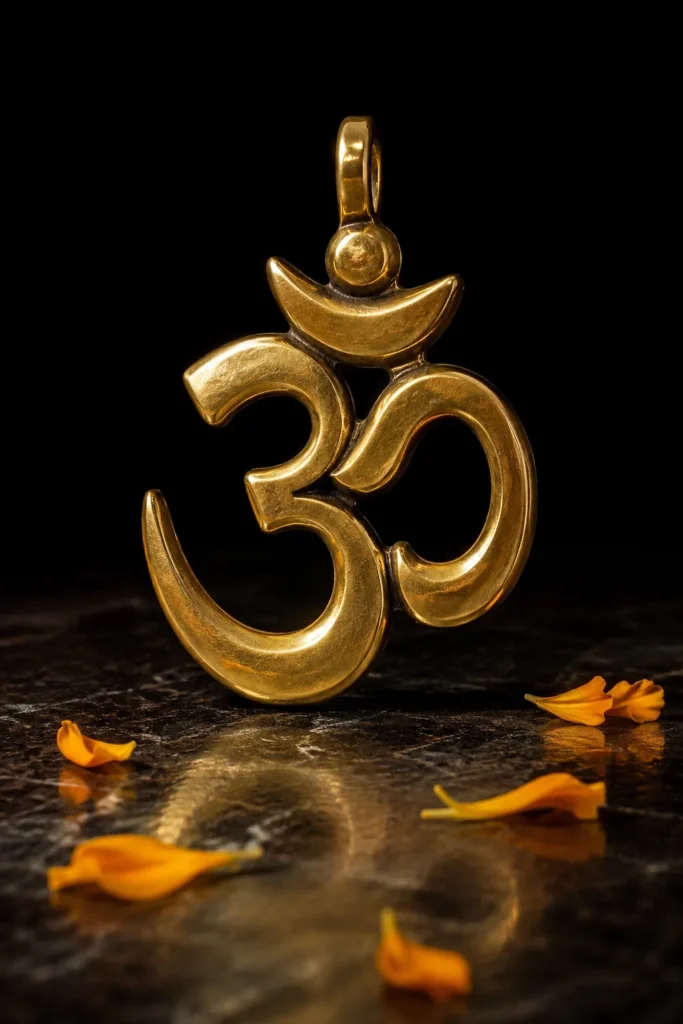
The written Om has an unmistakable form. In the Devanagari script it consists of several curved lines as well as a crescent and a dot in the upper region. These components together form a balanced, easily recognizable sign.
The individual parts of the sign are traditionally interpreted. The curves are associated with different states of consciousness, the crescent with the dividing world of appearances, and the dot with the highest state that transcends everything. The sign is thus not only a written form, but a condensed teaching image.
This form has made Om known beyond the circle of the literate. Even those who cannot read the Devanagari script recognize the sign. It was precisely this clear and memorable form that contributed to Om becoming a widely visible sign.
The pictorial form of Om in the Devanagari script that is known worldwide today established itself as the standard only over the course of time.
In the various scripts of the Indian region the syllable is written differently in each case, so that there is not one single but several traditional written forms of Om. The Devanagari form is the most widespread and shapes the image that most people associate with the sign.
A, U and M: the three sounds
Om is spoken as a single continuous sound, yet the tradition divides it into three sounds, A, U and M. These three sounds are associated with triads of Hindu teaching, for example with waking, dream and dreamless deep sleep.
To the three audible sounds is added a fourth element, the silence after the sound has died away. This silence is regarded as the essential thing, as the pointer to a state beyond all words and images. Om thereby encompasses the audible and that which points beyond the audible.
In this interpretation it becomes apparent why Om is regarded as so comprehensive. It includes the levels of reality, from waking to the highest state.
Whoever speaks Om passes, as it were, through this entire order within the sound, and it is precisely this that makes the syllable so effective in the conception of the tradition.
The three sounds of Om are associated in the tradition with numerous triads. Widespread is the assignment to the three great gods Brahma, Vishnu and Shiva and thereby to the creation, preservation and dissolution of the world.
The three sounds are likewise connected with the three Vedas. This abundance of interpretations underlines that Om is understood as a sign that encompasses the entire order of existence.
Om in ritual and in prayer
In the religious life of Hinduism, Om stands at the beginning and at the end. Prayers, recitations of sacred texts and ritual acts are opened and concluded with Om. The syllable thereby frames the sacred and sets it apart from the everyday.
Om is moreover regarded as a seed syllable, as a so-called bija mantra. It is a component of numerous longer prayer formulas and mantras and, according to traditional conception, lends them their power. In meditation, Om is repeatedly spoken or inwardly made present in order to gather the spirit.
This ritual use is the basis of the meaning as protection and blessing. By opening an action, Om sets it under a sacred omen. What begins with Om is, according to Hindu understanding, bound into the sacred order from the very start and thereby preserved.
In everyday ritual, Om is omnipresent. It opens the recitation of the Vedas, and it stands at the beginning of many well known prayer formulas.
In the practice of repetitive prayer, the Japa, Om is spoken again and again with the help of a prayer chain. In this way the syllable connects with daily practice and becomes a constant component of the religious life of many people.
Om as a sign of protection and blessing
From the sacred meaning of Om follows its role as a sign of protection and blessing in everyday life. The sign is placed at house entrances, painted above doors and hung in living rooms. It marks the place as blessed and sets it under a good omen.
As a pendant, Om is worn on the body, and it is found on vehicles and on objects of daily use. In all these forms it acts not as a weapon of defense against a particular enemy, but as a constant making present of the sacred. Where Om is, the sacred order is present.
Om thereby belongs to the group of signs that protect through consecration. It preserves by hallowing. This mode of action connects Om with other signs of blessing and at the same time distinguishes it from the signs of terror and defense that are meant to drive away evil through fear.
As a sign of protection and blessing, Om appears at many points of domestic life. At festivals such as the festival of lights Diwali it is painted together with other auspicious signs on thresholds and on the ground, often within the framework of elaborate floor designs.
Account books and new undertakings are also opened with Om. Everywhere there the sign sets a beginning under a good and sacred omen.
Om in the Indian religions
Om is not confined to Hinduism. Buddhism too knows the syllable and uses it, most famously in the widely spread formula Om mani padme hum, which plays a great role above all in Tibetan Buddhism.
Om likewise belongs to Jainism and to Sikhism, though each with its own interpretations and in its own spelling. In all these religions the syllable is regarded as sacred and as a sign of a highest reality, even if this reality is understood differently.
This spread across several religions makes Om a connecting sign of the Indian cultural sphere. It is an example of how a sacred sign can gain meaning beyond the boundaries of a single religion without losing its sacredness.
In the other Indian religions, Om receives its own coloring in each case. In Jainism the syllable is interpreted as a summary of the five highest beings.
Sikhism places at the beginning of its sacred scripture the formula Ik Onkar, which expresses a related idea, namely that of the one, all pervading divine. For all their difference, Om remains in all these traditions a sign of the highest sacredness.
Material and use as a pendant
As a worn sign, Om is made from various materials. Pendants of gold, silver and brass are widespread, and alongside them there are pieces of wood and stone. Often the sign is worked in relief, so that its curved form is shown to good effect.
Om is often combined with other sacred signs and with prayer chains. It appears on pendants together with depictions of deities or with further signs of blessing. In this combination the individual signs mutually reinforce one another in their meaning.
The use as a pendant shows how Om has passed from purely ritual use into personal everyday life. It accompanies the wearer through the day and visibly maintains the connection to the sacred. In this Om resembles the worn protective signs of other cultures.
As a pendant, Om is frequently combined with further signs promising good fortune and blessing, for example with the swastika understood in its original sense as a sign of good fortune.
Many people wear Om from childhood, and it is also encountered as a tattoo. In all these forms the syllable is not merely contemplated, but worn and thereby becomes a constant, personal companion in everyday life.
Reception today
Om has found a worldwide spread beyond the Indian cultural sphere. With the international spread of yoga and meditation the sign became known in many countries. Today it appears on jewelry, on clothing and in the design of rooms.
With this spread comes a shift of meaning. In many contexts Om is understood above all as a sign of calm, mindfulness and a general spirituality, detached from its precise standing within the Indian religions. From a sacred religious sign it partly becomes a general symbol.
Within Hinduism itself, by contrast, the original meaning remains unbroken. There Om is still the sacred primordial syllable, the sign of the primordial sound and a sign of blessing that accompanies everyday life. A factual account should name both levels, the religious depth of the sign and its modern, worldwide reception.
With the worldwide spread of the sign, the question of an appropriate handling also arises. Since Om is regarded as sacred by many believers, a careless or purely decorative use is felt by some to be little respectful.
A factual account therefore names both, the religious depth of the sign in the Indian religions and its role as a widely known shorthand sign for India and for spirituality.
Literature (selection)
Related key terms: Om Aum Pranava primordial syllable Devanagari bija mantra Upanishads sign of blessing Hinduism.
iWell Guard and protective traditions
iWell Guard stands in the cultural-historical line of portable protective objects to which the Om symbol also belongs. A modern companion for people who live with protective symbols: made in Germany, 41 layers of solid gold, platinum and silver, with a 30-day right of return.
Personal experiences may vary. Not a medical device. No healing promise.