Vajrapani, god of the Buddhist tradition
By Ralf Ittermann · last reviewed on
Vajrapani is a god of the Buddhist tradition.
The bodhisattva of the lightning bolt, protector and guardian of the power of the Buddha.
Vajrapani is the bodhisattva of power and vajra guardian of the Buddha Dharma.
Vajrapani
Vajrapani is one of the most powerful bodhisattvas of Mahayana Buddhism, a figure between god and enlightened being. With his vajra (thunderbolt) in hand, he stands as a guardian at the Buddha’s side, ready to shatter evil forces.
His name means “vajra hand”. In Tibetan Buddhism, Vajrapani is a protector and at the same time a tantric master; his intense mantra and his visualisation lead to inner power and to protection from negative energies.
Type: Mahayana Buddhist principal bodhisattva, embodiment of the power of the Buddhas
Pantheon: Mahayana and Vajrayana Buddhism
Function: protector of the Buddha and of the teaching, embodiment of spiritual power
Main attributes: vajra (thunderbolt), wrathful manifestation, tiger skin loincloth
Main places of worship: Sera and Drepung monasteries (Tibet), Nepalese and Bhutanese monastic complexes
Affiliation: one of the three principal bodhisattvas (with Avalokiteshvara and Manjushri)
Classification
Vajrapāṇi (“vajra in the hand”) is attested from the early Mahāyāna sutras (1st-2nd century AD). In the Pali texts he is mentioned as a yaksha bodyguard of the Buddha.
The main flowering of the wrathful form is the tantric Vajrayāna tradition (8th century onward) in Tibet. Today he is a central protective deity in the Tibetan Buddhist schools, especially the Gelug tradition.
Main places of worship: Tibetan Gelug monasteries (Sera, Drepung, Ganden, Tashilhunpo), Nepalese Sherpa monasteries, the Bhutanese Drukpa tradition. In Japan as Kongōrikishi or Nio, the two threshold guardians at every Japanese temple entrance. In China as the Heng-Ha guardian pair. Central in Mongolia and Buryatia.
Central sources: Laṅkāvatāra Sutra, Vajrapāṇi-Vajra-Sūtra, tantric texts of the Caryā Tantra class, the Tibetan Sadhana-mala. Secondary literature: Lalou, Iconographie des étoffes peintes (paṭa) dans le Mañjuśrīmūlakalpa; Lopez, Religions of Tibet in Practice.
Name
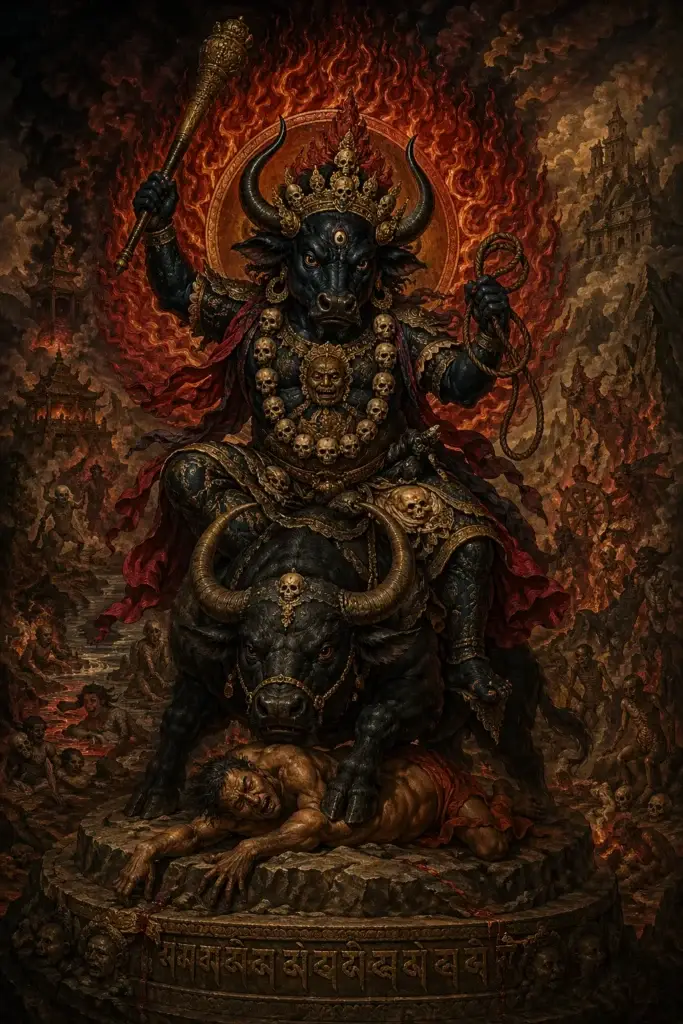
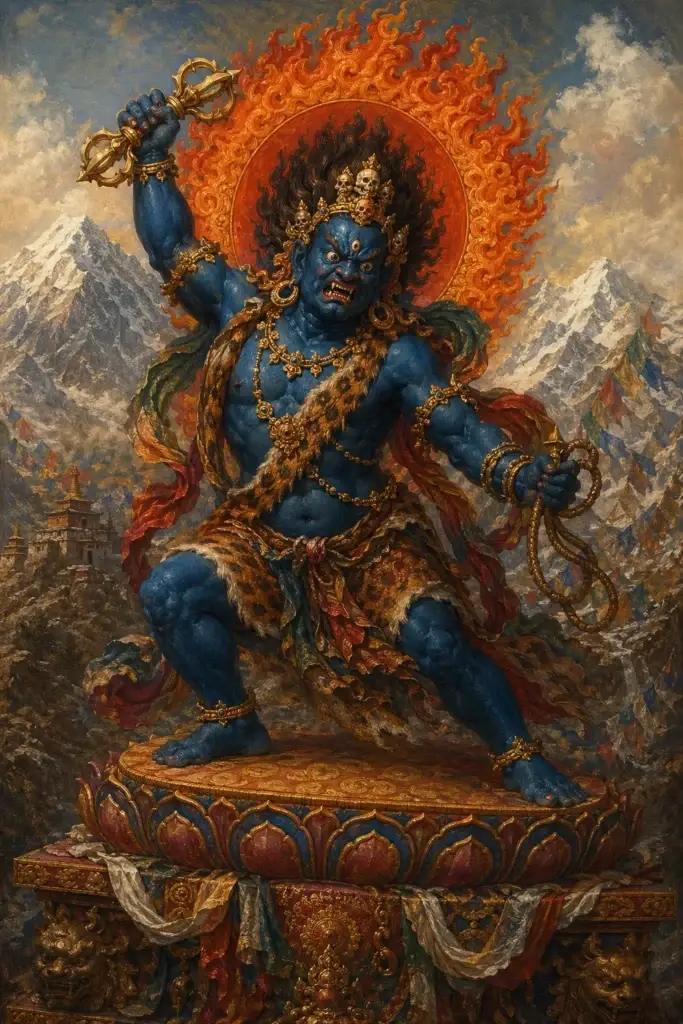
Vajrapani is frequently depicted in blue or dark blue, muscular and martial. He carries a vajra, often raised in the right hand or in both hands. Sometimes he also holds a serpent (naga) or has flaming hair.
His body is naked or minimally clothed, surrounded by fire and lightning. The fierce grimace, with bared teeth and wide-open eyes, is not evil but determined resistance against ignorance.
Characteristics
Vajrapani is the protector bodhisattva; his power shatters outer and inner obstacles. In tantric practices Vajrapani is visualised: the practitioner sees himself as Vajrapani, holds the vajra and recites the mantra Om Vajrapani Hum.
This is not weapons training but inner transformation, the conversion of anger into enlightened anger, of raw power into power filled with wisdom. The Vajrapani initiation (abhisheka) is important in the Tibetan Buddhist schools.
Profile: Vajrapani
The most important aspects of Vajrapāṇi at a glance. The following fields summarise origin, function, appearance, veneration, symbols and parallels.
Vajrapāṇi arises in the Mahāyāna tradition as the embodiment of the power (bala) of the Buddhas; while Avalokiteshvara embodies compassion and Manjuśri embodies wisdom, Vajrapāṇi is the spiritual and protective power.
In the early texts he is the bodyguard of the Buddha; in the tantric tradition he develops into an independent wrathful deity. In Japanese syncretism he is split into the two Nio guardians.
Protector of the Buddhist teaching and of practitioners. Embodiment of the spiritual power that destroys obstacles on the path. In tantric practices, a central protection against Mara, all negative forces and disturbing demons.
In Tibet a principal meditation yidam for those who seek a vigorous practice. Whoever recites the Vajrapāṇi mantra receives protection from all outer and inner threats.
Wrathful, dark blue (sometimes black) muscular male body. Third eye, flaming hair, broad mouth with curved teeth, flaming aureole. Vajra (thunderbolt) in the raised right hand. Tiger skin loincloth. A serpent as a belt.
Bone ornaments. Three eyes. A crown of skulls. In Cham dances often with a lasso (pāsa). Gentler form (Aryadeva Vajrapāṇi): a young bodhisattva with golden skin, vajra in the right hand.
Sphere of action: Vajrapāṇi is invoked in Tibetan monasteries during initiation rituals and protection rituals. His mantra OM VAJRAPĀṆI HŪM is one of the most common protective mantras. In the Cham dance rituals he appears as a mask bearer.
As a Nio guardian in Japan he forms a gate pair at every Buddhist temple and protects against the entry of evil spirits. Personal invocation: in case of illness or threat.
Vajra (thunderbolt, main attribute), lasso (pāsa), third eye, flaming aureole, tiger skin loincloth, skull crown, bone ornaments, a serpent as a belt. Sacred animals: tiger (fur), serpent. Sacred plants: lotus. Sacred colours: dark blue, black, fiery red.
Avalokiteshvara (Buddhism, bodhisattva of compassion), Mañjuśrī (Buddhism, bodhisattva of wisdom, with a sword), Mahakala (Buddhism, related wrathful protective deity), Yamantaka (Vajrayāna). Hindu root: Indra (Vedic thunderbolt bearer, Vajrayudhasāsin). Global threshold guardian parallels: Bes (Egypt), Pazuzu (Mesopotamia), Nio (Japan), Heng-Ha (China).
Practical defence
Rituals of veneration
Vajrapani (Skt. “thunderbolt holder”) is, alongside Avalokiteshvara and Manjushri, one of the three central bodhisattvas of Mahayana and tantric Buddhism. In Tibetan monasteries, Vajrapani statues stand as gate guardians (dvarapala) at the entrance.
In Vajrayana he is the central tantric protective deity (yidam) of the three family protectors. Pujas take place daily in the morning before the beginning of practice (cf. Linrothe).
Mantras
The Vajrapani mantra “Om Vajrapani Hum” is recited for the protection practice. The more powerful Mahayana mantra is contained in the Vajravidarana Dharani. In the Mahayana tradition, the sutra of “King Mahavairocana” (Tantra) is a principal source text.
Amulets and protective symbols
The vajra (thunderbolt) as the central symbol, used in Vajrayana practice as a small bronze ritual instrument as well as worn as a pendant.
The phurba (ritual dagger) as a counter-demonic tool. Sculptures of Vajrapani in the wrathful aspect with a flame aura, tiger skin skirt and skull crown are set up in Tibetan temples.
Vajrapani, parallels in other cultures
The thunderbolt in the hand: the meaning of the name
The name Vajrapani is Sanskrit and is composed of vajra and pani. Pani means hand, while vajra denotes both the thunderbolt and the diamond. Vajrapani is therefore the one who holds the vajra in his hand.
The vajra is a symbol of great significance in Buddhism, especially in its tantric forms. It stands for the indestructible, penetrating power of awakening and at the same time for the hardness and clarity with which ignorance is broken through.
The origin of the vajra symbol reaches back into the older religious history of India. In the Vedic texts the vajra is the weapon of the god Indra, with which he slays the dragon Vritra.
Scholarship sees in Vajrapani in part a successor to, or a reshaping of, Indra-like conceptions, which also fits his often powerful, lordly or martial bearing.
In the Buddhist context, however, the weapon is reinterpreted: it is no longer a means of the battle of the gods but a symbolic image of the awakened power of mind.
In early Buddhist art, Vajrapani frequently appears as a companion of the Buddha. In the reliefs of the Gandhara region, where Greek-influenced and Indian pictorial traditions met, a vajra-bearing figure often stands at the Buddha’s side, occasionally with features reminiscent of the Greek Heracles.
This pictorial tradition shows that Vajrapani was understood as the protector and helper of the Buddha early on, long before he developed in later times into an independent, highly venerated figure.
From companion of the Buddha to the great bodhisattva
Over the course of Buddhist religious history, the figure of Vajrapani has undergone a considerable development. In the early texts and in Gandhara art he is above all a protector, a spirit being who accompanies the Buddha and stands by him. There he still has no prominent role in the history of salvation.
With the unfolding of the Mahayana tradition, Vajrapani became a bodhisattva, that is, a figure who stands on the path to perfect awakening and devotes himself to the welfare of all beings.
In this lineage he is often named in a group of three with two further great bodhisattvas and thereby embodies a particular aspect: while Avalokiteshvara, for example, is associated with compassion and Manjushri with wisdom, Vajrapani is assigned the might, or the active power, of the awakened mind.
In the tantric currents of Buddhism, in the so-called Vajrayana, Vajrapani finally acquired a very prominent position. Here he appears partly in a peaceful, partly in a wrathful form. The wrathful form is not an expression of malice but of the resolute power with which obstacles on the path are removed.
In this tradition Vajrapani is also regarded as a preserver and transmitter of certain tantric teachings.
The breadth of his manifestations, from the quiet companion to the terrifying protective deity, makes him a good example of how a Buddhist figure can gain new layers of meaning over the centuries without losing its core, the connection with the vajra and the power of awakening.
The wrathful form: iconography and its interpretation
In Tibetan and, more generally, Vajrayana Buddhist art, Vajrapani frequently appears in a wrathful form.
It follows a fixed visual language: a stocky, powerful body, often of dark blue colour, a face contorted with rage with wide-open eyes and bared teeth, a flame aureole, an ornament of skulls or serpents, and the raised vajra in the right hand.
This figure usually stands in a dynamic, striding posture on a lotus pedestal.
For an appropriate understanding, the interpretation of these images is decisive. In the Buddhist tradition, the wrathful appearance is not an expression of hatred or a lust for destruction. Rather, it embodies the resolve and energy with which inner obstacles, above all ignorance and attachment, are broken through.
The wrath is directed, according to the traditional interpretation, against delusion itself, not against beings. In this sense, the terrifying attributes are to be understood as a means of making the power of liberation perceptible to the senses.
The wrathful form of Vajrapani also has a protective function. He is regarded as a dispeller of obstacles and harmful influences, and in this capacity he is invoked in rituals. Some traditions link him closely with other protective deities and wrathful figures of Tibetan Buddhism.
Religious studies scholarship emphasises that such wrathful figures do not fall outside the Buddhist doctrinal framework but are firmly embedded in its understanding of spirit, liberation and the obstacles on the path.
Whoever regards the wrathful iconography in isolation runs the risk of misunderstanding it. Related protective and wrathful figures are found in the wider context of Buddhism.
Further links
Research literature
Further standard works in the literature index.
Frequently asked questions about Vajrapani
Who is Vajrapani in Buddhism?
Vajrapani (Sanskrit, the one who holds the thunderbolt in his hand) is the bodhisattva of power and of resolute action. Together with Avalokiteshvara (compassion) and Manjushri (wisdom) he forms the triad of the most important bodhisattvas.
His attribute is the vajra, the thunderbolt or diamond sceptre, symbol of indestructible enlightened power. Vajrapani is often depicted in a wrathful form: dark blue, surrounded by flames, with a threatening expression that embodies the might to overcome all obstacles on the path to enlightenment.
What early role did Vajrapani have in Buddhist art?
Vajrapani is among the oldest figures in Buddhist visual art. In Gandhara art (roughly the 1st to 5th century, in present-day Pakistan and Afghanistan) he appears as a companion and protector of the historical Buddha.
Notable here is the Greek influence: in some Gandhara reliefs Vajrapani bears the features of the Greek Heracles, with club and lion skin. This is evidence of the cultural exchange along the Silk Road after Alexander’s campaigns, in which Greek and Buddhist pictorial traditions merged.