iWell Guard

Beings: four classes worldwide

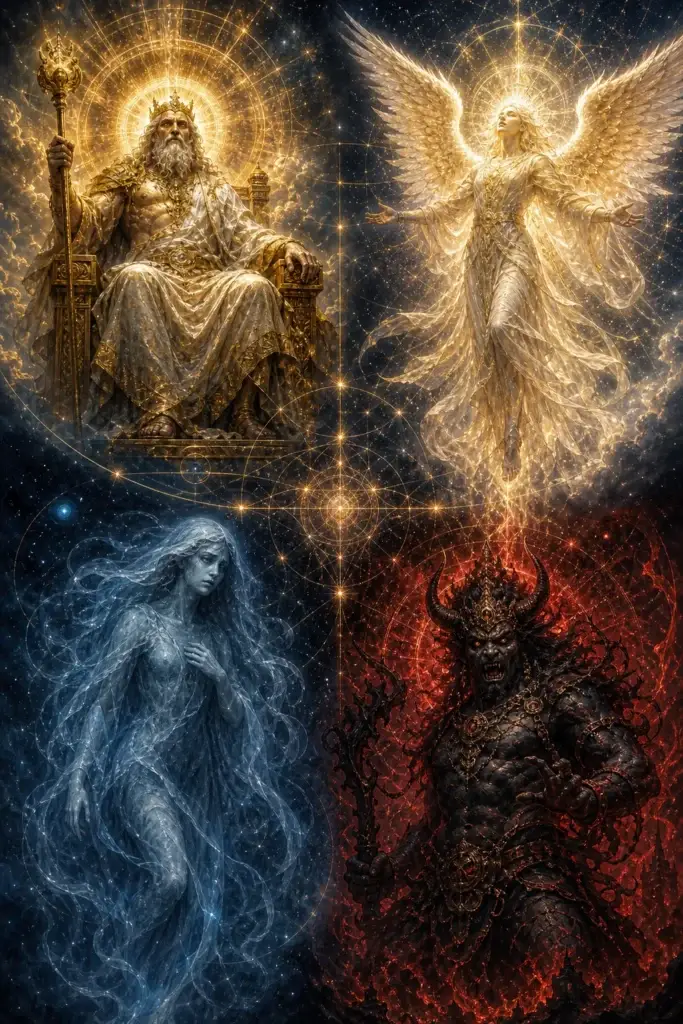
On iWell Guard we sort the beings of various mythologies into four main classes: gods, beings of light, spirits and demons.

This overview explains the classification system by which we distinguish them, where the boundaries are fluid, and how we handle beings that can be assigned to more than one class.

Four-panel composition: gods, beings of light, spirits, demons

The class overview of all types of beings in the lexicon.

Beings, class overview

The collective page for the four classes of beings, gods, demons, spirits and beings of light, brings together the class landing pages, their sub-categories and all individual entries contained in the iWell Guard lexicon.

It is the entrance to the entire directory of beings and at the same time the answer to the question of how we order the highly heterogeneous material from around 18 cultural spheres in a uniform way without flattening the culture-specific particularities.

The classification follows a simple logic: we distinguish between the highest personified powers of a pantheon (gods), the harm-oriented or ambivalent beings below the gods (demons), the beings tied to a place, to the deceased or to natural thresholds (spirits), and the spiritual helper figures of Western esotericism and the modern New Age (beings of light).

Where a figure fits several classes, for instance Lilith as a demoness, spirit and, in a feminist reading, goddess, she is linked in all relevant classes and explained accordingly in each context.

This overview presents the four classes of beings worldwide.

Four classes of beings

On iWell Guard we organize the beings recorded in the lexicon into four main classes that are sound in religious studies and at the same time useful for mediumistic practice. Each class has its own overview page with cross-cultural classification, characteristic features and an alphabetical list of all individual beings.

Gods

The highest personified powers of a pantheon. They bear names, have defined responsibilities (sky, war, love, death, creation) and stand in a hierarchical or kinship relationship to one another. In the sources, gods are typically equipped with fixed attributes, animals, symbols and cult sites.

On iWell Guard the Egyptian, Mesopotamian, Greco-Roman, Germanic, Celtic, Slavic, Hindu, Buddhist, Japanese and Chinese pantheons are documented in detail; the Jewish-Christian-Islamic concept is treated in relation to the hierarchy of angels and to monotheistic theology.

Demons

Supernatural harmful beings or ambivalent intermediary figures below the hierarchy of the gods. In the narrow sense, demon means the harm-oriented figure (Pazuzu, Lilith, Mara, Asmodeus); in a broader sense, for instance in the Greek daimonion, it also covers ambivalent or neutral intermediary beings.

We mark the variant of meaning in each individual entry and show how the concept of the demon shifts between epochs of religious history and between cultures, from the Akkadian corpus of incantations through the Goetia and Christian demonology to the Tibetan-Buddhist notion of harm-bringing Mara beings.

Spirits

Beings related to the deceased, to natural places or to threshold experiences. Spirits are often bound to a place (spring, forest, threshold, cemetery) or to a time (hour spirits, seasonal beings).

They include both the spirits of the deceased (Edimmu, Yuurei, Preta) and nature and elemental beings (Rusalka, Kappa, Kobold, Mahr). The class is numerically the largest in the lexicon; the overview spirits sorts the beings by sub-category (water spirits, forest spirits, spirits of the dead, shapeshifters).

Beings of light

The most recent class, which does not exist as such in the classical material of religious history but comes from Western esotericism, theosophy, the New Age movement and modern mediumistic practice.

Beings of light are the archangels of the Jewish-Christian-Islamic tradition (Michael, Gabriel, Raphael, Uriel, Metatron), the ascended masters of theosophy and certain specific forms of being that are observed exclusively in mediumistic practice.

We treat this class with particular caution: here the sources are to a high degree secondary or modern, and the source criticism makes this explicitly transparent in every individual entry.

Classification logic for multiple membership

Some figures fit into several classes: in the Talmud Lilith is a demoness, in the Babylonian inscription tradition a nocturnal harmful spirit, and in modern feminist theology a goddess of self-determination. The Erinyes are Greek goddesses of vengeance but appear as a troop of spirits.

Pazuzu is a demon and at the same time an apotropaic protective spirit against Lamashtu. In all these cases the being is listed in each relevant class; the detailed presentation is in the main entry, and a cross-reference appears in the other classes.

This way no dead ends arise for the reader, while the complexity of religious history remains visible.

Sorting and search paths

Anyone looking for a particular being will find it most quickly via the alphabetical register kept on the respective class landing page. Anyone wishing to sort by culture goes via the overview cultures; there all beings are grouped by mythology.

Anyone interested in method, that is, how we evaluate the sources and what practical notes we provide, will find the answers under methodology. Terms and classes of beings are briefly explained in the glossary; further secondary literature is in the bibliography under literature.

How many beings are documented

The current holdings of the website include around 300 individual entries, distributed across 18 cultural spheres. This is not a complete record of all beings ever described, which would not be possible at all, because many folk-belief figures are transmitted only locally and research continually finds new evidence.

It is, however, a considerably more extensive collection than most lexica available online, and it systematically covers the most important figures of the respective mythology. Gaps are filled in a targeted way as soon as a need arises through requests from readers, through more recent secondary literature or through cross-comparison with related cultures.

What a class assignment achieves in practice

Classification is an aid, not an end in itself.

It makes it possible, in a 300-being lexicon, to reach the right information quickly: anyone looking for Pazuzu finds him under demons with a cross-reference to the protective-spirit function; anyone looking for Kappa ends up among the spirits and not in an unspecific “Japanese mythology” collective article.

At the same time, classification forces us to examine each figure closely in the sources, since many beings are misclassified in popular reception because a generalization was drawn from a single passage. On iWell Guard we try to anchor each class assignment in a broad source base and to mark shifts of meaning explicitly.

Relation to scholarly classification of religion

Religious-studies research predominantly uses a narrower pair of terms: higher beings (gods, angels) and lower beings (demons, spirits, nymphs, genii).

This pair of terms is established in the classical Pauly and in older religious history, but it has the disadvantage that many figures, especially the ambivalent ones and those that migrate across cultures, are hard to classify.

Our four-class logic, with beings of light as a class of its own, takes account of modern esoteric practice without abandoning the care of religious history. Anyone familiar with the scholarly terminology will find the respective fitting cross-references in the individual entries.

What was not included in the lexicon

Pure legendary persons without a supernatural component (heroes without a divine function, historical figures in legendary guise) are not included in the lexicon of beings. Nor are saints in the narrower sense; Christian saints would be a category of their own that is not treated systematically here.

For mixed figures, beings that are partly sacred-historical and partly mythical, for instance St. George in the dragon fight or Mary in reports of popular devotional apparitions, we refer to the respective relevant specialist literature of religious history.

Selected bibliography on beings:

  • Frazer, James George: Der goldene Zweig. Das Geheimnis von Glauben und Sitten der Völker. Rowohlt, Reinbek 1989.
  • Hanegraaff, Wouter J. (Ed.): Dictionary of Gnosis and Western Esotericism. Brill, Leiden 2005.

Note: This selection serves as orientation; detailed entries follow their own curated list of sources.

The beings documented in the iWell Guard lexicon are broadly divided into four functional main classes: gods as originally or by definition powerful exalted figures with a supra-regional cult; demons as deliberately harmful or seductive powers; spirits as intermediary beings often bound to a place, a family or the deceased; and beings of light as helping, protecting or enlightening appearances (angels, bodhisattvas, ascended masters).

This fourfold division is not universal; many cultures know transitional and mixed forms, such as Indian Yakshas, Japanese kami or Mesopotamian apkallu.

Scholarly religious history therefore avoids dogmatic classification and describes beings primarily in functional terms: for what is the being invoked, in what ritual context does it appear, what cultural history does its veneration or banishment have? (Cf. Hans Kippenberg: Die Entdeckung der Religionsgeschichte, Munich 1997; Jan Assmann: Religion und kulturelles Gedächtnis, Munich 2000.) This functional perspective also shapes the structure of each individual entry page of the lexicon.

In addition to the main classification, the lexicon notes, where relevant to religious history, further sub-categories, such as high deity, creator god, deity of the dead, vegetation deity, protective deity, trickster, messenger, water spirit, forest spirit, house spirit, archangel, ascended master, dharmapāla. These so-called tradition pills (see pill system) allow readers to quickly identify comparable beings across cultures, for example to set side by side all high deities of the world religions or all messengers of the dead of various pantheons.

Further standard works in the literature index.

iWell Guard and traditions of protection

Across all documented cultures, protective objects can be attested that people wore on the body, from Pazuzu amulets in Mesopotamia through the Hamsa in the Mediterranean region to the Mezuzah on Jewish doorposts and to Christian protective medallions. iWell Guard takes up this tradition in a contemporary material architecture, made in Germany, 41 layers, solid gold, platinum, silver. 30-day right of return.

Personal experiences may vary. Not a medical device. No promise of healing.