Yuki-onna, Spirit of the Japanese Tradition
By Ralf Ittermann · last reviewed on
Yuki-onna is a spirit of the Japanese tradition.
Snow-spirit woman of the Japanese mountain regions, white breath, freezing gaze.
Yuki-onna’s Mountain-Pass Iconography
Yuki-onna („snow woman“) is a yokai figure of the Japanese mountain regions, mainly of the northern Japanese prefectures of Aomori, Akita and Niigata.
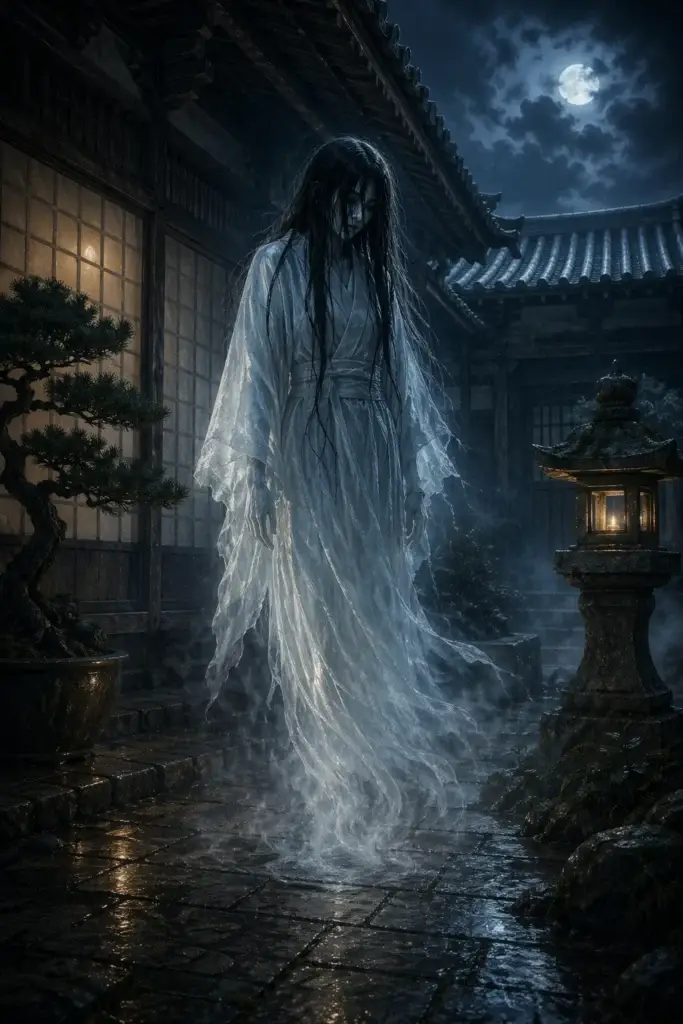
She appears in snowstorms over lonely mountain passes at night, in a white kimono with long black hair, often barefoot upon the snow. Her freezing breath kills wanderers who have fallen asleep.
The principal literary source is the tale in Lafcadio Hearn‘s Kwaidan (1904), which is based on a folk tale from the land of Musashi: the woodcutter Minokichi survives an encounter with a Yuki-onna because she binds him to silence; years later he breaks his silence and realises that his wife Oyuki was the snow woman.
Related figures of the Japanese yokai tradition: Yuki-warashi (snow child), Yuki-jorō (snow woman), Tsurara-onna (icicle woman).
Yuki-onna
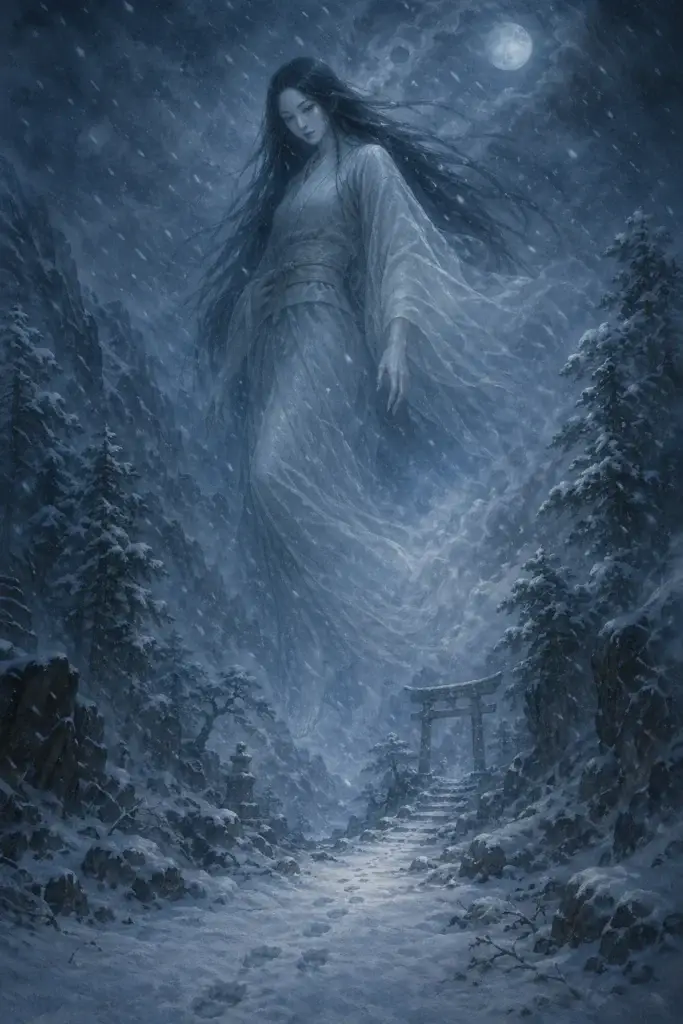
Yuki-onna (雪女, „snow woman“) is the prominent snow-spirit figure of Japanese mountain tradition. She appears in heavy snowstorms as a young, beautiful woman in a white kimono, with long black hair, pale skin and often hovering above the snow.
Her touch or her breath cause the person before her to freeze stiff and perish from the cold.
The Yuki-onna combines traits of the yōkai with motifs of the ghost of the dead; she is at once a nature being and a figure of vengeance. A central narrative tradition is the love of a Yuki-onna for a human, who must keep to an unspoken vow of silence.
Lafcadio Hearn’s Canonisation in Kwaidan
The European and Western perception of the Yuki-onna was decisively shaped by Lafcadio Hearn’s collection Kwaidan: Stories and Studies of Strange Things (1904). Hearn, an Irish-Greek journalist and folklorist who settled in Japan, transcribed and gave literary form to Japanese folk tales, among them the core narrative of the snow woman.
His version in Kwaidan established the motif of the white, supernatural woman who seduces and kills travellers in snowstorms. Hearn’s scholarly approach combined with narrative density made the Yuki-onna accessible to Western readers and considerably influenced subsequent Japanological and occult receptions.
His fidelity to the oral tradition as a source was incomplete, yet his aestheticisation laid down the iconographic basis on which later interpretations built.
Quick Overview: Yuki
Type: mountain being, snow spirit
Origin: folk belief of the snow regions of northern and central Japan
Texts: Sōgi Shokoku Monogatari (printed 1685), Lafcadio Hearn „Kwaidan“ (1904)
Region: Tōhoku, Hokuriku, Echigo, Hokkaidō
Danger: freezing to death, delusion, incurable longing
Distinction from the Oni: Unlike the Oni, the Buddhist hell-fiend with horns and club, the Yuki-onna is a nature spirit of the northern Japanese high mountains with traits of a spirit of the dead, not a creature of hell but a personification of the deadly snowstorms.
Context
Period of the Texts
The Yuki-onna does not belong to the oldest yōkai attested in writing. The first clearly identifiable episodes are found in the Sōgi Shokoku Monogatari (printed 1685), an Edo-period collection attributed to the poet Sōgi, which describes an encounter in the snow mountains of Echigo. Broader recording and systematisation took place in the Edo period.
The figure became internationally known through Lafcadio Hearn’s version in the volume „Kwaidan“ (1904), which tells the motif of the vow of silence between a young woodcutter and the Yuki-onna.
Area of Distribution
The Yuki-onna is bound to the snow regions: the Tōhoku region (in particular Aomori, Iwate, Akita), the Hokuriku coast (Niigata, Toyama, Ishikawa) and Hokkaidō. In warmer regions she is barely represented, whereas in the snow mountains she is firmly anchored.
Local variants bear regional names; in some villages she appears as Tsurara-onna (icicle woman), in others as Yuki-musume („snow daughter“) or Yuki-jorō („snow woman“).
State of the Sources
Important sources: Sōgi Shokoku Monogatari (printed 1685); Yanagita Kunio, Tōno Monogatari and later collections of folk tales; Lafcadio Hearn, Kwaidan (1904). Modern research in Komatsu Kazuhiko and Michael Dylan Foster.
The figure lives on in film (Kobayashi Masaki, „Kwaidan“, 1964) and in countless anime and manga adaptations.
Name
The name 雪女 is composed of 雪 („snow“) and 女 („woman“).
- Yuki-musume, „snow daughter“; in some regions a designation for a younger variant.
- Yuki-jorō, „snow woman“ in the broader sense.
- Tsurara-onna, „icicle woman“; a female figure that emerged from an icicle.
- Yuki-hime, „snow princess“; a literary, at times courtly-embellished form.
Characteristics
Appearance. A young, tall woman, mostly appearing between 17 and 25 years of age; pale, almost translucent skin; long black hair; a white kimono, often with a snow-crystal pattern. In many depictions she hovers above the ground without leaving traces, and has no feet.
Behaviour. She appears in snowstorms, often in the evening. Approaching those who have lost their way or woodcutters in the forest, she breathes upon them or demands to be carried. Her touch freezes the blood; the one she breathes upon stiffens into ice.
Ambivalence. In some tales she spares young men, but demands silence about the encounter. If the man breaks the silence, she returns.
Regional Hokkaido and Tohoku Variants
The Yuki-onna tradition divides regionally into distinct subtypes. Tohoku variants favour more melancholy narratives in which the Yuki-onna seeks human affection on cold nights.
Hokkaido variants show stronger contaminations with kitsune motifs, while Tohoku moves the Yuki-onna closer to sacred concepts of femininity. These regional gradients are documented in modern ethnographic collections.
Profile: Yuki
The most important aspects of Yuki-onna at a glance.
Folk belief of the Japanese snow regions; motifs of the nature being and of the vengeful spirit merged.
Woodcutters, hunters, travellers, traders who are out in the snowstorm; young men in mountain villages.
A young, pale woman in a white kimono, long black hair, often hovering; white breath, cold gaze.
Freezing to death through touch or breath, loss of orientation in the storm, death in lonely huts; in love stories: loss and parting.
Seek shelter at once in a storm, do not travel alone through snow-covered passes, keep promises made to mountain beings; shrine visits at the local mountain sanctuaries.
The Slavic Morana / Marzanna, the Norse Skadi, Tibetan mountain-woman figures, the Russian Snegurochka.
Protective Practice
Travel rules. In snow regions clear rules applied: not alone through passes, never into the storm after nightfall, and if need be seek out a hut and wait.
The silence taboo. In tales with a love motif, the keeping of a vow of silence stands at the centre; the Yuki-onna remains bound to the human as long as he keeps silent.
Mountain shrines. Small sanctuaries along the mountain paths are visited before passing through; offerings of rice, sake and fruit are meant to secure the goodwill of the mountain beings.
Community rituals. In some villages of the Tōhoku region, annual winter rites used to take place at which the family kept watch together for a whole night to ward off ill-boding visits.
Yuki, Parallels in Other Cultures
Slavic. Morana / Marzanna as the embodiment of winter shares traits of the deadly-beautiful snow figure.
Norse. The giantess Skadi is typologically related, a winter figure with an ambivalent relationship to men and to pacts.
Tibet and the Himalayas. Individual mountain deities of female kind appear in a similar function, but are less firmly fixed in narrative.
Russia. Snegurochka („snowflake“) is a related figure, in literature and in the children’s sphere; she shares the motif of the melting snow woman with the Yuki-onna.
Ukiyo-e iconography of the Edo period
The visual art tradition of the Edo period (1603-1868) established visual conventions for the Yuki-onna that remain effective to this day. Tsukioka Yoshitoshi (1839-1892) too created, with his series New Forms of Thirty-Six Ghosts (1889 to 1892, Meiji period), woodblock prints of ghostly beings in an elegant, pale form with blue-toned colour zones.
This aesthetic of cold colouring became the signifier of the Yuki-onna in popular iconography. Earlier Edo illustrators had already marked female supernaturalness in kaidan collections through asymmetries in posture and unnatural colour relationships. This visual coding shaped subsequent theatre productions and kabuki adaptations, in which costume and colour design directly referenced ukiyo-e models.
Lafcadio Hearn and the Canonical Tale
The version of the Yuki-onna story best known today comes from Kwaidan: Stories and Studies of Strange Things, a collection that Lafcadio Hearn published in 1904. Hearn, an author born in Greece who settled in Japan and took the name Koizumi Yakumo, stated that he had heard the tale from a farmer in the region of Musashi.
In Hearn’s version, two woodcutters, the old Mosaku and the young Minokichi, encounter a white-clad woman in a hut on a snowy night. She breathes the old man to death but spares Minokichi on the condition that he must never speak of the experience.
Years later Minokichi marries a woman named O-Yuki. When he tells her one evening about the snowy night, she reveals herself as the Yuki-onna and disappears, yet spares him for the sake of their shared children.
This tale became so influential that today it is often equated with “the” Yuki-onna legend. This must be qualified from the standpoint of source criticism.
Hearn wrote for a Western audience and gave his sources literary form. Scholarship debates how accurately he rendered the transmitted narrative material and where his own hand left its mark.
What is certain is that the Yuki-onna as a figure is older than Hearn and existed in various regional forms. Hearn’s merit, and at the same time his distorting effect, lies in having raised a single, particularly framed version to an international standard.
Regional Variants: Many Snow Women, Not One
Japanese folk tradition knows the snow woman in numerous local forms, which sometimes differ considerably. The collections of Japanese folklore studies, in particular the works in the circle of Yanagita Kunio, document a broad spectrum.
In some regions of the snowy north and of the mountain areas, the Yuki-onna is a deadly figure who lets travellers freeze to death or draws the breath of life from them.
In other areas she appears more gently. There are tales in which she knocks at doors and asks for admittance or for hot water, and in which her behaviour depends on the people’s reaction.
In yet other versions she appears with a child in her arms and asks passers-by to hold it, whereupon the child grows ever heavier, a motif that connects the Yuki-onna with other Japanese spirit beings such as the ubume.
The names likewise vary: yuki-onna, yuki-musume (“snow girl”), yuki-jorō, yukinba (“snow crone”) and further regional designations. This diversity is significant for the history of religion.
It shows that the snow woman is not a uniform “myth” with fixed content, but a narrative type that adapted to the respective landscape and lived world.
In areas where winter could indeed be deadly, the figure turned out more threatening. The Yuki-onna is thus also a piece of narrated engagement with a real danger of nature.
The Yuki-onna in Theatre, Print and Film
The snow woman has a rich history of reception in the Japanese arts. In the field of ukiyo-e, the art of the woodblock print, artists of the 19th century took up the motif.
Particularly well known are the ghostly depictions that belong to the genre of yūrei-zu, the ghost pictures, and that show the Yuki-onna as a pale, footless figure or one blurring into the snow.
The theatre also took her up. There are plays for the kabuki and for the puppet theatre that work with snow-woman material. The cool, statuesque appearance of the Yuki-onna lent itself to the stylised stage aesthetic, in which a slow, hovering entrance and white garments mark the supernatural.
In the 20th century, film gave her new renown. Masaki Kobayashi’s episode film Kwaidan of 1964, which is based on Hearn’s collection, contains a much-noticed Yuki-onna episode with a strongly stylised, painted studio landscape.
Since then the snow woman has appeared regularly in anime, manga, video games and horror films, often with the fixed attributes of white kimono, black hair and cold beauty.
This modern popular culture has spread the image of the Yuki-onna internationally, but in doing so has tended to standardise it. What in folk tradition was a multiform regional narrative type has, in mass culture, become a recognisable standard figure.
The study of religion keeps both layers apart: the local oral tradition and its modern media condensation.
Further Links
Sources and Literature
The protective practice described here is a religious-studies classification of historical traditions. iWell Guard ties in with this cultural-historical line of wearable protective objects and represents a contemporary form of it. More about the iWell Guard →