Naraka Guardian, demon of the Buddhist tradition
By Ralf Ittermann · last reviewed on
Hell guardians of the eight hot and eight cold Narakas.
Naraka Guardians are Buddhist hell wardens under the command of Yama.
Naraka Guardian is a demon of the Buddhist tradition.
The Naraka Guardians (Sanskrit narakapāla) are the enforcers within the Buddhist hell realms. Abhidharma cosmology recognizes eight hot and eight cold principal Narakas, each with numerous sub-hells; each is governed by a specific form of punishment that constitutes the karmic counterpart to the underlying transgression.
The guardians carry out these punishments not out of cruelty, but as a functional expression of karmic consequence.
Important: the Narakas are not eternal hells in the Buddhist sense. They are states of rebirth with a fixed duration. Once the karmic weight is exhausted, the being is reborn in another existence.
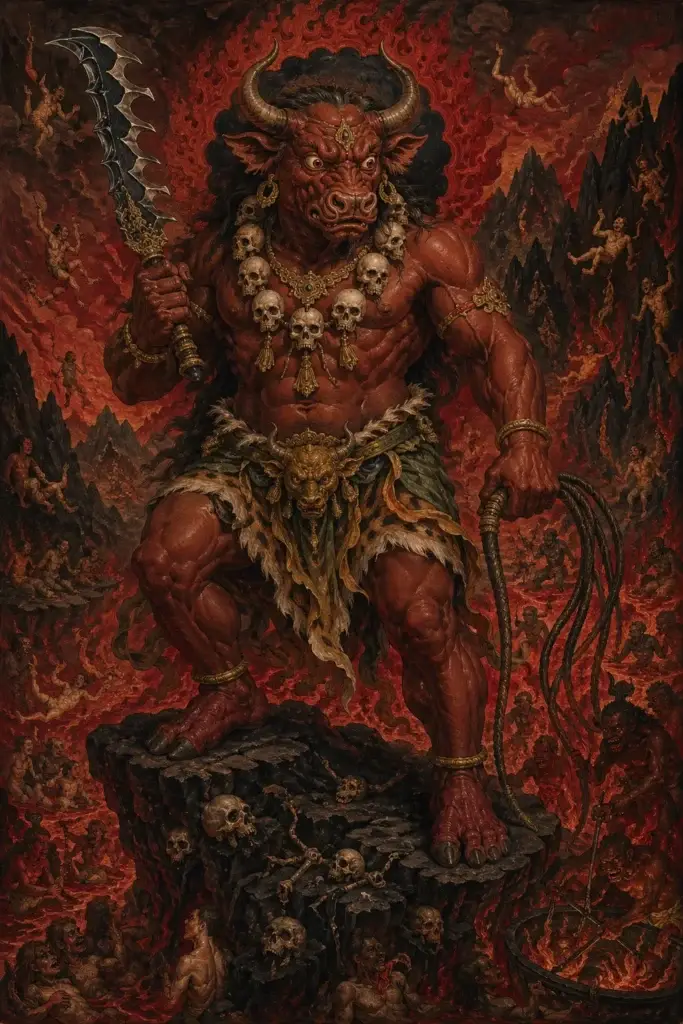
The guardians are therefore not devil figures but functionaries within a mechanism. The Tibetan Book of the Dead and the Chinese Di Yu system give the guardians distinct forms, including ox-head, horse-face, and tiger-head figures among others, which have become world-famous in iconography.
Buddhist Naraka Sutras and their classifications
The most detailed Buddhist account of the hells and their guardians is found in sutras such as the Mahayana Mahaparinirvana Sutra, the Karmavibhanga Sutra, and the Surangama Sutra.
These texts classify hell guardians according to their function and karmic status. Some guardians are demonic beings trapped in their roles by their own negative karma.
Others are Bodhisattvas who have voluntarily assumed roles in hell in order to rescue beings.
Distinguishing between these two categories is central to Buddhist ethics: the guardian is not inherently evil but is either trapped in a role or represents a missionary force. The Naraka Guardian is therefore not only feared within Buddhism but also venerated.
Naraka at a Glance
Type: hell guardian, karmic enforcer
Origin: service under Yama; in the East Asian tradition of Yanluo Wang
Texts: Abhidharmakosha, Mahayana sutras, Bardo Thödol, Di Yu literature
Period: Buddhist tradition to the present
Structure: eight hot and eight cold Narakas, each with its own guardians
Historical Context
Pali Canon with early hell descriptions. Vasubandhu’s Abhidharmakosha (4th/5th century CE) systematizes Naraka cosmology. The Tibetan Book of the Dead with detailed guardian iconography. Chinese Di Yu literature from the Tang period onward; Japanese Jigoku depictions from the Heian period onward.
All Buddhist regions; particularly elaborate in China, Japan, and Tibet. The Chinese Di Yu system with ten hells, each subordinate to a Yama king (Yanluo). The Japanese Jigoku tradition. Mongolian and Tibetan hell paintings.
Abhidharmakosha (Vasubandhu), Saddharmasmrityupasthana Sutra, Bardo Thödol, Chinese Yuli Bao Chao (“Precious Records of the Jade Calendar”, Song dynasty), Japanese Jigoku-zoshi (illustrated hell scrolls), Korean folk art.
Names and Variant Spellings
Sanskrit: narakapāla, “hell guardian”; narakadūta, “hell messenger”.
Chinese: 獄卒 (Yu Zu, “hell soldiers”); specific guardian pairs Niu Tou (ox-head) and Ma Mian (horse-face).
Japanese: Gokusotsu; East Asian variant with ten hell kings.
Tibetan: Shinje-pho-nya.
The East Asian elaboration is particularly detailed. The Di Yu system with ten hells, each with its own kings, courts, and guardians, is a combination of Buddhist roots and Daoist-Confucian bureaucratic hierarchies.
Characteristics
Appearance
Animal-faced: ox-head, horse-face, tiger-head, and raven-face are common forms. Armed with clubs, pitchforks, chains, and swords. In Chinese depictions shown in formal official robes with hats and seals. In Tibetan thangkas depicted in wrathful dancing postures.
Behavior
Functional, not personal: they receive the deceased on Yama’s command, escort them to the assigned Naraka, and carry out the prescribed punishments. No freedom of choice; they execute karmic necessity.
Sphere of Activity
The sixteen principal Narakas, each with numerous sub-hells. In the East Asian tradition, the ten hells of Di Yu, each assigned to a specific transgression (lying, stealing, killing, and so on). Not active in the world of the living.
Mythological Classification
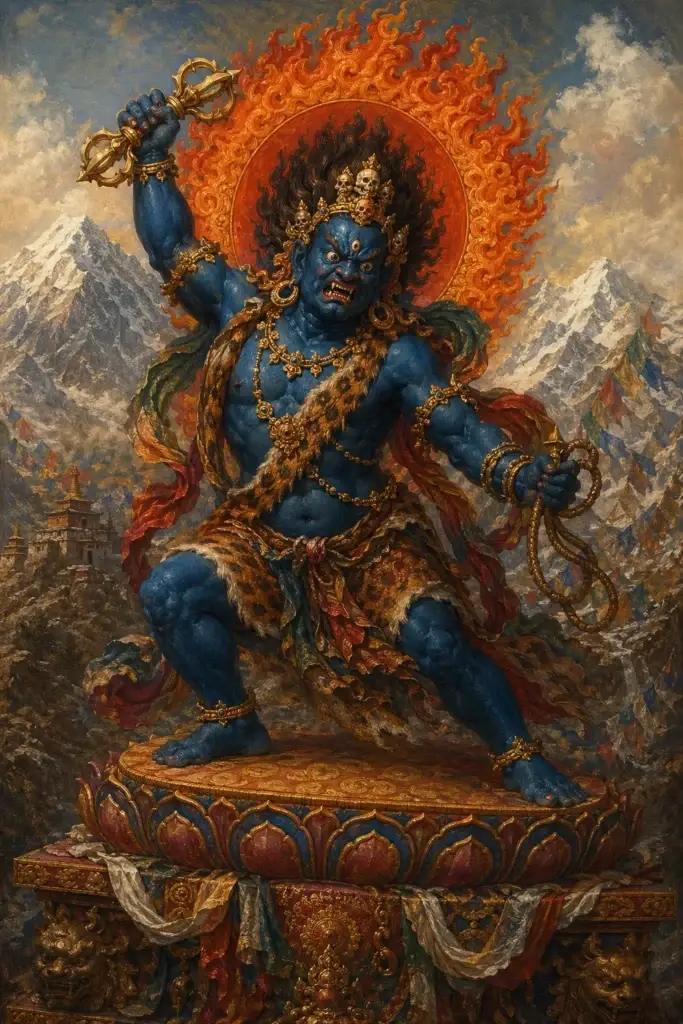
Not independent figures but functional agents. In Vajrayana they are understood as energetic aspects that can be transmuted into wrathful protective deities (Yamantaka as the conqueror of Yama himself).
The eight warm hells and their overseers
Within the context of the Asta Naraka (the eight warm hell realms) and the eight cold hell realms, the function of the Naraka Guardian becomes very specific. An overseer of the boiling hell, for instance, is not always the same demon; texts report different guardians for different ages.
In Tibetan Buddhism, the Naraka Guardians are often understood as manifestations of Mahakala or Yamantaka, that is, as wrathful aspects of compassion. A Naraka Guardian does not strike out of malice but in order to overcome the karma of the imprisoned being. This is a radical reinterpretation of punishment as therapeutic intervention.
Profile: Naraka
The most important aspects of the Naraka Guardians at a glance.
In the service of Yama or Yanluo. Functionaries of karmic enforcement, not autonomous demons. In East Asia, specific individual figures (ox-head, horse-face).
The deceased with grave karmic transgressions. In East Asia, distributed across the ten hells according to type of transgression.
Animal-faced (ox, horse, tiger), armed with weapons. In official robes in Chinese depictions; wrathful in Tibetan representations.
They execute karmic punishments: fire, ice, dismemberment, and consumption. Each punishment is the specific counterpart to the underlying transgression.
Invoking Ksitigarbha (Bodhisattva of hell beings), sutra recitation, ancestral offerings, Ullambana rituals. In Vajrayana: Phowa, tantric purification practices, binding rituals to Yamantaka.
Hell Topography and Practice
Eight Hot Narakas
Sanghata, Raurava, Maharaurava, Tapana, Pratapana, Samjiva, Kalasutra, Avici. Each with its own forms of punishment: fire, crushing, dismemberment, and partitions of boiling oil. Avici (“the Unceasing”) is the deepest, reserved for the heaviest karmas.
Eight Cold Narakas
Arbuda, Nirarbuda, Atata, Hahava, Huhuva, Utpala, Padma, Mahapadma. Icy cold as the form of punishment; bodies freeze, split apart, and break into lotus-shaped fragments (hence the names).
Ksitigarbha Practice
The Bodhisattva Ksitigarbha (Chinese Dizang, Japanese Jizo) has made the vow to save all hell beings before he himself enters Nirvana. His invocation is the most important hell-liberation practice in East Asia. Jizo statues line Japanese paths and protect children and travelers.
Parallels and Reception
Ancient Parallels
The Mesopotamian Gallu in the underworld of Ereškigal, the Egyptian Ammit at the judgment of the dead, and the Greek Erinyes as avengers. Structurally similar: enforcement organs of cosmic justice.
Chinese Di Yu System: Ten hell kings, each with his own palace and administrative staff. A Buddhist-Daoist hybrid; the Yuli literature (Song dynasty) describes the system in detail. Temples at Chinese city boundaries and cemeteries depict Di Yu scenes.
Modern Reception
Japanese anime (Hozuki no Reitetsu, Di Yu comedies), Bollywood films featuring Yamraj hell realms, and Korean films such as Along with the Gods (2017) with detailed Naraka navigation. The hell cosmology remains visually popular.
Yamantaka as cosmic guardian over all hells
A central figure in this context is Yamantaka, the conqueror of Yama. In Tibetan Buddhism, Yamantaka is not only the conqueror of Yama but also lord over all demonic guardians in Yama’s realm. Yamantaka is invoked meditatively in tantric sadhanas in order to gain mastery over inner demonic forces.
This means that the outer hell with its guardians is understood as a projection of unresolved inner emotions. A Naraka Guardian is ultimately also the guardian over one’s own greed, anger, and ignorance. This psychological transformation of the hell motif shows how Buddhism reframes pre-modern conceptions within soteriological frameworks.
Naraka in the Buddhist Cosmos
The Naraka Guardians can only be understood in the context of the position of Naraka within the Buddhist worldview. Naraka is the Sanskrit term for the hell realms, the lowest of the six planes of existence into which a being can be reborn.
A fundamental difference from the Christian hell is important: the Narakas are not eternal. They are places of temporally limited, though immensely long, punishment, where heavy negative karma is worked off. Once it is exhausted, the stay in hell also ends, and rebirth in a higher realm becomes possible.
Buddhist cosmology has elaborated the Narakas in considerable detail. The texts generally distinguish eight hot and eight cold principal hells, each with numerous secondary hells in which different torments are endured according to the nature of earlier transgressions.
The duration of existence in these realms is expressed in the texts with astronomically large numbers in order to convey their severity, without implying genuine eternity.
The Naraka Guardians belong to this system as the personnel who carry out the punishments. They are not independent gods and not fallen beings, but functional figures within the hell realms.
Their task is to torment, dismember, burn, and cut apart those reborn there, with the texts emphasizing that the hell beings are repeatedly reassembled so that the punishment can continue.
The Naraka Guardians are thus enforcers of an impersonal cosmic law, not agents of personal vengeance. Related conceptions are known in Buddhism across all its regional forms.
Are the Guardians Themselves Suffering Beings? A Doctrinal Debate
One of the most interesting questions surrounding the Naraka Guardians is an ancient intra-Buddhist doctrinal debate: what kind of beings are the hell guardians? This question is not marginal, as it touches the core of the Buddhist teaching on karma and rebirth.
One position, discussed in Abhidharma literature, holds that the hell guardians are not truly sentient, suffering beings but a kind of apparition, produced by the collective karma of the hell inhabitants themselves.
According to this view, the damned generate their tormentors through their own negative karma; the guardians are then, in effect, objectified consequences of the condemned beings’ own actions.
This interpretation has the advantage that no one accumulates new bad karma through the activity of tormenting, since the guardians would not be acting persons in the full sense.
Another position regards the hell guardians as actual beings who have themselves been reborn in hell and lead a tormenting existence by tormenting others. In some texts, figures associated with Yama, such as Yamapala, appear in this role.
This view raises the difficult question of whether the guardians do not generate further bad karma through their cruelty and are thereby kept trapped in hell.
Various Buddhist schools have given different answers, and the disputed point remained unresolved over centuries. For the academic study of religion, this debate is illuminating because it shows that the Naraka Guardians are not a simple pictorial element but a figure around which fundamental questions of the Buddhist teaching on responsibility, action, and rebirth crystallize.
Yama and the Hell Court
Standing above the individual tormentors in the Buddhist vision of hell is the figure of Yama, lord of the underworld and judge of the dead.
Yama is an ancient Indian deity who already appears in Vedic texts as the first mortal and lord of the dead; Buddhism incorporated him into its cosmological system. In its Buddhist form, Yama presides over the court before which the deceased appear, and he questions them about their deeds.
A well-known teaching parable, the simile of the divine messengers, describes how Yama reminds a dead person that during his lifetime he had seen old age, illness, and death but had not taken them as occasion for good action.
Yama appears here not as an arbitrary tyrant but as an authority that confronts the being with its own failure; the punishment follows from karma, not from Yama’s whim. In the East Asian elaboration, this court was expanded into a system of ten underworld kings through whose successive courts the soul is guided.
The Naraka Guardians stand in this structure below Yama. They are the executive organs of the judgment delivered in the hell court, comparable to bailiffs and executioners of an earthly justice system.
This bureaucratization of the underworld, particularly pronounced in the Chinese and Japanese traditions, has firmly embedded the Naraka Guardians within an ordered vision of the afterlife.
They do not act on their own initiative but on instruction, and their activity is part of a regulated procedure. This classification is important for understanding the guardians not as mere figures of terror but as functionaries within a cosmic legal order ultimately grounded in the law of karma.
Pictorial Representation and the Didactic Function of the Hell Guardians
The Naraka Guardians and the hell realms they inhabit belong to the most frequently depicted motifs in Buddhist art, and these depictions served a clear purpose.
On the Bhavachakra, the “Wheel of Life” depicted in many monasteries, the hell realm occupies one of the six sectors; there one sees the condemned, the instruments of punishment, and the guardians who torment them. In East Asia, entire pictorial cycles were created depicting the ten hell kings and their courts.
These images were not primarily decorative but didactic. They confronted the believer, often including those who could not read, with the consequences of bad conduct in vivid terms.
The elaborate, sometimes graphic depiction of hell punishments and their executors served moral instruction: those who saw the images were meant to be motivated to observe the Buddhist precepts, to avoid killing, stealing, and lying.
In Japan, distinct pictorial traditions developed from this, and texts such as the Ojoyoshu of Genshin depicted the hells so vividly that they left a lasting mark on religious imagination.
The Naraka Guardians appear in these depictions in fixed visual formulas: with animal heads, often ox-head or horse-head, with massive clubs, pitchforks, and other implements, in figures of fearsome appearance.
In the Chinese and Japanese traditions, the ox-head and horse-faced guardians have become particularly well known. Important for classification is that these images of terror are never an end in themselves within the Buddhist context.
They serve a teaching that ultimately aims at liberation from the cycle of rebirths. Hell and its guardians are the warning, the presupposed background against which the Buddhist path gains its urgency. Those who regard the Naraka Guardians merely as monsters overlook their actual function as instruments of a religious pedagogy.
Research Literature
Further standard works in the literature index.
The protective practice described here represents an academic classification of historical traditions. iWell Guard draws on this cultural-historical line of wearable protective objects and represents a contemporary form of that tradition. More about iWell Guard