Cailleach, goddess of the Celtic tradition
By Ralf Ittermann · last reviewed on
Cailleach is a goddess of the Celtic tradition.
The Old One, winter goddess and shaper of rocks in the Celtic world.
Cailleach
The Cailleach is one of the oldest figures in Celtic tradition. Her name (“the veiled one,” “the old woman wrapped in a veil”) designates an ambivalent female primordial power: winter goddess, shaper of mountains and rocks, primordial mother of the landscape, and in later tradition also a threatening witch figure.
She stands at the boundary between goddess and demoness, between cosmic creator and dark winter force.
In Irish and Scottish Gaelic tradition, the Cailleach is linked to specific mountains, islands, and seasonal transitions. She reigns from Samhain until Beltane; in spring she turns to stone or becomes young again.
Her rich geography, hundreds of place names, rock formations, and peaks, makes her very likely the figure most deeply rooted in the landscape within Celtic mythology.
Quick Overview: Cailleach
Type: Ambivalent primordial mother, winter goddess, shaper of landscape
Origin: Gaelic tradition
Texts: Dindsenchas, place-name legends, folk tradition
Period: Middle Ages to the present
Distribution: Ireland, Scotland, Isle of Man
Context
A pre-Christian Cailleach is not archaeologically attested. Early literary attestations in the Irish Dindsenchas (place-name explanations, 10th to 11th century). Rich tradition in Scottish Gaelic folklore of the 19th and 20th centuries (Campbell, Carmichael, McNeill). Modern revival in neo-paganism.
Ireland (Cailleach Bhéara, Cailleach Beara), Scotland (Cailleach Bheur, Cailleach nan Cruachan), Isle of Man (Caillagh ny Groamagh). Hundreds of places bear her name: peaks, rocks, islands. Particularly dense along the Atlantic coast of western Scotland and western Ireland.
Dindsenchas, the Irish place-name corpus; Campbell’s West Highland collections; F. Marian McNeill’s The Silver Bough (1957, 1968); modern ethnology of the Gaelic coastal regions.
Name and Variants
Irish: cailleach, literally “the veiled one” (from Latin pallium, veil), extended to mean “old woman, nun, witch.”
Scottish Gaelic: cailleach; specifically Cailleach Bheur, “the sharp old woman.”
Epithets: Cailleach Bhéara (Kerry region), Cailleach nan Cruachan (the Scottish Highlands), Caillagh ny Groamagh (Isle of Man).
Related goddesses: Morrígan (war goddess), Danu (primordial mother of the Tuatha Dé Danann).
The name carries three layers of meaning: physically an old woman, religiously a veiled nun (under Christian influence), and mythically the primordial mother and winter sovereign. All three layers remain simultaneously active in folk tradition.
Description
Appearance
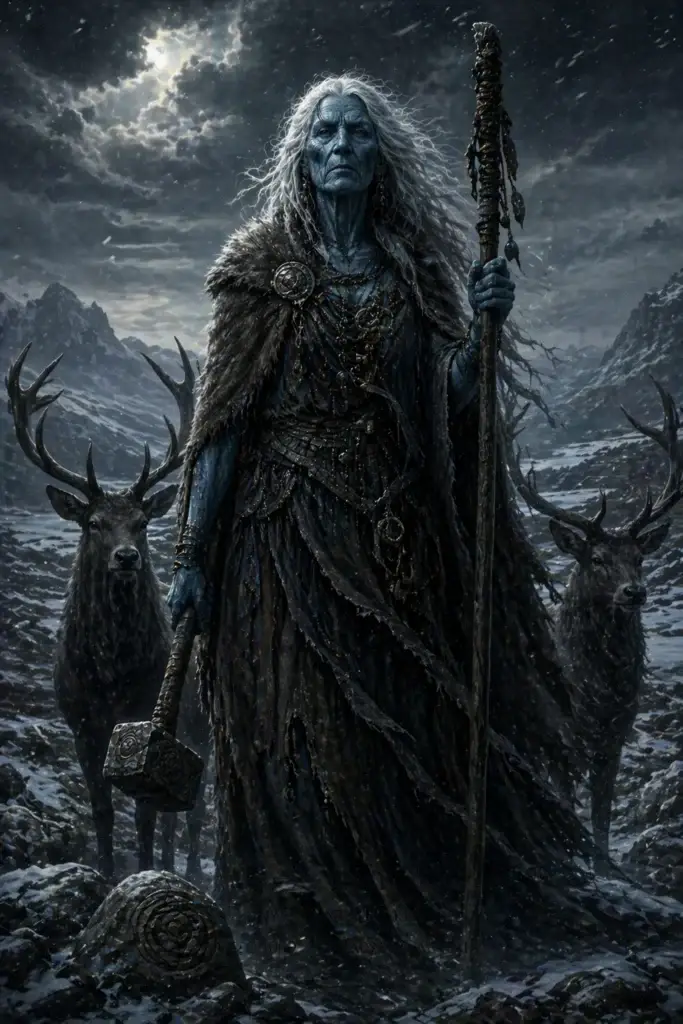
An old woman, tall, sometimes with blue skin, brown teeth, and only one eye. Bent with a staff. In her transformed state: a young woman, a beautiful queen, or a rock. In winter tradition: accompanied by a white stag or a cow.
Behavior
She shapes the landscape, hurling stones that become mountains and carrying earth in her apron that becomes islands. She governs winter: striking the ground with her staff, she freezes the earth. At Beltane (1 May) she turns to stone or becomes young again.
Domain
Wild nature, mountains, rocks, islands, and the sea. Weather, especially winter and storms. The succession of ages and seasonal transitions. In some traditions also the guardian of wild animals (stags, wolves).
Mythological Classification
Not a classical goddess in the Roman sense, but a primordial power of Gaelic tradition. After Christianization she was reinterpreted as a witch or a saint (with connections to Sheela-na-Gig), without losing her mythic dimension. Venerated anew in modern neo-pagan movements.
Appearance and Symbolism
Cailleach is depicted as a gigantic, ancient woman with a deeply furrowed face. She sometimes has only one eye. She wears a blue or green robe and carries a staff. Her footsteps shaped mountains and valleys. Stone and winter are her symbols.
Profile: Cailleach
The most important aspects of the Cailleach at a glance.
Primordial power of Gaelic tradition; possible ancestral figure of Celtic goddesses. Shaper of landscape, winter goddess, guardian of wild nature.
The whole community through the cycle of the year, especially shepherds and rural dwellers who depend on weather and winter conditions.
Old woman with a staff, sometimes blue-skinned, with brown teeth and one eye. Capable of transformation: young queen, beauty, or rock. Accompanied by a stag or cow.
She shapes the landscape, brings winter, and freezes the earth. Ambivalent: destructive and world-sustaining at the same time. At spring she transforms into stone or becomes young.
No warding off as such; rather, respect and ritual acknowledgment. Certain plants (rowan, gorse) and places (Cailleach stones) are honored with offerings.
Functionally related to the Irish Mórrígan and Béfind as aging shapers of fate; to Baba Yaga (Slavic) as the forest and initiation witch; to the Germanic Frau Holle/Holda; and to the North American Grandmother Spider (Hopi/Cherokee).
Within the Celtic Scottish world, the Cailleach merges with local mountain spirits; Hecate as a counterpart in the Greek tradition shares the profile of nocturnal, threshold-related power.
Cult and Folk Custom
Seasonal Rites
Samhain (31 October / 1 November) marks the beginning of her reign; Beltane (1 May) marks its end.
In some regions, the encounter between the old Cailleach and the young Brigid was enacted at Imbolc (1 February, the Feast of Brigid): the Old One gathers firewood for a long or short winter, depending on the weather.
Place-Based Cults
Hundreds of Cailleach sites exist in Ireland and Scotland. Cailleach stones, Cailleach peaks, and Cailleach caves are respected to this day. Some farmers leave a strip of grain standing in the fields as the “Cailleach’s share.”
Weather Divination
The Scottish February brings her final storms; the “Cailleach storm” carries specific meteorological signatures. The weather of the twelve days after Christmas, the “Cailleach days,” is interpreted as a forecast for the twelve coming months.
Parallels and Modern Reception
European Parallels: Perchta and Hulda in Germanic tradition are functionally close: old women with a connection to winter, ambivalent and dangerous. Baba Yaga in the Slavic world shares distinguishing features: an old woman with a world of her own, occupying an intermediate position between protector and threat.
Neo-Pagan Reception: In modern Wicca and Celtic neo-paganism, the Cailleach is venerated as the Crone aspect within the “Triple Goddess” (Maiden-Mother-Crone). This interpretation is modern and syncretic rather than historically Celtic, but has a validity of its own.
Literature and Culture: Contemporary Irish literature (Nuala Ní Dhomhnaill) takes up the Cailleach as a symbol of female ambivalence. The Scottish cultural movement invokes her as an identity-defining figure.
The Cailleach as Shaper of the Landscape
In the Gaelic tradition of Scotland and Ireland, the Cailleach is not merely a figure in stories but an explanatory power for the landscape itself. Numerous mountains, hills, rock formations, and islands are interpreted in local legends as her work.
She is said to have let stones fall from her apron, thereby forming mountain ranges, or to have shaped valleys with a hammer. Such aetiological narratives are scattered across the Scottish Highlands, the Hebrides, and parts of Ireland.
A particularly well-documented example is the whirlpool of Corryvreckan between the islands of Jura and Scarba.
A widely known legend explains the roaring water by saying that the Cailleach washes her plaid there in autumn; when it is washed, it is white, and the first snow covers the land. This narrative connects the Cailleach to the seasonal transition into winter.
Folklore studies, such as the work of Donald Mackenzie in the early 20th century and more critically in recent scholarship, have therefore read the Cailleach as a personification of wild, pre-human nature.
She is older than humanity, and older in part than the named gods, embodying the mountain, the storm, and the cold season. Methodological caution is important here: much of what today appears as a coherent Cailleach mythology was only assembled into a system by the collectors of the 19th and 20th centuries.
Cailleach and Brigid: the Contest for the Year
A tradition widespread in Scotland and Ireland places the Cailleach in opposition to the spring figure, commonly called Brigid. According to this narrative tradition, the Cailleach rules over the winter months, from Samhain in early November until Bealtaine in early May.
With the onset of spring her power ends, and some versions have the Cailleach turn to stone or go to a well of youth from which she emerges rejuvenated.
A frequently cited detail concerns the feast of La Fheil Brighde, the Feast of Brigid in early February. If that day is sunny and bright, so the saying goes, the Cailleach is abroad gathering firewood for a long, hard remainder of the winter, which means fine weather on this day is a bad omen.
If the day is overcast, the Cailleach has slept in, her supply of wood is small, and winter will end soon. This weather rule is structurally related to the central European Groundhog Day and Candlemas customs.
The academic interpretation of religion is more cautious here than popular accounts. Whether the Cailleach and Brigid were actually conceived in pre-Christian times as two aspects of a single goddess or as rival figures cannot be determined with certainty from the sources.
The opposition is reconstructed predominantly from later folklore. What is established beyond doubt is that in the living narrative tradition, the Cailleach was firmly associated with the winter half of the year.
The Last Sheaf and the Harvest Custom
Beyond the landscape myths, the Cailleach was embedded in a concrete harvest custom in the Scottish Highlands and on the Hebrides until the 19th and in some areas even into the 20th century.
The last sheaf cut in a field was in many areas also called Cailleach, the old woman. Whoever finished mowing last was left with the Cailleach, and in many localities this was considered a disgrace, as one would then have to house an unproductive consumer through the winter.
Various strategies were used to escape the Cailleach. Reapers threw their sickles into the final bundle of stalks or tied it quickly in order to pass it on to a slower neighbor.
The last sheaf was sometimes skillfully plaited into a figure, kept in the house, and given to the first seedlings in the following spring or to the livestock. In this way the force thought to reside in the grain was preserved over winter and carried into the new cycle.
James George Frazer cited this custom in The Golden Bough as an example of the corn daemon, a power dwelling in the grain that was captured with the last sheaf.
More recent scholarship is skeptical of Frazer’s grand schema, but emphasizes that the Cailleach harvest custom is well attested independently of it. It shows the Cailleach in a quite different role from that of the mighty shaper of mountains: as an everyday, half-feared, half-mocked figure of the agrarian working world.
Etymology and the Problem of Sources
The name Cailleach means in Scottish Gaelic and Irish literally “the veiled one” or “the old woman.” The word derives from caille, veil, which is itself borrowed from the Latin pallium.
Linguistically the term is therefore relatively recent and carries a meaning that originally referred to the veiled nun or simply the old woman in general. An important methodological consequence follows from this: the name itself does not prove the existence of a pre-Christian goddess but is a common noun applied to various figures.
The medieval Irish poem about the Cailleach Bhéarra, the Old Woman of Beara, is one of the oldest literary traces. It is a lament of an old woman for lost youth and beauty, dated to the eighth or ninth century.
Whether the figure speaking there is a mythological character or a literary personification of old age is a matter of controversy in Celtic studies. Some scholars see in it the remnant of a sovereignty goddess; others read the poem primarily as a Christian reflection on transience.
This state of the sources explains why the modern Cailleach takes so many forms. There is no single canonical myth.
Instead, the word was applied over centuries to local mountain spirits, weather powers, and personifications of harvest and nature, and only the folklorists of the 19th and 20th centuries drew these strands together into a single figure.
Anyone approaching the Cailleach from a scholarly perspective must therefore distinguish between the medieval texts, the regional legend tradition, and the modern synthesis.
Further Links
Selected Bibliography
Further standard works in the literature index.
Compared with the male deity figures of the Celtic pantheon, the Cailleach appears as an independent figure of the tradition embodying winter, storm, and mountain.
Where a typical Celtic god represents tribe, war, or craft, she embodies an older, landscape-bound layer: mountains, rock formations, and seasonal transitions in Scotland, Ireland, and on the Isle of Man are linked to her figure.