Dirae, Spirit of the Roman Tradition
By Ralf Ittermann · last reviewed on
Dirae is a spirit of the Roman tradition.
The Roman Furies, executors of divine wrath.
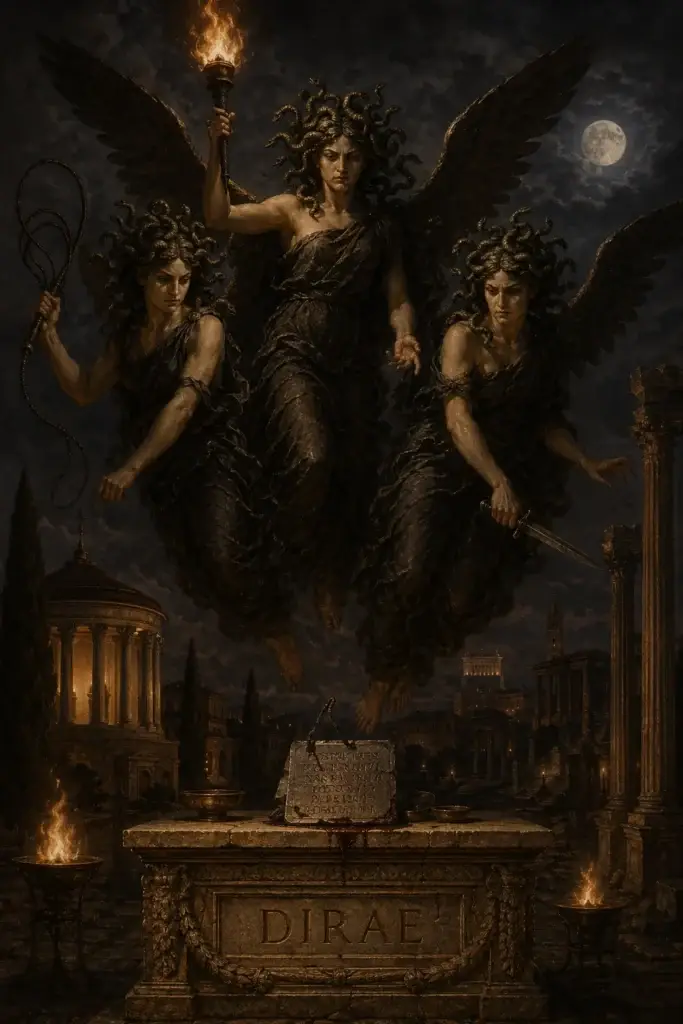
Dirae
The Dirae, often also called Furiae, are the Roman equivalent of the Greek Erinyes. They pursue bloodguilt, carry out divine wrath and bring plague and war. Virgil, Seneca and Ovid shaped their literary form and made them a fixed part of the Roman conception of revenge and cosmic justice.
Unlike the Erinyes, the Dirae in Rome have no cult of their own comparable to the Athenian sanctuary of the Eumenides. They remain at home in literature, in mythology, in tragedy. In defixiones they are invoked as instruments of revenge; there they overlap with the figures they represent in the myth.
Quick Overview: Dirae
Type: Avengers, messengers of doom
Origin: Adaptation of the Greek Erinyes; alongside this, distinct Italic roots
Names: Alecto, Megaera, Tisiphone (taken over from the Greek)
Texts: Virgil (Aeneid), Ovid, Seneca, Horace
Period: Late Republic to late antiquity
Defence / reconciliation: Purification rites, invocation of Jupiter and the di inferi
Classification
Period of the Texts
The adoption of the Greek Erinyes into Roman literature begins in the late Republic. Virgil’s Aeneid (1st century BC) gives the Dirae their best-known form. Seneca’s tragedies and Ovid’s Metamorphoses continue this. In late antiquity they merge with Christian conceptions of demons.
Area of Distribution
The cultural area is that of the Latin West. In Greek-influenced regions of the Empire the designation Erinyes remains customary, in Latin areas Dirae or Furiae. After the end of the Empire the Dirae live on in medieval literature and iconography.
Source Situation
Rich in literary terms. Primary sources: Virgil’s Aeneid Book VII (Allecto incites the war in Latium), Seneca’s tragedies, Ovid. Iconographically, Roman wall paintings and sarcophagi that depict the figures in the Greek traditional form.
Designation and Spellings
Latin: Dirae (“the dreadful ones”), Furiae (“the raging ones”).
Individual names: Alecto, Megaera, Tisiphone (direct Latin forms of the Greek names).
Eumenides equivalent: Semnae Theai or Eumenides remains Greek, not really Latinised.
Dira also simply means “calamity”; the plural form initially denotes, impersonally, bad omens, before it is specified as the designation of the avengers. This double meaning makes the Dirae the ideal bridge between a personal figure of revenge and an impersonal concept of calamity.
Description
Appearance
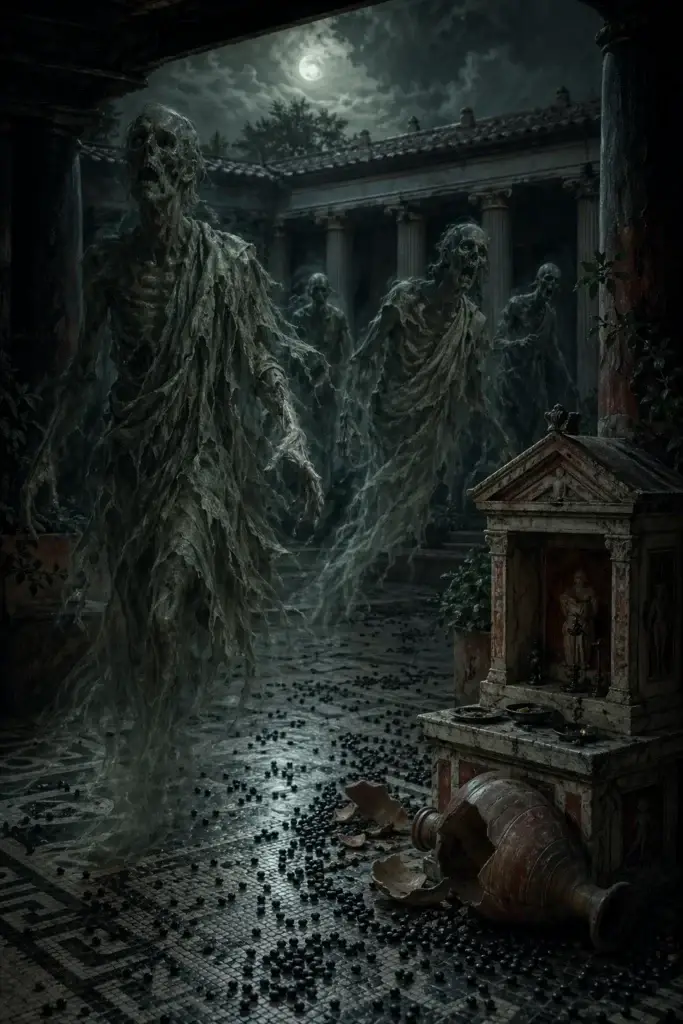
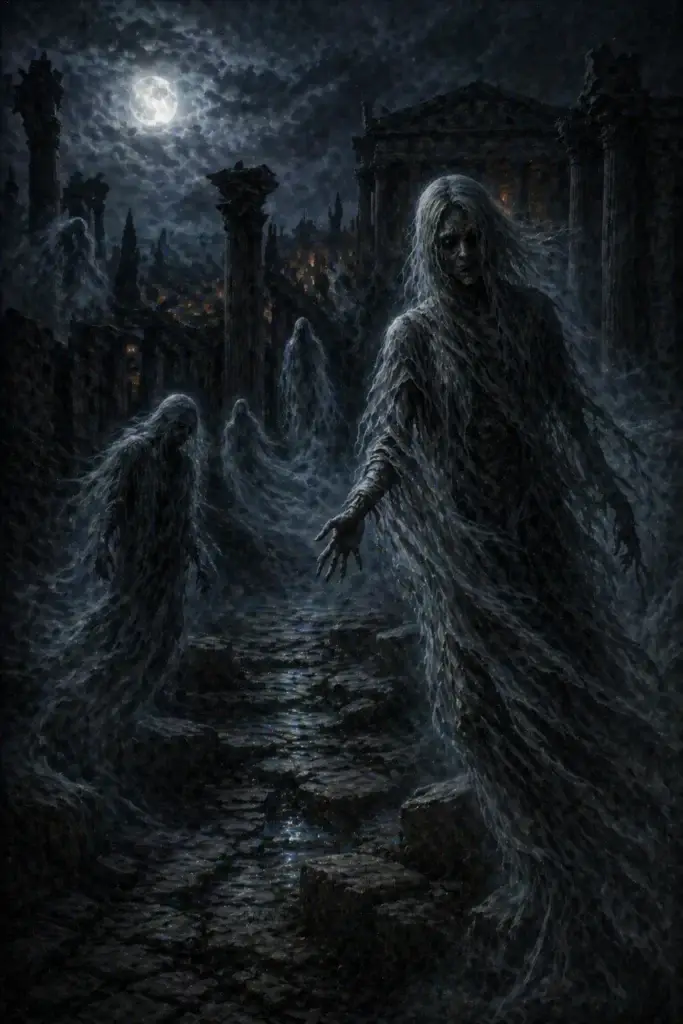
Like the Erinyes: winged, with snake hair, torches and whips. Dark garments, bloody eyes. In Roman iconography occasionally furnished more strongly with symbols of war and calamity; they bring individual revenge and at the same time war and plague.
Behaviour
They are sent out by gods (Juno, Jupiter) or in conjurations to carry out assignments. In Virgil’s Aeneid Juno sends Allecto to bar Aeneas’s path in Latium; she incites strife, madness, war. The Dirae are therefore not only avengers but active agents of divine will.
Sphere of Influence
Bloodguilt, perjury, family curse, war, plague, great political upheavals. They act in individual cases (the Orestes motif) as well as on the great stage.
Mythological Origin
Adopted from Greek genealogy: daughters of the Night or from the blood of the castrated Uranus. In Virgil the idea of an execution entrusted by the gods is strengthened; they are instruments of a higher order.
Profile: Dirae
The most important aspects of the Dirae at a glance. You will find the detailed account of name, description, cult and parallels in the following sections.
Adaptation of the Greek Erinyes, with their own Italic accents. Born from the blood of Uranus; in Roman literature often executors of Juno’s commissions.
Those burdened with bloodguilt, perjurers, family traitors. Also entire communities in war and plague, when order is broken.
Winged, snake hair, torches, whips. In Roman iconography often more warlike, more striking in dress than the rather archaic Erinyes.
Instigation of strife and madness, execution of divine wrath, bringing of war and plague. Impersonally effective also in great political developments.
No everyday amulets. Purification rites after bloodshed, sacrifice to the di inferi, prayers to Jupiter as the highest authority. Defixiones invoke the Dirae against opponents.
Erinyes (Greek, direct model), Gallu (Mesopotamia), Keres (battlefield motif), figures of the Grim Reaper.
Demonology in Everyday Life
Rituals of Reconciliation
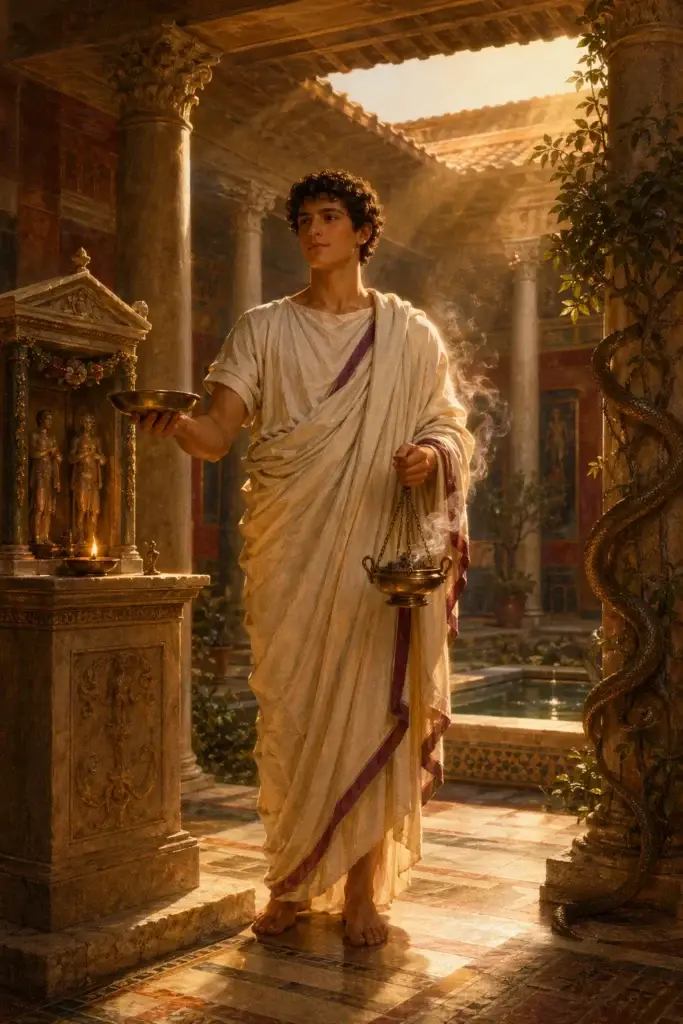
As in the Greek case: purification rites after bloodshed (lustratio), sacrifice to the gods of the underworld, invocation of Jupiter. The state performs public atonement in cases of great calamity; private families do so through burial and offerings to the dead.
Conjurations
Defixiones, mostly on lead, invoke the Dirae against opponents: “Dirae, pursue him day and night …”. The structures follow the Greek model but use Latin formulas. In the literary tradition the Dirae are invoked rhetorically by Virgil and Seneca.
Amulets and Protective Symbols
Amulets against the Dirae are not known; they belong to the non-negotiable cosmic powers. Protection is offered only by right conduct and ritual purity.
Dirae, Parallels in Other Cultures
Greece: The Erinyes are the direct model. Structure, names and function are adopted, with Roman accents (a stronger dimension of war and fate in Virgil).
Mesopotamia: The Gallû of the underworld likewise carry out the judgement of a higher power. Unlike the Dirae, however, they are messengers of death without a moral focus.
Christian Reception: In patristic literature the Dirae are often reinterpreted as demons. In medieval art their iconographic elements (snakes, torches) reappear with infernal figures, the path from the ancient avenger to the Christian devil.
The Dirae Between Curse and Goddess of Revenge
The Latin term dirae is ambiguous, and it is precisely this ambiguity that is important for understanding it. The word belongs to the adjective dirus, which means “calamitous”, “dreadful”, “ruinous”.
As a noun in the plural, dirae, it initially denotes the curses uttered, that is, the imprecations and cursing formulas themselves. In a second meaning it stands for the personified powers that carry out such curses.
This second meaning leads to an overlap with the Greek Erinyes, the goddesses of revenge, who in Roman thought were often equated with the Dirae or the Furiae.
Here the Roman conception did not produce a clearly delimited, independent deity with a fixed biography, but a fluid group of punishing powers whose contours shift according to author and context. Some texts speak of two or three Dirae, others leave the number open.
For scholarship this is a typical case of Roman religion, in which abstract concepts and divine powers are often not strictly separated. The curse and the power that executes it can bear the same name.
The Dirae are thus less a being in the narrower sense than a conception that oscillates between a speech act and a divine person. Anyone who wishes to understand them must acknowledge this vagueness as their actual characteristic and not try to give them a sharpness that the sources do not provide.
The Dirae in Virgil's Aeneid
The most important literary treatment of the Dirae is found in Virgil’s Aeneid, the Roman national epic from the late first century BC. In the twelfth and final book, shortly before the decisive battle between Aeneas and Turnus, Virgil draws on these figures to stage a crucial turning point.
Virgil describes how Jupiter keeps two Dirae beside him at his throne, born of the Night. They are his instruments, which he sends out when he wishes to bring terror, sickness or war upon mortals. At the decisive moment Jupiter sends one of these Dirae down.
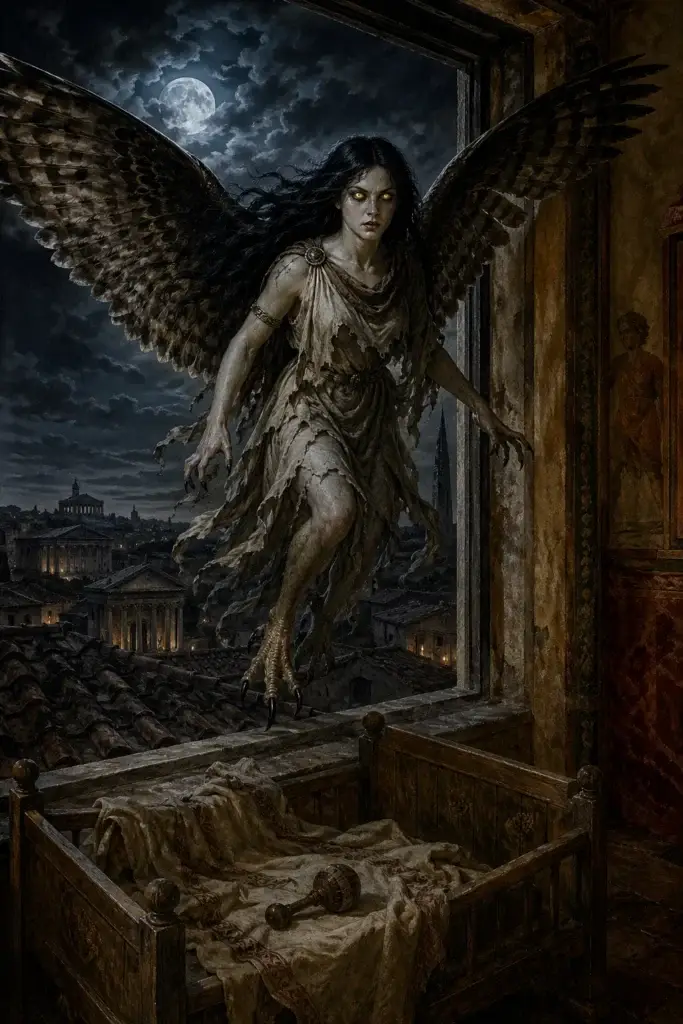
She takes the shape of a small bird, an owl, and flutters into Turnus’s face. Turnus recognises the evil omen, his strength fades, a cold shudder seizes him. The Dira thus brings about no physical attack but the inner paralysis that makes victory impossible for Turnus.
This scene is illuminating in terms of religious history because it shows how Virgil understands the Dirae: as executors of the divine will, as messengers of doom who, through terror and omens, bring what fate has decreed into reality. They are not autonomous deities but instruments of Jupiter.
At the same time Virgil connects them with the owl, an animal that in Roman divination was considered a bearer of ill omen. Scholarship has recognised in this passage a deliberate literary procedure: Virgil gives an abstract power a concrete, sensuously tangible appearance without making it into a fully developed person.
Relationship to the Furies and Erinyes
The relationship of the Dirae to the Furiae and the Greek Erinyes is one of the more intricate questions of Roman religious history. All three terms denote powers connected with curse, revenge and punishment, and the ancient authors do not treat them uniformly. Sometimes they are equated, sometimes distinguished, sometimes placed side by side.
In essence one can say that the Furiae are the Latin equivalent of the Greek Erinyes, those spirits of revenge who pursue above all crimes within the family, such as the murder of relatives.
The Dirae, by contrast, are originally bound more closely to the uttered curse and to the function of messengers bringing terror. In the practice of the poets, however, these distinctions blur. Virgil himself does not use the terms in strict separation, and later authors take over the vagueness.
Scholarship interprets this finding as an expression of a general trait of Roman religion. While Greek mythology furnished its punishing goddesses with elaborate genealogies and myths, the corresponding Roman powers remained more strongly functional and bound to concepts. Only through contact with Greek literature and through poetic treatment did they acquire sharper outlines.
The Dirae are thus a good example of the interaction between the Roman and Greek worlds of imagination: a Latin term that under Greek influence was increasingly endowed with the features of the goddesses of revenge, without ever entirely shedding its original meaning as an imprecation.
This dual nature makes the source situation demanding and requires a precise examination of the context at every passage.
Further Links
Sources and Literature
Further standard works in the literature index.
The protective practice described here is a religious-studies classification of historical traditions. iWell Guard ties in with this cultural-historical line of wearable protective objects and represents a contemporary form of it. More about the iWell Guard →