Caicai-Vilu and the flood that created Chiloé
By Ralf Ittermann · last reviewed on
Caicai-Vilu is a goddess of Mapuche tradition.
Mistress of the water in the eternal flood struggle against Tren-Tren-Vilu. The tradition tells of a flood that created Chiloé during her struggle against Tren-Tren-Vilu.
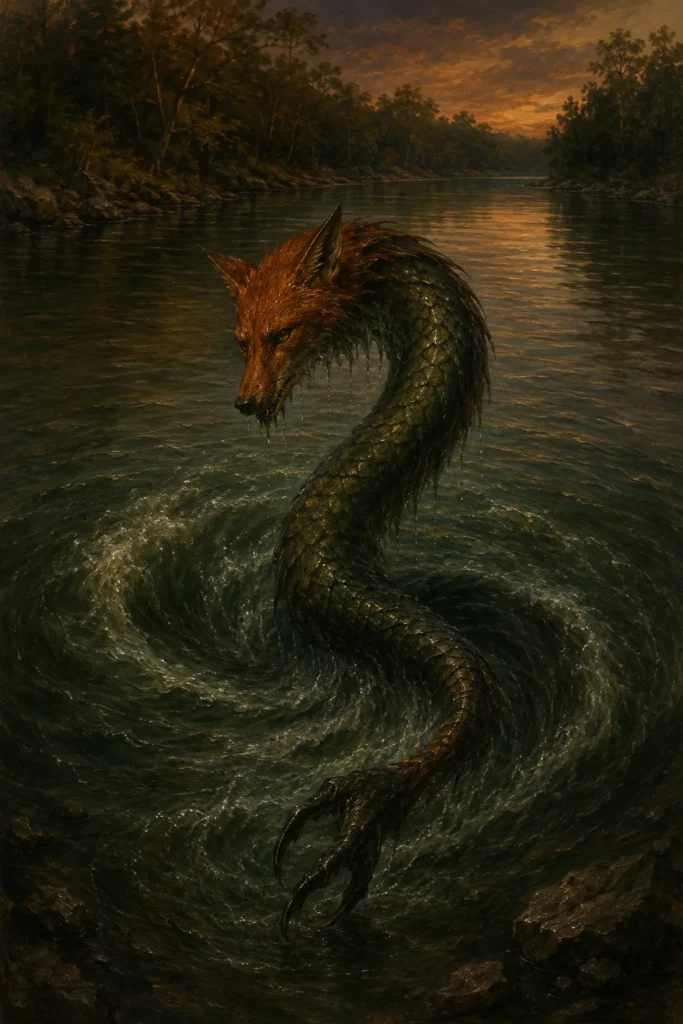
Caicai Vilu is the mighty sea serpent of Mapuche tradition, mistress of the water and adversary of the land serpent Tren-Tren-Vilu. Their struggle gave rise to the flood that shaped the landscape of southern Chile and the Chiloé archipelago.
Type: Sea serpent, mistress of the water
Origin: oral Mapuche tradition
Texts: regional variants
Period: pre-colonial to present
Appearance: mighty serpent, in some versions with a fish tail

Region of Origin and Sources
Period of the Texts
Pre-colonial oral tradition, put into writing from the 19th/20th century onward, still told today.
Area of Diffusion
Southern and central Chile, especially the Chiloé archipelago, with variants also found in Argentina.
Sources
Many regional variants; the Chilote version is regarded as a later synthesis.
Name and variants
Mapudungun: caicai, connected to water, vilu, serpent. Tren-Tren, its counterpart, is connected to the earth.
Form and Effect
Appearance
Mighty sea serpent, in some regions with a fish-shaped tail.
Effect
Causes floods and storm surges; cosmic, not directed against individuals.
Profile: Caicai-Vilu
The most important aspects of the sea serpent at a glance.
Oral Mapuche tradition with a Chilote sub-tradition, without a fixed canonical form.
Flood, storm surge and tsunami; a collective fate for entire regions.
Mighty sea serpent, in some regions with a fish-shaped tail, counterpart to the land serpent.
Floods valleys and hills; turns over in its sleep, thereby triggering storm surges.
No banishing ritual is recorded; the mythical protection is flight to higher ground.
The serpent struggle that shaped the landscape
Both serpents were children of the ancestor spirits Peripillán and Antu, transformed and sent respectively into the sea and onto the earth. Enraged by human ingratitude, Caicai-Vilu flooded valleys and hills.
Tren-Tren saved the people; the struggle ended in a stalemate and shaped the rugged geography of southern Chile.
Founding myth of Chilote identity
A central founding motif of Chilote identity, present in craftwork and in the animated film Nahuel and the Magic Book.
In religious studies, an aetiological flood myth that explains earthquakes and volcanism as expressions of the primordial conflict.
Rescue to higher ground
No banishing ritual is recorded; in the myth, protection is offered solely by Tren-Tren-Vilu, who lifts people up onto the heights. Circle of protection, amulet and salt are regarded as protection.
Water serpents and flood myths
Typologically related to flood and chaos-battle myths, alongside the Mishipeshu and the biblical Leviathan. Related within the same cultural sphere is the demon Nguruvilu.
Frequently asked questions about Caicai-Vilu
Did Caicai-Vilu defeat the people?
No, Tren-Tren-Vilu saved them by lifting them to the heights.
How does the myth explain the islands of Chiloé?
The water that did not recede left mountain peaks standing as islands.
Further links
Further reading:
Literature (selection)
More in the bibliography.
Those searching for Caicai Vilu Mapuche will find the origin myth of a coastline: as the sea serpent of Chiloé, she explains why the island landscape is so rugged.