Iku-Turso, the thousand-headed terror of the deep
By Ralf Ittermann · last reviewed on
Iku-Turso is a demon of Finnish (Kalevala) tradition.
The thousand-headed sea giant that Väinämöinen banished. The tradition remembers a thousand-headed terror of the deep, banished by Väinämöinen’s song.
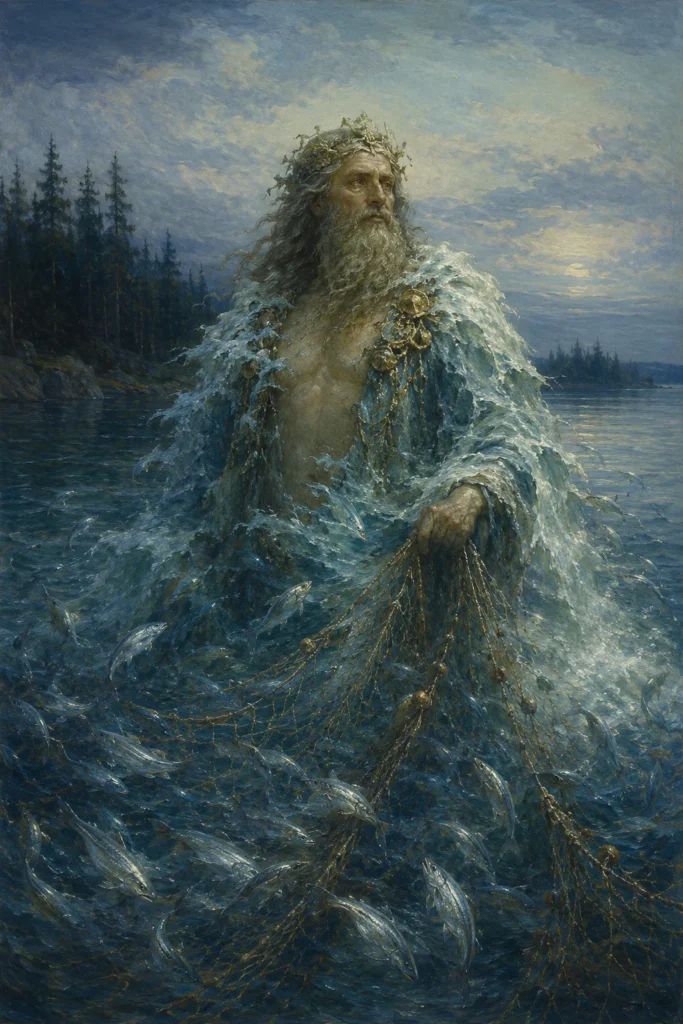
Iku-Turso is the malevolent sea monster of Finnish tradition, a mighty giant of the deep, described in the Kalevala as thousand-headed. As a tool of the hostile Louhi, he embodies the chaotic, hostile depths of the sea, in contrast to the benevolent water gods Ahti and Vellamo.
As early as 1551, Mikael Agricola names a war god Turisas, who granted victory in war; scholarship suspects that a war and primordial giant merged here with the malevolent sea demon Meri-Tursas. In the Kalevala, Iku-Turso appears twice, once as an arsonist who makes the world-darkening giant oak grow, and once as a monster that Väinämöinen subdues.
Type: Sea monster and war demon of the Kalevala
Origin: Finnish rune-song tradition, mentioned as Turisas by Agricola in 1551
Texts: Rune songs, given literary form in the Kalevala of 1835 and 1849, Rune II and Rune XLII
Period: 16th century to the present
Appearance: mighty sea giant, called thousand-headed and thousand-horned

Area of origin and sources
Period of the Texts
Mentioned as Turisas as early as 1551 by Agricola, given literary form in the Kalevala of 1835 and 1849, with appearances in Rune II and Rune XLII.
Area of Diffusion
Finland and Karelia; the figure is associated with the dark north, Pohjola.
Sources
The source material is inconsistent; it is likely that two originally separate figures merged in tradition.
Name and variants
Finnish: The name Turisas is probably an early loanword from the Proto-Germanic word for giant and is related to the Germanic thurses. The word tursas was partly associated with the walrus, and in modern Finnish with the octopus, from which the walrus- and octopus-like conception of the monster derives.
Appearance and behaviour
Appearance
Iku-Turso is a mighty sea giant, described in tradition as thousand-headed and thousand-horned, and associated with the realm of the dead, Tuoni, as well as with the dark north, Pohjola. The name tursas is also the source of the north European interlace symbol tursaansydän, the heart of the Tursas, a pre-Christian symbol of luck.
Effect
Iku-Turso is destructive: he starts fires, triggers the darkening of the world with the giant oak, and is sent out by Louhi as a weapon of war against the heroes of the Kalevala. As the war god Turisas, he was conversely regarded as a giver of victory, but as a sea demon he was seen as a threat to seafarers. In one tradition, he is even regarded as the father of diseases arising from his union with Loviatar.
Profile: Iku-Turso
The key aspects of the sea monster at a glance.
From the rune-song tradition, attested as Turisas by Agricola as early as 1551 and given literary form in the Kalevala as the sea monster Iku-Turso.
The thieves of the Sampo, against whom Louhi sends him, as well as, more generally, seafarers who encounter the monster of the deep.
A mighty sea giant, called thousand-headed and thousand-horned, associated with the dark north, Pohjola, and the realm of the dead, Tuoni.
Arson, the darkening of the world through the giant oak, and the attack on the Sampo thieves at Louhi’s behest.
The monster is overcome solely by Väinämöinen’s magic words; the woven symbol tursaansydän, the heart of Tursas, was regarded as a pre-Christian protective sign.
Turisas, Meri-Tursas, and the fusion of two figures
The name Turisas is probably an early loanword from the Proto-Germanic word for giant and is related to the Germanic thurses. According to research by Anna-Leena Siikala, two figures originally merged: the war and primordial giant Turisas and the malicious sea demon Meri-Tursas. Already in 1551, Mikael Agricola presents Turisas as a war god who granted victory in war. A rune song tells how Meri-Tursas impregnates the northern maiden Loviatar with the waves, from which the diseases of the world are born.
In the Kalevala, Iku-Turso appears twice: in the second rune, a fiery Tursas rises from the sea and burns the mown hay, from whose ashes the world-darkening giant oak grows. In the forty-second rune, Louhi, mistress of the North, sends Iku-Turso against the thieves of the Sampo; Väinämöinen grabs the monster by the ears and forces it, through magic words, never to rise from the sea again.
From submarine name to folk metal band
A Finnish submarine of the Vetehinen class bore the name Iku-Turso during the Second World War, and an asteroid is named after him. The Finnish folk metal band Turisas bears the name of the war god. In popular culture, Iku-Turso appears in comics, video games and fantasy worlds as a sea monster.
Iku-Turso stands at the demonic, chaotic pole of Finnish nature religion, interpreted variously as a water haltija, a primordial giant, or a war god. He embodies the hostile element in contrast to the benevolent water haltijat Ahti and Vellamo. The fusion of war god and sea demon, along with the strong Scandinavian loan connections, makes him a borderline case between Finno-Ugric and Germanic tradition.
Banishment through the word rather than offerings
A cult of veneration as a sea demon is absent; the mythical protective model is overcoming through the word. Väinämöinen subdues Iku-Turso solely through magic words and the power of naming, a model for the drawn protective circle, which corresponds to this mythical subjugation through word and boundary. Cold iron was regarded as a means of defence against the beings of the hostile deep, and bells served as a warning, banishing sound against what rises from the sea. As the war god Turisas, by contrast, the figure was invoked for victory, and the woven symbol tursaansydän, the heart of Tursas, was regarded as a pre-Christian sign of luck and protection. Protection thus lies in banishment and incantation, not in sacrifice or offering.
Giants and monsters of other mythologies
Research compares Iku-Turso to the Norse giants Ymir and Hymir, and through the octopus-like conception he is close to the Nordic kraken. As a chaotic sea monster, he is typologically related to the biblical Leviathan. In his war god interpretation he was equated with Tyr, Thor and Mars; as a hostile water power he stands far from the Germanic Nix and closer to the great monsters of the deep.
Frequently asked questions about Iku-Turso
Is Iku-Turso one being or several?
This is disputed. A war and primordial giant, Turisas, and a sea demon, Meri-Tursas, probably merged into a single figure in tradition.
Is Iku-Turso walrus-like or octopus-like?
Both are associated with him. The word tursas was linked to the walrus, while the modern Finnish word for octopus carries the same stem. A fixed description is absent from the Kalevala.
How is Iku-Turso defeated?
Väinämöinen grabs him by the ears and forces him, through magic words, never to rise from the sea again. According to legend, he has not been seen since.
Further links
Further reading:
- Ahti, Vellamo – the benevolent water haltijat in contrast to Iku-Turso
- Näkki, Vesihiisi – further water spirits of Finnish tradition
- Protective circle, Iron, Bells – traditional protective means
- Protection Compass – protective means at a glance
Literature (selection)
Further standard works in the bibliography.
Anyone searching for Iku Turso Kalevala will find a Finnish sea monster whose thousand heads were finally banished forever only by Väinämöinen’s magic words.