Hamadryad: born with the tree, died with the tree
By Ralf Ittermann · last reviewed on
The Hamadryad is a spirit of Greek tradition.
The nymph who lives and dies with her tree. Born with the tree and dying with it, the Hamadryad shares its entire fate.
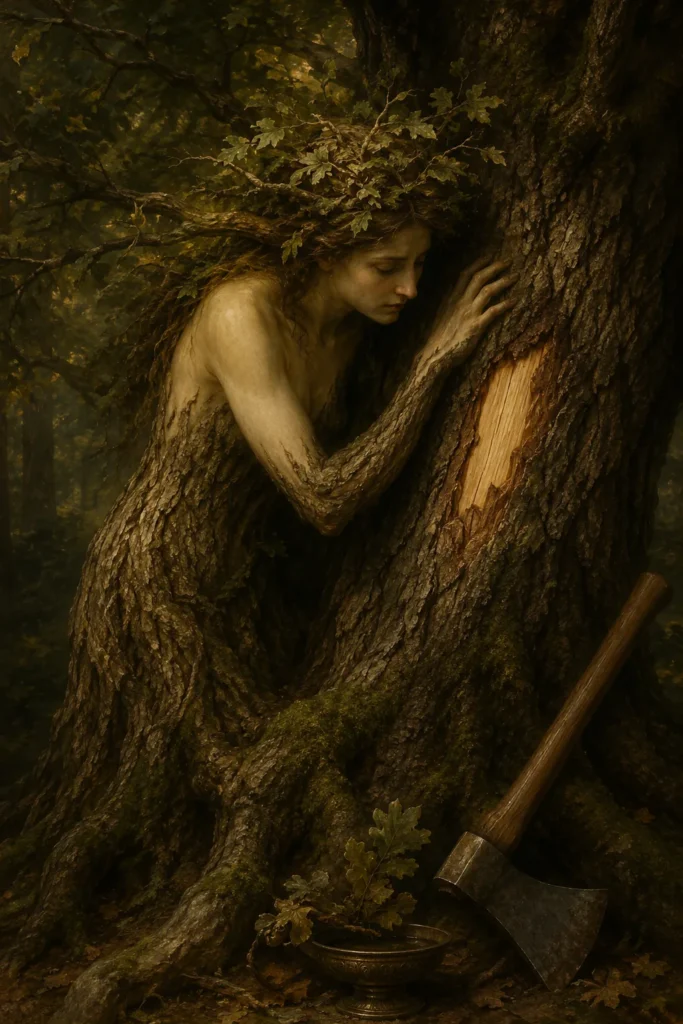
The Hamadryad is the form of Greek tree nymph most closely bound to the tree: she is born with her tree and dies with it. Her name combines hama, together with, and drys, tree and oak.
In the surviving stories, the Hamadryad stands for the idea that felling an ensouled tree counts as killing a being. In this she differs from the general Dryad, who lives around trees and groves without being bound to a single one.
Type: tree nymph, strictly bound to a single tree
Origin: Greek world, Roman reception
Texts: Homeric Hymn to Aphrodite, Apollonius of Rhodes, Callimachus, Ovid, Athenaeus
Period: motif from the 7th century BC, name in Hellenistic and Imperial-era literature
Appearance: female figure, imagined as merged with the trunk of her tree
Origin and sources
Period of the Texts
The motif appears from the 7th century BC in the Homeric Hymn to Aphrodite; Hamadryads become identifiable by name in Hellenistic and Imperial-era literature.
Area of Diffusion
The Greek world with its Roman reception; the effect of the Hamadryad is strictly fixed to place, bound to the individual tree.
Sources
Well attested: the Hymn to Aphrodite, Apollonius of Rhodes, Callimachus, Ovid and the scholar Athenaeus; scholarship is opened up by Larson.
Name and variants
Greek: hamadryas, from hama, together with, and drys, tree, oak. The name states the programme: a life together with the tree, from birth to a shared death.
Nature and effect
Appearance
Poetry conceives of the Hamadryad as a woman whose body merges into the trunk; art and literature of the modern era show her half emerging from the bark or fused with it. In Ovid, the wounded tree bleeds, and the dying nymph speaks her curse from within the trunk: image and voice make the unity of being and tree vividly apparent.
Effect
Hamadryads act almost solely in relation to their tree: they ask woodcutters for mercy, reward rescuers, as with the nymph of Rhoecus, and punish offenders with curses that bring crop failure or unquenchable hunger and can even affect descendants, as in the case of Paraebius. Those who avoid or respect their tree have nothing to fear; at the same time, every axe threatens the nymph’s own life.
Profile: Hamadryad
The key aspects of the tree-bound nymph at a glance.
A motif of Greek poetry from the Homeric Hymn and the Pindar fragment to Apollonius of Rhodes and Ovid; Athenaeus records eight Hamadryads named after tree species.
Woodcutters, landowners and country folk: all who decide the fate of a tree in which a nymph dwells.
A female figure whose body merges into the trunk; in Ovid, the tree bleeds under the axe, and the dying nymph speaks from the wood.
A plea for mercy, reward for rescuers, a curse for offenders: the curse can bring crop failure and unquenchable hunger, and it also affects descendants.
Prayer for permission before felling, sparing sacred trees, atonement through altar and sacrifice, as advised by the seer Phineus to Paraebius.
Paraibios, Rhoikos and the Eight Daughters of Oxylos
The motif of the tree-bound nymph first appears in the Homeric Hymn to Aphrodite: fir trees and oaks grow up together with the nymphs, and when the tree withers, their soul also leaves the light. A fragment of Pindar grants them a lifespan equal to that of the tree. Hamadryads become identifiable by name in the Hellenistic period: in the Argonautika, Apollonius of Rhodes tells how the father of Paraibios felled a Hamadryad’s oak despite her pleading and was cursed for it along with his lineage; the seer Phineus advises atonement through altar and offering. Alongside this stands the story of Rhoikos, who had a falling tree propped up and was at first favoured by the rescued nymph, but punished after an insult.
The scholar Athenaeus, following Pherenikos, records eight Hamadryads as daughters of Oxylos and Hamadryas, whose names are tree species, among them Karya (walnut), Balanos (oak), Aigeiros (black poplar), Ptelea (elm), Ampelos (grapevine) and Syke (fig). Ovid brings the motif into Roman literature with the tale of Erysichthon; in Callimachus the offence befalls a poplar, in Ovid an oak.
From Cautionary Tale to Animal Name
Ovid’s Erysichthon became a cautionary tale about offences against nature and has shaped its reception into the present. Nineteenth-century painting took up the figure, for instance John William Waterhouse with A Hamadryad (1893). The name migrated into natural history: the king cobra long carried the genus name Hamadryas, and the hamadryas baboon still bears the name Papio hamadryas today. In debates about the protection of old trees, the dying tree nymph regularly serves as a symbol.
In the study of religion, the Hamadryad condenses the idea of the tree soul into an equation of tree life and spirit life; Edward B. Tylor cited it for this reason as a prime example of animistic thought. Jennifer Larson, by contrast, emphasises the literary character of many Hamadryad narratives: a broad cult of nymphs is well attested, whereas the strictly tree-bound nymph is chiefly a motif of poetry that impresses grove taboos through storytelling. In the history of religion, the stories function like accompanying texts to actual felling prohibitions: they give the protected tree a face and the offence a punishment.
Atonement and Caution Before the Axe
The tradition knows both atonement and caution: Apollonius has the seer Phineus, as a remedy for the curse, erect an altar for the nymph and make offerings; this is regarded as a model for dealing with wronged trees. Before felling, there was a prayer for permission; sacred trees and groves were protected by statutes, the breach of which incurred penalties. Roman practice continues this: Cato’s book on agriculture prescribes a pig sacrifice together with a prayer to the unknown deity before a grove could be thinned. Protection here consistently means avoiding the offence or formally atoning for it.
Ensouled Trees in Other Traditions
The idea that a tree harbours a personal being and that felling it brings misfortune is widespread: Japan knows the Kodama, whose trees were marked to spare them; related to this is the mountain forest spirit Tengu. The Slavic Leshy avenges offences against the forest as its master, while the German Moss Folk and Wood Maidens, like the Hamadryad, suffer when trees are stripped of bark or felled.
Frequently Asked Questions About the Hamadryad
Does the Hamadryad really die with her tree?
Yes, this is her defining trait. Even the Homeric Hymn to Aphrodite describes nymphs whose soul leaves the tree at death. This is precisely what distinguishes her from the general Dryad, who lives in the vicinity of trees.
What happened to Erysichthon?
The Thessalian king had a tree sacred to Demeter felled and ignored the pleading of the tree nymph, who died with it. As punishment the goddess struck him with unquenchable hunger, until he consumed his possessions and finally himself.
Could an offence against a tree be atoned for?
The sources answer yes. In Apollonius of Rhodes, the seer Phineus advises that an altar be erected for the nymph and offerings made on behalf of Paraibios’ cursed family. Roman agricultural literature also knows formal atonement offerings.
Further links
Further reading:
- Greece – all beings of Greek tradition
- Dryad – the tree nymph as a collective figure
- Meliai – the ash nymphs
- Amulet, Incense burning, Circle of protection, Salt – traditional protective means
- Protection Compass – protective means at a glance
Literature (selection)
Further standard works in the bibliography.
Thus the Hamadryads remain nymphs of a particular rigour: whether one of them dwells as a tree nymph in oaks, poplars or elms, her life begins and ends with the trunk to which she is bound.