iWell Guard

Kitsunebi and the nightly procession of fox lights

Kitsunebi is a spirit of Japanese tradition.

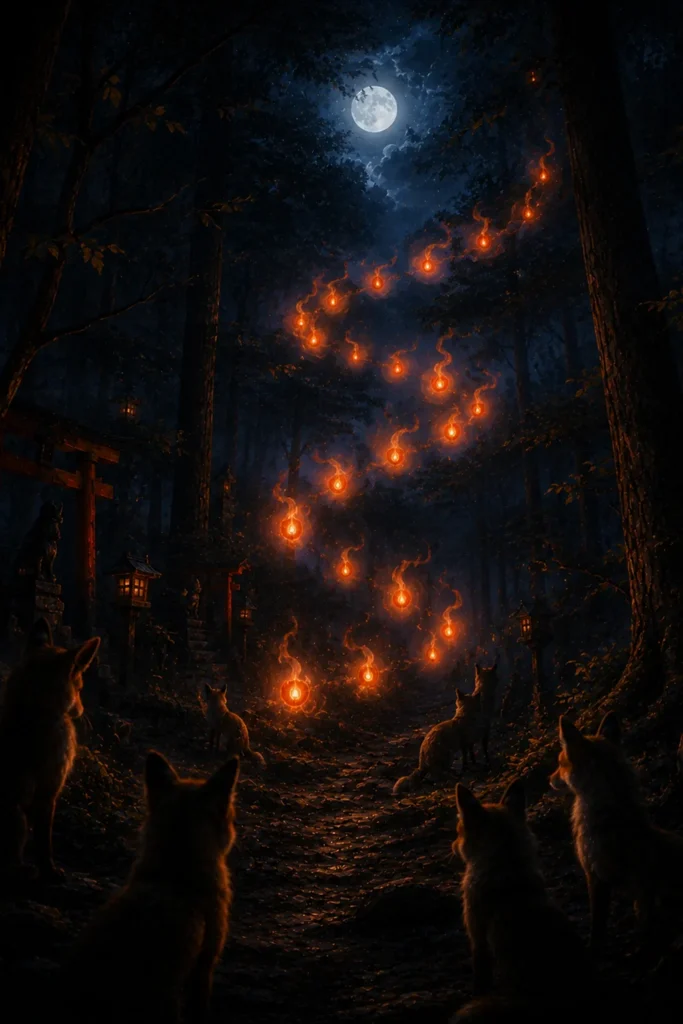
Chains of lights created by foxes that lure travellers off the path.

SpiritJapan

Table of Contents

Kitsunebi, the fox fire of Japanese folk belief
Kitsunebi

Kitsunebi, the fox fire, are mysterious lights in Japanese folk belief said to be produced by foxes, the kitsune. They appear as rows of hovering flames in the darkness, lead travellers astray, and in some places herald the nightly wedding procession of the foxes.

The belief belongs to the rich fox lore of Japan, in which the fox is regarded as a supernatural, shape-shifting being. In the Edo period, fox fire was frequently depicted; famous are the images of foxes gathering under a tree near Oji in Edo. In some places, the appearance of the lights was also taken as an omen of the coming harvest.

At a glance: Kitsunebi

Type: Fox fire, deceptive light phenomenon of fox belief
Origin: Japanese folk belief surrounding foxes and will-o’-the-wisps
Texts: rich folk and pictorial tradition, especially from the Edo period
Period: classical to modern
Appearance: rows of hovering reddish, orange or bluish lights

Traditional context

Period of the Texts

Classical to modern, with a broad Edo-period folk belief at the core of the tradition.

Area of Diffusion

All of Japan. The Edo-period depictions of foxes gathering under a tree near Oji in Edo became famous.

Sources

Good: a rich folk and pictorial tradition, along with the studies by Foster and Nozaki.

Name and variants

Japanese: kitsune means fox, bi or hi fire: Kitsunebi is the fox fire. Unlike other night lights, the name thus names a cause, the supernatural animal to which folk belief attributed the lights.

Being and effect

Appearance

Kitsunebi appears as a row or chain of reddish, orange or bluish lights that flare up in the dark, move and then fade again.

Effect

It is regarded as a sign of the presence of foxes and their deceptive power over human perception. At night it leads travellers astray, causing them to lose their way. In some traditions, long rows of fox fires herald the wedding procession of the foxes, the kitsune no yomeiri.

Profile: Kitsunebi

The key aspects of the fox fire at a glance.

Tradition

Part of the rich fox lore of Japan, in which the fox is regarded as a supernatural shape-shifter.

Object of Influence

Nocturnal travellers who lose their way; also whole regions to which long rows of lights signal the fox wedding.

Depiction

Chain of hovering lights in the dark; the Edo-period images of foxes gathering near Oji are famous.

Sphere of Influence

Deception and deceit; the appearance of the lights was in some places also taken as an omen of the coming harvest.

Handling

Vigilance, avoiding solitary night paths and protective formulas; the Inari shrines maintained a reverent relationship with the foxes.

Distinctions

Hitodama as a soul flame and Onibi as demon fire; kitsunebi, by contrast, is the work of foxes.

Fox belief, Inari and the lights of Oji

Kitsunebi cannot be understood without the fox belief of Japan: the fox, the Kitsune, is regarded as a supernatural, shape-shifting being, and since foxes were seen as messengers of the rice god Inari, reverence combined with caution. The mysterious lights of the night were attributed to this animal.

The motif reached its greatest popularity in the Edo period: fox fire was frequently depicted, for instance in the famous images of foxes gathering under a tree near Oji in Edo. There, it was believed, the foxes gathered with their lights before moving through the night.

From the fox wedding to a festival

Kitsunebi is firmly established in Japanese art, folk belief and modern pop culture; the fox wedding and fox fire are popular motifs in film, anime and festivals. In some places, fox wedding processions are re-enacted as festivals.

From a religious-studies perspective, kitsunebi is an example of how nocturnal light phenomena are attributed to a supernatural animal. It links the worldwide belief in will-o’-the-wisps with the specifically Japanese fox lore and the notion of the fox as a deceptive shape-shifter.

Caution on nighttime paths

Kitsunebi is a phenomenon of appearance, not a cult being. Its handling belongs to fox belief: since foxes were regarded as messengers of the rice god Inari, reverence combined with caution. Against being misled by fox fire and fox magic, folk belief relied on vigilance, avoiding lonely night roads and protective formulas; the Inari shrines cultivated respectful conduct towards the foxes.

Fox fire, soul flame, demon fire

Kitsunebi corresponds to the European will-o’-the-wisp and the deceptive night lights of other cultures. Within Japan it stands alongside Onibi, the demon fire, and Hitodama, the soul flame; its distinguishing feature is the named originator. The fox behind it is the Kitsune, the shapeshifting fox spirit.

Frequently asked questions about Kitsunebi

What is Kitsunebi?

The fox fire: mysterious lights that, in Japanese folk belief, are produced by foxes and appear as rows of hovering flames.

What is the fox wedding?

Kitsune no yomeiri, a nocturnal procession of foxes, heralded by long rows of fox fires. In some places it is re-enacted as a festival.

Is Kitsunebi dangerous?

Usually only misleading: it can lead travellers astray, but is rarely considered immediately dangerous.

Further links

Recommended internal links:

Literature (selection)

A selection of key sources and studies:
  • Foster, Michael Dylan: The Book of Yokai. Berkeley 2015.
  • Nozaki, Kiyoshi: Kitsune. Japan’s Fox of Mystery, Romance and Humor. Tokyo 1961.

Further standard works in the bibliography.

As a Japanese fox fire, Kitsunebi remains the will-o’-the-wisp of the foxes: a light that does not announce the dead, but the deceptive presence of an animal to which folk belief attributed almost anything.

Classification & Protection

IILEVEL
The Protection Compass assigns this being to influence level II, Noticeable influence.

Against its influence, cross-cultural tradition names these protective means:

Compare in the Protection Compass →

Recommended protective means

iWell Guard

The simplest protective means in this collection: 41 layers of fine gold 999, platinum, silver and silicon, manufactured in Ruhla, Thuringia. It requires no activation, is bound to no person, and is effective within a radius of around 50 meters, even without being worn.

All protective means at a glance →