Damballa, Serpent God of Vodou
By Ralf Ittermann · last reviewed on
Damballa is the serpent god of Vodou, venerated as primal father, source of life and emblem of permanence. Damballa Wedo (also Danbala, Dambala) is one of the oldest and highest loa in Haitian Vodou and belongs to the Rada family of benevolent spirits.
He is venerated as cosmic creator, as heavenly father and as personified wisdom. His symbolism revolves around the serpent as bearer of life energy. Damballa is venerated together with his wife Ayida Wedo, the rainbow serpent; together the two form the cosmic axis of sky and water, of movement and stillness.
Table of Contents

West African Roots
The Damballa cult has its roots in West African Vodun, above all in the tradition of the Fon in present-day Benin, and in the religion of the neighbouring Ewe.
There Dangbe is regarded as the sacred royal serpent of the city of Ouidah, venerated in a temple of its own and considered a manifestation of a cosmic serpent deity. Among the Yoruba in neighbouring Nigeria too, the serpent deity Oshunmare is venerated, a rainbow serpent that bears structural similarities to Damballa’s wife Ayida Wedo.
Alfred Métraux, in «Le vaudou haïtien» (1958), discussed the question of continuity, namely in what way the Caribbean form is derived from the African one. He concluded that the basic structure of a cosmic serpent cult most probably originates from the Fon tradition, but was reshaped by Caribbean conditions and by contact with other traditions.
Leslie Desmangles, in «The Faces of the Gods» (1992), showed that the transfer was accompanied by adaptations to Catholic imagery, above all to the figure of Moses and to the saints with serpent symbolism.
Function and Nature
Damballa is the oldest loa and is considered directly connected to Bondye, the highest, transcendent god of Vodou. Unlike the younger, often hot-blooded loa, Damballa is cool, slow, dignified and wordless.
When he rides a horse believer (the term for the medium possessed by a loa), the person becomes mute; instead of words he produces only hissing sounds, or none at all. This quiet dignity distinguishes him from the lively younger loa such as the Gede or the Petwo spirits.
Maya Deren, in «Divine Horsemen» (1953), described Damballa’s function as cosmic father and as guarantor of the cosmic order.
She emphasizes that the veneration of Damballa establishes the connection to the oldest layer of Vodou, and that many Vodou practitioners turn to him before any larger ceremony, in order to secure continuity with the tradition of the ancestors. Damballa is thereby invoked early in the sequence of the loa invocations.
Symbolism and Attributes
The central symbols of Damballa are the serpent, white cloth, water, the egg and the rainbow. The serpent appears in the «vèvè», the ritual ground drawings that are drawn for his invocation, in stylized form as a double serpent or as a serpent raised upon a staff.
These drawings recall caduceus symbols and are drawn with flour, coffee or powder on the floor of the temple.
The colour white marks his purity and his sublimity. Followers of Damballa wear white clothing, temples are decorated with white cloths, offerings are eggs (symbol of creation), rice and milk.
Water is his element; many Damballa temples have a water source where his serpent manifestation lives. The rainbow connects him with Ayida Wedo, whose arch stands over the water.
Rituals and Invocation Practice
The most important rituals for Damballa take place in the Hounfor, the Vodou temples. The Houngan (priest) or the Mambo (priestess) invokes Damballa through the drawing of his vèvè, through drums and through the singing of his songs.
The drum rhythms are slow and dignified, clearly different from the fast rhythms for younger loa. When Damballa arrives and rides a follower, the person mostly crawls on the ground, hisses and takes on a serpentine posture.
Karen McCarthy Brown, in «Mama Lola» (1991), described in detail the Vodou practice of a Haitian American priestess in Brooklyn and showed how Damballa is integrated into domestic practice.
The priestess keeps a fixed place for him in her home altar and regularly presents offerings. The personal relationship between practitioners and loa is highly individualized in Haitian Vodou; Damballa can be a person’s «protective loa», which shapes their entire life.
Syncretic Identification with Saint Patrick
In the Catholic and Vodou syncretic system, Damballa is traditionally identified with Saint Patrick, the Irish saint who is often depicted iconographically with serpents that he drives out of Ireland.
At first glance this identification is paradoxical, because Saint Patrick drives out the serpents, while Damballa is himself a serpent. The connection rests on the iconographic presence of the serpent and is a typical example of the creative appropriation of Catholic images by Vodou practitioners.
Leslie Desmangles, in his work, described this form of syncretism as «masking»: during the colonial period, when the veneration of African deities was forbidden, Catholic saints served as an outer disguise for the actual veneration.
Damballa could be venerated behind the statue of Saint Patrick without the colonial authorities intervening. This practice was pragmatically motivated, but it led to a lasting double identity that is present in Haitian Vodou to this day.
Damballa and Ayida Wedo
Damballa is married to Ayida Wedo, the rainbow serpent. The two form a cosmic polarity: Damballa is horizontal, earthly and flowing, connected to the earth; Ayida Wedo is vertical, heavenly, as a rainbow over the water.
Together they form the complete cosmic circle. In the vèvè, both serpents often appear intertwined, an image that recalls alchemical depictions but was developed autonomously within the West African and Caribbean tradition.
Joan Dayan, in «Haiti, History, and the Gods» (1995), pointed to the gender-political dimension of this polarity: Damballa and Ayida Wedo form an equal divine couple that sets domestic and cosmic complementarity as equivalent. This complementarity distinguishes Vodou from patriarchally centred traditions and lastingly shapes the image of gender in Haitian religiosity.
Damballa in the Haitian Diaspora
With the Haitian diaspora, the veneration of Damballa has spread to the USA (above all New York, Miami), to Canada (Montreal), to France and to other countries. In Brooklyn, New Orleans and Miami there are pronounced Vodou communities that maintain their temple practice and venerate Damballa as a central figure.
Elizabeth McAlister, in «Rara!» (2002), described the transnational form of Haitian religiosity and showed how Damballa continues to be venerated in the diaspora on the one hand, and on the other takes on new meanings through migration.
In religious studies, the study of the Damballa diaspora is an increasingly important field. Researchers such as Yvonne Daniel, Patrick Bellegarde-Smith and Claudine Michel have shown how the practice, originally tied to Haitian geography, reorganizes itself in the urban contexts of the major American cities without losing its African and Caribbean roots.
Damballa and Scholarship
The scholarly study of Damballa faces a number of complex methodological challenges. The tradition is primarily oral, the most important bearers of knowledge are the Houngans and Mambos themselves, and the written sources are often coloured by Catholic missionary perspectives.
Wade Davis, in «The Serpent and the Rainbow» (1985), attempted an ethnobotanical approach that is in part scientifically disputed, but that in other respects opened up important sources for Haitian folklore studies.
The central standard works remain Maya Deren’s «Divine Horsemen» and Alfred Métraux’s «Le vaudou haïtien», supplemented by the works of Karen McCarthy Brown, Leslie Desmangles, Elizabeth McAlister, Joan Dayan and Claudine Michel.
Together they have created a differentiated picture of Damballa and of Vodou as a whole, one that emphasizes the Creole independence of the religion and defends it against exoticizing and demonizing depictions. In this research Damballa appears as a complex theological figure who cannot be forced into Western categories of «god» or «spirit».
Position within the Rada Family
In Haitian Vodou, Damballa is the first among the Rada loa, the older and cooler of the two loa families. The Rada family («rite Rada») comprises the loa whose names and rites go back to West African Vodun, above all to the tradition of Dahomey.
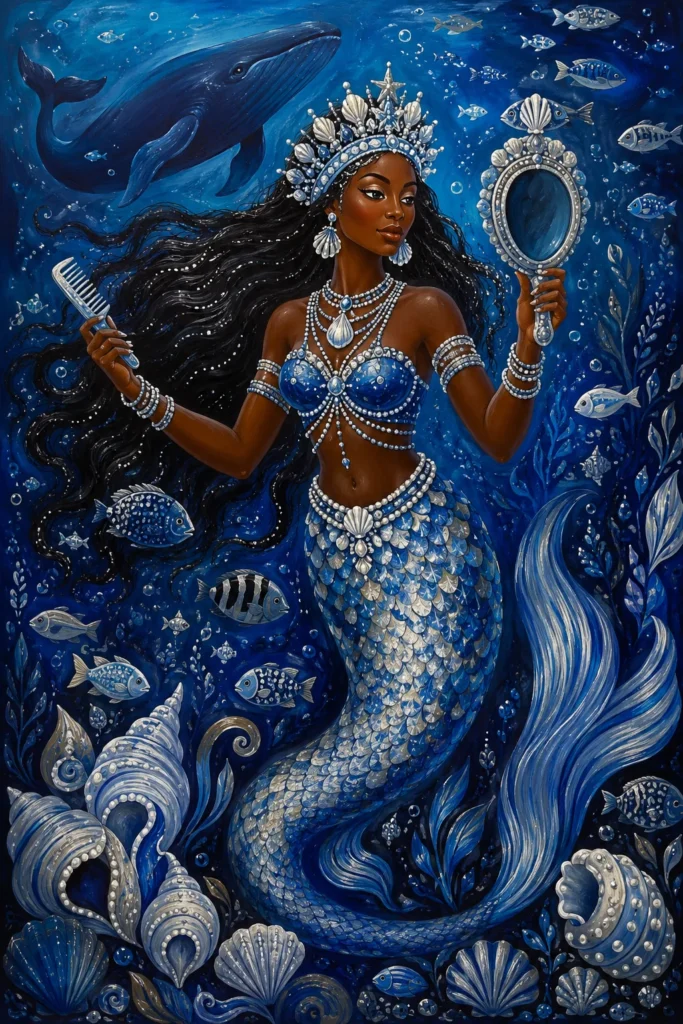
Besides Damballa and Ayida Wedo, the Rada family includes, among others, Legba (the gatekeeper), Loko (the healer), Ayizan, Erzulie Freda, Agwe (the loa of the sea), Sobo and Bade.
Set against it stands the Petwo family («rite Petwo»), which arose in Haiti itself out of the creolization of Kongolese, indigenous Taino and African elements, and which is characterized by hotter, faster rites and by a greater aggressiveness.
As the eldest, Damballa opens most Rada ceremonies. The Houngan or the Mambo greets him after Legba, who opens the spiritual gates, as well as after Loko and Ayizan. This liturgical position reflects his cosmological standing.
Alfred Métraux documented in 1948 in Marbial the sequence «Legba, Loko, Ayizan, Damballa», which was binding in many Hounfor. The Petwo spirits are invoked in a second part of the night, often after a ritual pause and a change of the drums from the Rada drum set («tanbou Rada») to the Petwo drum set.
Dahomey, Dangbe and the Ways of the Serpent
The West African prehistory of Damballa can be linked more precisely to the court religion of the Kingdom of Dahomey (today southern Benin). There the sacred python Dangbe was venerated, whose temple had stood in Ouidah since the 17th century in the immediate vicinity of the Atlantic slave ports.
Melville Herskovits, in «Dahomey: An Ancient West African Kingdom» (1938), documented the court religion with its serpent temples and showed that Dangbe was part of a multilayered Vodun pantheon. The serpent was regarded as messenger and manifestation of a complementary double deity Mawu-Lisa, the cosmic divine couple of Dahomey.
Suzanne Preston Blier, in «African Vodun: Art, Psychology, and Power» (Chicago 1995), worked out the art-historical connection between the Dahomean «bocio» figures and the Haitian vèvè. Robin Law, in «Ouidah: The Social History of a West African Slaving Port» (Athens, OH 2004), examined the historical mechanics by which the religious practices from Ouidah reached Saint-Domingue via the Atlantic ports.
The name Damballa itself is a creolized form of the Fon word «Dan» (serpent) with an extension that allows several variants in Haitian pronunciation: Damballa, Danbala, Dambala. The epithet «Wedo» goes back to «Ouidah», the West African place of origin.
Lave-tèt and Initiation Practice
The transmission of Damballa to a practitioner usually takes place within the framework of an initiation, above all in the ceremony of the «lave-tèt» («head washing») and the later «kanzo» initiation.
In the process it is determined which loa «carries» the head of the initiate, that is, which loa is considered the personal protective loa («met-tèt»).
A «Damballa daughter» or a «Damballa son» thereby takes on lifelong ritual obligations: white clothing on certain days of the week, avoidance of spicy foods, regular egg offerings and the learning of the specific Damballa songs.
Karen McCarthy Brown, in «Mama Lola: A Vodou Priestess in Brooklyn» (Berkeley 1991, expanded several times), played out this chain of initiation through a single case and showed how the relationship to Damballa is passed on across generations.
Patrick Bellegarde-Smith and Claudine Michel, in «Haitian Vodou: Spirit, Myth, and Reality» (Bloomington 2006), analysed the theological depth of this personal loa bond. They emphasize that the «met-tèt» relationship in Haitian religiosity shapes people’s everyday conduct of life, not only the ritual high points.
Legal Recognition and Diaspora
For a long time Vodou was legally persecuted in Haiti. The Code Noir of 1685 banned African religious practice. After independence in 1804, persecutions continued under shifting political justifications: anticlerical «campagnes anti-superstitieuses» in 1864, 1896 and, particularly aggressively, in 1941 under the Lescot government in cooperation with the Catholic Church.
Only the constitution of 1987 recognized freedom of religion comprehensively, and on 4 April 2003 President Jean-Bertrand Aristide issued a decree that recognizes Vodou as an official religion of Haiti and grants its priests professional rights, among them the state recognition of marriages and funerals.
Kate Ramsey, in «The Spirits and the Law: Vodou and Power in Haiti» (Chicago 2011), comprehensively reconstructed the legal-historical development. In the diaspora, above all in New York, Miami and Montreal, an institutional differentiation has taken place: associations such as «KOSANBA» (Congress of Santa Barbara) carry the scholarly and religious representation of Vodou.
In this modern institutional form, Damballa remains a central loa whose veneration continues even in the English-speaking temples of New York and Miami, albeit with adaptations to the urban life-world.
Sources and Literature
Secondary literature: Alfred Métraux, «Le vaudou haïtien» (Paris 1958, German «Voodoo in Haiti», Olten/Freiburg 1961); Maya Deren, «Divine Horsemen: The Living Gods of Haiti» (New York 1953); Karen McCarthy Brown, «Mama Lola: A Vodou Priestess in Brooklyn» (Berkeley 1991, expanded edition 2010); Leslie G. Desmangles, «The Faces of the Gods: Vodou and Roman Catholicism in Haiti» (Chapel Hill 1992); Laënnec Hurbon, «Le barbare imaginaire» (Paris 1988) and «Dieu dans le vaudou haïtien» (Paris 1972); Joan Dayan, «Haiti, History, and the Gods» (Berkeley 1995); Donald Cosentino (ed.), «Sacred Arts of Haitian Vodou» (Los Angeles 1995); Elizabeth McAlister, «Rara! Vodou, Power, and Performance in Haiti and Its Diaspora» (Berkeley 2002); Patrick Bellegarde-Smith and Claudine Michel (eds.), «Haitian Vodou: Spirit, Myth, and Reality» (Bloomington 2006); Kate Ramsey, «The Spirits and the Law: Vodou and Power in Haiti» (Chicago 2011). On West Africa: Melville J. Herskovits, «Dahomey: An Ancient West African Kingdom» (New York 1938); Suzanne Preston Blier, «African Vodun: Art, Psychology, and Power» (Chicago 1995); Robin Law, «Ouidah: The Social History of a West African Slaving Port 1727-1892» (Athens, OH 2004). Historical sources: Médéric-Louis-Élie Moreau de Saint-Méry, «Description topographique, physique, civile, politique et historique de la partie française de l’isle Saint-Domingue» (Philadelphia 1797).